


Participation Rises in 2015-16
June 30, 2016
By Geoff Kimmerly
Second Half editor
Despite another slight decline in enrollment at Michigan High School Athletic Association member high schools for the 2015-16 school year, participation in sports rose for the first time since 2010-11 as a total of 284,227 participants took part in the 28 sports for which postseason tournaments are sponsored by the MHSAA.
This year’s 0.71 percent dip in enrollment at member schools is the latest in a steady decrease that has seen enrollment fall nearly 12 percent total since 2006-07; however, participation in MHSAA-sponsored sports was up 0.57 percent over 2014-15. A total of 15 sports saw participation increases from the school year before, with boys and girls bowling, boys cross country and girls lacrosse setting records.
Girls participation was up 1.7 percent to 119,281 participants, despite a fall in girls enrollment of sixth tenths of a percent. Boys participation did fall a slight two tenths of a percent, to 164,946 participants, but boys enrollment fell eighth tenths of a percent from the previous school year. The overall MHSAA totals count students once for each sport in which they participate, meaning students who are multiple-sport athletes are counted more than once.
Girls lacrosse continued its streak of setting a participation record every season since becoming a sponsored tournament sport in 2005, this time with a 7.2 increase in participation to 2,775 athletes. Boys bowling saw a 3.7 percent increase this season to a record total of 3,860 athletes, while girls bowling was up 2.6 percent for a record total of 3,047. Boys cross country set a record for the second time in three seasons, this time up 5.3 percent with 9,254 runners.
A number of sports experienced bounce-backs from decreases over recent years. Boys basketball (0.5 percent increase to 21,524 athletes) was up after two straight years of decreases, while girls softball (5.2 percent increase to 13,788 athletes) was up after four straight years of lowering numbers. Boys track & field had seen participation decrease six straight seasons before bouncing back 1.6 percent this spring with 22,803 athletes, and wrestling also came back from six straight seasons of decreases with a 1.3 percent increase to 9,601 athletes. Girls volleyball just edged girls lacrosse for the largest increase of any MHSAA-sponsored sport in 2015-16, jumping 7.8 percent with 19,395 athletes after three straight seasons of declining participation.
Other sports with increased participation in 2015-16 were girls cross country (0.6 percent to 8,403 athletes), girls golf (3.8 percent to 3,460), girls gymnastics (3.2 percent to 638), boys soccer (1.0 percent to 14,574), girls soccer (0.3 percent to 13,367) and girls tennis (0.5 percent to 8,675).
However, a few troubling trends did continue. Girls basketball participation fell for the 10th straight season, this time nearly a percent to 15,558 athletes, the sport’s lowest total since records first were kept in 1991-92. The latest decrease brings the total fall in participation to 18.7 percent in that sport since a U.S. District Court decision led to the switching of girls basketball season from fall to winter beginning in 2007-08. Comparatively, girls enrollment at MHSAA schools during that time has fallen 12.1 percent. Although volleyball, the sport that swapped seasons with girls basketball and moved to fall, saw a large increase in 2015-16, its total number of athletes still was the third-lowest for the sport since 1993-94 and its participation is still down 10 percent since the seasons changed.
Also of note in this year’s survey:
• The increase in participation for 15 sports with a decrease in 13 was compared to an increase for only eight and decrease for 20 in 2014-15. Those increases and decreases were split evenly across boys and girls sports last school year; this school year, six boys sports were up and eight were down in participation, while nine girls sports were up and only five saw decreases.
• For the second straight year, a slight decrease in football participation fell in line with the slight decrease in boys enrollment after larger drops previously. Football participation was down 1.4 percent for the second straight year (and slowed this time a few hundredths of a percent, from 1.44 in 2014-15 to 1.42). The drop in football participation from 2011-12 to 2012-13 was 3.7 percent, and the drop from 2012-13 to 2013-14 was two percent.
• Skiing saw the largest combined decrease among pairs of related sports, with boys participation down 7.2 percent to 719 and girls down 2.8 percent to 652 after both experienced increases a year ago. Swimming & diving experienced decreases for both girls and boys together for the second straight year, although this time the decreases were smaller than in 2014-15; girls were down 4.3 percent to 5,378 athletes and boys were down 4.2 percent to 4,732.
• Boys golf participation fell for the seventh straight season, four percent to 6,271 athletes, its lowest total on record. Boys tennis experienced its seventh straight decrease to 6,077 athletes, also the lowest total on record for that sport and a dip of 3.6 percent from 2014-15.
• Baseball, after three straight seasons of increases, was down just less than a percent this spring. Boys lacrosse, after setting a participation record in 2013-14, was down for the second straight year but this time by only six athletes, or one tenth of a percent. Girls track & field was down for the second straight year, by 1.5 percent, after three straight of increases.
The participation figures are gathered annually from MHSAA member schools to submit to the National Federation of State High School Associations for compiling of its national participation survey. Results of Michigan surveys from the 2000-01 school year to present may be viewed on the MHSAA Website.
The following chart shows participation figures for the 2015-16 school year from MHSAA member schools for sports in which the Association sponsors a postseason tournament:
|
Boys |
|
Girls |
|
|
SPORT |
SCHOOLS (A) |
PARTICIPANTS |
SCHOOLS (A) |
PARTICIPANTS (B) |
|
Baseball |
635/654/5 |
18,173 |
- |
0/6 |
|
Basketball |
728/735/4 |
21,509 |
653/722 |
15,558/15 |
|
Bowling |
369/382/4 |
3,853 |
350/374 |
3,047/7 |
|
Competitive Cheer |
- |
- |
336/350 |
7,062 |
|
Cross Country |
615/641/1 |
9,252 |
597/636 |
8,403/2 |
|
Football - 11 player |
595/627/81 |
38,500 |
- |
0/92 |
|
8-player |
47/49/1 |
927 |
- |
1 |
|
Golf |
497/532/42 |
6,197 |
334/340 |
3,460/74 |
|
Gymnastics |
- |
- |
67/76 |
638 |
|
Ice Hockey |
227/260/5 |
3346 |
- |
0/6 |
|
Lacrosse |
137/143/4 |
4,948 |
97/99 |
2,775/4 |
|
Skiing-Alpine |
85/100/0 |
719 |
92/102 |
652/0 |
|
Soccer |
474/497/15 |
14,526 |
456/477 |
13,367/48 |
|
Softball-Fast Pitch |
- |
- |
612/639 |
13,788 |
|
Swimming & Diving |
238/271/0 |
4,732 |
253/281 |
5,378/0 |
|
Tennis |
293/309/3 |
6,065 |
331/344 |
8,675/12 |
|
Track & Field - Outdoor |
662/686/0 |
22,803 |
646/685 |
16,611/0 |
|
Volleyball |
- |
- |
708/719 |
19,395 |
|
Wrestling |
463/480/130 |
9,396 |
- |
0/205 |
(A) The first number is the number of schools reporting sponsorship on the Sports Participation Survey. The second number indicates schools sponsoring the sport including primary and secondary schools in cooperative programs as of May 7, 2016. The third number indicates the number of schools that had girls playing on teams consisting primarily of boys.
(B)The second number indicates the number of additional girls playing on teams consisting primarily of boys and entered in boys competition.
The MHSAA is a private, not-for-profit corporation of voluntary membership by more than 1,400 public and private senior high schools and junior high/middle schools which exists to develop common rules for athletic eligibility and competition. No government funds or tax dollars support the MHSAA, which was the first such association nationally to not accept membership dues or tournament entry fees from schools. Member schools which enforce these rules are permitted to participate in MHSAA tournaments, which attract more than 1.4 million spectators each year.
6 Schools Win First Titles in 2012-13
By
Geoff Kimmerly
MHSAA.com senior editor
June 24, 2013
A total of 101 schools won one or more of the 127 team Finals championships awarded by the Michigan High School Athletic Association during the 2012-13 school year – with six programs winning the first MHSAA team titles in any sport for their respective schools.
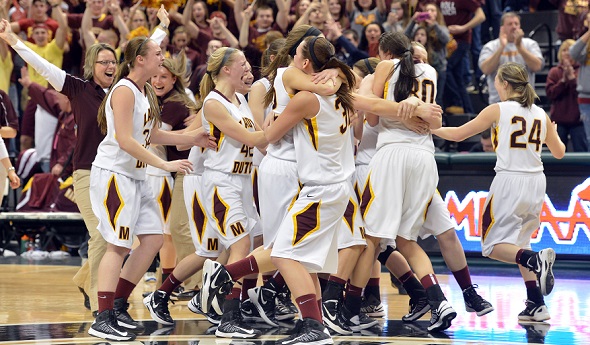
The Manchester girls basketball, Jackson Northwest girls bowling, Portland football, Harbor Beach football, Deckerville football and Hamtramck Frontier International boys soccer teams brought home the first MHSAA team championships in their schools’ histories.
A total of 33 teams won their first MHSAA titles. A total of 46 champions were repeat winners from 2011-12 – and 23 of those won for at least the third straight season. The Bloomfield Hills Brother Rice boys lacrosse team has the longest title streak of nine seasons, while the Battle Creek St. Philip volleyball team has won six straight titles for the second-longest streak overall and longest among girls programs.
Bloomfield Hills Cranbrook-Kingswood claimed the most championships, four, winning in Division 2 boys lacrosse, Lower Peninsula Division 3 girls swimming and diving, Lower Peninsula Division 3 girls tennis and Division 3 ice hockey. Four schools won three titles apiece: Grand Rapids Christian, Grand Rapids South Christian, Marquette and St. Ignace LaSalle.
Sixteen of the MHSAA's 28 championship tournaments are unified, involving teams from the Upper and Lower Peninsulas, while separate competition to determine titlists in both Peninsulas is conducted in remaining sports.
For a sport-by-sport listing of MHSAA champions for 2012-13 - Click Here (PDF)
The MHSAA is a private, not-for-profit corporation of voluntary membership by more than 1,500 public and private senior high schools and junior high/middle schools which exists to develop common rules for athletic eligibility and competition. No government funds or tax dollars support the MHSAA, which was the first such association nationally to not accept membership dues or tournament entry fees from schools. Member schools which enforce these rules are permitted to participate in MHSAA tournaments, which attract approximately 1.6 million spectators each year.
PHOTO: Manchester's girls basketball team celebrates the school's first MHSAA team championship in any sport this March at the Breslin Center. (Click to see more at HighSchoolsSportsScene.com.)