

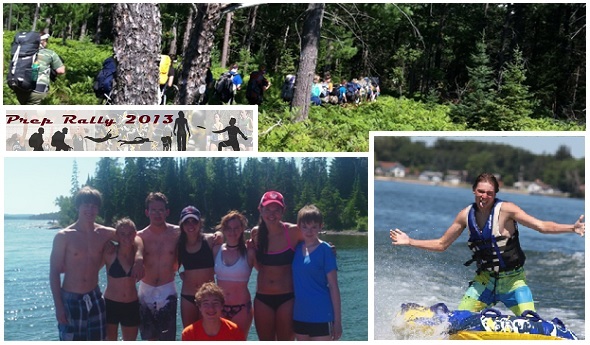
Rally Finalists Prepped for Competition
August 16, 2013
By Geoff Kimmerly
Second Half editor
The MHSAA’s inaugural “Prep Rally” contest was born this spring to help us teach athletes the importance of staying in shape during the offseason – while showing them fun ways to do so.
And like with our MHSAA “Battle of the Fans” contest during the past two winters, we learned a few things from our Prep Rally participants – most notably, that athletes during the school year enjoy staying active during the offseason. And especially if that activity includes a creative challenge or two.
Following are brief stories behind our three finalists for this summer's contest, which was part of the MHSAA’s PLAY (Preparation Lasts All Year) initiative designed to encourage athletes to remain active during the offseason so they are prepared physically and acclimated to warm weather when practice begins in the fall.
Thanks to all who submitted applications – we hope this is just the start of your helping us tell more athletes the best and most enjoyable ways to stay in shape and get ready for competition. The inaugural Prep Rally winner will be announced Monday on Second Half and be awarded tickets to an MHSAA Final of their choice, at which they will be recognized for their accomplishment.
Not surprising given Michigan’s abundance of woods and water, outdoor activities were a dominant theme of the inaugural Prep Rally.
Here’s a look at our finalists:
Beal City: Game Changers
“For many students the summer is simply a time to kick back, relax, hang out on the couch and play video games. However, this is not the case for Beal City athletes,” sophomore Billy Chilman wrote.
 “When we are not training for our championship teams on the field or in the classroom, we are always looking for new ways to stay fit and have fun. Whether it’s going to Coldwater Lake, to boat, knee board, ski or tube, we always seem to find something active to do.”
And that led to ATV tubing.
In essence, a four-wheeler on one bank of a small pond pulls the rider, sitting on a snow sled, across the pond. “It was also a great workout, improving our balance and upper body strength,” Chillman added.
Fenton: Into the Woods
A team that will spend all fall in the pool spends a valuable part of it offseason prep on dry land.
 Fenton girls swimming and diving team journeys away from home leading up to every season. This summer it headed to Pigeon River Country State Forest near Vanderbilt at the northern end of the Lower Peninsula for a three-day “survival trip.”
Plans included a four-mile hike to the first camp, followed by 4-5 mile hikes to each day to a new camp site.
The team also was divided into four smaller squads that competed in challenges as well as setting up camp, building fires and cooking meals.
“The purpose of the trip is to provide some physical conditioning as well as a team-building activity,” Fenton coach Brad Jones wrote in the Tigers’ submission.
Grosse Pointe Woods University Liggett: Crossing the Isle
Seniors Hannah Hodges and Danielle Lorant participate in three sports together during the school year – cross country, hockey and soccer – so staying in shape over the summer is especially key.
 This summer, that included a five-day backpacking trip at Isle Royale National Park as part of a program hosted by Michigan Tech University.
The Knights’ pair hiked 45 miles while carrying 50 pounds of supplies in backpacks. To prepare for the trip, Hodges and Lorant went on weekly hikes closer to home at Stoney Creek Metropolitan Park, Island Lake State Recreation Area and Algonac State Park – which built endurance but also allowed for an opportunity to test their gear.
“Backpacking on Isle Royale granted the chance to interact in nature and connect with other Michigan high school athletes who also participated in the trip, and to stay in good physical condition,” Hodges wrote in her submission.
“This trip demonstrated that there are other ways to stay in shape over the summer besides participating in the sports that we play during the school year.”
Follow the #PrepRally conversation on Facebook and Twitter @MHSAA.

2018 Scholar-Athlete Finalists Announced
By
Geoff Kimmerly
MHSAA.com senior editor
January 19, 2018
By Geoff Kimmerly
Second Half editor
The 120 finalists for the Michigan High School Athletic Association's Scholar-Athlete Awards for the 2017-18 school year, presented by Farm Bureau Insurance, have been announced.
 The program, in its 29th year, has recognized student-athletes since the 1989-90 school year and again this winter will honor 32 individuals from MHSAA member schools who participate in at least one sport in which the Association sponsors a postseason tournament.
Farm Bureau Insurance underwrites the Scholar-Athlete Awards and will present a $1,000 scholarship to each recipient. Since the beginning of the program, 736 scholarships have been awarded.
Scholarships will be presented proportionately by school classification, with 12 scholarships to be awarded to Class A student-athletes, six female and six male; eight scholarships will be awarded to Class B student-athletes, four female and four male; six scholarships will be awarded to Class C student-athletes, three female and three male; and four scholarships will be awarded to Class D student-athletes, two female and two male. In addition, two scholarships will be awarded at-large to minority recipients, regardless of school size.
Every MHSAA member high school could submit as many applications as there are scholarships available in its classification, and could have more than one finalist. Saline has four finalists this year, while Negaunee, Rochester and Saginaw Swan Valley each have three. Seventeen schools each have two finalists: Bloomfield Hills Academy of the Sacred Heart, Bloomfield Hills Cranbrook Kingswood, Chelsea, East Grand Rapids, Ferndale, Grand Rapids Christian, Harbor Springs, Kingsford, Ludington, Marshall, Northville, Okemos, Paw Paw, Pontiac Notre Dame Prep, Saranac, Sault Ste. Marie and Troy.
Multiple-sport participation remains the norm among applicants. The average sport participation rate of the finalists is 2.63, while the average of the application pool was 2.20. There are 65 three-plus sport participants in the finalists field, and all but two of the 28 sports in which the MHSAA sponsors postseason tournaments are represented.
Of 396 schools which submitted applicants, 39 submitted the maximum allowed. This year, 1,422 applications were received. All applicants will be presented with certificates commemorating their achievement. Additional Scholar-Athlete information, including a complete list of scholarship nominees, can be found on the MHSAA Website.
The applications were judged by a 64-member committee of school coaches, counselors, faculty members, administrators and board members from MHSAA member schools. Selection of the 32 scholarship recipients will take place in early February. Class C and D scholarship recipients will be announced Feb. 6, Class B scholarship recipients will be announced Feb. 13 and Class A scholarship recipients will be announced Feb. 20. All announcements will be made on the MHSAA Website.
To honor the 32 Scholar-Athlete Award recipients, a ceremony will take place during halftime of the Class C Boys Basketball Final, March 24, at the Breslin Student Events Center in East Lansing.
To be eligible for the award, students must have a cumulative grade-point average of 3.50 (on a 4.0 scale) and previously have won a varsity letter in at least one sport in which the MHSAA sponsors a postseason tournament. Students also were asked to respond to a series of short essay questions, submit two letters of recommendation and a 500-word essay on the importance of sportsmanship in educational athletics.
Farm Bureau Insurance of Michigan was founded in 1949 by Michigan farmers who wanted an insurance company that worked as hard as they did. Those values still guide the company today and are a big reason why it is known as Michigan’s Insurance Company, dedicated to protecting the farms, families, and businesses of this great state. Farm Bureau Insurance agents across Michigan provide a full range of insurance services—life, home, auto, farm, business, retirement, Lake Estate®, and more — protecting nearly 500,000 Michigan policyholders
The MHSAA is a private, not-for-profit corporation of voluntary membership by more than 1,500 public and private senior high schools and junior high/middle schools which exists to develop common rules for athletic eligibility and competition. No government funds or tax dollars support the MHSAA, which was the first such association nationally to not accept membership dues or tournament entry fees from schools. Member schools which enforce these rules are permitted to participate in MHSAA tournaments, which attract more than 1.4 million spectators each year.
2017-18 Scholar-Athlete Award Finalists
BOYS CLASS A
Kobie Mueller, Ann Arbor Huron
Adam Good, Auburn Hills Avondale
Jacob Willemsen, Byron Center
William Marano, Dearborn Edsel Ford
Anthony Joseph, DeWitt
Ben Forstner, East Grand Rapids
Anthony Kim, Grand Blanc
Nicholas Weigle, Grandville
Yzrael Silguero, Holland
Danny deForest, Holland West Ottawa
Joseph Corner, Holt
Luke Rambo, Marquette
Aditya Middha, Midland Dow
Paul Cheng McKinley, Okemos
David Paquette, Petoskey
Michael Robert Melaragni, Rochester Hills Stoney Creek
Cole Johnson, Rockford
Anthony G. DeKraker, Saline
Aidan Delfuoco, Saline
Reagan Miller, Saline
Emmett Turner, Saline
Hunter Gandee, Temperance Bedford
Nathan Frazier, Warren Cousino
Nick Seidel, West Bloomfield
GIRLS CLASS A
Maggie Wood, Battle Creek Lakeview
Emily Rooney, Birmingham Seaholm
Susannah Deems, East Grand Rapids
Kelly Ann Giles, East Kentwood
Olivia Perkins, Farmington Hills Harrison
Maria Poortenga, Grand Rapids Christian
Sarah Van Dyke, Grand Rapids Christian
Breanna Probst, Grand Rapids Forest Hills Central
Lauren Sickmiller, Grosse Pointe North
Samantha Hild, Holly
Talia Naomi Edmonds, Kalamazoo Central
Tess Scheidel, Middleville Thornapple Kellogg
Grace VanArendonk, Muskegon Mona Shores
Kendall Dillon, Northville
Roan Haines, Northville
Anushka Murthy, Okemos
Hallie C. Roman, Port Huron Northern
Kendall Jordan, Rochester
Karlyn Kelley, Rochester
Jenna Norgrove, Rochester
Anna Fischer, St. Joseph
Meghan Monaghan, Troy
Megan Worrel, Troy
Julie Smith, Walled Lake Northern
BOYS CLASS B
Jackson Lund, Big Rapids
Lucas Misra, Bloomfield Hills Cranbrook Kingswood
Patrick J. Bertoni, Chelsea
Justin A. Lyle, Dowagiac
Jacob Keener, Ferndale
John Stellard, Ferndale
Vincent Goyette, Flint Powers Catholic
Anthony Harris, Frankenmuth
David Ameriguian, Grosse Ile
Sawyer Perpich, Kingsford
Caleb Schoon, Ludington
William Rayner, Marshall
Thomas Otten, Paw Paw
Anthony Reo, Paw Paw
Hunter Goldensoph, Saginaw Swan Valley
Troy Joseph Distelrath, St. Clair
GIRLS CLASS B
Kate Cao, Bloomfield Hills Cranbrook Kingswood
Caroline Hirth, Chelsea
Hannah Shorkey, Essexville Garber
Katelyn Brown, Jonesville
Jordyn Kriegl, Kingsford
Mackenzie Luce, Ludington
Mackenzie Horn, Marshall
Grace VerHage, Otsego
Celia C. Gaynor, Pontiac Notre Dame Prep
Lauren Neiheisel, Pontiac Notre Dame Prep
Megan Brooks, Saginaw Swan Valley
Emily Buska, Saginaw Swan Valley
Valeta A. Gage, Sault Ste. Marie
Mackenzie M. Kalchik, Sault Ste. Marie
Izabella Marie Taylor, Three Rivers
MacKenzie Desloover, Yale
BOYS CLASS C
Jack Avery Harris, Ann Arbor Greenhills
Parker Hayes, Beaverton
Matthew Harazin, Bridgman
Ilhan Onder, Calumet
Joseph R. Claramunt, Harbor Springs
Thomas Kelbel, Harbor Springs
Evans Brown, Kalamazoo Hackett
Eric Vandefifer, Montrose
Luke Skewis, Negaunee
Colton Yesney, Negaunee
Ben Hogan, North Muskegon
Bryant Kieft, Watervliet
GIRLS CLASS C
Shelby Trevino, Beal City
Kendall Gassman, Bloomfield Hills Academy of the Sacred Heart
Kelleigh Keating, Bloomfield Hills Academy of the Sacred Heart
Ellen Charlotte Laurenz, Breckenridge
Rachel Nesburg, Charlevoix
Morgan Hartline, Marcellus
Clara Johnson, Negaunee
Emily Spitzley, Pewamo-Westphalia
Halie Robinson, Royal Oak Shrine Catholic
Kendahl Grace Overbeck, Saranac
Emma Pachulski, Saranac
Melody Antel, Saugatuck
BOYS CLASS D
Nicholas Burlingame, Ashley
Brendan Delaney, Gaylord St. Mary
Peter Kalthoff, Hillsdale Academy
Andrew Pechette, Kinde-North Huron
Andrew Hager, Mio
Jeremiah Torrey, Onekama
Aaron Jacob Fahrner, Owendale-Gagetown
Thomas Hursey, Suttons Bay
GIRLS CLASS D
Katelyn Smith, Akron-Fairgrove
Corra Hamilton, Athens
Madison Kadlec, Bellaire
Ciera Weber, Fowler
Laura Lyons, Lake Linden-Hubbell
Stephanie Schuman, Lawrence
Ellie Haan, McBain Northern Michigan Christian
Sophie Ruggles, Mt. Pleasant Sacred Heart