


Rate of MHSAA High Schools Charging Participation Fees Falls to Lowest in 22 Years
By
Geoff Kimmerly
MHSAA.com senior editor
August 5, 2026
The annual Michigan High School Athletic Association participation fee survey completed for the 2025-26 school year continued to confirm the positive direction that has emerged this decade as the rate of member high schools charging student-athletes to play sports fell to its lowest in more than two decades.
Of the 703 MHSAA member schools (93 percent of membership) which responded to the most recent survey, only 38 percent (270 schools) charged participation fees in 2025-26 – a drop of two percent from the year prior and the lowest percentage since 34.5 percent of member schools reported charging a fee for the 2004-05 school year. Over the two decades between, the rate of high schools charging participation fees reached a high of 57 percent in 2013-14. Rates consistently have measured in the low 40s after the COVID-19 pandemic.
The MHSAA began conducting the participation fee survey with the 2003-04 school year. For the purposes of the survey, a participation fee is anything $20 or more regardless of what the school called the charge – registration fee, athletic fee, etc.
All four school-size classifications also saw rate decreases, with Class A schools leading the way with 46 percent charging fees – which was still a reduction of seven percent from 2024-25. Class B was down slightly to 39 percent charging for participation, while Class C schools were down six points to 28 percent charging and Class D schools were down four points also to 28 percent.
A standardized fee for each team on which a student-athlete participates – regardless of the number of teams – has remained the norm over the history of the MHSAA’s survey, and for the second-straight year 43 percent of schools charging a fee did so in this way during 2025-26. That was followed by 33 percent of responding schools charging a one-time standardized fee and 13 percent assessing fees based on tiers of the number of sports a student-athlete plays (for example, charging a larger fee for the first team and less for additional sports).
For 2025-26, the median maximum amount a school charged per student-athlete for the school year was $150, and the median annual maximum charged per family was $350. For schools charging student-athletes a one-time fee to cover all sports played, the median was $125. For schools charging a fee per sport, the median was $80 for each team.
The survey for 2025-26 and surveys from previous years can be found on the Pay-To-Play Survey page (direct link to this year’s results).
The MHSAA is a private, not-for-profit corporation of voluntary membership by more than 1,500 public and private senior high schools and junior high/middle schools which exists to develop common rules for athletic eligibility and competition. No government funds or tax dollars support the MHSAA, which was the first such association nationally to not accept membership dues or tournament entry fees from schools. Member schools which enforce these rules are permitted to participate in MHSAA tournaments, which attract more than 1.3 million spectators each year.
Finalists Announced for 2022-23 MHSAA-Farm Bureau Insurance Scholar-Athlete Awards
By
Geoff Kimmerly
MHSAA.com senior editor
January 18, 2023
The 120 finalists for the Michigan High School Athletic Association's Scholar-Athlete Awards for the 2022-23 school year, presented by Farm Bureau Insurance, have been announced.
The program, in its 34th year, has recognized student-athletes since the 1989-90 school year and again this winter will honor 32 individuals from MHSAA member schools who participate in at least one sport in which the Association sponsors a postseason tournament.
Farm Bureau Insurance underwrites the Scholar-Athlete Awards and will present a $2,000 scholarship to each recipient. Since the beginning of the program, 896 scholarships have been awarded.
Scholarships will be presented proportionately by school classification, with 12 scholarships to be awarded to Class A student-athletes, six female and six male; eight scholarships will be awarded to Class B student-athletes, four female and four male; six scholarships will be awarded to Class C student-athletes, three female and three male; and four scholarships will be awarded to Class D student-athletes, two female and two male. In addition, two scholarships will be awarded at-large to minority recipients, regardless of school size.
Every MHSAA member high school could submit as many applications as there are scholarships available in its classification and could have more than one finalist. Bloomfield Hills Cranbrook Kingswood has four finalists and Kalamazoo Loy Norrix and Midland Dow have three finalists this year. Twelve schools have two finalists: Ada Forest Hills Eastern, Cass City, Fenton, Hillsdale Academy, Holland, Holland Christian, Milford, Negaunee, Northville, Saginaw Michigan Lutheran Seminary, South Lyon East, and Tecumseh.
Multiple-sport participation remains the norm among applicants. The average sport participation rate of the finalists is 2.88. There are 74 three-plus sport participants in the finalists field, and all but two of the 28 sports in which the MHSAA sponsors postseason tournaments are represented.
Of 421 schools which submitted applicants, 25 submitted the maximum allowed. This year, 1,440 applications were received. All applicants will be presented with certificates commemorating their achievement. Additional Scholar-Athlete information, including a complete list of scholarship nominees, can be found on the Scholar-Athlete page.
The applications were judged by a 65-member committee of school coaches, counselors, faculty members, administrators and board members from MHSAA member schools. Selection of the 32 scholarship recipients will take place in early February. Class C and D scholarship recipients will be announced Feb. 7, Class B scholarship recipients will be announced Feb. 14 and Class A scholarship recipients will be announced Feb. 21. All announcements will be made on the MHSAA Website.
To be eligible for the award, students must have a cumulative grade-point average of 3.50 (on a 4.0 scale) and previously have won a varsity letter in at least one sport in which the MHSAA sponsors a postseason tournament. Students also were asked to respond to a series of short essay questions, submit two letters of recommendation and a 500-word essay on the importance of sportsmanship in educational athletics.
Farm Bureau Insurance of Michigan was founded in 1949 by Michigan farmers who wanted an insurance company that worked as hard as they did. Those values still guide the company today and are a big reason why it is known as Michigan’s Insurance Company, dedicated to protecting the farms, families, and businesses of this great state. Farm Bureau Insurance agents across Michigan provide a full range of insurance services—life, home, auto, farm, business, retirement, Lake Estate®, and more—protecting nearly 500,000 Michigan policyholders.
The MHSAA is a private, not-for-profit corporation of voluntary membership by more than 1,500 public and private senior high schools and junior high/middle schools which exists to develop common rules for athletic eligibility and competition. No government funds or tax dollars support the MHSAA, which was the first such association nationally to not accept membership dues or tournament entry fees from schools. Member schools which enforce these rules are permitted to participate in MHSAA tournaments, which attract more than 1.3 million spectators each year.
2022-23 Scholar-Athlete Award Finalists
GIRLS CLASS A
Daria Igonin, Belleville
Ella Blank, Birmingham Groves
Ella Thomas, Brownstown Woodhaven
Keira Tolmie, Clarkston
Nora Chamas, Dearborn
Miryam El-Saghir, Dearborn Edsel Ford
Abigail Frushour, DeWitt
Rachel Williamson, East Grand Rapids
Naomi Sowa, East Lansing
Adrienne Staib, Fenton
Abigail Cumings, Grand Rapids Forest Hills Central
Ella Eitniear, Grand Rapids Kenowa Hills
Sophia Borowski, Grosse Pointe North
Eva Whiteman, Holland
Ana Dunfee, Kalamazoo Loy Norrix
Wendy Miedema, Kalamazoo Loy Norrix
Colleen Blackwood, Linden
Kathleen Doneth, Mason
Caroline Colt, Milford
Leah Merriam, Milford
Sophia Hekkema, Muskegon Reeths-Puffer
Jane Barnett, Royal Oak
Kate Mazur, South Lyon East
Amyla Eberhart, South Lyon East
BOYS CLASS A
Henry Jackson, Bloomfield Hills
Connor Anderson, Cadillac
Isaac David Clark, Caledonia
Braylen Himmelein, Davison
Nathan Katic, Fenton
Isaac Postema, Grand Haven
Ryan Lee, Grand Rapids Forest Hills Northern
Brayden Ryan LaCroix, Grandville
Brendan Downey, Grosse Pointe South
James R. Baer, Holland
Treyton William Carr, Hudsonville
James Rocco, Kalamazoo Loy Norrix
James Patterson Jr., Lake Orion
Shubhan Nagarkar, Midland Dow
Danny Safadi, Midland Dow
Jack Bakus, Midland Dow
Gavyn Stout, Muskegon Mona Shores
Abhinav Attaluri, Northville
David Whitaker, Northville
Samuel Gibson, Plainwell
Harsimmer Sohi, Portage Central
Shane Pitcher, Saline
Ian Robertson, Traverse City West
Trevor Wallar, Zeeland West
GIRLS CLASS B
Devin Johnston, Almont
Rylie Haist, Big Rapids
Jordan Richie, Bloomfield Hills Cranbrook Kingswood
Anna Smith, Clawson
Carney Salo, Escanaba
Ella Wagner, Essexville Garber
Lauren Harrold, Flint Powers Catholic
Tiffany Keller, Frankenmuth
Ainsley VandenBrink, Holland Christian
Claire Filpus, Houghton
Elaina Bortolini, Kingsford
Matelyn Midkiff, Midland Bullock Creek
Rachel Niskanen, Negaunee
Molly McNitt, Paw Paw
Chesney Wilke, Tecumseh
Allison Tate, Whitehall
BOYS CLASS B
Sreejay Ramakrishnan, Ada Forest Hills Eastern
Jacob Pallo, Ada Forest Hills Eastern
Aiden Eric Smith, Adrian
Evan Jose Evans, Bloomfield Hills Cranbrook Kingswood
John Kersh, Bloomfield Hills Cranbrook Kingswood
Nathan Hooker, Bloomfield Hills Cranbrook Kingswood
Jacob Fenbert, Dundee
Michael App, Grand Rapids Catholic Central
James Oosterhouse, Holland Christian
Matthew Bowman, Milan
Philip Nelson, Negaunee
Grant H. Harkness, Newaygo
Nicholas Liparoto, Pontiac Notre Dame Prep
Isaiah Pelc, Portland
Aldo Barba, Tecumseh
Camden Johnecheck, Williamston
GIRLS CLASS C
Tailor Onstott, Beal City
Saylar Cuthrell, Cass City
Kylie McGrath, Cass City
Claire Scholten, Charlevoix
Ruby Sierer, Clinton
Quinn Watts, Fowler
Danni Swihart, Hanover-Horton
Aziza Burgoon, Iron Mountain
Abigail Meyer, Marlette
Alaina Andrews, Ottawa Lake Whiteford
Laina Harger, St. Charles
Samantha Dietz, Watervliet
BOYS CLASS C
Logan Pflug, Cassopolis
Seth Vanderwest, Kent City
Ethan Green, Kingston
Andrew Mleczko, Madison Heights Bishop Foley
Grant Mason, Manistique
Blake O'Connor, Maple City Glen Lake
Brock Murphy, Menominee
Riley DeSarbo, Monroe St. Mary Catholic Central
Ty Kohlmann, New Lothrop
Noah Etnyre, Plymouth Christian Academy
Brennan Cannaday, Royal Oak Shrine Catholic
Dirk Rierson, Unionville-Sebewaing
GIRLS CLASS D
Kylie Quist, Athens
Kasandra Lynn Waldi, Chesterfield Austin Catholic
Megan Roberts, Hillsdale Academy
Emma Case, Kinde North Huron
Monique Brisson, Munising
Makennah Uotila, Ontonagon
Gabriella Wenzel, Saginaw Michigan Lutheran Seminary
Macey Springer, Three Oaks River Valley
BOYS CLASS D
Ryan McDonell, Bay City All Saints
Luke Walker, Clarkston Everest Collegiate
Amos Norland, Dollar Bay
Brody Appelgren, Hillman
Caleb Diener, Hillsdale Academy
Matthew Zammit, Marine City Cardinal Mooney
James Blackburn, Martin
Caleb Munson, Saginaw Michigan Lutheran Seminary
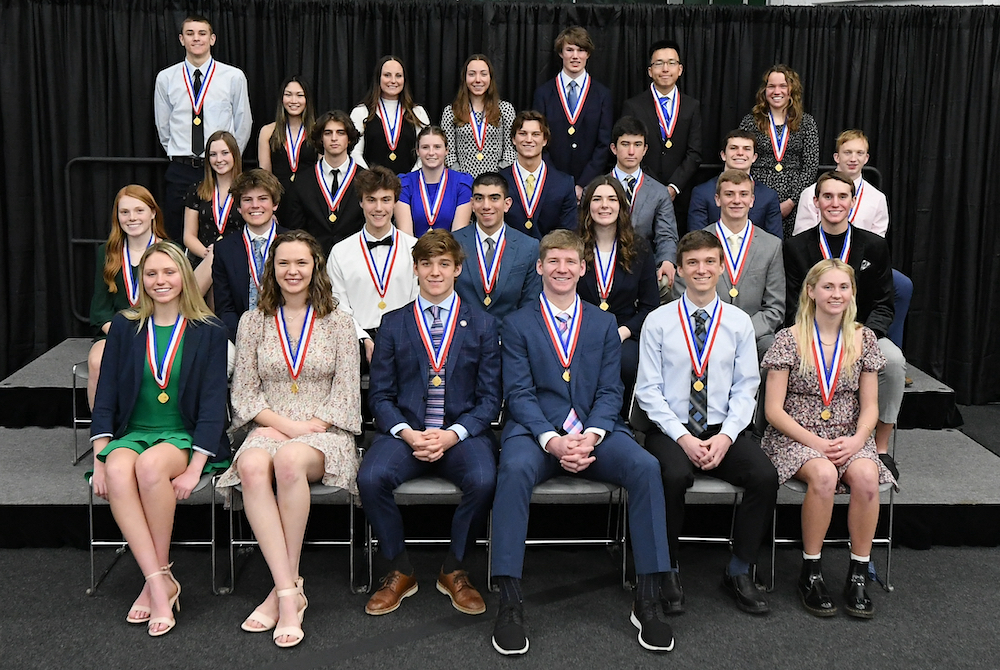
PHOTO A group including 27 of last season's 32 MHSAA-Farm Bureau Insurance Scholar-Athlete Award winners take a photo together during the banquet at Breslin Center.