


Rep Council Wrap-up: Fall 2012
December 7, 2012
A change in format for the Boys Basketball Finals highlighted actions taken by the Representative Council of the Michigan High School Athletic Association during its annual Fall Meeting, Nov. 30 in East Lansing.
Mirroring closely the format of the MHSAA Girls Basketball Finals, the Boys Finals will move this season from three to two sessions. The first session will tip off with the Class D Final at 10 a.m., followed by the Class A championship game. The second session will begin tentatively at 4:30 p.m. with the Class C Final and conclude with the Class B title game.
Previously, the Class A and B Finals were separate sessions, with the Class A Final tipping at 4 p.m. and Class B at 8 p.m. The change will make for a shorter day for spectators wishing to attend all four games, and also allow them to do so by purchasing tickets for two sessions instead of three.
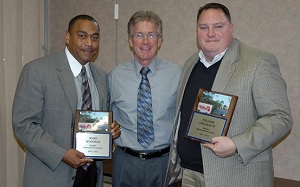 The Fall Meeting also saw the addition of two members to the 19-person council. Reese Public Schools athletic director Dave Derocher began a two-year term after being elected earlier this fall to represent Class C and D schools in the northern Lower Peninsula. Orlando Medina, who serves as athletic coordinator for Harrison Township L’Anse Creuse Public Schools, was appointed for a two-year term. He also previously served as athletic director at Detroit Cesar Chavez Academy. They fill positions formerly held by Beal City superintendent William Chilman IV and Romulus High School athletic director Mark Woodson, whose terms ended.
Also, Carmen Kennedy, principal at St. Clair Shores South Lake High School, was reappointed for a second two-year term. The Representative Council is the legislative body of the MHSAA. All but five members are elected by member schools. Four members are appointed by the Council to facilitate representation of females and minorities, and the 19th position is occupied by the Superintendent of Public Instruction or designee.
The most prominent points discussed at the Fall Meeting were risk minimization for athletes and possible strategies for making school sports safer. Among topics discussed were raising expectations for coaches’ participation in online safety courses and schools’ management of heat illness; the possible restructuring of practice policies in regards to hot weather; and game rules revisions to enhance safety especially in football, soccer and ice hockey.
The Council reviewed its previous actions on those topics, including discussions in December 2011 that led to the inclusion of health and safety content in online rules meetings. Council members considered a model policy for managing heat and humidity, and also a number of ideas collected during Fall Update meetings with administrators throughout the state.
No action was requested on those items at the Fall Meeting. Complete and vetted proposals are likely to be considered when the Council next meets in March and then May.
PHOTO: Outgoing Representative Council members Mark Woodson of Romulus (left) and William Chilman IV (right) are presented plaques for their service by MHSAA Executive Director Jack Roberts (middle) during the Fall Meeting.
Girls Events Set Record in 2013-14
September 18, 2014
By Geoff Kimmerly
Second Half editor
Michigan High School Athletic Association postseason tournaments drew more than 1.4 million fans in 2013-14 for the 15th straight school year, keyed in part by record attendance at girls events.
Total attendance for 2013-14 was 1,423,229 fans, with 988,669 at boys tournaments and 434,560 spectators at girls tournaments. Attendance is kept for all sports except golf, skiing and tennis, for which admission typically is not charged.
Total attendance did fall 10,127 fans, or 0.7 percent, from 2012-13. However, the girls tournament total broke a previous record set during the 2009-10 school year, with three girls sports setting overall attendance records: volleyball (101,654 fans), lacrosse (5,737) and competitive cheer (25,996). Boys and girls bowling tournaments, conducted simultaneously, also set an attendance record with 12,595 fans.
Cheer attendance increased for the 11th consecutive year and 2.8 percent from 2012-13; Cheer Finals attendance increased for the fifth straight year to a record 7,766 fans. The Boys Ice Hockey Finals also set a record with 14,595 fans, an increase of 1,690 over the previous year, while ice hockey’s total tournament attendance (60,778) was up 2.9 percent with increases at the Pre-Regional and Quarterfinal levels as well. Bowling, in addition to an overall attendance record, also saw a record for its Finals of 4,100 fans. The Baseball and Softball Finals, played at Michigan State University for the first time, did not set a record – but did draw 5,297 fans, a 29-percent increase from the previous season.
Attendance at boys tournament events fell to its lowest total since 1993-94, although the decrease from 2012-13 was less than one percent. However, football, despite a 1.5-percent decrease in attendance from the previous season, remained the highest MHSAA tournament draw for the seventh consecutive year with 392,069 fans. Football Finals attendance (52,409) rebounded 10.6 percent from 2012-13 after a similarly significant drop following 2011-12.
Boys Basketball Finals weekend attendance also bounced back significantly, with a 21.7-percent increase from the 2012-13 event to a three-day total of 42,373 fans at the Semifinals and Finals. Regional attendance also was up 4.8 percent, although overall boys basketball tournament attendance was down 3.2 percent to 308,205 fans. Girls basketball attendance was down 2.8 percent to 161,569 fans with Finals weekend attendance down 11.8 percent from 2012-13 – although the total Finals attendance of 16,763 fans in 2013-14 was the second-highest over the last four seasons, and attendance at Regionals and Quarterfinals increased from the previous girls basketball season.
Volleyball attendance increased 5.7 percent from 2012-13 while setting a District record of 68,447 fans, 16 percent more than the previous record set during 2011-12. Girls lacrosse bounced back from a slight drop in 2012-13 to set a record for overall attendance with 5,737 fans including a record for Semifinal attendance. Softball (3.7 percent to 42,242 fans), girls soccer (0.9 percent to 27,072) and girls swimming and diving (3.2 percent to 5,084) also saw attendance increases from 2012-13 – with girls soccer enjoying an 18-percent increase at the District level – while gymnastics (1,877) saw its lowest tournament attendance since 2007-08.
Five more sports saw attendance increases in 2013-14: Individual wrestling (49,037) was up 2.8 percent, boys lacrosse (7,726) was up 6.1 percent, baseball (47,540) was up 3.9 percent, boys and girls cross country (17,300) increased 1.9 percent and boys soccer (28,903) drew 35 more fans total than during 2012-13. Boys and girls cross country postseason events, like for bowling, are conducted simultaneously.
The MHSAA is a private, not-for-profit corporation of voluntary membership by more than 1,500 public and private senior high schools and junior high/middle schools which exists to develop common rules for athletic eligibility and competition. No government funds or tax dollars support the MHSAA, which was the first such association nationally to not accept membership dues or tournament entry fees from schools. Member schools which enforce these rules are permitted to participate in MHSAA tournaments, which attract more than 1.4 million spectators each year.