


Rep Council Wrap-Up: Fall 2016
December 12, 2016
By Geoff Kimmerly
Second Half editor
The Representative Council of the Michigan High School Athletic Association took actions at its Fall Meeting on Dec. 2 in East Lansing that will affect baseball and Upper Peninsula golf teams this spring.
Generally, the Council takes only a few actions during its Fall Meeting, with topics often introduced for additional consideration and actions during its meetings in winter and spring. However, a rules change approved in baseball was required by the National Federation of State High School Associations before the start of the spring 2017 season, while the golf change is a result of multiple years of discussion concerning classifications for MHSAA Upper Peninsula Finals.
Beginning this upcoming baseball season, pitchers will be required to follow a pitch count limit, instead of the previous rule that limited their innings based on the number of outs thrown. In July, the NFHS Baseball Rules Committee mandated that all states adopt a pitch count rule in an effort to further prevent pitcher arm injuries, effective with the 2016-17 school year. Pitchers will be allowed to throw a maximum of 105 pitches in one day; they will be required to rest three days if they throw more than 75. Pitchers must rest two days after throwing 51-75 pitches, one day after throwing 26-50, and will not be required to rest if they throw 25 or fewer pitches in one day. The MHSAA pitch count rule was the result of work by a task force made up of current and former coaches and administrators, including representatives of the Michigan High School Baseball Coaches Association.
For Upper Peninsula Golf, both the girls and boys tournaments, the Council approved a change classifying participating schools into three equal divisions beginning in the spring of 2017. Previously, Class A, B and C schools were split evenly into Divisions 1 and 2, with Division 3 reserved for Class D schools. However, Class D had grown to include nearly twice as many participating schools as both Division 1 and 2, complicating tournament logistics. This proposal was advanced by the Upper Peninsula Athletic Committee.
The Council also approved for the MHSAA’s Multi-Sport Participation Task Force to continue its work indefinitely beyond the end of 2016, and also approved possible expansion of the task force as it continues to work toward preparing strategies and specific tactics for the MHSAA, allied organizations and local schools and conferences to promote multi-sport participation by student-athletes. The task force has determined it must focus on educating students and parents on the benefits of multi-sport participation when students are at younger ages – as early as when they are attending elementary school – while providing service and support at the junior high/middle school level; both efforts aim to create an atmosphere promoting multi-sport participation that would carry on when students reach high school.
Results of efforts to grow junior high/middle school membership were reported, with 757 junior high/middle schools in the MHSAA’s membership for 2016-17, compared to 705 at the conclusion of the 2015-16 school year. Of those 757, there are 498 that have included sixth grade in their membership, as allowed this school year for the first time. The Council also heard reports related to the MHSAA’s “Defining & Defending Educational Athletics” mission, notably on a pair of efforts by the National Federation focused on enhancing participation, reducing risk, optimizing performance and spreading the positive message of educational athletics. In addition, the Council discussed results of a recent survey of officials who had left the avocation and their reasons why, with the hope of staff using that data as it works to recruit and retain officials.
The Council also began a discussion on the future of 8-player football, including its growth and potential tournament format modifications, and the potential effects on 11-player football. There were 52 8-player football teams in Michigan for the 2016 season, including four that were ineligible for postseason play because their enrollments were too high (only Class D schools are eligible for the playoffs in the 8-player format). Discussions will continue with the MHSAA Classification Committee and Football Committee and at the League Leadership meeting before returning to the Council’s agenda.
The Fall Meeting saw the addition of Vicky Groat, principal and athletic director at Battle Creek St. Philip High School, to the 19-person Council. She was appointed to a two-year term. She also serves as her school’s varsity volleyball coach. Groat fills the position formerly held by Orlando Medina, athletic director at Harrison Township L’Anse Creuse High School, whose term ended. Also, Pat Watson, principal at West Bloomfield High School, was re-appointed for a second two-year term.
The Council re-elected Scott Grimes, assistant superintendent of human services for Grand Haven Area Public Schools, as its president; Benton Harbor athletic director Fred Smith was re-elected vice president and Vic Michaels, director of physical education and athletics for the Archdiocese of Detroit, was re-elected secretary-treasurer.
The Representative Council is the legislative body of the MHSAA. All but five members are elected by member schools. Four members are appointed by the Council to facilitate representation of females and minorities, and the 19th position is occupied by the Superintendent of Public Instruction or designee.
The MHSAA is a private, not-for-profit corporation of voluntary membership by more than 1,400 public and private senior high schools and junior high/middle schools which exists to develop common rules for athletic eligibility and competition. No government funds or tax dollars support the MHSAA, which was the first such association nationally to not accept membership dues or tournament entry fees from schools. Member schools which enforce these rules are permitted to participate in MHSAA tournaments, which attract more than 1.4 million spectators each year.
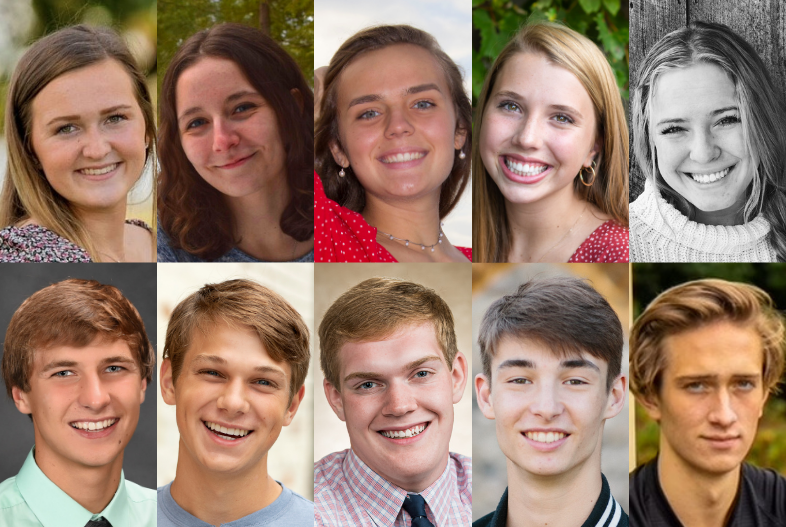
Scholars & Athletes 2021: Class C & D
By
Geoff Kimmerly
MHSAA.com senior editor
February 9, 2021
The Michigan High School Athletic Association has selected 10 student-athletes from Class C and D member schools to receive scholarships through the MHSAA/Farm Bureau Insurance Scholar-Athlete Award program.
 Farm Bureau Insurance, in its 32nd year of sponsoring the award, will give $1,000 college scholarships to 32 individuals who represent their member schools in at least one sport in which the Association sponsors a postseason tournament. The first 30 scholarships are awarded proportionately by school classification and the number of student-athletes involved in those classes; also, there are two at-large honorees who can come from any classification.
Students applying for the Scholar-Athlete Award must be carrying at least a 3.5 (on a 4.0 scale) grade-point average and have previously won a letter in a varsity sport in which the Michigan High School Athletic Association sponsors a postseason tournament. Other requirements for the applicants were to show active participation in other school and community activities and produce an essay on the importance of sportsmanship in educational athletics.
Each of the scholarship recipients will be honored during an online ceremony later this winter. Commemorative medallions will be given to the finalists in recognition of their accomplishments.
The Class C Scholar-Athlete Award honorees are: Meagan Lasky, Bronson; Sophia Rayes, Oscoda; Elizabeth M. Williams, Ishpeming Westwood; Nicholas Errer, Bad Axe; Finn Feldeisen, Ann Arbor Greenhills; and David Jahnke, Saginaw Valley Lutheran.
The Class D Scholar-Athlete Award recipients are: Olivia Lowe, Leland; Sophia Stowe, Northport; Jäeger Griswold, Ellsworth; and Wyatt Sirrine, Leland.
Overviews of the scholarship recipients of the Class C Scholar-Athlete Award follow. A quote from each recipient's essay also is included:
(NOTE: If an athlete intended to play and was part of a spring sports team in 2020, that sport is counted among the athlete’s total although the season was canceled due to COVID-19.)
 Meagan Lasky, Bronson
Played four seasons of varsity volleyball, is playing her fourth of varsity basketball and will play her second of varsity soccer in the spring. Earned multiple all-state honors for volleyball and all-league honors in basketball, and served as captain of both teams. Helped 2017 and 2018 volleyball teams to Class C/Division 3 Finals championships. Participating on school’s inaugural girls soccer team, which will play its first games this spring. Earned volleyball academic all-state individual recognition as a senior and was part of four team awards, and earned academic all-league in basketball. Serving fourth year as student council secretary, and as National Honor Society chapter vice president this school year, and also is participating in fourth year of Make a Difference Club. Earned a number of awards for 4-H animal showmanship and crafts. Served as youth basketball referee throughout high school. Will attend Albion College and major in psychology.
Essay Quote: “(My sister) taught me to respect the game, my teammates, and your opponent. She also taught me about leadership, facing adversity, and that success does not always stem from making the winning play. I learned that sportsmanship is more than a handshake at the end of the game; it represents integrity, resilience, humility, and perseverance.”
 Sophia Rayes, Oscoda
Ran three seasons of varsity cross country and will participate in her third season of varsity track & field this spring. Also wrestled on varsity as a freshman and sophomore and played junior varsity volleyball as a freshman. Earned all-league recognition in both cross country and track, and served as team captain of the latter. Participating in fourth years of student council and Rotary Interact club and third as part of National Honor Society and robotics team. Served as vice president and president of Interact and as a student representative to both the Oscoda Board of Education and local United Way board. Also served as vice president of student leadership group and coordinated Red Cross blood drive. Will attend University of Michigan and study secondary English education.
Essay Quote: “Extending one’s hand regardless of an outcome can be difficult for anyone, especially when the person you competed against is your own teammate. However, her earnest demeanor revealed that she didn’t mean to upset me with her victory. I knew the hardest thing to say was the one I needed to the most. … Placing my hand on her back, we walked embracing each other and our outcomes. Even though I lost, I found myself glad to be able to share in my friend’s victory.”
 Elizabeth Williams, Ishpeming Westwood
Ran four seasons of varsity cross country, is participating in her fourth of varsity swimming & diving and will compete in her fourth of track & field this spring. Placed in MHSAA Finals in all three sports multiple times and earned all-state in cross country and track. Also earned all-state academic recognition in cross country. Served as three-time captain in cross country and two-time in swim. Serving as secretary of Business Professionals of America chapter and has qualified for state competition. Serving third year on student council and was secretary as a sophomore. Serving second year on superintendent’s Student Advisory Committee and participating in second year of National Honor Society. Will attend Northern Michigan University and study environmental studies and political science.
Essay Quote: “Without proper sportsmanship from all parties, student-athletes may have a negative experience in a sport, lose their passion to play, have poor relationships within small communities, and miss out on impactful life lessons … . When we are all held to the same sportsmanship standards, students can have a positive experience in educational athletics, equipping them with valuable skills and preparing them for life beyond sports.”
 Nicholas Errer, Bad Axe
Played four seasons of varsity soccer, is bowling third season on varsity and will play his third season of varsity baseball in the spring; also played junior varsity basketball as a freshman. Earned all-state multiple seasons in soccer and academic all-conference in all three sports. Served as captain of soccer and bowling teams. Serving fourth year on student council and was class vice president as a freshman. Participating in second year of National Honor Society and third as officer for local FFA chapter, having served as president, treasurer and regional sentinel. Earned regional award in construction trades. Participated two years in Rotary Interact club, and served on area tech center’s Student Leadership Team as a junior. Will attend Oakland University and study finance.
Essay Quote: “(Sportsmanship) is a choice that each athlete makes each and every time they step out onto the field. How they talk to their teammates and coaches. How they poise themselves towards the opposition. How they react when a mistake is made. These are all situations that athletes are placed in each time they compete, and how they react is what determines the legacy they leave behind.”
 Finn Feldeisen, Ann Arbor Greenhills
Played four seasons of varsity tennis and will play fourth of varsity lacrosse this spring. Contributed to tennis championships at multiple levels including Finals as a sophomore and junior, and helped lacrosse team to a league title in 2019. Won a Finals flight championship as a sophomore and earned all-state tennis honors multiple years and all-league lacrosse honors. Earned academic all-state in tennis. Served as team captain in both sports. Participating in fourth year of student council and as president this year. Also serving as co-secretary general for Model United Nations, an oratory event leader in forensics and head of peer-to-peer math tutoring as a senior. Participated on team state champion in forensics as a sophomore. Awarded Ambassador Award by United Nations Association of the USA and varsity letter in service by local United Way. Serving third year on regional youth council. Is undecided on where he will attend college, but intends to study business.
Essay Quote: “Embodying sportsmanship means being an ambassador and leading others to be the same, even when it may not be the easy choice. But it is so much more as well. It is the unknown and undefined aspect that all teams seek to achieve. Its unwillingness to become a simple action is what makes it truly special.”
 David Jahnke, Saginaw Valley Lutheran
Played three seasons of varsity football, wrestling on varsity for fourth season and will run his second season of varsity track & field in the spring. Earned all-league recognition and won a county championship in wrestling, and served as team captain. Earned academic all-state in football. Participating in second year of student council and elected class treasurer. Participating in second year of National Honor Society and fourth years in school’s key club, STEM club, Spanish club and global awareness club. Playing in school’s symphonic band for third year. Earned key club Service Medallion and elected to organize group projects, and also serving as STEM school Chief Science Officer. Will attend Michigan State University and study biomedical engineering.
Essay Quote: “Without the true sportsmanship amongst my teammates and the opponents we faced, I would not have continued participating in those sports. In doing so I would have walked away from a sport I learned to love, and that has caused me to grow as a person by building my character. … If I had been shown unkindness instead of goodwill, mockery instead of encouragement, selfishness instead of generosity, I would have missed all the valuable lessons taught to me by athletics.”
Other Class C girls finalists for the Scholar-Athlete Award were: Kenzie Bowers, Kent City; Grace Graham, Laingsburg; Makayla Harris, Ann Arbor Greenhills; Hope Johnson, North Muskegon; Grace Kalb, Petersburg Summerfield; Reese Martin, Grosse Pointe Woods University Liggett; Avery McNally, Bloomfield Hills Academy of the Sacred Heart; Hannah Penfold, Elkton-Pigeon-Bay Port Laker; and Mahrle Siddall, Maple City Glen Lake.
Other Class C boys finalists for the Scholar-Athlete Award were: Jameson Chesser, Adrian Lenawee Christian; Micah Gordon, Bad Axe; Brennan Griffith, Adrian Lenawee Christian; Caden Kienitz, Munising; Drew Kohlmann, New Lothrop; Braxton Lamey, Ithaca; Zachary Stephenson, Alcona; Jeffrey Vanholla, Norway; and Trayton Wenzlaff, Kingston.
Overviews of the scholarship recipients of the Class D Scholar-Athlete Award follow. A quote from each recipient's essay also is included:
(NOTE: If an athlete intended to play and was part of a spring sports team in 2020, that sport is counted among the athlete’s total although the season was canceled due to COVID-19.)
 Olivia Lowe, Leland
Played three seasons of varsity volleyball, playing her fourth of varsity basketball and will play her third of girls soccer in the spring. Named all-state in basketball as a junior, when she went over 1,000 career points, and also has earned all-league in volleyball and helped Leland to back-to-back Division 4 runner-up finishes in 2018 and 2019. Earned academic all-state individual honors and was part of team honors in those two sports, and served as captain of both of those varsity teams. Carries a 4.0 grade point average and earned the International Baccalaureate World School Middle Years diploma. Participating in fourth year of student council and has served as president, and participating in second year of National Honor Society and has served as chapter treasurer. Earned Principal of Excellence Award from local career tech center’s Teacher Academy. Also participates in National Art Honor Society and has had work published multiple times in local student art journal. Will attend Hope College and study elementary education.
Essay Quote: “Sportsmanship teaches many important lessons in life. Good sportsmanship builds teamwork, teaches respect, honor, discipline, resilience, and perseverance. These skills are very important to being an athlete, but they are also important skills you use in your everyday life outside of sports. I believe the path to true sportsmanship is to lead by example.”
 Sophia Stowe, Northport
Played varsity volleyball all four years of high school and will play her third season of varsity soccer this spring. Also played junior varsity basketball as a freshman. Earned all-state volleyball honors and also individual academic all-state as part of an academic all-state team honoree in that sport. Served as varsity volleyball captain multiple seasons. Serving as student government and class president, the latter for the second year, and serving her third years as local township’s Youth Advisory Council vice president and National Honor Society chapter secretary. Studying with dual enrollment at Northwestern Michigan College. Participating in National Art Honor Society and has had work published multiple times in local student art journal. Serving as a county health department youth COVID advocate. Will attend Michigan State University and study human biology.
Essay Quote: “That’s when I realized how easy it is to make an impact on someone else’s life and how simple it is to be a good sport and a kind human. … People will forget the score of the game and how many kills you had, but they will never forget how you made them feel. We don’t remember statistics, we remember sportsmanship.”
 Jäeger Griswold, Ellsworth
Playing second season of varsity basketball and participated in two seasons of varsity baseball and track & field. Earned all-league honors for basketball and is serving as team captain; helped last season’s basketball team and 2018 and 2019 baseball teams to league championships. Serving as president during fourth year of student council, and is participating in third year of National Honor Society and fourth years of school band and FIRST Robotics. Became member of American MENSA as a junior and selected to University of Notre Dame’s Summer Scholars program. Earned multiple honors for community service and serves as lead organizer for charity golf outing that annually raises more than $10,000 to benefit child burn victims. Selected to national “Keep America Beautiful” youth advisory council and is a three-year participant in local council. Will attend Vanderbilt University and is finalizing what he will study.
Essay Quote: “In that moment, that student, that was a just previously a stranger and basketball rival, became a friend and a sportsman like no other. He displayed sportsmanship outside of the game, which is the most valuable way to show kindness with athletes. … I have remembered this simple act of goodwill to this day very clearly because it defines how sportsmanship is the behavior of stepping into situations to help others, even when you do not have to.”
 Wyatt Sirrine, Leland
Played three seasons of varsity soccer, is playing his second of varsity basketball and plans to compete in varsity track & field for the first time this spring. Earned soccer all-state as a senior and served as captain in helping team to Division 4 Semifinals, and was part of team that won Division 4 championship in 2018. Selected to Michigan Olympic Development Program state team and Midwest regional pool in 2019. Carries a 4.0 grade-point average and is top-ranked student academically in his class. Participating in second year of National Honor Society and as secretary, and serving fourth year on student council and as treasurer. Also serving on school district’s COVID-19 Return to Learning Task Force. Coached youth players multiple years as part of Leland Soccer Academy and selected to attend Hugh O’Brian Youth Leadership Conference as a sophomore. Is unsure where he will attend college but intends to study international relations.
Essay Quote: “What I do know is that sportsmanship isn’t just about being a good sport on the field, it’s about being a good person in general. Like Lionel Messi (the best football player in the world) has said, ‘I am more worried about being a good person than being the best football player in the world.’”
Other Class D girls finalists for the Scholar-Athlete Award were: Elise Besonen, Ewen-Trout Creek; Josephine Gusa, Ubly; Molly Myllyoja, Dollar Bay; Aubrie Sparks, Boyne Falls; Kiera Welden, Hillsdale Academy; and Mollie Zaleski, Kinde North Huron.
Other Class D boys finalists for the Scholar-Athlete Award were: Christian Gossage, Hillsdale Academy; Jack Kaplan, Dryden; Connor LeClaire, Dollar Bay; Quincy Thayer, Frankfort; Nicholas Treloar, Hillsdale Academy; and Jacob M. Werner, Bay City All Saints.
The Class B scholarship award recipients will be announced Feb. 16, and the Class A honorees will be announced Feb. 23.
Farm Bureau Insurance of Michigan was founded in 1949 by Michigan farmers who wanted an insurance company that worked as hard as they did. Those values still guide the company today and are a big reason why it is known as Michigan’s Insurance Company, dedicated to protecting the farms, families, and businesses of this great state. Farm Bureau Insurance agents across Michigan provide a full range of insurance services—life, home, auto, farm, business, retirement, Lake Estate®, and more—protecting nearly 500,000 Michigan policyholders.