


Rep Council Wrap-Up: Fall 2016
December 12, 2016
By Geoff Kimmerly
Second Half editor
The Representative Council of the Michigan High School Athletic Association took actions at its Fall Meeting on Dec. 2 in East Lansing that will affect baseball and Upper Peninsula golf teams this spring.
Generally, the Council takes only a few actions during its Fall Meeting, with topics often introduced for additional consideration and actions during its meetings in winter and spring. However, a rules change approved in baseball was required by the National Federation of State High School Associations before the start of the spring 2017 season, while the golf change is a result of multiple years of discussion concerning classifications for MHSAA Upper Peninsula Finals.
Beginning this upcoming baseball season, pitchers will be required to follow a pitch count limit, instead of the previous rule that limited their innings based on the number of outs thrown. In July, the NFHS Baseball Rules Committee mandated that all states adopt a pitch count rule in an effort to further prevent pitcher arm injuries, effective with the 2016-17 school year. Pitchers will be allowed to throw a maximum of 105 pitches in one day; they will be required to rest three days if they throw more than 75. Pitchers must rest two days after throwing 51-75 pitches, one day after throwing 26-50, and will not be required to rest if they throw 25 or fewer pitches in one day. The MHSAA pitch count rule was the result of work by a task force made up of current and former coaches and administrators, including representatives of the Michigan High School Baseball Coaches Association.
For Upper Peninsula Golf, both the girls and boys tournaments, the Council approved a change classifying participating schools into three equal divisions beginning in the spring of 2017. Previously, Class A, B and C schools were split evenly into Divisions 1 and 2, with Division 3 reserved for Class D schools. However, Class D had grown to include nearly twice as many participating schools as both Division 1 and 2, complicating tournament logistics. This proposal was advanced by the Upper Peninsula Athletic Committee.
The Council also approved for the MHSAA’s Multi-Sport Participation Task Force to continue its work indefinitely beyond the end of 2016, and also approved possible expansion of the task force as it continues to work toward preparing strategies and specific tactics for the MHSAA, allied organizations and local schools and conferences to promote multi-sport participation by student-athletes. The task force has determined it must focus on educating students and parents on the benefits of multi-sport participation when students are at younger ages – as early as when they are attending elementary school – while providing service and support at the junior high/middle school level; both efforts aim to create an atmosphere promoting multi-sport participation that would carry on when students reach high school.
Results of efforts to grow junior high/middle school membership were reported, with 757 junior high/middle schools in the MHSAA’s membership for 2016-17, compared to 705 at the conclusion of the 2015-16 school year. Of those 757, there are 498 that have included sixth grade in their membership, as allowed this school year for the first time. The Council also heard reports related to the MHSAA’s “Defining & Defending Educational Athletics” mission, notably on a pair of efforts by the National Federation focused on enhancing participation, reducing risk, optimizing performance and spreading the positive message of educational athletics. In addition, the Council discussed results of a recent survey of officials who had left the avocation and their reasons why, with the hope of staff using that data as it works to recruit and retain officials.
The Council also began a discussion on the future of 8-player football, including its growth and potential tournament format modifications, and the potential effects on 11-player football. There were 52 8-player football teams in Michigan for the 2016 season, including four that were ineligible for postseason play because their enrollments were too high (only Class D schools are eligible for the playoffs in the 8-player format). Discussions will continue with the MHSAA Classification Committee and Football Committee and at the League Leadership meeting before returning to the Council’s agenda.
The Fall Meeting saw the addition of Vicky Groat, principal and athletic director at Battle Creek St. Philip High School, to the 19-person Council. She was appointed to a two-year term. She also serves as her school’s varsity volleyball coach. Groat fills the position formerly held by Orlando Medina, athletic director at Harrison Township L’Anse Creuse High School, whose term ended. Also, Pat Watson, principal at West Bloomfield High School, was re-appointed for a second two-year term.
The Council re-elected Scott Grimes, assistant superintendent of human services for Grand Haven Area Public Schools, as its president; Benton Harbor athletic director Fred Smith was re-elected vice president and Vic Michaels, director of physical education and athletics for the Archdiocese of Detroit, was re-elected secretary-treasurer.
The Representative Council is the legislative body of the MHSAA. All but five members are elected by member schools. Four members are appointed by the Council to facilitate representation of females and minorities, and the 19th position is occupied by the Superintendent of Public Instruction or designee.
The MHSAA is a private, not-for-profit corporation of voluntary membership by more than 1,400 public and private senior high schools and junior high/middle schools which exists to develop common rules for athletic eligibility and competition. No government funds or tax dollars support the MHSAA, which was the first such association nationally to not accept membership dues or tournament entry fees from schools. Member schools which enforce these rules are permitted to participate in MHSAA tournaments, which attract more than 1.4 million spectators each year.
6 Schools Win First Titles in 2012-13
By
Geoff Kimmerly
MHSAA.com senior editor
June 24, 2013
A total of 101 schools won one or more of the 127 team Finals championships awarded by the Michigan High School Athletic Association during the 2012-13 school year – with six programs winning the first MHSAA team titles in any sport for their respective schools.
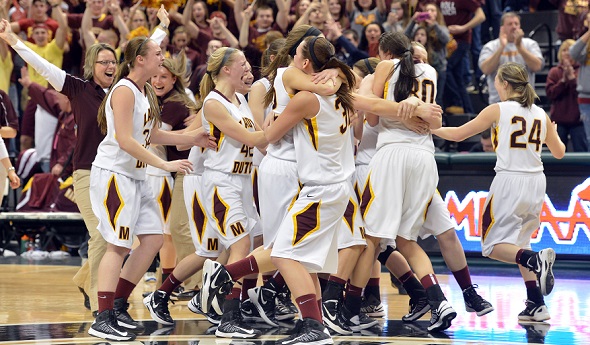
The Manchester girls basketball, Jackson Northwest girls bowling, Portland football, Harbor Beach football, Deckerville football and Hamtramck Frontier International boys soccer teams brought home the first MHSAA team championships in their schools’ histories.
A total of 33 teams won their first MHSAA titles. A total of 46 champions were repeat winners from 2011-12 – and 23 of those won for at least the third straight season. The Bloomfield Hills Brother Rice boys lacrosse team has the longest title streak of nine seasons, while the Battle Creek St. Philip volleyball team has won six straight titles for the second-longest streak overall and longest among girls programs.
Bloomfield Hills Cranbrook-Kingswood claimed the most championships, four, winning in Division 2 boys lacrosse, Lower Peninsula Division 3 girls swimming and diving, Lower Peninsula Division 3 girls tennis and Division 3 ice hockey. Four schools won three titles apiece: Grand Rapids Christian, Grand Rapids South Christian, Marquette and St. Ignace LaSalle.
Sixteen of the MHSAA's 28 championship tournaments are unified, involving teams from the Upper and Lower Peninsulas, while separate competition to determine titlists in both Peninsulas is conducted in remaining sports.
For a sport-by-sport listing of MHSAA champions for 2012-13 - Click Here (PDF)
The MHSAA is a private, not-for-profit corporation of voluntary membership by more than 1,500 public and private senior high schools and junior high/middle schools which exists to develop common rules for athletic eligibility and competition. No government funds or tax dollars support the MHSAA, which was the first such association nationally to not accept membership dues or tournament entry fees from schools. Member schools which enforce these rules are permitted to participate in MHSAA tournaments, which attract approximately 1.6 million spectators each year.
PHOTO: Manchester's girls basketball team celebrates the school's first MHSAA team championship in any sport this March at the Breslin Center. (Click to see more at HighSchoolsSportsScene.com.)