


Rep Council Wrap-Up: Fall 2018
December 6, 2018
By Geoff Kimmerly
Second Half editor
The adoption of alterations to the Michigan High School Athletic Association fall calendar and approval of Calvin College as the continued host site for the Girls Basketball Finals were among actions taken by the MHSAA’s Representative Council during its Fall Meeting on Nov. 30 in East Lansing.
Generally, the Council takes only a few actions during its Fall Meeting, with topics often introduced for additional consideration and action during its meetings in winter and spring. However, with multiple topics requiring immediate attention this fall, the Council approved calendar and basketball recommendations in advance of circumstances that will affect both during the 2019-20 school year and beyond.
The calendar change will keep the length of fall seasons consistent in boys soccer, cross country, tennis and golf in years when Thanksgiving is “late” during the fourth full week of November. The Council approved a recommendation allowing those four sports in “short years” – for example, 2019 – to begin practice the 16th Monday before Thanksgiving (Monday, Aug. 12, 2019) and begin competition after three days of practice over four calendar days (Friday, Aug. 16, 2019). Because the start of practice in those sports annually is tied to Thanksgiving, but the Finals are not, those four fall sports faced shorter seasons by one week in 2019, 2024, 2025, etc.
The Council also approved continuing to conduct the Girls Basketball Semifinals and Finals for 2019-20 and 2020-21 at Van Noord Arena at Calvin College. The Girls Finals moved to Van Noord Arena in 2017-18 because of the unavailability of Michigan State University’s Breslin Center due to a conflict with the NCAA Division I Women’s Basketball Tournament and an opportunity for Michigan State’s women’s team to host first and second-round games had it qualified and earned a top-16 overall seed. The same conflict is possible during Girls Basketball Finals traditional weekend in 2020, 2021, 2022 and 2023. Additionally, the Council discussed solutions for the 2023-24 and 2024-25 seasons, when Breslin may not be available during the traditional weekend of the MHSAA Boys Basketball Finals. The boys season for 2018-19 switched calendars with the girls season to avoid the same NCAA Tournament conflict; Breslin is the only building statewide that has made itself available for the Boys Basketball Finals and is large enough to accommodate the event. Only one other location offered to host the Girls Basketball Finals for 2019-20 and 2020-21.
Also affecting competition for 2019-20, the Council approved the continuation of an experiment begun in 2016-17 that allows cooperative programs in a series of sports – regardless of the student enrollment maximum – for two or more schools of the same public school district (and with the same governing board). Districts may form these co-ops in baseball, bowling, girls competitive cheer, cross country, golf, soccer, girls softball, tennis and wrestling. The experiment was designed to provide opportunities to participate in urban school districts where schools previously did not have enough athletes for team sponsorship on their own. Districts must show a demonstrated history of inadequate numbers of participants to be approved. These programs require the same two-year renewal process as other cooperative programs.
The Council also approved a change effective in spring 2020 that will allow spring sports teams, that have received MHSAA approval to travel out of state, to practice jointly and/or scrimmage (up to the season’s limit of four allowed scrimmages) with and against other approved MHSAA member schools. The Council reviewed survey data from the fall Update meetings and an online survey of membership that showed significant support for the allowance.
A number of other discussions focused on matters that could come before the Council for action at its Winter Meeting in March or Spring Meeting in May. In preparation for the Football Committee meeting in January, the Council discussed survey results concerning regular-season scheduling and the MHSAA Tournament for both 11 and 8-player football. The Council also reviewed possible benefits of adjusting MHSAA officials registration to include National Association of Sports Officials (NASO) membership and also other options for changing MHSAA registration prices to encourage more multi-sport officials. These officiating concepts will be presented to the MHSAA Audit and Finance Committee in February in advance of possible Council action in March or May.
The Council discussed creating an MHSAA Sports Medicine Advisory Committee to provide input and guidance on such topics, and also heard feedback received during Update meetings on the MHSAA’s possible role in mental health initiatives. The Council heard an update on the communication and notice that has taken place regarding the new Sport-Specific Transfer Rule that goes into effect for 2019-20 based on the sports a student participated in during 2018-19. The Council also continued its 2018 March and May discussions concerning the boarding school student exception to the transfer rule, with staff reporting on a recent meeting with those boarding schools administrators.
Additionally, the Council heard an update on the “Presenting Sponsor” program whereby the MHSAA has provided support to junior high/middle school competitions in cross country and track & field over the last two years; in 2018-19, the MHSAA also is serving as presenting sponsor at events for junior high/middle school volleyball and basketball. Similarly, the MHSAA will serve this winter as a presenting sponsor of a Special Olympics Unified basketball invitational in February at Novi High School and at the Michigan High School Powerlifting Association Finals in March at Ionia High School. Both high school events will include fields filled with MHSAA member high schools and provide the Association with further opportunities to provide financial and messaging support for these student-focused activities.
The Fall Meeting saw the addition of Nicole Carter, principal of Novi High School, to the 19-person Council. She was appointed to a two-year term. Carter fills the position formerly held by Pat Watson, principal of West Bloomfield High School, whose term ended. Also, Vicky Groat, principal and athletic director at Battle Creek St. Philip High School, was reappointed for a second two-year term.
The Council reelected Scott Grimes, assistant superintendent of human services for Grand Haven Area Public Schools, as its president; Saginaw Heritage athletic director Pete Ryan as vice president and Vic Michaels, director of physical education and athletics for the Archdiocese of Detroit, as secretary-treasurer.
The Representative Council is the legislative body of the MHSAA. All but five members are elected by member schools. Four members are appointed by the Council to facilitate representation of females and minorities, and the 19th position is occupied by the Superintendent of Public Instruction or designee.
The MHSAA is a private, not-for-profit corporation of voluntary membership by more than 1,500 public and private senior high schools and junior high/middle schools which exists to develop common rules for athletic eligibility and competition. No government funds or tax dollars support the MHSAA, which was the first such association nationally to not accept membership dues or tournament entry fees from schools. Member schools which enforce these rules are permitted to participate in MHSAA tournaments, which attract more than 1.4 million spectators each year.
MHSAA Connecting at Junior High Level
By
Geoff Kimmerly
MHSAA.com senior editor
June 6, 2017
By Geoff Kimmerly
Second Half editor
Signs and banners were displayed at stadiums. Announcements were made to the crowd.
And most of all, questions were answered concerning the current role of the Michigan High School Athletic Association in junior high/middle school athletics – and the increased role the Association would like to take on in the future.
Throughout May, the MHSAA served as presenting sponsor at junior high/middle school track & field meets at Ravenna, Harrison, Grand Blanc and Saginaw White Pine Middle School.
This sponsorship pilot program was a first step on the path to making stronger connections with student-athletes before they reach high school. The MHSAA provided meet management with banners and other signage to hang at the events, and public address announcements on sportsmanship, multi-sport participation, officials recruitment and other notable topics affecting competitors and their families.
Also made available were printed materials on sportsmanship, officials recruitment and the benefits of taking part in junior high/middle school sports. And as part of the opportunity, the MHSAA donated grants of $500 to help with the administration of those meets – again, all in the name of getting the MHSAA message in front of students years before they reach high school.
“I couldn’t believe how many people did not realize middle schools were connected to the MHSAA. That in itself was huge for publicity,” said Damon Amey, athletic director at White Pine. “I feel that if they know we are members, they immediately know we follow a set of rules. We are student-first oriented.”
The MHSAA served 740 junior high/middle school members, plus 24 elementary schools with 6th graders participating, during the 2016-17 school year – up from 705 junior high/middle schools only a year before.
Junior high/middle schools long have been eligible for membership in the MHSAA. An entire section of the MHSAA Handbook is dedicated to them. But the Association also has turned a heavier focus toward that level over the last four years.
The MHSAA Representative Council approved the creation of a Junior High/Middle School Task Force during its December 2013 meeting, and that task force was instrumental in the addition of 6th grader participation this past school year and the lengthening of contests in some sports. The Council this spring approved a recommendation by the Junior High/Middle School Committee (a permanent committee separate from the task force) urging all MHSAA sport committees to consider opportunities to add more games and dates to middle school schedules.
Last month’s sponsorship pilot program also stemmed from this recent work.
“We need to, for the future of high school sports, get more involved at the junior high/middle school level,” said MHSAA assistant director Cody Inglis, who oversees the Junior High/Middle School Committee and led the task force. “It’s not a matter of should we, but how quickly can we get involved.”
Inglis served as something of an ambassador in setting up and attending multiple sponsored junior high/middle school meets. Because of the perception that the MHSAA is mostly associated with high school athletics, Inglis noticed some curious and questioning looks in response to the visible presence of the Association at those meets.
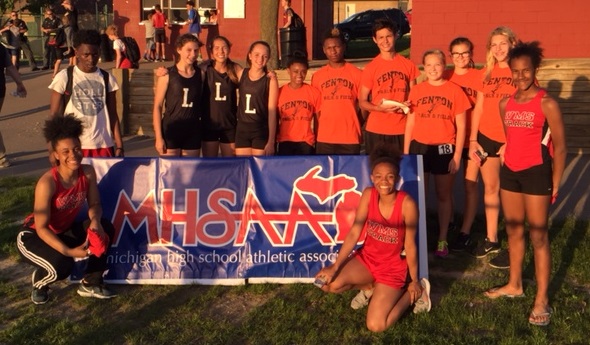
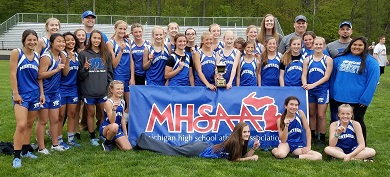 But there were more positives, by far. On multiple occasions, the winners of the meets asked to have their team photos taken with the MHSAA banner on the field. One team took individual photos of each athlete holding the trophy in front of the banner as well.
While not many, Inglis did have conversations about officiating with a handful of interested people – good news as the MHSAA is always in pursuit of adding to those numbers. And his presence gave fans an opportunity to ask about the MHSAA’s role both at the high school and junior high/middle school level – and gave him the opportunity to explain how the Association works and dispel some myths.
“I love the fact that the MHSAA was at our conference track meet,” Montague NBC Middle School athletic director Jay Mulder said. “Cody did a great job in talking with parents, athletes and coaches. The presence was just enough to get people to take notice of the MHSAA.
“As a middle school AD and a middle school coach, I am very encouraged and excited to see the active role that the MHSAA is taking with middle school sports. I think that it bodes well for the future.”
Amey noted a number of opportunities with printed materials and championship medals that could further promote the MHSAA’s messaging at junior high/middle school meets. Also part of future plans is the recruitment of regional “ambassadors” – retired coaches, athletic directors and officials would be among candidates – who will travel to junior highs and middle schools in their areas and grow connections at that level.
As members, junior highs and middle schools receive the structure and support of MHSAA rules and governance, and every athlete receives catastrophic and concussion care insurance managed by the MHSAA. More interaction by these ambassadors could lead to more membership – the meet at White Pine, for example, included nearly half non-MHSAA schools – and also more benefit to members, be it additional sponsorship, off-field programs or even MHSAA-created championship events to give those athletes more opportunities to shine at this lower level and as they work toward taking that big step to high school.
“It’s been like a light bulb has gone off,” Inglis said. “The brand of the MHSAA is viewed as a high school-only brand, and it was humbling to see the power in that brand as people look to the ultimate goal.
“However we can parlay that into more of a presence and use that brand to get involved in school sports at the younger levels, that helps in that transition.”
PHOTOS: (Top) Students from Grand Blanc West Middle School, Fenton Schmidt Middle School and Linden Middle School stand together with an MHSAA banner during the Flint Metro League meet last month. (Middle) The Montague NBC Middle School girls track & field team poses with a banner after winning the West Michigan Conference championship. (Photos courtesy of the Grand Blanc and Montague schools’ athletic departments.)