


Rep Council Wrap-Up: Spring 2017
May 18, 2017
By Geoff Kimmerly
Second Half editor
The adoption of a change in how basketball and volleyball teams will be classified for Michigan High School Athletic Association tournaments was among notable actions taken by the Representative Council during its annual Spring Meeting, May 7-8, in Glen Arbor, in addition to MHSAA Finals site changes announced in a previous release May 9.
The Spring Meeting of the 19-member legislative body of the Association’s more than 1,400 member schools is generally the busiest of its three sessions each year. The Council considered 29 committee proposals and dealt with a variety of eligibility rule, postseason tournament and operational issues.
The tournaments in girls and boys basketball, and volleyball – the last to be organized based on traditional Class (A-B-C-D) enrollment breaks – instead will be conducted using equal divisions (1-2-3-4) beginning with the 2018-19 school year. The Council approved this change in response to a proposal by the Basketball Coaches Association of Michigan; Michigan’s interscholastic volleyball community also has expressed openness to equal divisions in the past. All other MHSAA tournaments, except for football, are conducted using equal divisions based on enrollment and determined prior to the school year. Football is the only sport requiring teams to qualify for postseason play, and its equal divisions are not determined until after the regular season ends.
After previously approving the addition of a second division to the 8-Player Football Playoffs for 2017-18 at its Winter Meeting, the Council approved the selection of the field after the ninth week of the regular season and based on playoff point average. The 32 teams with highest playoff point averages will be listed by enrollment, with the largest 16 placed in Division 1 and the smallest 16 in Division 2 of the 8-Player tournament.
Also concerning tournament setup, the Council chose to not adopt a Basketball Committee proposal that would have seeded both the girls and boys tournaments at the District and Regional levels. Instead, the Council instructed staff to examine seeding options for the District level only, to be presented at Council meetings during the 2017-18 school year.
Continuing a focus on athletes’ health and safety, and in the case of football reducing the number of collisions experienced by players, the Council approved a Football Committee recommendation that, after the first game of the regular season, limits teams to no more than 90 total minutes of collision practice in any week. Similar to the previous rule limiting teams to two days of collision contact per week after the first game, blocking and tackling techniques are allowed by the new rule – but full-speed contact is limited to players versus pads, shields, sleds or dummies. Players may continue to wear helmets and other protective pads for non-collision practice sessions.
Here is a summary of other actions taken by the Representative Council at the Spring Meeting, which will take effect during the 2017-18 school year unless noted:
Sport Matters
• In competitive cheer, the Council approved a committee recommendation to allow forward/backward suspended rolls, in a double-braced pyramid, to be transitioned directly to a stunt. Those rolls are allowed to a cradle, sponge or stunt, but not the cheering surface.
• In football, the Council approved two recommendations, one by committee and one by staff, regarding the later rounds of the playoffs. For Semifinals and Finals, the home team and visitor will be determined by playoff point average instead of the previous Regional advancement. In addition, the Council also voted to allow 11-player Semifinals to be played either Friday night or Saturday, as opposed to only on Saturday.
• In golf, the Council approved a committee recommendation requiring a Golf Association of Michigan (GAM) rules official be present at each Lower Peninsula girls and boys Regional tournament to assist with rules issues and challenges.
• For hockey, the Council approved a recommendation that allows a 23rd active player to be dressed in uniform if that player is a goaltender. Previously, only 22 active players could dress and sit on the bench.
• Also for hockey, the Council approved a committee recommendation to add an MHSAA adaptation to a National Federation rule mandating helmets be worn by players and officials at all times on the ice, except while standing for the national anthem. The MHSAA adaptation adds postgame award ceremonies as another exception allowing helmets to be removed.
• In lacrosse, both boys and girls, the Council approved a recommendation from both sports’ committees to allow for multi-team tournaments on days not followed by school days (generally Fridays); currently they are allowed only on non-school days.
• In soccer, a committee recommendation was adopted eliminating overtime periods and shootouts during the regular season. Leagues and conferences will be allowed an overtime option for their end-of-season bracketed tournaments, but overtime in those cases must not exceed two 10-minute periods plus a shootout. Multi-team regular-season tournaments also may receive waivers to employ a shootout if it is used to determine the winner of a game.
• A swimming & diving committee recommendation was approved that reduces the number of regular-season wins required by a diver from five to four for that diver to qualify for the Diving Qualification Meet. A diver also may qualify for the Diving Qualification Meet if he or she places ahead of all divers from opposing schools in varsity competition in at least four meets, even if he or she does not finish ahead of his or her teammates.
• In tennis, the Council approved to adjust the limited team membership rule as it applies to tennis to go into effect on the first allowable date of competition for any student, as opposed to the current first day of allowable practice.
• In girls volleyball, a committee recommendation was approved allowing graduating 12th-grade athletes with no remaining interscholastic eligibility in any sport to wear school uniforms in one all-star game sponsored and conducted during the summer by the Michigan Interscholastic Volleyball Coaches Association, effective immediately.
• The Council approved two Wrestling Committee recommendations. The first changes the Team Regional hosting format so that a host will be selected from the four qualifying teams based on a yearly rotation among those Districts.
• The Council also approved a recommendation to revise the Weigh-In Form/Process to include a section for inspection, where all participating wrestlers would be subject to inspection by officials.
Junior High/Middle Schools
• The Council approved a Junior High/Middle School Committee recommendation urging each MHSAA sport committee to consider opportunities to add more games and dates to middle school schedules while not extending the length of the 13-week season for those sports. This likely would include expanding the number of multi-game events (all games played on the same day and on a day not followed by a day of school) from two to four events.
• For both girls and boys junior high/middle school lacrosse, the Council approved committee recommendations to increase the number of multi-team tournaments allowed. Both will be allowed four multi-team tournaments. One-day multi-team tournaments in both boys and girls lacrosse will be counted as one competition date. Also approved for boys junior high/middle school lacrosse were committee proposals upping the number of maximum game dates from 12 to 15 over the same 13-week season, and an increase in running time minutes during multi-team events from 150 to 160 minutes to allow for four games with 20-minute running-time halves.
The Council also reviewed reports on membership, with 750 senior high schools and 740 junior high/middle schools in 2016-17 plus 24 elementary schools with 6th-grader participation; eligibility advancement applications, which totaled five for the second straight school year; the use of Educational Transfer Forms, which fell 13 percent this year; school violations, attendance at athletic director in-service workshops and Coaches Advancement Program sessions, officials’ registrations, rules meetings attendance and officials reports submitted for the past three sports seasons. The Association’s $11.1 million budget for the 2017-18 school year also was approved.
The Representative Council is the 19-member legislative body of the MHSAA. All but five are elected by member schools. Four members are appointed by the Council to facilitate representation of females and minorities, and the 19th position is occupied by the Superintendent of Public Instruction or designee.
The MHSAA is a private, not-for-profit corporation of voluntary membership by more than 1,400 public and private senior high schools and junior high/middle schools which exists to develop common rules for athletic eligibility and competition. No government funds or tax dollars support the MHSAA, which was the first such association nationally to not accept membership dues or tournament entry fees from schools. Member schools which enforce these rules are permitted to participate in MHSAA tournaments, which attract more than 1.4 million spectators each year.
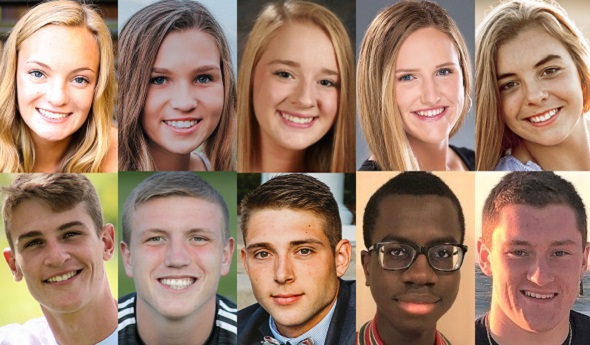
Scholars & Athletes 2020: Class C & D
By
Geoff Kimmerly
MHSAA.com senior editor
February 3, 2020
By Geoff Kimmerly
Second Half editor
The Michigan High School Athletic Association has selected 10 student-athletes from Class C and D member schools to receive scholarships through the MHSAA/Farm Bureau Insurance Scholar-Athlete Award program.
 Farm Bureau Insurance, in its 31st year of sponsoring the award, will give $1,000 college scholarships to 32 individuals who represent their member schools in at least one sport in which the Association sponsors a postseason tournament. The first 30 scholarships are awarded proportionately by school classification and the number of student-athletes involved in those classes; also, there are two at-large honorees who can come from any classification.
Students applying for the Scholar-Athlete Award must be carrying at least a 3.5 (on a 4.0 scale) grade-point average and have previously won a letter in a varsity sport in which the Michigan High School Athletic Association sponsors a postseason tournament. Other requirements for the applicants were to show active participation in other school and community activities and produce an essay on the importance of sportsmanship in educational athletics.
Each of the scholarship recipients will be honored at a halftime ceremony during the Division 3 Boys Basketball Final, March 28, at the Breslin Student Events Center in East Lansing. Commemorative medallions will be given to the finalists in recognition of their accomplishments.
The Class C Scholar-Athlete Award honorees are: Madelyn Koski, Ishpeming Westwood; Alanna Mayer, Bronson; Kayla Moore, Madison Heights Bishop Foley Catholic; Brendan Dafoe, Petersburg Summerfield; Noah Dusseau, Petersburg Summerfield; and Hutson Hohlbein, Adrian Lenawee Christian.
The Class D Scholar-Athlete Award recipients are: Emma Springer, Three Oaks River Valley; Samantha Teachworth, Portland St. Patrick; Lesley Armah, Mount Pleasant Sacred Heart; and James Storey, Pickford.
Overviews of the scholarship recipients of the Class C Scholar-Athlete Award follow. A quote from each recipient's essay also is included:
 Madelyn Koski, Ishpeming Westwood
Played four seasons of varsity tennis, is playing her fourth of varsity basketball and will play her fourth of varsity softball this spring; also participated in track & field as a junior. Earned all-state honors in basketball while helping her team to last season’s Division 3 Quarterfinals, and was named Upper Peninsula Division 2 Player of the Year in the fall in helping the tennis team to its fourth straight UPD2 championship. Also earned all-league honors in softball and has served as captain in basketball and tennis multiple seasons. Participating in second year of National Honor Society and third of Business Professionals of America, winning a Regional award for BPA as a junior and reaching the national competition as a sophomore. Serving as vice president of BPA chapter after previously serving as treasurer. Served as youth coach or clinician for basketball, softball and tennis throughout high school. Will attend Ferris State University and study pre-pharmacy.
Essay Quote: “No athlete should have to listen to belittling comments made by spectators. This makes me appreciate those with good sportsmanship even more than I did in the past. Seeing other schools with good sportsmanship reinforced my sportsmanship. I don’t want other athletes to feel the way I did when I was a freshman.”
 Alanna Mayer, Bronson
Played three seasons of varsity volleyball, is playing her third of varsity basketball and will participate in her fourth of varsity track & field this spring. Earned all-state recognition in helping volleyball team to two Class C/Division 3 Finals championships, earned all-area honors in basketball and qualified for the MHSAA Finals in track. Also contributed to multiple academic all-state team awards in volleyball. Served as captain of all three teams. Participating in second year of National Honor Society and serving as chapter president, and also serving fourth year as student council treasurer. Participated in 4-H and earned a number of “Best of Show” awards for crafts and livestock. Participated in various volunteer projects throughout high school. Finalizing college plans but intends to study business management.
Essay Quote: “Winning is important but showing good sportsmanship is even more important because it forms the basis on how student-athletes interact and treat other people. It teaches them to respect the players on their team as well as the players on the opposing teams. It teaches them to respect their coaches, and most importantly, the referees or officials involved in their games.”
 Kayla Moore, Madison Heights Bishop Foley Catholic
Played four seasons of varsity volleyball, is playing her fourth of varsity basketball and will played her fourth of varsity softball in the spring. Earned all-state in softball and all-league in volleyball and basketball, and helped both the volleyball and softball teams to multiple District championships. Served multiple seasons as captain of all three teams. Participating in second year of National Honor Society and serving as chapter president, and also serving as student council executive board president after previously serving as historian. Serving as executive board member for Catholic Athletes for Christ and prayer leader for Mission and Ministry Club’s Be the Difference Day committee. Founded “Hoops for Hope” charity basketball event to promote cancer awareness. Will attend Saginaw Valley State University and study physical therapy.
Essay Quote: “The most popular catch of the week or the buzzer-beating shot to win the game may be recognized, but it is the acts of positive sportsmanship that are remembered for ages. While I may forget a math formula or a vocab definition, I will never forget the impact that educational athletics has had on my life and the person it shaped me to be today.”
 Brendan Dafoe, Petersburg Summerfield
Playing third season of varsity basketball, played three of varsity football and will play fourth of varsity baseball in the spring; also participated in track & field as a junior. Earned all-state honors in baseball and all-region and all-league in basketball and football, and was named Monroe County Region “Athlete of the Year” as a junior by Monroe News. Helped baseball team to 2019 Division 4 Finals championship and served as captain of both basketball and football teams. Participating in fourth year of student council and serving as president, and also participating in second year of National Honor Society. Participating in multiple volunteer efforts serving youth and the elderly. Selected to attend numerous leadership conferences and earned a Hugh O’Brian Leadership Award. Will attend University of Toledo and study nursing.
Essay Quote: “Many younger kids look up to the actions I show on and off the field and court and they replicate those behaviors. I’m a fierce competitor, but my teammates will tell me to ‘quit being so nice!’ In fact, while on second base I picked up the ball that was overthrown by the catcher and was called out because of it. I haven’t lived that down, but I love how I have the opportunity as a student athlete to lead in a positive way.”
 Noah Dusseau, Petersburg Summerfield
Played two years of varsity football and ran three of cross country, playing second of varsity basketball and will participate in fourth of track & field in the spring; also played junior varsity baseball as a freshman. Helped basketball team to league title and track team to Michigan Interscholastic Track Coaches Association team state meet runner-up finish. Carries 4.0 grade-point average and has earned 11 academic all-state honors. Served as captain of track, cross country and junior varsity football teams. Participating in second years of National Honor Society, National Technical Honor Society and Future Farmers of America; serving as NHS, NTHS and Lenawee FFA chapter presidents. Participated in Lenawee TECH Center Student Leader Organization and American Legion Boys State, and has participated in Young Life for three years. Will attend University of Toledo and study pharmaceutical sciences.
Essay Quote: “There will be many parts of life that will be challenging for everyone. It can be something as simple as failing a math test to as serious as losing a loved one. These events will happen to everyone, and there is no way to avoid them. Sportsmanship teaches us to help those that are going through adversity, whether it be our teammates or opponents, to continue pushing.”
 Hutson Hohlbein, Adrian Lenawee Christian
Played four seasons of varsity football, playing fourth of varsity basketball and will play fourth of varsity baseball in the spring. Earned all-conference honors in football and all-county in football and basketball, and helped both of those teams to District titles. Served as captain for multiple seasons of both football and basketball teams and as part of player’s council for former. Selected as representative for Southern Central Athletic Association team-building retreat as sophomore. Carries grade-point average above 4.0 and participating in second year of National Honor Society, this year as treasurer. Also serving as student council vice president after previously serving two years as a representative and as class president as a freshman. Serving third year as class chaplain. Participated as youth basketball coach and continues to officiate multiple sports. Finalizing college plans but intends to study nursing as part of a pre-medical program.
Essay Quote: “If sportsmanship were to be put on the backburner, sports would not only lose their rule-locked organization, but it would also lose its special touch. Every athlete has a reason to play the game they love so much, but without a focus on sportsmanship, an athlete’s love for the game would soon fade while things like pride, cheating, and disrespect steal their joy.”
Other Class C girls finalists for the Scholar-Athlete Award were: Anna Laurenz, Breckenridge; Makayla Fletcher, Clinton; Lauren Schnicke, Kent City; Grace Tylutki, Monroe St. Mary Catholic Central; Isabella Santiago-Lindsay, North Muskegon; Ellie DuVall, Ottawa Lake Whiteford; Ellary Pachulski, Saranac; Allyson Kemp, Unionville-Sebewaing; and Olivia Bowman, White Cloud.
Other Class C boys finalists for the Scholar-Athlete Award were: Gabriel Seir, Ann Arbor Greenhills; Jared Gottschalk, Beal City; Kendall Anthes, Cass City; Sandyn Cuthrell, Cass City; Drew Markel, Cass City; Giovanni Basanese, Iron Mountain; Jack Pedlar, Lake City; Riley McKenna, Lakeview; John Hayhurst, North Muskegon.
Overviews of the scholarship recipients of the Class D Scholar-Athlete Award follow. A quote from each recipient's essay also is included:
 Emma Springer, Three Oaks River Valley
Played four varsity seasons of volleyball, playing fourth of basketball and will play her fourth of softball this spring; also ran cross country as a sophomore. Earned all-state honors in softball and all-league recognition in both volleyball and basketball, and was part of receiving team academic all-state recognition in basketball and softball. Helped softball team to league and District titles her first three seasons and has served as captain of all three teams three times. Has served or is serving as class president, National Honor Society chapter president, Varsity Club president, Interact Club founder and president, Spanish Club officer and vice president of student congress. Participated in various volunteer efforts over all four years of high school, and also in school’s peer-to-peer program as a junior. Will attend Calvin University and study kinesiology and Spanish with aspirations of obtaining a doctorate in physical therapy.
Essay Quote: “What the River Valley community learned in its time of grieving is that sportsmanship can be so much more than an interaction between two people, or even two teams. Sometimes sportsmanship is displayed by multiple teams and countless individuals over two years and comes from those you least expect.”
 Samantha Teachworth, Portland St. Patrick
Played four seasons of varsity volleyball, is playing her third of varsity basketball and will play her fourth of varsity softball in the spring. Earned all-league recognition in volleyball and softball and has captained all three of her varsity teams. Helped volleyball team to Regional championship and basketball team to District title. Participating in third year of National Honor Society and serving this year as president of the school’s Student Advisory Committee. Also has served as president of the Ionia Future Farmers of America chapter and multiple 4-H clubs, as a church alter server prefect and township election official. Received various FFA awards and was recipient of the FFA’s Washington Leadership Conference Scholarship. Will attend Aquinas College and study political science.
Essay Quote: “When it comes to organized sports, I feel sportsmanship is one of the first things that should be taught. It is an issue that makes me nervous for the future of sports. … I watched my brother’s third-grade basketball game where a parent was getting so upset about the calls, he would follow a 15-year-old referee on the court to yell at him. It becomes a matter of self-control. We have to realize that at the end of the day, it is a game.”
 Lesley Armah, Mount Pleasant Sacred Heart
Ran four seasons of varsity cross country and will run his fourth of varsity track this spring, and played junior varsity basketball as a sophomore. Participated on cross country teams that finished first and second at MHSAA Finals. Earned AP Scholar with Honor Award and a third place in the Mid-Michigan Regional Brain Bee competition. Has represented his class as secretary/treasurer and vice president on student senate, served as co-captain of the school quiz bowl team and delegation leader for Model United Nations. Earned all- conference recognition for both quiz bowl and Model UN, helping the former to a state championship. Founded and served as president of College Prep Club and also participates in Key Club, National Honor Society, Science Olympiad and robotics. Finalizing college plans but intends to study biology.
Essay Quote: “Unsurprisingly, gracefully leaping over thirty-nine inches of cold, hard metal while in a dead sprint is a difficult task to learn and one that I struggled with for quite some time. Fortunately, whenever I got critiqued for my mediocre form or smacked head-first into a hurdled, I had my trusty group of other hurdlers waiting with words of encouragement. … Despite my numerous, humiliating falls, I constantly received sportsmanly encouragement from teammates and even other competitors that made my bumpy transition into hurdling bearable.”
 James Storey, Pickford
Played four seasons of varsity football, is playing his fourth of varsity basketball and will play his fourth of varsity baseball and participate in his third season of track & field this spring. Earned all-state honors in football and all-conference in basketball and baseball, and led Pickford to the 8-player Division 2 championship this past fall. Served as team captain in all four sports. Carries 3.99 grade-point average while dually enrolled for nine college credits, and earned school academic excellence awards in multiple subjects. Served as school and class president during four years of student government, and is participating in second year of National Honor Society. Tutors in math and serves as church volunteer. Finalizing college plans but intends to pursue a pre-medical degree with aspirations of a career in dermatology.
Essay Quote: “Sportsmanship is the one aspect of the game that makes high school athletics memorable forever. While there are times that athletes get caught up in the heat of an intense game, these are the situations where it is most important to maintain a good attitude and good sportsmanship. There will always be people who act unsportsmanlike in these situations; however, this is where student-athletes need to be leaders and deal with the situation in a sportsmanlike manner.”
Other Class D girls finalists for the Scholar-Athlete Award were: Teegan Dawson, Bellaire; Josie Koenigsknecht, Fowler; Colleen McCarthy, Onekama; Emma Engler, Peck; Kaitlyn Bricker, Pellston; and Isabel Mossel, Plymouth Christian Academy.
Other Class D boys finalists for the Scholar-Athlete Award were: Tony Piggott, Fowler; Ramy Abueita, Genesee; Alex Sutten, Marion; Adam Paga, Petoskey St. Michael Academy; Bryce Opie, Suttons Bay; and Matthew Schmidt, Three Oaks River Valley.
The Class B scholarship award recipients will be announced Feb. 11, and the Class A honorees will be announced Feb. 18.
Farm Bureau Insurance of Michigan was founded in 1949 by Michigan farmers who wanted an insurance company that worked as hard as they did. Those values still guide the company today and are a big reason why it is known as Michigan’s Insurance Company, dedicated to protecting the farms, families, and businesses of this great state. Farm Bureau Insurance agents across Michigan provide a full range of insurance services—life, home, auto, farm, business, retirement, Lake Estate®, and more—protecting nearly 500,000 Michigan policyholders.
The MHSAA is a private, not-for-profit corporation of voluntary membership by more than 1,500 public and private senior high schools and junior high/middle schools which exists to develop common rules for athletic eligibility and competition. No government funds or tax dollars support the MHSAA, which was the first such association nationally to not accept membership dues or tournament entry fees from schools. Member schools which enforce these rules are permitted to participate in MHSAA tournaments, which attract more than 1.4 million spectators each year.