


Rep Council Wrap-Up: Spring 2018
By
Geoff Kimmerly
MHSAA.com senior editor
May 14, 2018
The adoption of major changes to the Michigan High School Athletic Association transfer regulation was among notable actions taken by the Representative Council during its annual Spring Meeting, May 6-7, in Gaylord, in addition to the selection of the Association’s next executive director announced in a previous release May 8.
The Spring Meeting of the 19-member legislative body of the Association’s more than 1,400 member schools is generally the busiest of its three sessions each year. The Council considered 29 committee proposals and dealt with a variety of eligibility rule, postseason tournament and operational issues.
The revised transfer regulation will go into effect for the 2019-20 school year, based on a student-athlete’s sports participation during 2018-19. The new transfer rule will make transferring student-athletes ineligible for one year in any sport played during the previous year at the previous school – unless that student-athlete’s situation fits one of the current 15 exceptions that allow for immediate eligibility. However, the revised transfer regulation also allows that transferring student-athlete immediate eligibility in any other MHSAA-sponsored sport not participated in during that previous year at the previous school.
The additions to the transfer rule received vast support from member schools in surveys leading up to the Council’s vote.
“We are hopeful this ‘sport-specific’ transfer rule will be easier to understand, and therefore, more consistently enforced,” MHSAA Executive Director John E. “Jack” Roberts said. “This rule better addresses the changing landscape of transfers, hopefully dissuading those considering moving for athletic reasons while still allowing a full range of sports for those who do switch. It may seem like a punishment to some, but the new rule is actually more permissive for many transfer students, and we saw growing support for these changes from our schools since we began discussing this proposal a year ago.”
A number of significant actions at the Spring Meeting will affect the junior high/middle school levels, as the Council continued growing its impact among those who represent the future of educational athletics.
The Council approved Junior High/Middle School Committee recommendations to increase the number of contests and days of competition in three sports, beginning in 2018-19. Softball teams will have 12 days of competition over 13 weeks, with doubleheaders counting as one of those 12 days. Basketball teams may play 12 games over 13 weeks with one game a day allowed, except that two games may be played on a day not followed by a school day up to four times a season; each of those doubleheader days will count as one of the 12 games. Soccer teams may play 12 games over 13 weeks with one game a day allowed, except that two games may be played on a day not followed by a school day up to two times a season; each of those doubleheader days also will count as one of the 12 games.
Another committee recommendation approved by the Council will allow a middle school student-athlete to compete in two non-school events during the school season in team sports except football – making the rule for team sports at the junior high/middle school level the same as the individual sport model currently enforced.
The Council also approved of continuing to develop and expand opportunities for the MHSAA to act as a “presenting sponsor” of already-existing junior high/middle school meets, invitationals and tournaments conducted by leagues, conferences and schools around Michigan. Staff was authorized to approach MHSAA sport committees and sport coaches association to explore possible junior high/middle school area or sectional competitions in cross country, track & field, wrestling, swimming & diving and potentially other sports.
“The Representative Council continued to consider ways to better serve the youngest student-athletes in our membership – the junior high/middle school participants who are the future of high school sports,” Roberts said. “While these actions may not gain as much attention as changes at the high school level, they are just as important if not more critical to the status of educational athletics moving forward. Nurturing this youngest level must continue to be a focus in the years to come as we work to strengthen and provide more opportunities at all levels.”
The Council approved a number of recommendations by respective sport committees that will alter the tournament setup beginning this fall. In ice hockey, the Pre-Regional system of tournament assignments has been eliminated; all teams will instead be organized into traditional Regionals, 24 total with no more than eight teams assigned to each. In boys lacrosse, a game will end when an 18-goal margin is reached any time after the completion of the third quarter; the 12-goal differential that starts a running clock during the second half will continue. In soccer, beginning with the 2019 season, the first round of District games will be required to be played the week before the current District week on that Wednesday, Thursday or Friday. District Semifinals and Finals will be scheduled for the following week – but Saturday games can be used only as a weather backup during the District round.
To better assist with scheduling and provide transportation relief, the Council approved a number of adjustments to the non-traditional draw policies for District and Regional tournaments; non-traditional draws do not require all contests be played as a designated host site, assisting primarily teams that might be located far from their tournament host but closer to their opponent(s). For the 2018-19 MHSAA Basketball and Volleyball Tournaments, non-traditional draws will be mandated for Districts made up of (a) all Upper Peninsula teams, (b) a combination of Upper and Lower Peninsula teams, or (c) seven or eight-team District grouping in any location of the state. In Districts with circumstances (a) and (b), a traditional draw may be conducted if all participating teams agree to that format. At the Regional level, any that include more than one District located in the Upper Peninsula will require geographic neutral sites be used. The Council also authorized a work group to review all aspects of non-traditional draws and all affected sports and report at the Council’s Fall meeting this Nov. 30.
Additionally, the Council approved a Classification Committee recommendation to move the “opt-up” deadline for fall sports from April 15 to May 1, while keeping the dates for winter (Aug. 15) and spring sports (Oct. 15) the same.
Here is a summary of other actions taken by the Representative Council at the Spring Meeting, which will take effect during the 2018-19 school year unless noted:
Sport Matters
• In baseball, the Council approved a committee recommendation altering tournament trophies to match the tournament format previously approved to begin with the 2019 season. Starting that spring, baseball teams will play what previously were Quarterfinals as the final game of a “Super Regional” tournament, and trophies awarded to those 16 winners will read “Super Regional Champion.” Trophies awarded to losing teams in that round will read “Regional Champion” as they still will have won the Regional level of the tournament.
• In basketball, the Council approved a committee recommendation to adopt the 28-foot coaching box for competition allowed under National Federation of State High School Associations (NFHS) rules. Previously, the MHSAA allowed for a 14-foot coaches box in front of the team’s bench.
• In competitive cheer, the Council approved four committee recommendations. The first allows junior high/middle school athletes to perform an inverted exit-cradle to back walkover out only. At the high school level, any catch that originates from shoulder level or below and transitions from a vertical body position to a horizontal body position now will require only three catchers, while four catchers are still required for any catch that exceeds shoulder level. The two other recommendations affect scoring: the first will allow at the high school level a mountain climber to an unbraced OLE to receive the OLE choreography bonus, while the second will allow for all levels (grades 7-12) four difficulty points to be awarded for a ground-up to an elevator.
• In cross country and track & field, the Council approved a Committee recommendation to adopt a recommendation from the state coaches and officials associations to use a one-turn stagger for the 3,200-meter relay and open 800, 1,600 and 3,200 meter runs. This stagger will begin to be used in 2020. The Council also approved a Committee recommendation to alter the junior high/middle school meet order to closely align with the high school order; eight events will switch so that relays and similar sprints and distance runs are ordered in the same way.
• In football, the Council approved a Football Committee recommendation that the MHSAA continue for the third year to experiment with a 40-second clock for use between plays. Teams taking part in the experiment will have 40 seconds from the end of the previous play to snap the ball to begin the next, unless there is an administrative stoppage (for penalty, measurement, etc.). MHSAA schools began experimenting with the 40-second clock during the 2016 season.
• In boys lacrosse, the Council approved a Committee recommendation to allow contests with out-of-state schools from states that do not sponsor a statewide boys lacrosse tournament only as long as those opponents follow comparable regulations of other spring sport teams in that state – including practice and contest limits, use of NFHS playing rules and prohibitions on undue influence and recruiting. Member schools must receive pre-approval from the MHSAA to play these opponents.
• In skiing, the Council approved a Committee recommendation to increase the maximum number of contests from 15 to 17 while reducing the number of scrimmages allowed from four to two.
• In soccer, the Council approved a Committee recommendation to allow at the high school level, as a part of the multi-team tournament rule, teams to play two full games on a non-school day and have those two count as one of the 18 regular-season contests. Teams still have the option to play 180 minutes under the current multi-team tournament rule. The only overtime allowed would be a shootout if part of a bracket tournament.
The Council also discussed a number of topics that will require action as quickly as its Nov. 30 meeting. The Council considered options for the Girls and Boys Basketball Tournaments for the 2019-20 season; one option follows the current format of playing tournaments with a one week offset and Finals at separate sites, and a second option would have the tournaments conducted simultaneously over three weeks with Semifinals at sites around the state and all eight championship games (four for girls, four for boys) at the same arena during the same weekend.
The possible scheduling by the MHSAA of regular-season games for 8-player football teams also was discussed and may be voted upon Nov. 30.
Make-up of the MHSAA’s sport committees is an emerging topic, and the Council considered suggestions for making them more effective. The committee appointment procedure originally was adopted by the Council in 1987 and modified in 2007.
The Council also reviewed reports on membership, with 751 senior high schools and 752 junior high/middle schools in 2017-18 plus 42 elementary schools with 6th-grader participation; eligibility advancement applications, which totaled six for this school year; the use of Educational Transfer Forms, which fell eight percent this year; out-of-state practice requests, school violations, attendance at athletic director in-service workshops and Coaches Advancement Program sessions, officials’ registrations, rules meetings attendance and officials reports submitted for the past three sports seasons. The Association’s $11.6 million budget for the 2018-19 school year also was approved.
The Representative Council is the 19-member legislative body of the MHSAA. All but five are elected by member schools. Four members are appointed by the Council to facilitate representation of females and minorities, and the 19th position is occupied by the Superintendent of Public Instruction or designee.
The MHSAA is a private, not-for-profit corporation of voluntary membership by more than 1,500 public and private senior high schools and junior high/middle schools which exists to develop common rules for athletic eligibility and competition. No government funds or tax dollars support the MHSAA, which was the first such association nationally to not accept membership dues or tournament entry fees from schools. Member schools which enforce these rules are permitted to participate in MHSAA tournaments, which attract more than 1.4 million spectators each year.
Leland's Glass Childress Selected as 11th Michigan Inductee Into NFHS Hall of Fame
By
Geoff Kimmerly
MHSAA.com senior editor
March 9, 2026
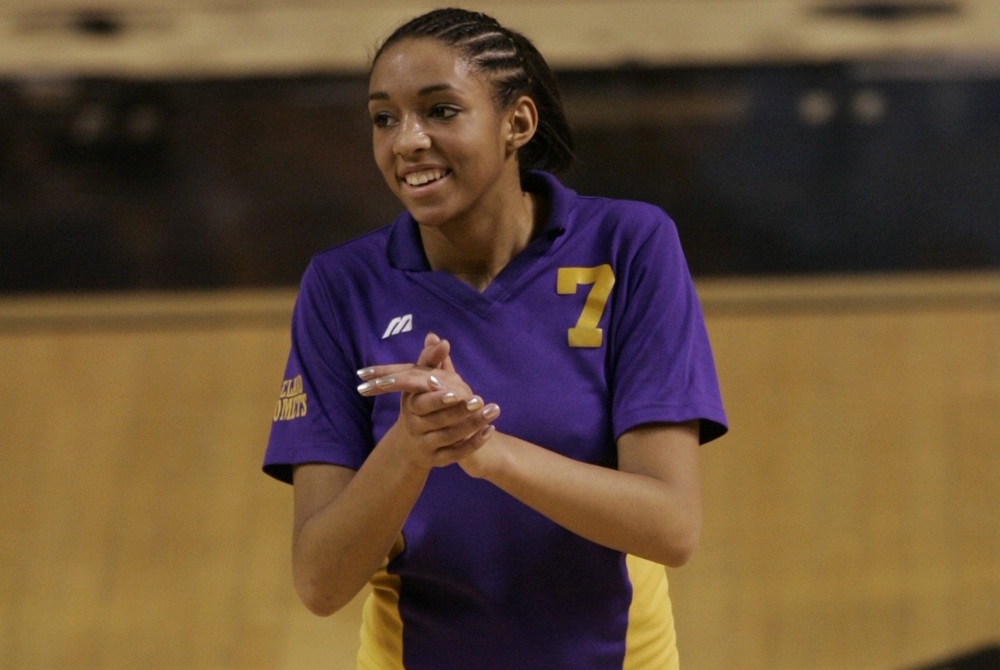
More than two decades have passed since Alisha Glass took her final swing at a volleyball in a Leland High School uniform, and yet her accomplishments for her small-town school in Northern Michigan remain among the most notable in that sport’s history not just statewide, but at the national level.
Glass, now Alisha Glass Childress – who went on to star on three Penn State national championship teams and help the U.S. national team to a bronze medal at the 2016 Olympics – will have her record-setting high school career enshrined this summer as one of 12 honorees announced today as this year’s inductees into the National High School Hall of Fame by the National Federation of State High School Associations (NFHS).
 Childress will be inducted as part of the 43rd Hall of Fame class at a ceremony during the NFHS summer meeting June 29 in Salt Lake City. The rest of the class is made up of four more athletes, three coaches, two game officials, one former state association administrator and one former fine arts educator. Childress was nominated by the Michigan High School Athletic Association.
She will become the Hall of Fame’s 11th inductee from Michigan, joining the MHSAA’s first full-time Executive Director Charles E. Forsythe (inducted 1983), River Rouge boys basketball coach Lofton Greene (1986), Warren Regina athletic director, softball and basketball coach Diane Laffey (2000), Fennville basketball and baseball standout Richie Jordan (2001), Grosse Pointe Woods University Liggett boys and girls tennis coach Bob Wood (2005), Bloomfield Hills Cranbrook hockey standout Jim Johnson (2007), Owosso football, basketball and baseball all-stater Brad Van Pelt (2011); Vermontville Maple Valley baseball national record holder Ken Beardslee (2016), retired MHSAA Executive Director John E. “Jack” Roberts (2022) and Dearborn Heights Robichaud football, basketball and track & field star Tyrone Wheatley (2024).
“My high school career at Leland, surrounded by such an amazing support system and community, was the essential first chapter of my story. It cultivated the grit and the fundamental love for the game that allowed me to reach the highest levels of athletics,” Childress said. “I’m proud of every medal and trophy, but I’m just as proud of the roots I planted back in high school that made them all possible.”
Childress graduated from Leland in 2006 with national high school career records of 3,584 kills, 680 blocks and 937 aces, and 296 aces for one season as a junior. Her aces records still stand, her career kills record stood until broken in 2024 by Shelby’s Navea Gauthier, and she remains third on the career blocks list. Glass continues to hold MHSAA records for single-season and career aces and also for her 48 kills in Leland’s 2005-06 Class D Final win over Battle Creek St. Philip. Childress also led Leland to a Class D runner-up finish in 2004-05 and the Semifinals in 2003-04. (All three tournament runs took place while girls volleyball was still played during the winter season before moving to the fall to begin the 2007-08 school year).
Childress earned the Miss Volleyball Award and Gatorade Player of the Year Award for Michigan as a senior, and her name is listed 19 times throughout the MHSAA girls volleyball record book. She also made Michigan's Class D all-state first team on the basketball court as both a junior and senior, averaging 18 points and 11 rebounds per game as a junior and 16 points, 10 rebounds and 3.7 blocked shots per game as a senior while leading her basketball team to Class D Quarterfinals both of those seasons.
“As our staff researched our first 50 years of female sports for our ‘Title IX at 50’ celebration during the 2021-22 school year, they told stories of several standouts who went on to collegiate, Olympic and professional stardom – and Alisha Glass stands out even among the greats,” MHSAA Executive Director Mark Uyl said. “Taking into account everything she accomplished individually and with her teams, and not just in volleyball but basketball as well, it’s a strong argument that Alisha Glass continues to set the bar as not only our state’s best female athlete all-time, but arguably the most accomplished volleyball player in national high school history. We are thrilled that she will be inducted into the National High School Hall of Fame.”
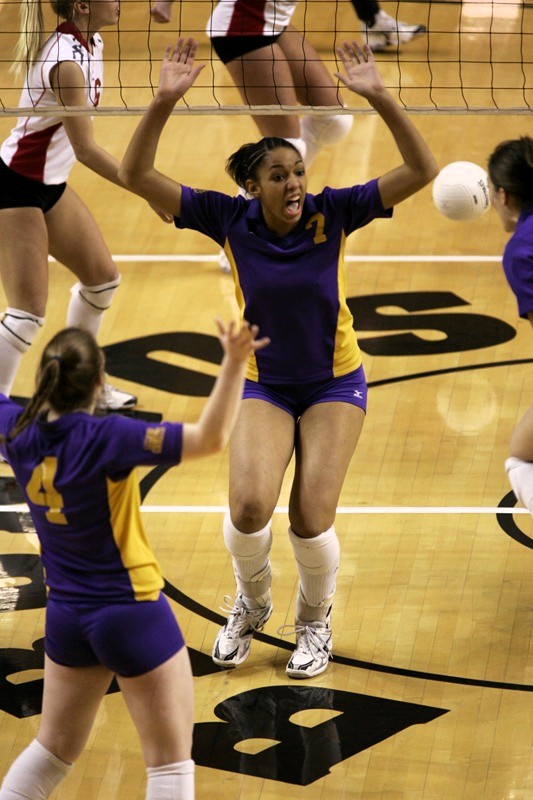 Also during high school, Childress played on the 2004 and 2005 USA youth national volleyball teams and helped the 2004 team to the North, Central America and Caribbean Volleyball Confederation (NORECA) championship, and was named Best Server at that event. After high school, she started all four seasons at national power Penn State and set the Nittany Lions to three straight NCAA championships, being named to the American Volleyball Coaches Association (AVCA) All-America first team twice and second team once.
Childress continued her career professionally and internationally, playing professionally in the United States and Puerto Rico, Italy, Turkey, Poland and Brazil and being named USA Volleyball Indoor Female Athlete of the Year for both 2013 and 2014. She led the U.S. national team to bronze at 2016 Olympics and was named Best Setter of the tournament, after being selected as an alternate for the 2012 Olympic team.
Most recently, Childress played for the Pro Volleyball Federation's Vegas Thrill in 2024 and 2025 and played in the league's first All-Star Match last season. She’s currently the head coach of the San Diego Mojo of Major League Volleyball and last summer also completed her first season as a coach with Athletes Unlimited. She previously served as an assistant coach with the Stanford University women’s volleyball program from 2019-21 – including during the team’s run to the Division I national title in 2019 – and also served as an assistant for the gold medal-winning U.S. national team during the 2018 Pan American Cup.
Childress is the daughter of Laurie Glass, who retired from coaching Leland after the 2023 season and ranks seventh in MHSAA girls volleyball coaching history for victories with a career record of 1,259-410-124. Glass led Leland to three Class D championships and five runner-up finishes. Childress’ grandfather Larry Glass ranks on the MHSAA girls basketball coaching victory list with a 388-110 record and led Leland to three straight Class D titles from 1980-82. He also coached the Northwestern University men’s basketball team for six seasons.
Additionally, Childress is married to past Stanford basketball star Josh Childress, who went on to play eight seasons in the NBA and several more overseas. They have three daughters, Maya, Mina and Amara.
The National High School Hall of Fame was started in 1982 by the NFHS. The 12 individuals were chosen after a two-level selection process involving a screening committee composed of active high school state association administrators, coaches and officials, and a final selection committee composed of coaches, former athletes, state association officials, media representatives and educational leaders. Nominations were made through NFHS member associations. Also chosen for this class were athletes Joe Carter (Oklahoma), Jordan Larson (Nebraska), Krissy Wendell-Pohl (Minnesota) and Patrick Willis (Tennessee); sport coaches Jan Barker (Texas), David Gentry (North Carolina) and Flo Valdez (New Mexico); game officials Burney Jenkins (Kentucky) and Mary Lou Thimas (Massachusetts), former state association administrator Steve Savarese (Alabama) and former fine arts educator Craig Ihnen (Iowa).
For more on this year’s Hall of Fame class, visit the NFHS Website.