


Rep Council Wrap-Up: Spring 2018
By
Geoff Kimmerly
MHSAA.com senior editor
May 14, 2018
The adoption of major changes to the Michigan High School Athletic Association transfer regulation was among notable actions taken by the Representative Council during its annual Spring Meeting, May 6-7, in Gaylord, in addition to the selection of the Association’s next executive director announced in a previous release May 8.
The Spring Meeting of the 19-member legislative body of the Association’s more than 1,400 member schools is generally the busiest of its three sessions each year. The Council considered 29 committee proposals and dealt with a variety of eligibility rule, postseason tournament and operational issues.
The revised transfer regulation will go into effect for the 2019-20 school year, based on a student-athlete’s sports participation during 2018-19. The new transfer rule will make transferring student-athletes ineligible for one year in any sport played during the previous year at the previous school – unless that student-athlete’s situation fits one of the current 15 exceptions that allow for immediate eligibility. However, the revised transfer regulation also allows that transferring student-athlete immediate eligibility in any other MHSAA-sponsored sport not participated in during that previous year at the previous school.
The additions to the transfer rule received vast support from member schools in surveys leading up to the Council’s vote.
“We are hopeful this ‘sport-specific’ transfer rule will be easier to understand, and therefore, more consistently enforced,” MHSAA Executive Director John E. “Jack” Roberts said. “This rule better addresses the changing landscape of transfers, hopefully dissuading those considering moving for athletic reasons while still allowing a full range of sports for those who do switch. It may seem like a punishment to some, but the new rule is actually more permissive for many transfer students, and we saw growing support for these changes from our schools since we began discussing this proposal a year ago.”
A number of significant actions at the Spring Meeting will affect the junior high/middle school levels, as the Council continued growing its impact among those who represent the future of educational athletics.
The Council approved Junior High/Middle School Committee recommendations to increase the number of contests and days of competition in three sports, beginning in 2018-19. Softball teams will have 12 days of competition over 13 weeks, with doubleheaders counting as one of those 12 days. Basketball teams may play 12 games over 13 weeks with one game a day allowed, except that two games may be played on a day not followed by a school day up to four times a season; each of those doubleheader days will count as one of the 12 games. Soccer teams may play 12 games over 13 weeks with one game a day allowed, except that two games may be played on a day not followed by a school day up to two times a season; each of those doubleheader days also will count as one of the 12 games.
Another committee recommendation approved by the Council will allow a middle school student-athlete to compete in two non-school events during the school season in team sports except football – making the rule for team sports at the junior high/middle school level the same as the individual sport model currently enforced.
The Council also approved of continuing to develop and expand opportunities for the MHSAA to act as a “presenting sponsor” of already-existing junior high/middle school meets, invitationals and tournaments conducted by leagues, conferences and schools around Michigan. Staff was authorized to approach MHSAA sport committees and sport coaches association to explore possible junior high/middle school area or sectional competitions in cross country, track & field, wrestling, swimming & diving and potentially other sports.
“The Representative Council continued to consider ways to better serve the youngest student-athletes in our membership – the junior high/middle school participants who are the future of high school sports,” Roberts said. “While these actions may not gain as much attention as changes at the high school level, they are just as important if not more critical to the status of educational athletics moving forward. Nurturing this youngest level must continue to be a focus in the years to come as we work to strengthen and provide more opportunities at all levels.”
The Council approved a number of recommendations by respective sport committees that will alter the tournament setup beginning this fall. In ice hockey, the Pre-Regional system of tournament assignments has been eliminated; all teams will instead be organized into traditional Regionals, 24 total with no more than eight teams assigned to each. In boys lacrosse, a game will end when an 18-goal margin is reached any time after the completion of the third quarter; the 12-goal differential that starts a running clock during the second half will continue. In soccer, beginning with the 2019 season, the first round of District games will be required to be played the week before the current District week on that Wednesday, Thursday or Friday. District Semifinals and Finals will be scheduled for the following week – but Saturday games can be used only as a weather backup during the District round.
To better assist with scheduling and provide transportation relief, the Council approved a number of adjustments to the non-traditional draw policies for District and Regional tournaments; non-traditional draws do not require all contests be played as a designated host site, assisting primarily teams that might be located far from their tournament host but closer to their opponent(s). For the 2018-19 MHSAA Basketball and Volleyball Tournaments, non-traditional draws will be mandated for Districts made up of (a) all Upper Peninsula teams, (b) a combination of Upper and Lower Peninsula teams, or (c) seven or eight-team District grouping in any location of the state. In Districts with circumstances (a) and (b), a traditional draw may be conducted if all participating teams agree to that format. At the Regional level, any that include more than one District located in the Upper Peninsula will require geographic neutral sites be used. The Council also authorized a work group to review all aspects of non-traditional draws and all affected sports and report at the Council’s Fall meeting this Nov. 30.
Additionally, the Council approved a Classification Committee recommendation to move the “opt-up” deadline for fall sports from April 15 to May 1, while keeping the dates for winter (Aug. 15) and spring sports (Oct. 15) the same.
Here is a summary of other actions taken by the Representative Council at the Spring Meeting, which will take effect during the 2018-19 school year unless noted:
Sport Matters
• In baseball, the Council approved a committee recommendation altering tournament trophies to match the tournament format previously approved to begin with the 2019 season. Starting that spring, baseball teams will play what previously were Quarterfinals as the final game of a “Super Regional” tournament, and trophies awarded to those 16 winners will read “Super Regional Champion.” Trophies awarded to losing teams in that round will read “Regional Champion” as they still will have won the Regional level of the tournament.
• In basketball, the Council approved a committee recommendation to adopt the 28-foot coaching box for competition allowed under National Federation of State High School Associations (NFHS) rules. Previously, the MHSAA allowed for a 14-foot coaches box in front of the team’s bench.
• In competitive cheer, the Council approved four committee recommendations. The first allows junior high/middle school athletes to perform an inverted exit-cradle to back walkover out only. At the high school level, any catch that originates from shoulder level or below and transitions from a vertical body position to a horizontal body position now will require only three catchers, while four catchers are still required for any catch that exceeds shoulder level. The two other recommendations affect scoring: the first will allow at the high school level a mountain climber to an unbraced OLE to receive the OLE choreography bonus, while the second will allow for all levels (grades 7-12) four difficulty points to be awarded for a ground-up to an elevator.
• In cross country and track & field, the Council approved a Committee recommendation to adopt a recommendation from the state coaches and officials associations to use a one-turn stagger for the 3,200-meter relay and open 800, 1,600 and 3,200 meter runs. This stagger will begin to be used in 2020. The Council also approved a Committee recommendation to alter the junior high/middle school meet order to closely align with the high school order; eight events will switch so that relays and similar sprints and distance runs are ordered in the same way.
• In football, the Council approved a Football Committee recommendation that the MHSAA continue for the third year to experiment with a 40-second clock for use between plays. Teams taking part in the experiment will have 40 seconds from the end of the previous play to snap the ball to begin the next, unless there is an administrative stoppage (for penalty, measurement, etc.). MHSAA schools began experimenting with the 40-second clock during the 2016 season.
• In boys lacrosse, the Council approved a Committee recommendation to allow contests with out-of-state schools from states that do not sponsor a statewide boys lacrosse tournament only as long as those opponents follow comparable regulations of other spring sport teams in that state – including practice and contest limits, use of NFHS playing rules and prohibitions on undue influence and recruiting. Member schools must receive pre-approval from the MHSAA to play these opponents.
• In skiing, the Council approved a Committee recommendation to increase the maximum number of contests from 15 to 17 while reducing the number of scrimmages allowed from four to two.
• In soccer, the Council approved a Committee recommendation to allow at the high school level, as a part of the multi-team tournament rule, teams to play two full games on a non-school day and have those two count as one of the 18 regular-season contests. Teams still have the option to play 180 minutes under the current multi-team tournament rule. The only overtime allowed would be a shootout if part of a bracket tournament.
The Council also discussed a number of topics that will require action as quickly as its Nov. 30 meeting. The Council considered options for the Girls and Boys Basketball Tournaments for the 2019-20 season; one option follows the current format of playing tournaments with a one week offset and Finals at separate sites, and a second option would have the tournaments conducted simultaneously over three weeks with Semifinals at sites around the state and all eight championship games (four for girls, four for boys) at the same arena during the same weekend.
The possible scheduling by the MHSAA of regular-season games for 8-player football teams also was discussed and may be voted upon Nov. 30.
Make-up of the MHSAA’s sport committees is an emerging topic, and the Council considered suggestions for making them more effective. The committee appointment procedure originally was adopted by the Council in 1987 and modified in 2007.
The Council also reviewed reports on membership, with 751 senior high schools and 752 junior high/middle schools in 2017-18 plus 42 elementary schools with 6th-grader participation; eligibility advancement applications, which totaled six for this school year; the use of Educational Transfer Forms, which fell eight percent this year; out-of-state practice requests, school violations, attendance at athletic director in-service workshops and Coaches Advancement Program sessions, officials’ registrations, rules meetings attendance and officials reports submitted for the past three sports seasons. The Association’s $11.6 million budget for the 2018-19 school year also was approved.
The Representative Council is the 19-member legislative body of the MHSAA. All but five are elected by member schools. Four members are appointed by the Council to facilitate representation of females and minorities, and the 19th position is occupied by the Superintendent of Public Instruction or designee.
The MHSAA is a private, not-for-profit corporation of voluntary membership by more than 1,500 public and private senior high schools and junior high/middle schools which exists to develop common rules for athletic eligibility and competition. No government funds or tax dollars support the MHSAA, which was the first such association nationally to not accept membership dues or tournament entry fees from schools. Member schools which enforce these rules are permitted to participate in MHSAA tournaments, which attract more than 1.4 million spectators each year.
'Mentor' to Receive Forsythe Award
By
Geoff Kimmerly
MHSAA.com senior editor
March 14, 2017
Long before he became superintendent for multiple Oakland County school districts, George Heitsch was a young athletic director first at Westland Huron Valley and then West Bloomfield High School.
And thankfully, there were veterans like Auburn Hills Avondale’s Chuck Nurek to show him the ropes.
“Chuck was a gracious mentor taking the time to encourage, support and, at times, direct a ‘newbie,’” wrote Heitsch in recommending Nurek for the MHSAA’s Charles E. Forsythe Award. “Chuck has a passion and dedication for the Avondale interscholastic athletic program and high school sports in general. … Chuck had dedicated his life service to not only the students in Avondale but to bettering the student-athlete experience for everyone in Michigan.”
That career of service, and especially dedication to the training and educating of athletic directors and coaches throughout Michigan, has earned Nurek this year’s MHSAA annual honor for outstanding contributions to the interscholastic athletics community.
The Charles E. Forsythe Award is in its 40th year and named after the MHSAA’s first full-time and longest-serving chief executive. Forsythe Award recipients are selected each year by the MHSAA Representative Council. Nurek will receive his honor during the break after the first quarter of the MHSAA Class A Boys Basketball Final on March 25 at the Breslin Student Events Center in East Lansing.
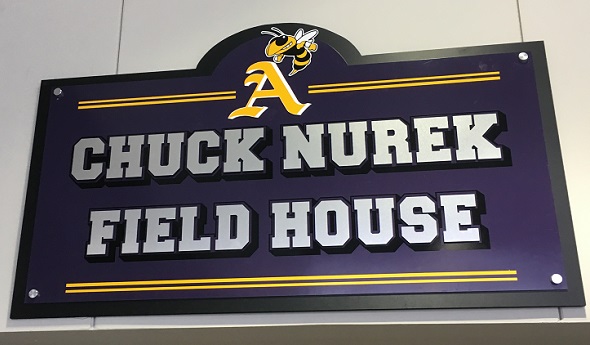
Nurek served as athletic director at Auburn Hills Avondale High School from 1978-1999 after previously serving as assistant athletic administrator beginning in 1968. In addition to his leadership at that school – Avondale named its fieldhouse after him in 2012 – Nurek also was active in county and league leadership and statewide as part of the Michigan Interscholastic Athletic Administrators Association (MIAAA).
In all three roles, Nurek helped to provide tools, training and mentoring for those charged with directing high school sports programs and teams. One of his far-reaching impacts came as a longtime member and chairperson of the MIAAA Convention Program Committee, growing and planning an event that regularly draws more than 500 athletic directors, secretaries and assistants. Nurek also served as an early steering committee member of the MHSAA coaches education program that has evolved to educate and certify thousands over the last 30 years.
“Chuck Nurek has dedicated decades to educational athletics and particularly to the training of those who in turn lead our programs in their daily pursuits,” MHSAA Executive Director John E. “Jack” Roberts said. “He has impacted multiple generations of school leaders in our state, both through his assistance in building up our coaches education and then his work in making the MIAAA conference one of the most valuable teaching tools of its kind. We’re pleased to present Chuck Nurek with the Charles E. Forsythe Award.”
Nurek coached varsity basketball, cross country and subvarsity football at points during his Avondale tenure, and also taught physical education for all but the final few years of his time as an athletic administrator.
It was during his time as athletic director that Nurek saw the need for education, both to combat heavy turnover among school athletic directors and also to provide framework for an influx of coaches who did not work fulltime in schools.
He first began in coaches education as part of a small group of athletic directors building a program for Oakland County. That group merged with another, and in 1987 Nurek contributed in the creation of what became known as the MHSAA’s Program of Athletic Coaches Education (PACE), the predecessor of the current Coaches Advancement Program (CAP).
 A frequent past speaker at MHSAA athletic director in-service programs, Nurek also served as part of an MHSAA mentoring program that paired veteran or retired athletic directors with new administrators. And he played a significant role in designing the MIAAA convention, which includes various training sessions for high school and middle school athletic directors, their assistants and secretaries while also serving as a significant source for networking and professional development.
“Just being able to work with all the great people over the years that I worked with, whether it be the leaders in Oakland County or leaders at the MIAAA,” Nurek said of his favorite memories over four decades, “and especially just the outstanding people on the conference committee, putting together one of the best conferences in the country.”
Nurek also served as part of the MIAAA’s State Sportsmanship Committee and Exemplary Athletic Programs Committee and as a representative to the 5 State Exchange Committee, chairing that group for a year.
At Avondale, Nurek co-sponsored a successful Substance Abuse Awareness Conference and organized a group of students to develop standards for sportsmanship both for the student body and the school’s parent group as well. At the league level, Nurek served as North Oakland Activities Conference president in 1980 and Metro Conference president from 1986-87, and later as president and secretary of the Macomb-Oakland Activities Conference. He also created a program to recognize academic excellence both for his league and all of Oakland County.
Nurek was named “Athletic Director of the Year” by the MIAAA for 1998-99 and his region’s award winner in 1991, and received the MIAAA’s George Lovich State Award of Merit in 2004. He also was named “Athletic Director of the Year” by the Oakland County Athletic Directors Association in 1996 and served as that body’s treasurer from 1983-99.
Nurek has been a member of the MIAAA since 1980 and National Interscholastic Athletic Administrators Association (NIAAA) since 1985. He also has been a member of the Michigan Association for Health, Physical Education, Recreation and Dance (MAHPERD) and American Alliance for Health, Physical Education, Recreation and Dance (AAHPERD).
He graduated from Avondale in 1958 and then earned his bachelor’s degree in education from Northwest Missouri State University in 1966. He also earned a master’s in education from Eastern Michigan University in 1971 and received Certified Athletic Administrator certification from the NIAAA in 1994. Nurek maintained a strong presence in the Avondale community, speaking at the district’s annual parent fairs and serving as a board member of Auburn Hills’ Boys Club for a decade. Nurek also was involved with the local Little League program for a number of years and worked as part of the Avondale football scholarship golf outing committee.
Past recipients of the Charles E. Forsythe Award
1978 - Brick Fowler, Port Huron; Paul Smarks, Warren
1979 - Earl Messner, Reed City; Howard Beatty, Saginaw
1980 - Max Carey, Freesoil
1981 - Steven Sluka, Grand Haven; Samuel Madden, Detroit
1982 - Ernest Buckholz, Mt. Clemens; T. Arthur Treloar, Petoskey
1983 - Leroy Dues, Detroit; Richard Maher, Sturgis
1984 - William Hart, Marquette; Donald Stamats, Caro
1985 - John Cotton, Farmington; Robert James, Warren
1986 - William Robinson, Detroit; Irving Soderland, Norway
1987 - Jack Streidl, Plainwell; Wayne Hellenga, Decatur
1988 - Jack Johnson, Dearborn; Alan Williams, North Adams
1989 - Walter Bazylewicz, Berkley; Dennis Kiley, Jackson
1990 - Webster Morrison, Pickford; Herbert Quade, Benton Harbor
1991 - Clifford Buckmaster, Petoskey; Donald Domke, Northville
1992 - William Maskill, Kalamazoo; Thomas G. McShannock, Muskegon
1993 - Roy A. Allen Jr., Detroit; John Duncan, Cedarville
1994 - Kermit Ambrose, Royal Oak
1995 - Bob Perry, Lowell
1996 - Charles H. Jones, Royal Oak
1997 - Michael A. Foster, Richland; Robert G. Grimes, Battle Creek
1998 - Lofton C. Greene, River Rouge; Joseph J. Todey, Essexville
1999 - Bernie Larson, Battle Creek
2000 - Blake Hagman, Kalamazoo; Jerry Cvengros, Escanaba
2001 - Norm Johnson, Bangor; George Lovich, Canton
2002 - John Fundukian, Novi
2003 - Ken Semelsberger, Port Huron
2004 - Marco Marcet, Frankenmuth
2005 - Jim Feldkamp, Troy
2006 - Dan McShannock, Midland; Dail Prucka, Monroe
2007 - Keith Eldred, Williamston; Tom Hickman, Spring Lake
2008 - Jamie Gent, Haslett; William Newkirk, Sanford-Meridian
2009 - Paul Ellinger, Cheboygan
2010 - Rudy Godefroidt, Hemlock; Mike Boyd, Waterford
2011 - Eric C. Federico, Trenton
2012 - Bill Mick, Midland
2013 - Jim Gilmore, Tecumseh; Dave Hutton, Grandville
2014 - Dan Flynn, Escanaba
2015 - Hugh Matson, Saginaw
2016 - Gary Hice, Petoskey; Gina Mazzolini, Lansing
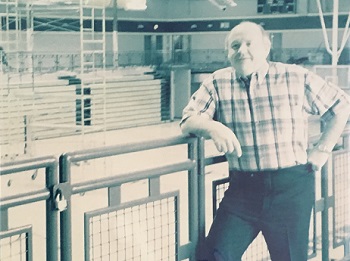
PHOTOS: (Top) A sign over the doors at Auburn Hills Avondale's gym announces the former athletic director for which it is named. (Middle) Chuck Nurek stands for a photo inside the building named after him. (Photos courtesy of Avondale High School.)