


Rep Council Wrap-up: Spring 2019
May 8, 2019
By Geoff Kimmerly
Second Half editor
The addition of seeding at the District level in basketball and soccer and multiple adjustments to the process used to select the playoff field for 11-player football were among the most notable actions taken by the Representative Council of the Michigan High School Athletic Association during its annual Spring Meeting, May 5-6 in Gaylord.
The Spring Meeting of the 19-member legislative body of the Association’s more than 1,500 member schools is generally the busiest of its three sessions each year. The Council considered 26 committee proposals and dealt with a variety of eligibility rule, postseason tournament and operational issues.
Beginning with the 2019-20 school year, girls and boys basketball and soccer will employ a seeding process to place the top two teams in every District on opposite sides of that bracket, guaranteeing those two teams could not play each other before the District championship game.
The two teams to be seeded in each District will be determined using a Michigan Power Ratings computer formula based on regular-season results against other MHSAA Tournament-eligible teams and opponents’ strength of schedule. (Games against out-of-state or non-MHSAA opponents will not count in the MPR formula.) The MHSAA will draw all brackets two weeks before the start of District play. After the top seeds are determined and separated to opposite sides of the bracket, the draw process will place the remaining teams on the bracket based on a randomly-selected order determined earlier in the season. However, the draw process does not guarantee the seeded teams will receive byes or serve as home teams.
The MPR is being used this spring to seed the Boys Lacrosse Tournament. Separate seeding proposals were recommended to the Council by the MHSAA committees for both soccer and basketball.
The changes to the 11-Player Football Playoffs selection process were proposed by the MHSAA Football Committee and are designed to reward teams that play more successful opponents. Beginning with the 2020 season, eight divisions will be determined before the season, and 32 playoff qualifiers from each division will be selected at the end of the regular season based on playoff-point average – there no longer will be automatic qualification based on win total. The adjusted playoff points formula will award bonus points for all opponents’ wins, regardless of whether the team beat or lost to those opponents. Currently bonus points are awarded only if the team defeated an opponent. More points also are awarded for defeating teams from larger divisions. The Football Committee proposed these changes believing the bonus points received for a “good loss” – combined with the elimination of automatic qualifiers – will be enough incentive for teams to schedule more successful opponents, easing the annual difficulty in football scheduling and taking away arguably the most cited reason for the breakup of leagues and conferences.
Also on recommendation by the Football Committee, the Council approved an enrollment limit of 215 students for teams to be eligible for the MHSAA 8-Player Playoffs. This too will take effect for the 2020 season. Currently, a school must be Class D to be eligible for the postseason, or in a one-year grace period if it grew larger than Class D for the current school year. While the Class D enrollment line changes annually, the 8-player line of 215 students will remain static year to year. The grace period also will remain for schools that might receive a one-year enrollment bump before falling back below 215 students.
The Council also approved a committee recommendation to add limited video review of scoring plays or potential scoring plays, or of turnovers or potential turnovers at MHSAA Football Finals for both the 11 and 8-player formats. This process will be available at Finals only because of the availability of camera coverage provided by broadcasts of those highest-level games of the tournament. Although all scoring and turnover plays could be reviewed, a play will be reversed only when there is indisputable video evidence showing the original call was incorrect.
Continuing its focus on safety in football, the Council also approved a committee recommendation to adopt revised definitions and limits on contact allowed during preseason practices and practices after games have begun. Beginning with this 2019 football season, teams will be allowed no more than six hours of full-pads collision contact per week during the preseason and no more than 30 minutes of collision contact during a week of in-season (after games begin) practice. “Collision” is defined as contact at game speed, with the execution of full tackles at a competitive pace, taking players to the ground.
However, while “collision” contact will be limited, “thud” contact will be unlimited. “Thud” is defined as full speed but above the waist only, with no player taken to the ground and no winner or loser. Thud contact is not considered collision contact. The revised definitions of “collision” and “thud” and related time limitations are products of collaboration between the MHSAA, Michigan High School Football Coaches Association and Practice Like Pros, a national movement dedicated to safety in high school football. The recommendation was brought to the Football Committee by leadership of the Michigan High School Football Coaches Association and further defines the degree and amount of practice contact following similar practice safety changes approved by the Council for football in 2014 and 2017.
The new sport-specific transfer rule will take effect with the 2019-20 school year, and the Council approved a series of corresponding changes. Most notably, the Council approved a change to the athletic-related (links) rule to not grant immediate eligibility with a residential change if a student follows a coach from his or her former school to a school where the coach has been newly hired. The Council also approved a sport-specific penalty for the athletic-motivated transfer rule so that a student would not be eligible during the current school year in the sport played the previous school year if that student was confirmed to have made an athletic-motivated transfer.
The Council additionally approved clarifications under the sport-specific transfer rule for multi-school districts which have schools that are both geographical boundary schools and schools which are district-wide, for students transferring to nonpublic or charter schools and for students who have taken part in international student exchange programs and chosen to stay in Michigan.
To provide consistency for officials’ jurisdiction across all sports, the Council approved the addition of wording that allows an official to disqualify a student or coach following the conclusion of a contest – but before the official has left the facility and/or grounds – if that student or coach commits an offense worthy of ejection and disqualification against the official. (Example: A player or coach verbally berates an official while following that official to his or her vehicle.) This penalty also would include the next-day-of-competition suspension. This does not apply if the official has remained at the facility and encounters the offense while as a spectator for another event.
Here is a summary of other notable actions taken by the Representative Council at the Spring Meeting, which will take effect during the 2019-20 school year unless noted:
Regulations
• The Council approved an increase from $25 to $40 as the maximum value for any award (trophies, medals, plaques, etc.) that an athlete may receive for participation in an athletic event without conflicting his or her amateur status.
Sport Matters
• In track & field, the Council approved a Cross County/Track & Field Committee recommendation to allow Upper Peninsula and Lower Peninsula Regional competitions to be conducted on Thursdays, in addition to the current Fridays and Saturdays, to provide for more flexibility for tournament hosts and participants when up against other school activities and college entrance exam testing dates.
• Also in track & field, the Council approved a recommendation to allow for use of a double waterfall mark and step-up start in the 800, 1,600 and 3,200 meters, beginning in 2020 when those events will begin employing a one-turn stagger.
• In golf, a committee recommendation was approved allowing golfers to use cell phones during play in four circumstances – to call a coach or tournament administrator for a health and safety issue, for use in inputting scores for live scoring or other scoring applications, to contact a rules official with questions, and for use as a distance-measuring device.
• The Council approved a Golf Committee recommendation setting the maximum allowable score at 12 strokes per hole, in part to help improve pace of play.
• The Council also approved a Golf Committee recommendation to allow for a Lower Peninsula Regional to be played any day, Monday through Saturday, during the week reserved for that round of the tournament. Similar to track & field, this allowance was made to increase scheduling flexibility.
• In girls competitive cheer, the Council approved a committee recommendation allowing for non-braced static inversions at the high school level only with the following stipulations: the original base or spotter maintains constant contact with the flyer, prior to the static inverted position the flyer must originate from below shoulder level, and the inversion must dismount to the cheering surface, cradle, any waist-level position or a non-inverted stunt at shoulder level. Also, twists from inversions and inversions released to extended level are illegal.
• The Council also approved a recommendation to allow for the review and possible restructuring of the girls competitive cheer format as early as the 2020-21 season, keeping athlete safety and efforts to increase participation as the primary focuses.
• In girls gymnastics, the Council approved a committee recommendation solidifying language stating that when four judges are contracted for a meet in which two events are conducted simultaneously, a total of 28 gymnasts may compete per event in a double-dual or quad meet, with up to 14 per school per event (for schools with A and B teams).
• In boys lacrosse, the Council approved a committee recommendation allowing for a multi-team tournament option of playing two full games (four 12-minute quarters) with a possible four-minute sudden-victory overtime period, instead of three running-time games (25-minute halves) with no overtimes allowed.
• In soccer, the Council approved a recommendation to allow for multi-team tournaments to be played not only on non-school days, but on days not followed by a school day.
• The Council also approved a committee recommendation in soccer removing a rule that previously required District and Regional Finals to begin after 5 p.m. on SAT and ACT national testing days.
• In diving, the Council approved a Swimming & Diving Committee recommendation requiring divers who enter MHSAA Qualifying Meets to provide a name of a designated MHSAA-certified coach to serve on the judging panel. After volunteers are accepted from the list, a random draw of those designated coaches will fill out the rest of the seven-judge panel.
• In tennis, the Council approved two committee recommendations regarding MHSAA Tournament play. The first requires any lineup substitution be made before the end of the last scheduled coaches meeting prior to play to allow for the automatic redrawing of a bracket if a seeded player is unable to play. The Council also approved the allowance of three coaches on the first day of MHSAA Finals, when play often takes place at many courts and at multiple sites. In the case of multiple sites, an additional coach may be added for each site (all coaches must continue to meet MHSAA coaching requirements). On the second day of the Finals, only two coaches are allowed.
• Additionally in tennis, the Council approved a committee recommendation allowing coaches who are on-court for coaching purposes during matches to text coaches or players not engaged in matches, as long as it is not disruptive to play. The Council also approved a committee recommendation allowing coaches at the subvarsity and middle school levels to offer coaching at any time during a match as long as the coach remains off court and does not disrupt the flow of play.
In an effort to increase recruitment of young officials, the Council approved a staff proposal to expand the Student Officials Legacy Program to include freshman and sophomore students at least 14 years of age. These underclassmen will be allowed to officiate with a mentor official at the junior high/middle school level only.
The Council also discussed various other topics, including work by the Multi-Sport Task Force toward a possible awards program and the MHSAA’s growing efforts as a presenting sponsor at junior high/middle school events and at high school events that have ties to MHSAA member schools but are not MHSAA-sponsored sports (that is by competition rules, governance, etc.).
The Council also reviewed reports on membership, with 750 senior high schools and 810 junior high/middle schools in 2018-19 plus 56 elementary schools with 6th-grader participation; cooperative programs, with 313 programs for 552 teams during 2018-19; eligibility advancement applications, which totaled three for this school year; the use of Educational Transfer Forms, out-of-state practice requests, school violations, attendance at athletic director in-service workshops and Coaches Advancement Program sessions, officials’ registrations, rules meetings attendance and officials reports submitted for the past three sports seasons. The Association’s $11.9 million budget for the 2019-20 school year also was approved.
The Representative Council is the 19-member legislative body of the MHSAA. All but five are elected by member schools. Four members are appointed by the Council to facilitate representation of females and minorities, and the 19th position is occupied by the Superintendent of Public Instruction or designee.
The MHSAA is a private, not-for-profit corporation of voluntary membership by more than 1,500 public and private senior high schools and junior high/middle schools which exists to develop common rules for athletic eligibility and competition. No government funds or tax dollars support the MHSAA, which was the first such association nationally to not accept membership dues or tournament entry fees from schools. Member schools which enforce these rules are permitted to participate in MHSAA tournaments, which attract more than 1.4 million spectators each year.
Leland's Glass Childress Selected as 11th Michigan Inductee Into NFHS Hall of Fame
By
Geoff Kimmerly
MHSAA.com senior editor
March 9, 2026
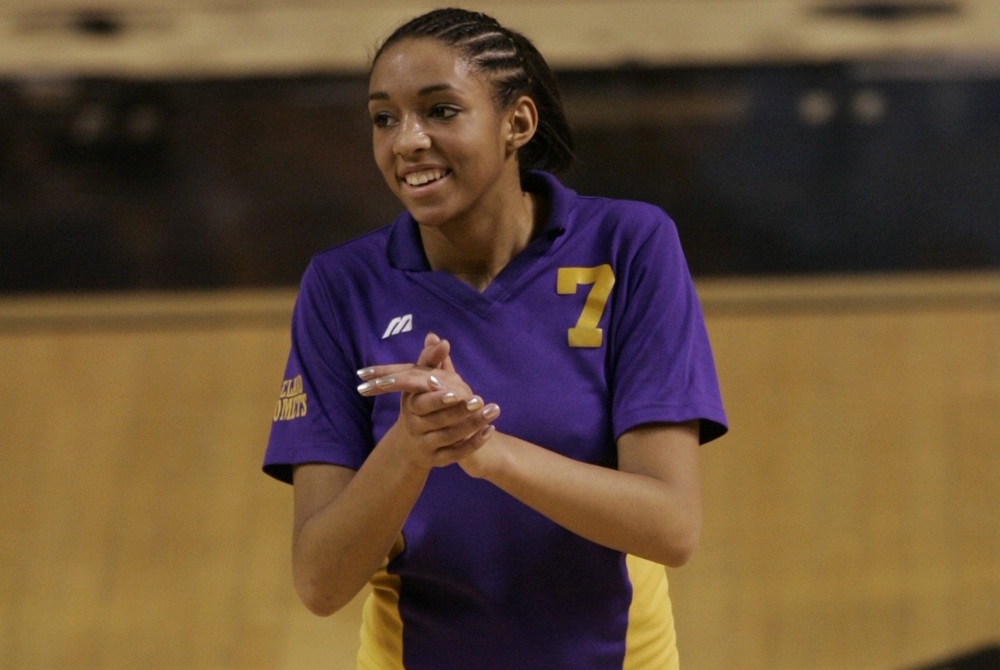
More than two decades have passed since Alisha Glass took her final swing at a volleyball in a Leland High School uniform, and yet her accomplishments for her small-town school in Northern Michigan remain among the most notable in that sport’s history not just statewide, but at the national level.
Glass, now Alisha Glass Childress – who went on to star on three Penn State national championship teams and help the U.S. national team to a bronze medal at the 2016 Olympics – will have her record-setting high school career enshrined this summer as one of 12 honorees announced today as this year’s inductees into the National High School Hall of Fame by the National Federation of State High School Associations (NFHS).
 Childress will be inducted as part of the 43rd Hall of Fame class at a ceremony during the NFHS summer meeting June 29 in Salt Lake City. The rest of the class is made up of four more athletes, three coaches, two game officials, one former state association administrator and one former fine arts educator. Childress was nominated by the Michigan High School Athletic Association.
She will become the Hall of Fame’s 11th inductee from Michigan, joining the MHSAA’s first full-time Executive Director Charles E. Forsythe (inducted 1983), River Rouge boys basketball coach Lofton Greene (1986), Warren Regina athletic director, softball and basketball coach Diane Laffey (2000), Fennville basketball and baseball standout Richie Jordan (2001), Grosse Pointe Woods University Liggett boys and girls tennis coach Bob Wood (2005), Bloomfield Hills Cranbrook hockey standout Jim Johnson (2007), Owosso football, basketball and baseball all-stater Brad Van Pelt (2011); Vermontville Maple Valley baseball national record holder Ken Beardslee (2016), retired MHSAA Executive Director John E. “Jack” Roberts (2022) and Dearborn Heights Robichaud football, basketball and track & field star Tyrone Wheatley (2024).
“My high school career at Leland, surrounded by such an amazing support system and community, was the essential first chapter of my story. It cultivated the grit and the fundamental love for the game that allowed me to reach the highest levels of athletics,” Childress said. “I’m proud of every medal and trophy, but I’m just as proud of the roots I planted back in high school that made them all possible.”
Childress graduated from Leland in 2006 with national high school career records of 3,584 kills, 680 blocks and 937 aces, and 296 aces for one season as a junior. Her aces records still stand, her career kills record stood until broken in 2024 by Shelby’s Navea Gauthier, and she remains third on the career blocks list. Glass continues to hold MHSAA records for single-season and career aces and also for her 48 kills in Leland’s 2005-06 Class D Final win over Battle Creek St. Philip. Childress also led Leland to a Class D runner-up finish in 2004-05 and the Semifinals in 2003-04. (All three tournament runs took place while girls volleyball was still played during the winter season before moving to the fall to begin the 2007-08 school year).
Childress earned the Miss Volleyball Award and Gatorade Player of the Year Award for Michigan as a senior, and her name is listed 19 times throughout the MHSAA girls volleyball record book. She also made Michigan's Class D all-state first team on the basketball court as both a junior and senior, averaging 18 points and 11 rebounds per game as a junior and 16 points, 10 rebounds and 3.7 blocked shots per game as a senior while leading her basketball team to Class D Quarterfinals both of those seasons.
“As our staff researched our first 50 years of female sports for our ‘Title IX at 50’ celebration during the 2021-22 school year, they told stories of several standouts who went on to collegiate, Olympic and professional stardom – and Alisha Glass stands out even among the greats,” MHSAA Executive Director Mark Uyl said. “Taking into account everything she accomplished individually and with her teams, and not just in volleyball but basketball as well, it’s a strong argument that Alisha Glass continues to set the bar as not only our state’s best female athlete all-time, but arguably the most accomplished volleyball player in national high school history. We are thrilled that she will be inducted into the National High School Hall of Fame.”
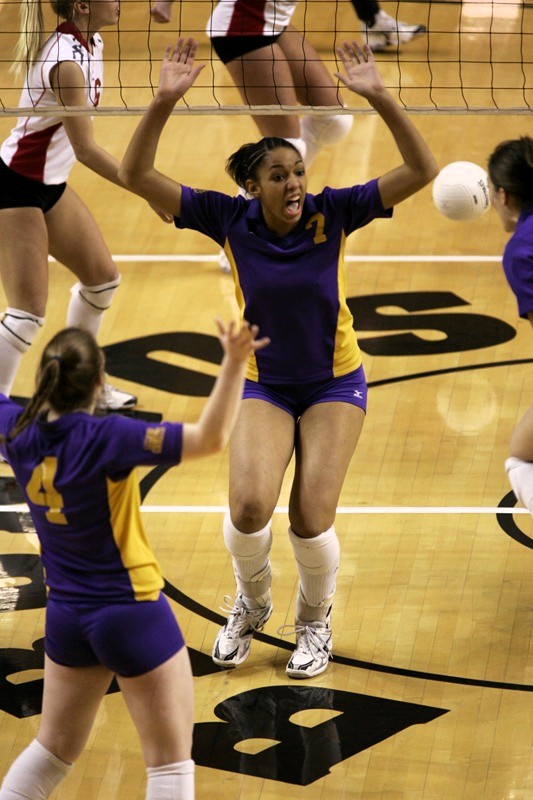 Also during high school, Childress played on the 2004 and 2005 USA youth national volleyball teams and helped the 2004 team to the North, Central America and Caribbean Volleyball Confederation (NORECA) championship, and was named Best Server at that event. After high school, she started all four seasons at national power Penn State and set the Nittany Lions to three straight NCAA championships, being named to the American Volleyball Coaches Association (AVCA) All-America first team twice and second team once.
Childress continued her career professionally and internationally, playing professionally in the United States and Puerto Rico, Italy, Turkey, Poland and Brazil and being named USA Volleyball Indoor Female Athlete of the Year for both 2013 and 2014. She led the U.S. national team to bronze at 2016 Olympics and was named Best Setter of the tournament, after being selected as an alternate for the 2012 Olympic team.
Most recently, Childress played for the Pro Volleyball Federation's Vegas Thrill in 2024 and 2025 and played in the league's first All-Star Match last season. She’s currently the head coach of the San Diego Mojo of Major League Volleyball and last summer also completed her first season as a coach with Athletes Unlimited. She previously served as an assistant coach with the Stanford University women’s volleyball program from 2019-21 – including during the team’s run to the Division I national title in 2019 – and also served as an assistant for the gold medal-winning U.S. national team during the 2018 Pan American Cup.
Childress is the daughter of Laurie Glass, who retired from coaching Leland after the 2023 season and ranks seventh in MHSAA girls volleyball coaching history for victories with a career record of 1,259-410-124. Glass led Leland to three Class D championships and five runner-up finishes. Childress’ grandfather Larry Glass ranks on the MHSAA girls basketball coaching victory list with a 388-110 record and led Leland to three straight Class D titles from 1980-82. He also coached the Northwestern University men’s basketball team for six seasons.
Additionally, Childress is married to past Stanford basketball star Josh Childress, who went on to play eight seasons in the NBA and several more overseas. They have three daughters, Maya, Mina and Amara.
The National High School Hall of Fame was started in 1982 by the NFHS. The 12 individuals were chosen after a two-level selection process involving a screening committee composed of active high school state association administrators, coaches and officials, and a final selection committee composed of coaches, former athletes, state association officials, media representatives and educational leaders. Nominations were made through NFHS member associations. Also chosen for this class were athletes Joe Carter (Oklahoma), Jordan Larson (Nebraska), Krissy Wendell-Pohl (Minnesota) and Patrick Willis (Tennessee); sport coaches Jan Barker (Texas), David Gentry (North Carolina) and Flo Valdez (New Mexico); game officials Burney Jenkins (Kentucky) and Mary Lou Thimas (Massachusetts), former state association administrator Steve Savarese (Alabama) and former fine arts educator Craig Ihnen (Iowa).
For more on this year’s Hall of Fame class, visit the NFHS Website.