


Rep Council Wrap-up: Spring 2020
May 8, 2020
By Geoff Kimmerly
Second Half editor
The addition of seeding at the Regional level in ice hockey and adjustments to provide byes for top-seeded teams in basketball and soccer were among the most notable actions taken by the Representative Council of the Michigan High School Athletic Association during its annual Spring Meeting on May 4.
The Spring Meeting of the 19-member legislative body of the Association’s more than 1,500 member schools is generally the busiest of its three sessions each year. The Council considered 32 committee proposals and dealt with a variety of eligibility rule, postseason tournament and operational issues. As with the Council’s Winter Meeting in March, the Spring Meeting was conducted remotely to keep with social distancing required by the COVID-19 pandemic.
Beginning with the 2020-21 school year, ice hockey will employ a seeding process to place the top two teams in every Regional on opposite sides of that bracket, guaranteeing those two teams could not play each other before the Regional championship game. The two teams are to be seeded in each Regional using the Michigan Power Rating computer formula based on regular-season results against other MHSAA Tournament-eligible teams and opponents’ strength of schedule, the same system used in basketball and soccer and as one of multiple methods to seed in boys lacrosse. (Games against out-of-state or non-MHSAA opponents do not count in the MPR formula.) The MHSAA will draw all ice hockey brackets 15 days before the start of Regional play. The addition of hockey seeding was proposed by the MHSAA Hockey Committee.
The Council also adopted a change to seeding to take affect for hockey, basketball and soccer to provide any existing byes to the #1, and then #2 seed, in that order, if multiple byes are part of a bracket. The draw process then will continue to place the remaining teams on the bracket based on a randomly-selected order determined earlier in the season.
Similar rules changes in football and basketball approved by the Council and recommended by the MHSAA committees for those respective sports aim to create more opportunities, especially for programs struggling to field teams at multiple levels. In football, while an athlete may still play only four quarters in one day, that athlete may play in up to five quarters per week. In basketball, an athlete may compete in up to five quarters per day, during no more than three dates per week and 20 dates per team or individual. Both changes will allow athletes to contribute to both varsity and subvarsity teams simultaneously, potentially bolstering numbers and opportunities to retain those squads.
The Council also took action on a number of MHSAA Handbook regulations requiring adjustment because of the COVID-19 pandemic and disruption it has caused to Michigan high school athletics. Notably, the Council voted to waive the 2020-21 pre-participation physical exam requirement for athletes who received one during the 2019-20 school year, although they are still required to fill out and sign the MHSAA Annual Sports Health Questionnaire. The Council also authorized schools to make decisions on multiple summer matters, including an opportunity for athletic directors to request a waiver from the MHSAA to wear school competition uniforms during events that are school-sponsored and designed to recognize graduating 12th-graders. Additionally, the Council voted to give schools the opportunity to waive the annually-required week-long period of no summer activity, if they choose to do so.
Here is a summary of other notable actions taken by the Representative Council at the Spring Meeting, which will take effect during the 2020-21 school year unless noted. Additionally, three sport changes were approved by the Council during its Winter meeting in March and not yet publicized; those too are noted below.
Regulations
• The Council approved a change allowing teams in sports governed by MHSAA summer competition limits – basketball, football, ice hockey, lacrosse, soccer and girls volleyball – to participate against all opponents present at out-of-state summer events. MHSAA member schools must continue to abide by the MHSAA travel limit – traveling only to events that are hosted either in bordering states/provinces (Illinois, Indiana, Ohio, Ontario and Wisconsin) or within 300 miles one way. MHSAA member schools now may participate at those events against out-of-state teams that exceed the travel limit by traveling more than 300 miles to the event site.
Sport Matters
• In baseball, the Council approved a Baseball Committee recommendation to adopt a suspended-game policy stating that any game called before it reaches regulation, or when the score is tied, is suspended with play to pick up at a later time from that point. However, if both schools agree, a game called prior to regulation may be replayed in its entirety.
• Also in baseball, during its Winter meeting, the Council approved a Baseball Committee recommendation renaming the “Super Regional” level of the MHSAA Tournament as the “Quarterfinal” level – with trophies and medals to be presented to both Regional champions after the day’s Regional Finals are completed and before the day’s Quarterfinal matching up those two teams. The Council also adopted at the Winter meeting a tournament schedule that during even-numbered years will see Semifinals for Divisions 2 and 4 played on Thursday and Divisions 1 and 3 on Friday. The Semifinal schedule will flip during odd-numbered years.
• The Council approved a series of Girls Competitive Cheer Committee recommendations. High school athletes now are allowed to transition to stunts or loads from the flatback position. Also at the high school level, bases will be allowed to rotate or move while a flyer is in the inverted position (in a static inversion), and to provide for the allowance of additional flairs at the point of static inversion.
• Also in cheer, the Council approved a Committee recommendation requiring three safety judges (instead of two) and five panel judges at MHSAA Regional events.
• In football, the Council approved a Football Committee recommendation extending the running clock when a team leads its opponent by 50 points to both the first and second halves of a game; the 50-point running clock stops only for player injuries and previously was employed only during the second half. The 35-point running clock employed during the second half, with stoppages also for penalty enforcement, scoring plays and called timeouts, will remain in effect if the differential dips below 50 and until it reaches 50 points again.
• Also in football, the Council approved a Committee recommendation allowing schools 15 summer dates of non-mandatory contact with an unlimited number of players (wearing helmets only). Schools may use these dates as they see fit, but of these 15 only seven dates may be used for 7-on-7 competition against other teams. This also eliminates the previous allowance for a camp.
• The Council approved another change in hockey to improve safety, adopting a Hockey Committee recommendation requiring all members of a coaching staff to wear HECC-certified helmets while on the ice for practices or games.
• In alpine skiing, the Council approved a Ski Committee recommendation that will allow athletes who qualify for an MHSAA Final in one discipline (giant slalom or slalom) during Regional racing to compete in both disciplines at the Finals level.
• In soccer, the Council approved a recommendation from the Soccer Committee to allow girls soccer athletes to compete in scrimmages at a maximum of two college ID camps during the spring girls soccer season, when these ID events generally take place.
• A pair of changes were adopted for swimming & diving, one affecting each group of athletes. The Council approved a Swimming & Diving Committee recommendation allowing swimmers to wear caps reading “State Team” during both regular-season and postseason competition. For diving, the Council approved a Committee recommendation to designate the number of qualifiers from each Lower Peninsula Regional to be in proportion to the number of entries at those respective Regionals in each division. This will allow Regionals with larger numbers of participants to contribute more Finals qualifiers, while eliminating the possibility that a Regional could send all entrants to the Finals regardless of performance because only 12 participate at that site. Each division will continue to advance 36 divers total to the MHSAA Finals.
• In tennis, the Council approved a Tennis Committee recommendation to play the MHSAA Final two-day tournament on Friday and Saturday unless there is a conflict with the host facility. In that case, that specific Final would be scheduled for Thursday and Friday.
• During its Winter meeting, the Council approved a Classification Committee recommendation that adds girls and boys tennis to the group of sports that schools may play as cooperative programs – with Executive Committee approval – if their combined enrollments do not exceed 3,500 students. The Council will reexamine this allowance after its first two years.
Junior High/Middle Schools
• The Council approved a Junior High/Middle School Committee recommendation to conduct MHSAA-sponsored cross country Regional meets for junior high/middle school athletes at eight sites across the state, based on “zones” currently designated by the MHSAA. These Regional meets will begin with the 2021-22 school year.
• The Council also approved a Girls Competitive Cheer Committee recommendation to allow junior high/middle school teams to participate in three competitions per week (instead of two) as long as one of the three is conducted on a non-school day or a day not followed by school.
Officials
• The Council approved a series of recommendations from the Officials Review Committee. Of particular note, coaches and athletes ejected from competition now are required to complete an online sportsmanship course from the National Federation of State High School Associations (NFHS) before returning to competition.
The Council also discussed various other topics, including possibilities for presentation during this fall’s Update Meeting statewide tour, and took action to clarify Handbook language regarding a few eligibility scenarios. The Association’s $11.5 million budget for the 2020-21 school year also was approved.
The Representative Council is the 19-member legislative body of the MHSAA. All but five are elected by member schools. Four members are appointed by the Council to facilitate representation of females and minorities, and the 19th position is occupied by the Superintendent of Public Instruction or designee.
The MHSAA is a private, not-for-profit corporation of voluntary membership by more than 1,500 public and private senior high schools and junior high/middle schools which exists to develop common rules for athletic eligibility and competition. No government funds or tax dollars support the MHSAA, which was the first such association nationally to not accept membership dues or tournament entry fees from schools. Member schools which enforce these rules are permitted to participate in MHSAA tournaments, which attract more than 1.4 million spectators each year.
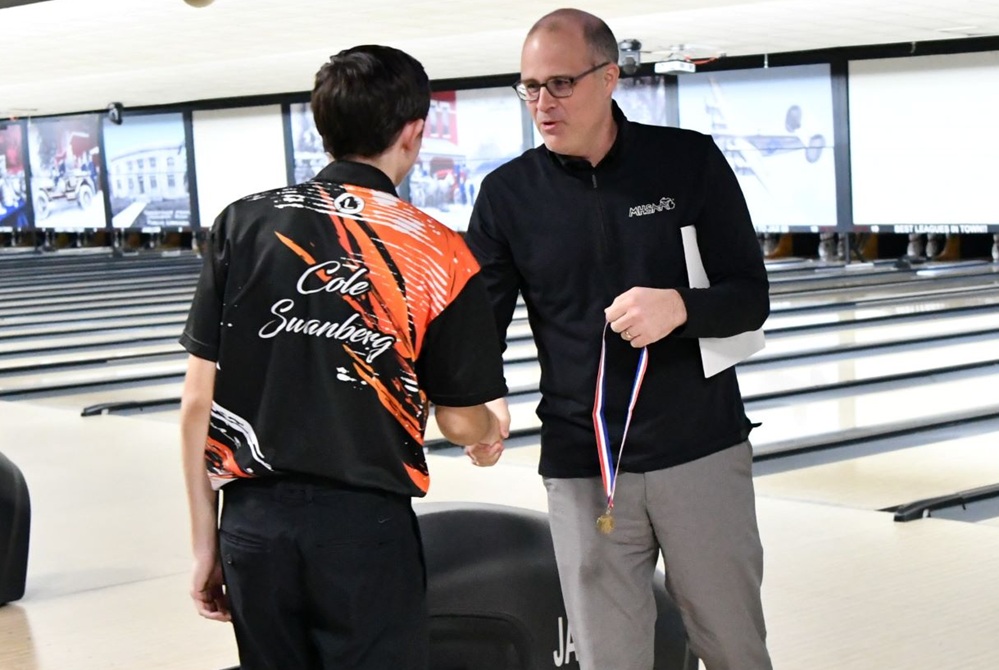
MHSAA Senior Assistant Director Frushour to Receive NFHS Citation
By
Geoff Kimmerly
MHSAA.com senior editor
January 23, 2026
Andy Frushour, a senior assistant director for the Michigan High School Athletic Association, is one of eight high school association leaders who has been selected to receive a Citation from the National Federation of State High School Associations (NFHS) during this summer’s annual meeting.
The Citation is one of the NFHS’ highest honors and recognizes recipients for their contributions to the NFHS, state high school associations, athletic director and coaching professions, the officiating avocation and fine arts/performing arts programs.
Frushour is in his 25th year at the MHSAA and currently directs the association’s efforts in marketing, girls and boys soccer, and student services. His tenure has been most notably defined by his leadership in making the MHSAA a national trendsetter in digital initiatives and communication, and he has spearheaded several pioneering efforts to bring student voices into decisions affecting their activities.
After beginning his tenure in the communications department, Frushour created the MHSAA’s marketing and brand team – which remains unique among state associations and aims to tell the story of school sports. The team tackles everything from media communications, sports information, website content and social media to ticketing, corporate sales and merchandise. As part of his digital branding contributions, Frushour has served as the lead contributor on every website redesign since 1999, created the Michigan Power Rating (MPR) formula now used for seeding in eight MHSAA Tournament sports, and led Michigan’s efforts to exclusively use digital tickets for postseason events.
“Sometimes the most valuable player on a baseball team is the utility player – somebody who plays but also excels at a number of different positions. For the last 25 years, Andy clearly has done that – from student leadership, to running a sport, to branding, to business decisions,” MHSAA Executive Director Mark Uyl said. “He’s someone who is competent, respected and has become a huge part of MHSAA history during his 25 years with us.”
Frushour also has steered the MHSAA to adopt a more prominent focus on students through the creation of several popular programs, including the Student Advisory Council, a series of annual interactive sportsmanship summits and captains clinics, and the Battle of the Fans student section competition. Building off that work, he has developed and created four free NFHS Learn courses geared toward team captains.
Frushour also has served on NFHS committees for soccer, student services, summer meeting and strategic planning, and spoken at several summer meetings and one NFHS winter meeting, and at the National Athletic Directors Conference.
After graduating in 1995 from Mason High School (Mich.) – where he played baseball and golf – Frushour attended Hope College, where he majored in business administration and minored in communications, graduating in 1999. He received an MBA in sports business from Arizona State in 2003.