

Sailor Nation Works Together to Save Life
December 12, 2019
By Tom Kendra
Special for Second Half
Bob Mirkle calls it a miracle that he’s still alive.
 The 74-year-old Norton Shores resident had a brush with death Oct. 18 in front of 7,000 fans packed into Sailor Stadium for the blockbuster Muskegon at Mona Shores football game.
Just as the huge crowd stood for the national anthem, Mirkle was slumping back onto the bleachers from cardiac arrest, later identified as the failure of a heart stent which had been implanted 18 years ago.
“Something’s wrong with grandpa!” screamed his grandson, causing a ruckus in the Mona Shores reserved section, about 10 rows below the press box.
What transpired over the next 30 minutes was an incredible performance by the Mona Shores fans, coaches, media and entire community to save Mirkle’s life. It was a textbook reaction which was lauded by Norton Shores public safety officials – and the Mirkle family.
“We live in a great community,” said Cheryl Mirkle, Bob’s wife, who stayed home that night to babysit two of her grandchildren. “In a lot of other places, he wouldn’t have made it. We were told that 1 out of 9 people who have that situation happen don’t make it. So we believe it was nothing short of a miracle.”
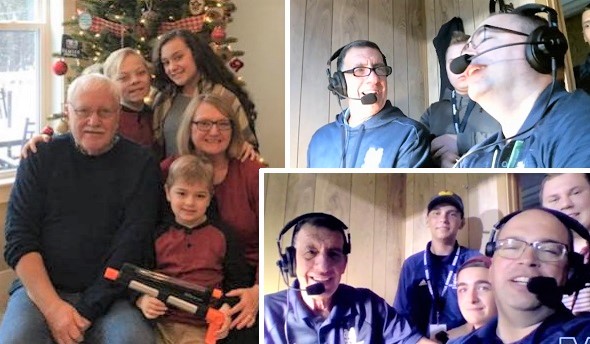
The immediate family surrounding Mirkle – many of whom were at the game to support Shores starting junior linebacker Karsen Marihugh, Bob’s great-nephew, and two other family members who are cheerleaders – helped clear a small area in the packed stands and get Mirkle down flat on his back.
A woman sitting four rows back, who was well trained in cardio-pulmonary resuscitation, was able to clear Mirkle’s airway and immediately start chest compressions.
Mark Konecny, a Mona Shores assistant coach and part-time Norton Shores fireman, recognized what was going on and grabbed the automated external defibrillator (AED) on the sidelines and headed up into the stands. Konecny, who was an all-state quarterback for Shores in 1980 and went on to play two years in the NFL with Miami and Philadelphia, was able to connect the defibrillator and shock Mirkle’s heart back into action.
 Joe Kinnucan, who was in the press box about to go on the air with a Sailor Nation Sports Network broadcast of the game, threw down his headset and made a beeline for Mirkle, leaving his son Noah to make his unplanned broadcasting debut.
“There was no second thought,” explained Kinnucan, whose full-time job is Deputy Fire Chief for the Norton Shores Fire Department. “You ask any first responder who is truly vested in their work, and they will tell you that they are always on call. I was just happy to be able to help out.”
The huge crowd and both teams, who were wired for one of the state’s biggest regular-season prep football games of the year, briefly put aside the intense rivalry and went dead quiet out of respect. Shores public address announcer Dan Vandermyde even asked those in attendance to say a prayer as Mirkle was carried underneath the bleachers, where Konecny and Kinnucan and others continued working on him as the game began.
Cheryl Mirkle, meanwhile, who was at home and receiving cryptic, panicked phone calls and texts from friends and family, believed that her husband had died. That is until she got a call from her niece, screaming: “He’s breathing! He’s alive!”
Cheryl first saw her husband at Mercy Hospital in Muskegon where, like a true fan, the first words out of his mouth were: “What’s the score?”
The score of that night’s game was surprisingly one-sided: Muskegon 53, Mona Shores 0. Since that shocking night, both Mirkle and the Sailors have been on the recovery trail.
Mirkle underwent heart bypass surgery Oct. 23, five days after the game, and ended up spending 11 days in the hospital. He is back home and even mowed the lawn one day, and will start his therapy sessions this week.
“I’m doing great,” said Mirkle, a retired truck driver and devout fisherman. “I’m getting better and getting ready to start going to therapy. My story has a happy ending.”
As Mirkle was recovering, the Sailors and Big Reds were putting together long playoff runs, with both culminating Thanksgiving weekend in MHSAA Finals appearances at Ford Field in Detroit.
Muskegon’s run came to a disappointing end in a 30-7 loss to River Rouge in the Division 3 championship game.
Mona Shores, meanwhile, continued its magic run under diminutive junior quarterback Brady Rose, upsetting Detroit Martin Luther King, 35-26, in the Division 2 title game.
It capped an amazing rags-to-riches story for Mona Shores, which until recently had become synonymous with losing on the football field. Shores had only one winning season during a 14-year stretch from 1998 to 2012, but ended its playoff drought in 2013 and then made it all the way to the Division 2 championship game in both 2014 and 2018, before taking it all this time.
“We have waited all of these years for Shores to win some football games, and now it’s happening,” said Cheryl, who has been going to games with her husband since the late 1980s when their nephew, Sam Wakefield, was playing for the Sailors. “It really has been an amazing season in so many ways.”
At the community celebration at the school’s gym on Dec. 1, Mona Shores athletic director Todd Conrad praised the community for its support of the team and for rising up and raising funds to help defray the cost of travel en route to the championship.
It was actually the second time this season that the Mona Shores community responded quickly in a time of need.
“The saving of that man’s life was a textbook example of an entire community responding in the right way,” said Kinnucan. “People responded in a split-second with training which they had acquired somewhere along the line.
“Sure, we went on to win a state championship, which is incredible, but it still doesn’t top that moment and how everyone worked together to save his life.”
 Tom Kendra worked 23 years at The Muskegon Chronicle, including five as assistant sports editor and the final six as sports editor through 2011. E-mail him at [email protected] with story ideas for Muskegon, Oceana, Mason, Lake, Oceola, Mecosta and Newaygo counties.
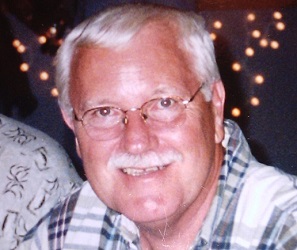
PHOTOS: (Top left) Bob and Cheryl Mirkle sit for a photo with their three grandchildren during Christmas 2017. (Top right) Joe Kinnucan, far right, returns to the press box Oct. 18 to share with play-by-play partner Nick Davros and their viewers that a man in the stands who was experiencing a cardiac event was “breathing and had a pulse.” (Top below) The Sailor Nation Sports Network crew, from left: Nick Davros, Noah Kinnucan, Connor Fritz, Joe Kinnucan and John Hall (with videographer Kimon Kotos on the roof). (Middle) Bob Mirkle. (Photos courtesy of Joe Kinnucan and Bob Mirkle, respectively.)

2017 Scholar-Athlete Finalists Announced
By
Geoff Kimmerly
MHSAA.com senior editor
January 20, 2017
By Geoff Kimmerly
Second Half editor
The 120 finalists for the Michigan High School Athletic Association's Scholar-Athlete Awards for the 2016-17 school year, presented by Farm Bureau Insurance, have been announced.
 The program, celebrating its 28th anniversary, has recognized student-athletes since the 1989-90 school year and again this winter will honor 32 individuals from MHSAA member schools who participate in at least one sport in which the Association sponsors a postseason tournament.
Farm Bureau Insurance underwrites the Scholar-Athlete Awards and will present a $1,000 scholarship to each recipient. Since the beginning of the program, 704 scholarships have been awarded.
Scholarships will be presented proportionately by school classification, with 12 scholarships to be awarded to Class A student-athletes, six female and six male; eight scholarships will be awarded to Class B student-athletes, four female and four male; six scholarships will be awarded to Class C student-athletes, three female and three male; and four scholarships will be awarded to Class D student-athletes, two female and two male. In addition, two scholarships will be awarded at-large to minority recipients, regardless of school size.
Every MHSAA member high school could submit as many applications as there are scholarships available in its classification, and could have more than one finalist. New Boston Huron has three finalists this year. Seventeen schools each have two finalists: Blissfield, Bloomfield Hills Cranbrook Kingswood, Coldwater, Dearborn Divine Child, Detroit Catholic Central, Edwardsburg, Gladwin, Greenville, Ishpeming, Kalamazoo Hackett Catholic Prep, Midland Dow, Pewamo-Westphalia, Saline, Sault Ste. Marie, Sturgis, Watervliet and Yale.
Multiple-sport participation remains the norm among applicants. The average sport participation rate of the finalists is 2.63, while the average of the application pool was 2.18. There are 72 three-plus sport participants in the finalists field, and all but one of the 28 sports in which the MHSAA sponsors postseason tournaments are represented.
Of 409 schools which submitted applicants, 52 submitted the maximum allowed. This year, 1,515 applications were received. All applicants will be presented with certificates commemorating their achievement. Additional Scholar-Athlete information, including a complete list of scholarship nominees, can be found on the Scholar-Athlete page of the MHSAA Website.
The applications were judged by a 70-member committee of school coaches, counselors, faculty members, administrators and board members from MHSAA member schools. Selection of the 32 scholarship recipients will take place in early February. Class C and D scholarship recipients will be announced Feb. 7, Class B scholarship recipients will be announced Feb. 14 and Class A scholarship recipients will be announced Feb. 21. All announcements will be made on the MHSAA Website.
To honor the 32 Scholar-Athlete Award recipients, a ceremony will take place during halftime of the Class C Boys Basketball Final, March 25, at the Breslin Student Events Center in East Lansing.
To be eligible for the award, students must have a cumulative grade point average of 3.50 (on a 4.0 scale) and previously have won a varsity letter in at least one sport in which the MHSAA sponsors a postseason tournament. Students also were asked to respond to a series of short essay questions, submit two letters of recommendation and a 500-word essay on the importance of sportsmanship in educational athletics.
Farm Bureau Insurance of Michigan was founded in 1949 by Michigan farmers who wanted an insurance company that worked as hard as they did. Those values still guide the company today and are a big reason why it is known as Michigan’s Insurance Company, dedicated to protecting the farms, families, and businesses of this great state. Farm Bureau Insurance agents across Michigan provide a full range of insurance services—life, home, auto, farm, business, retirement, Lake Estate®, and more—protecting nearly 500,000 Michigan policyholders.
The MHSAA is a private, not-for-profit corporation of voluntary membership by more than 1,400 public and private senior high schools and junior high/middle schools which exists to develop common rules for athletic eligibility and competition. No government funds or tax dollars support the MHSAA, which was the first such association nationally to not accept membership dues or tournament entry fees from schools. Member schools which enforce these rules are permitted to participate in MHSAA tournaments, which attract more than 1.4 million spectators each year.
2016-17 Scholar-Athlete Award Finalists
BOYS CLASS A
Trevor Roznowski, Alpena
Jordan George-Nwogu, Ann Arbor Pioneer
Nathan Jones, Battle Creek Lakeview
Jonah Kamoo, Birmingham Groves
Ben Williams, Birmingham Seaholm
Andrew R Twiford, Byron Center
Eric Bach, Coldwater
Kameron Miller, Coldwater
CJ Baird, Detroit Catholic Central
Jackson Ross, Detroit Catholic Central
Justin Beemer, Fenton
Steven Stine, Fraser
Dominic LaJoie, Gaylord
Drew VanAndel, Grand Haven
Michael Gumbko, Grand Rapids Forest Hills Northern
Connor K Fischer, Grandville
Michael Visscher, Holland
Tyler Opdycke, Livonia Churchill
Varun R Shanker, Midland Dow
Gary R O'Brien III, Riverview
Aidan Carichner, Saline
Connor Bryant Meehan, Saline
Matthew J Polzin, Sturgis
Andrew Long, White Lake Lakeland
GIRLS CLASS A
Kaitlyn Coons, Cedar Springs
Lindsay Duca, East Grand Rapids
Sarah Kurpiers, Farmington Hills Mercy
Jocelyn Prinz, Grand Rapids Forest Hills Central
Paige Hallock, Greenville
Landon Kemp, Greenville
Amber Nicole Manitowabi-Huebner, Marquette
Alex Wilkinson, Middleville Thornapple Kellogg
Caroline Szabo, Midland Dow
Jordan Walker, Muskegon Mona Shores
Emma Streveler, New Baltimore Anchor Bay
Alexa Scroggie, New Boston Huron
Elizabeth Stockert, New Boston Huron
Allissa Wight, New Boston Huron
Katelyn Jones, Owosso
Jalynn Byers, Petoskey
Mackenzie Carano, Pinckney
Sydney Asuncion, Rochester
Allyson Faulkner, Rockford
Harmony Groves, Sturgis
Maggie Dutmers, Traverse City Central
Hunter Kehoe, Traverse City West
Nikki Sorgi, Utica Ford
Aubrey Fetzer, Warren Cousino
BOYS CLASS B
Brayden Huddleston, Benzie Central
Tait Morrissey, Big Rapids
Michael Bian, Bloomfield Hills Cranbrook Kingswood
Michael J Gussert, Cadillac
Christopher A Roush, Chelsea
Collin Lieber, Croswell-Lexington
Evan Latham, Dearborn Divine Child
Adam Kozinski, Edwardsburg
Patrick Johns, Marine City
Richard Dominick Reo III, Paw Paw
Brendan Gered Fraser, Pontiac Notre Dame Prep
Ryley Alaspa, Sault Ste. Marie
Ryan Sanderson, Sault Ste. Marie
Josef Hissom, Spring Lake
Andrew D Marten, Tecumseh
Cade Smeznik, Yale
GIRLS CLASS B
Emma Nowak, Ann Arbor Gabriel Richard
Michel Faliski, Bloomfield Hills Cranbrook Kingswood
Jasmine Harper, Clare
Madeline Filiatraut, Dearborn Divine Child
Sasha Hartje, Detroit Country Day
Noelle Kraus, Edwardsburg
Peyton Rellinger, Gladwin
Lindsey Shearer, Gladwin
Erika Freyhof, Hamilton
Morgan Colling, Houghton
Haley Heldt, Midland Bullock Creek
Megan Aalberts, Otsego
Raechel K McKiernan, Richmond
Kylie Hutchinson, Shepherd
Kim Anh Nguyen, Wyoming Kelloggsville
Gabrielle Smith, Yale
BOYS CLASS C
Clark Brady, Bad Axe
Spencer Fisher, Blissfield
Jonathan Lutchka, Grass Lake
Sam Bailey, Harbor Springs
Ashok Ravindran, Ishpeming
Joe Rigling, Leroy Pine River
Alexander Dixon, Madison Heights Bishop Foley Catholic
Jacob Shoop, Mason County Central
Bryce J Thelen, Pewamo-Westphalia
Nicholas Hammond, Riverview Gabriel Richard
Tyler Brant, Watervliet
Cameron Rendo, Watervliet
GIRLS CLASS C
Kelsey Wyman, Blissfield
Madeline Wu, Grosse Pointe Woods University Liggett
Khora Swanson, Ishpeming
Hope Baldwin, Kalamazoo Hackett Catholic Prep
Quinn Epkey, Kalamazoo Hackett Catholic Prep
Keilene Renae Elmer, Lincoln Alcona
Bailey Downs, Munising
Maysa Sitar, Newberry
Mary Hoopes, North Muskegon
Brenna Wirth, Pewamo-Westphalia
Sidney Linck, Ravenna
Madison Bryce, St. Charles
BOYS CLASS D
Jacob Single, Adrian Lenawee Christian
Jacob Martin, Athens
Richard Steffan, Auburn Hills Oakland Christian
Elijah Newton, Central Lake
Jace Feldpausch, Fowler
Brian A Price, Mio
Nicholas Morgenstern, Muskegon Catholic Central
Seth Polfus, Powers North Central
GIRLS CLASS D
Rachel Hiveley, Au Gres-Sims
Allyson Richards, Fruitport Calvary Christian
Alexa Destrampe, Lake Linden-Hubbell
Jade Sibley, Marcellus
Mary Leighton, Mendon
Alexis McConnell, Mt. Pleasant Sacred Heart
Grace Alvesteffer, Pentwater
Rhiley Hubert, Rapid River