


Sparrow to Present MHSAA Hoops Finals
March 15, 2016
By Geoff Kimmerly
Second Half editor
Sparrow Health System of Lansing, a provider of medical expertise and information to Michigan High School Athletic Association schools, their athletes, parents and staff, will serve as the presenting sponsor of this season’s Girls & Boys Basketball Finals to be played over the next two weeks.
 Sparrow, a member of the prestigious Mayo Clinic Care Network, is mid-Michigan’s premier healthcare organization with more than 10,000 caregivers. Sparrow’s Sports Medicine division offers programs for athletes at all levels and includes primary care physicians, orthopedic surgeons, physical therapists and athletic and performance trainers.
The MHSAA Girls Basketball Finals will begin with Semifinals this Thursday (March 17) and Friday, with all four Finals on Saturday. The Boys Basketball Semifinals and Finals will be played next week, March 24-26. All games will be played at the Breslin Student Events Center at Michigan State University.
Sparrow lends its expertise through the MHSAA Website and on-site at various MHSAA tournament events. Resources from Sparrow staff, including information on current health and safety topics and trends, are accessible online through the Health & Safety page of the MHSAA Website, where an “Ask the Expert” feature connects users with sports health-related questions to Sparrow Caregivers.
“Sparrow Health System’s contributions have allowed us to bolster our ability to provide assistance on health and wellness topics to our athletes, parents, coaches and administrators,” said John E. “Jack” Roberts, executive director of the MHSAA. “We are pleased to have Sparrow involved with two of our most attended events and the opportunities they provide to make contact with many of our constituents.”
The Girls and Boys Basketball Finals weekends drew a combined 62,654 fans in 2015.
In addition to its presence at MHSAA Tournament events, Sparrow also provides speakers at MHSAA functions and events throughout the state, offering guidance on health issues for student-athletes. Sparrow physicians have spoken during MHSAA staff training sessions, Student Advisory Council meetings and athletic director orientations.
“Sparrow is proud to be the official health system of the MHSAA,” said Michael Shingles, D.O., Sparrow Sports Medicine medical director and team orthopedic surgeon for Michigan State University. “We provide some of the most advanced care in the mid-Michigan region and world. We are particularly excited to have a new Sports Medicine practice specifically for athletes like those participating in the high school basketball playoffs at the Breslin Center.”
Sparrow is mid-Michigan’s premier health care organization and includes hospitals in Lansing, St. Johns, Ionia and Carson City as well as Physicians Health Plan, Sparrow Physicians Health Network, the Sparrow Medical Group and the Michigan Athletic Club. Sparrow is affiliated with Michigan State University’s three human health colleges. Through these partnerships and the dedication of 10,000 caregivers, Sparrow pursues a vision to be nationally recognized as a leader in quality and patient experience.
The MHSAA is a private, not-for-profit corporation of voluntary membership by more than 1,400 public and private senior high schools and junior high/middle schools which exists to develop common rules for athletic eligibility and competition. No government funds or tax dollars support the MHSAA, which was the first such association nationally to not accept membership dues or tournament entry fees from schools. Member schools which enforce these rules are permitted to participate in MHSAA tournaments, which attract more than 1.4 million spectators each year.
'Yard Squad' Enjoys Unexpected Response
May 20, 2017
By Geoff Kimmerly
Second Half editor
The task itself was a simple one, and the reasons for doing it simple at first.
 An elderly woman called Colon High School – on the advice of her daughter, who teaches in the Upper Peninsula – looking for a student group that might be interested in assisting with some yard work.
Sophomore Andrew Smolarz, meanwhile, always is looking for community service hours to go toward membership in his school’s Varsity Club and National Honor Society chapter.
So he and four track & field teammates volunteered and spent a few hours picking up sticks, raking around her house and cleaning up brush. But they never anticipated the response.
“After the first time we did it, the reaction we got from people – it was more than just doing work for them,” Smolarz said. “When she saw us, the first lady said we’d restored her faith in the youth in the community. She got pretty teary-eyed, so it meant a lot to us, and she wanted a hug from all of us too.”
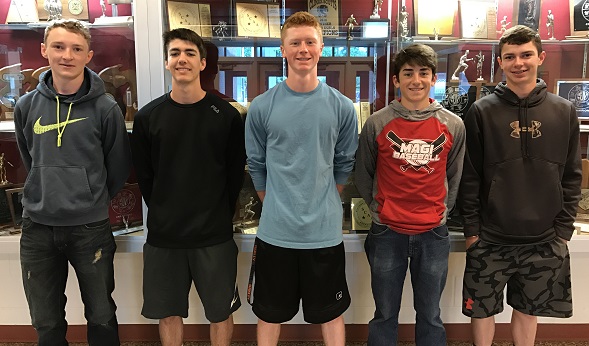
Since, Smolarz and his “Yard Squad” – sophomores Isaiah Fellers and Andy Stoll and freshmen Philip Alva and Austin Stoll – have taken their cleaning talents to two more homes, with three more and a restaurant also on the schedule.
Colon’s Yard Squad is a recipient of an inaugural MHSAA/Lake Trust Credit Union “Community Service Award” recognizing contributions by Michigan’s high school student-athletes away from the field. The Yard Squad will receive $1,000, which will go toward Colon’s athletic department and equipment for the track & field and baseball teams. Six honorees total are receiving awards this spring; Second Half will feature one a day this week.
While there are a multitude of ways to serve one’s community – over the next few days we will feature some incredibly impressive campaigns to raise money, awareness and donate goods to those in need – Colon’s Yard Squad found a way to help that students at any school can replicate, and to the same unexpected benefits.
That first call ended up on the ear of Colon athletic director Paige Smolarz – also Andrew’s mother and the school’s boys track & field coach – and when she offered the opportunity, these five underclassmen stepped up. It’s not that they don’t have other things going on; all five are dual sport athletes also playing baseball or golf, so clean-ups so far have come on Sundays adding up to about 15 hours total by each student with many more yet to be worked this spring.
Among others they’ve helped were a second elderly woman and her disabled husband, and a young couple where the wife is fighting cancer and the husband is working long shifts to support the family.
The village of Colon, tucked south of Kalamazoo and north of Sturgis, has roughly 1,200 residents, and word quickly gets around. The first woman helped by the Yard Squad told her friends, and there was some Facebook buzz as well. Smolarz said he and the “squad” are just a bunch of friends (and the Stolls are cousins) having fun working together to do something good.
“People think so much more of the little things you do for them than I actually thought (they would),” Andrew Smolarz said. “I just thought we’d go clean up, say thanks, and leave. But they thought so much more over it.
“It’s gotten a lot more fun in my opinion. The reaction is really cool to see on people’s faces. People just can’t believe we’d come out and do that for them.”
The Community Service Awards are sponsored by the Michigan High School Athletic Association and Lake Trust Credit Union to recognize student-athletes' efforts to improve the lives of others in their communities. In addition to the $1,000 award, the Lake Trust Foundation is awarding an additional $500 to each honoree, to be donated to a non-profit, 501 (c)(3) organization of the awardee’s choice.
PHOTO: Colon High School's "Yard Squad" from left: Isaiah Fellers, Andy Stoll, Andrew Smolarz, Phillip Alva and Austin Stoll. (Photo courtesy of the Colon athletic department.)