

Stoney Creek Leaders Speak Up to Save Lives
May 26, 2017
By Geoff Kimmerly
Second Half editor
The crowd for Rochester Hills Stoney Creek’s boys basketball game against rival Rochester was as rowdy as could be hoped for most of the evening Feb. 28.
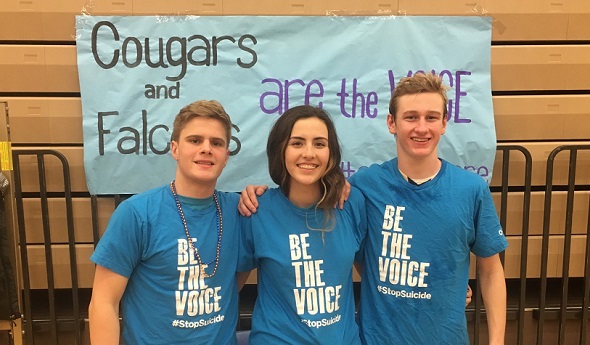
 But it fell silent during halftime as Stoney Creek juniors Nate Davis, Kevin Price and Isabella Ubaydi spoke of how suicide had affected them and their community.
A student had committed suicide every year during their high school careers – including Price’s brother just six months before.
All three are members of the school’s Cougar Athletic Leadership Council, which put on the Suicide Prevention Awareness basketball game not only to raise money for the American Foundation for Suicide Prevention, but also to start the conversation on a sensitive topic that has hit home.
“We wanted to get the word out that it’s OK to talk about these issues – help the topic get out of the dark,” Ubaydi said.
“It was insane. It was awesome. There were so many people. Our student section area where we all sit was filled up to the top row. There were a lot of people from the community who didn’t go to Stoney Creek, or have alumni (associated with the school) or anything like that. But they were at Stoney Creek, and it was great to show people actually care in our community.”
The leadership council is a club made up of Stoney Creek athletes who coordinate special events, including for athletics, with an eye especially on helping the community’s youth, elderly and those with disabilities. Ubaydi, Price and Davis are co-chairs of the CALC’s special events committee.
The tragic circumstances of the last three years led the group to bring suicide prevention to the forefront. While Ubaydi spoke mostly about why the event was held and how donations would be spent, Price and Davis (Price’s best friend) talked about how suicide had affected them personally. “You could hear a pin drop,” Ubaydi said. “After we were done, (the crowd) gave a standing ovation.”
CALC raised nearly $3,500 selling T-shirts that also included free student admission to the game. After Ubaydi, Price and Davis spoke, buckets were passed through the crowd during a “miracle minute” and filled with another $1,200.
All profits from the night, including $500 from concessions, were donated to the American Foundation for Suicide Prevention, and Ubaydi said the $1,000 from the Community Service Award also will be sent to AFSP.
She’s since heard stories from teachers of classmates coming forward to express worries about people in their lives, a sign awareness is paying off. At the same time, Ubaydi and her co-chairs are just as concerned about people who didn’t attend the Suicide Prevention Awareness game and might be experiencing troubles in their lives – but the hope is the event spoke loudly enough to be heard by anyone who needs help.
All three leaders are juniors beginning to contemplate their futures after high school; Ubaydi is leaning toward Roanoke College in Virginia to study political science and minor in theology, while Price is considering Michigan State to study environmental science and Davis is looking at options for pre-law or political science. They hope to host the suicide prevention event again as seniors before they graduate, with future CALC students then carrying on the mission.
“Suicide is an uncomfortable topic to talk about. Since people saw us relating to how it has affected us personally, the community will become comfortable discussing mental illnesses together,” Ubaydi wrote in CALC’s award application.
“I wanted to have this event so people understand that the influence that one person can make may be life-changing. This then causes them to be there for others, see the signs quicker, and save more lives.”
PHOTO: (Top) Cougar Athletic Leadership Council leaders Kevin Price, Isabella Ubaydi and Nate Davis show their shirts from the school’s Suicide Prevention Awareness night. VIDEOS: (Top) State Champs! Network covered the event and interviewed its organizers. (Below) Davis, Ubaydi and Price speak during halftime, also filmed by State Champs! Network.
2017 Community Service Awards
Sunday: Colon "Yard Squad" - Read
Monday: Bailey Brown, Brighton - Read
Tuesday: Justice Ottinger, Newaygo - Read
Thursday: Katie Sesi, Ann Arbor Huron - Read
Friday: Nikki Sorgi, Utica Ford - Read
Friday: Cougar Athletic Leadership Council, Rochester Hills Stoney Creek - Read

Rules Changes Minimize Health Risks
August 3, 2017
By Geoff Kimmerly
Second Half editor
A pair of football rules changes taking effect this season build on continuing work to minimize health risks in all interscholastic sports as 2017-18 fall practices begin next week for member schools of the Michigan High School Athletic Association.
Practice in football must begin on Aug. 7 for all schools wishing to begin regular-season games the weekend of Aug. 24-26. Schools must have 12 days of preseason practice at all levels before their first game, over a period of 16 calendar days before the first kickoff.
Practice sessions for all other sports begin Wednesday (Aug. 9). In golf and tennis, competition may commence no earlier than after three separate days of team practice, and not before seven calendar days. The first day competition may take place in golf and tennis is Aug. 16. In all other fall sports, contests can take place after seven days of practice for the team and not before nine calendar days. The first day competition may take place in cross country, soccer, swimming & diving, and volleyball is Aug. 18.
This fall, two football game dates again precede Labor Day, and a number of MHSAA schools will play their first varsity games on Thursday, Aug. 24. In Week 1, 141 varsity games will be played on Thursday, 153 contests will be played on Friday, and 16 games will be played on Saturday. In the second week, four games will be played Wednesday, 238 games will take place Thursday, 64 will be played Friday, and five contests are Saturday.
A change to the allowable level of contact on a blindside block in football is one of the latest rules changes aimed at increasing player safety. A blindside block involves contact by a blocker against an opponent who, because of physical positioning and focus of concentration (for example, while following a ball carrier on a kickoff return), is vulnerable to injury by a block coming from outside his field of vision. Blindside blocks now must be initiated with open hands only; blindside contact that is forceful and initiated with other parts of the body outside of the free blocking zone will be penalized as excessive and unnecessary.
In addition to redefining the blindside block, the National Federation of State High School Associations (NFHS) sought to also minimize risk by eliminating the pop-up kick – that is, any free kick during which the kicker drives the ball immediately to the ground, causing it to bounce only once and into the air similar to the flight of a ball kicked directly off the tee. Kicks off a tee that bounce multiple times and then pop into the air remain allowed.
A few other notable rules changes in football will be apparent this fall:
• A defensive player will be called for encroachment for striking the offensive snapper’s hand or arm, or the ball, prior to the snapper releasing the ball to begin a play.
• Non-contact face guarding is no longer considered pass interference.
• A team accepting a penalty during the final two minutes of either half now will have the option of re-starting the clock at the snap of the ball rather than the referee’s ready-for-play signal.
While most fall sports face at least minor rules changes this season, a few more of the most noticeable adjustments will come in boys soccer and girls swimming & diving.
• In boys soccer, overtime periods and shootouts during the regular season have been eliminated. Leagues and conferences are allowed an overtime option for their end-of-season bracketed tournaments, but overtime in those cases must not exceed two 10-minute periods plus a shootout. Multi-team regular-season tournaments also may receive waivers to employ a shootout if it is used to determine the winner of a game.
• Also in soccer, kickoffs may now travel in any direction from the center of the field. Previously, kickoffs at the high school level were required to move forward down the field of play.
• In girls swimming & diving, a diver will need only four regular-season wins (instead of the previous five) to qualify for the Regional Diving Qualification Meet. A diver also may qualify if she places ahead of all divers from opposing schools in varsity competition in at least four meets, even if she does not finish ahead of her teammates.
• Also in swimming & diving, to promote safer take-offs during relays, the second, third and fourth swimmers must have at least one foot in contact with the starting platform in front of the starting block wedge during take-off. Those second, third and fourths swimmers may not take off with both feet on top of the starting block wedge.
The 2017 fall campaign culminates with postseason tournaments beginning with the Upper Peninsula Girls Tennis Finals the week of Sept. 25 and wraps up with the 11-Player Football Playoff Finals on Nov. 24 and 25. Here is a complete list of fall tournament dates:
Cross Country
U.P. Finals – Oct. 21
L.P. Regionals – Oct. 27 or 28
L.P. Finals – Nov. 4
11-Player Football
Selection Sunday – Oct. 22
Pre-Districts – Oct. 27 or Oct. 28
District Finals – Nov. 3 or 4
Regional Finals – Nov. 10 or 11
Semifinals – Nov. 18
Finals – Nov. 24-25
8-Player Football
Selection Sunday – Oct. 22
Regional Semifinals – Oct. 27 or Oct. 28
Regional Finals – Nov. 3 or 4
Semifinals – Nov. 11
Finals – Nov. 17
L.P. Girls Golf
Regionals – Oct. 11 or 12 or 13 or 14
Finals – Oct. 20-21
Soccer
Boys L.P. Districts – Oct. 16-21
Boys L.P. Regionals – Oct. 24-28
Boys L.P. Semifinals – Nov. 1
Boys L.P. Finals – Nov. 4
L.P. Girls Swimming & Diving
Diving Regionals – Nov. 9
Swimming/Diving Finals – Nov. 17-18
Tennis
U.P. Girls Finals – Sept. 27-30
L.P. Boys Regionals – Oct. 12 or 13 or 14
L.P. Finals – Oct. 20-21
Girls Volleyball
Districts – Oct. 30-Nov. 4
Regionals – Nov. 7 & 9
Quarterfinals – Nov. 14
Semifinals – Nov. 16-17
Finals – Nov. 18