

Stoney Creek Leaders Speak Up to Save Lives
May 26, 2017
By Geoff Kimmerly
Second Half editor
The crowd for Rochester Hills Stoney Creek’s boys basketball game against rival Rochester was as rowdy as could be hoped for most of the evening Feb. 28.
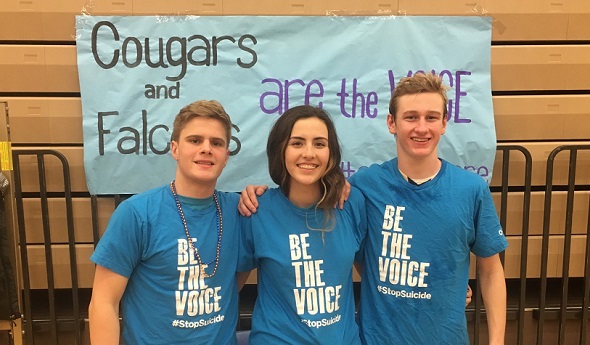
 But it fell silent during halftime as Stoney Creek juniors Nate Davis, Kevin Price and Isabella Ubaydi spoke of how suicide had affected them and their community.
A student had committed suicide every year during their high school careers – including Price’s brother just six months before.
All three are members of the school’s Cougar Athletic Leadership Council, which put on the Suicide Prevention Awareness basketball game not only to raise money for the American Foundation for Suicide Prevention, but also to start the conversation on a sensitive topic that has hit home.
“We wanted to get the word out that it’s OK to talk about these issues – help the topic get out of the dark,” Ubaydi said.
“It was insane. It was awesome. There were so many people. Our student section area where we all sit was filled up to the top row. There were a lot of people from the community who didn’t go to Stoney Creek, or have alumni (associated with the school) or anything like that. But they were at Stoney Creek, and it was great to show people actually care in our community.”
The leadership council is a club made up of Stoney Creek athletes who coordinate special events, including for athletics, with an eye especially on helping the community’s youth, elderly and those with disabilities. Ubaydi, Price and Davis are co-chairs of the CALC’s special events committee.
The tragic circumstances of the last three years led the group to bring suicide prevention to the forefront. While Ubaydi spoke mostly about why the event was held and how donations would be spent, Price and Davis (Price’s best friend) talked about how suicide had affected them personally. “You could hear a pin drop,” Ubaydi said. “After we were done, (the crowd) gave a standing ovation.”
CALC raised nearly $3,500 selling T-shirts that also included free student admission to the game. After Ubaydi, Price and Davis spoke, buckets were passed through the crowd during a “miracle minute” and filled with another $1,200.
All profits from the night, including $500 from concessions, were donated to the American Foundation for Suicide Prevention, and Ubaydi said the $1,000 from the Community Service Award also will be sent to AFSP.
She’s since heard stories from teachers of classmates coming forward to express worries about people in their lives, a sign awareness is paying off. At the same time, Ubaydi and her co-chairs are just as concerned about people who didn’t attend the Suicide Prevention Awareness game and might be experiencing troubles in their lives – but the hope is the event spoke loudly enough to be heard by anyone who needs help.
All three leaders are juniors beginning to contemplate their futures after high school; Ubaydi is leaning toward Roanoke College in Virginia to study political science and minor in theology, while Price is considering Michigan State to study environmental science and Davis is looking at options for pre-law or political science. They hope to host the suicide prevention event again as seniors before they graduate, with future CALC students then carrying on the mission.
“Suicide is an uncomfortable topic to talk about. Since people saw us relating to how it has affected us personally, the community will become comfortable discussing mental illnesses together,” Ubaydi wrote in CALC’s award application.
“I wanted to have this event so people understand that the influence that one person can make may be life-changing. This then causes them to be there for others, see the signs quicker, and save more lives.”
PHOTO: (Top) Cougar Athletic Leadership Council leaders Kevin Price, Isabella Ubaydi and Nate Davis show their shirts from the school’s Suicide Prevention Awareness night. VIDEOS: (Top) State Champs! Network covered the event and interviewed its organizers. (Below) Davis, Ubaydi and Price speak during halftime, also filmed by State Champs! Network.
2017 Community Service Awards
Sunday: Colon "Yard Squad" - Read
Monday: Bailey Brown, Brighton - Read
Tuesday: Justice Ottinger, Newaygo - Read
Thursday: Katie Sesi, Ann Arbor Huron - Read
Friday: Nikki Sorgi, Utica Ford - Read
Friday: Cougar Athletic Leadership Council, Rochester Hills Stoney Creek - Read

3 Sports Secure New Homes for 2017-18
May 9, 2017
By Geoff Kimmerly
Second Half editor
Championship rounds for girls basketball, team wrestling and individual wrestling will have new homes for the 2017-18 season, as approved by the Representative Council of the Michigan High School Athletic Association during its annual Spring Meeting, May 7-8, in Glen Arbor.
The Girls Basketball Semifinals and Finals, played from 2004-06 and then 2010-17 at the Jack Breslin Student Events Center at Michigan State University, will move to Van Noord Arena on the campus of Calvin College in Grand Rapids. The Team Wrestling Finals, contested the last two seasons at McGuirk Arena at Central Michigan University after a long run at Battle Creek’s Kellogg Arena, will begin at least a four-year engagement at Wings Event Center in Kalamazoo.
The Individual Wrestling Finals, previously a three-day event hosted by The Palace of Auburn Hills from 2002 through this March, will be contested at Ford Field in Detroit over two days.
In addition to those changes, the Representative Council also approved keeping the MHSAA Boys Basketball Semifinals and Finals at the Breslin Center for the 2017-18 season and approved a return to Northern Michigan University’s Superior Dome as the host of both 8-Player Football Finals in 2017. NMU hosted the first 8-Player Final in 2011; the 8-Player Football Playoffs will move from one to two divisions beginning this fall.
The moves of the Girls Basketball and Individual Wrestling Finals were made necessary by conditions outside of MHSAA control. The Girls Basketball Finals weekends in 2018 and also 2020-22 will conflict with the NCAA Division I Women’s Basketball Tournament and an opportunity for Michigan State’s women’s team to host first and second-round games should it qualify and earn a top-16 overall seed. The Individual Wrestling Finals – formerly held at multiple sites before moving together to Joe Louis Arena in 1999 – needed a new host as the Palace is expected to close before next season.
“It is with much gratitude to our recent hosts of the Girls Basketball and Wrestling Finals that we make these changes. But although we have enjoyed our time and relationships built, we also are excited to work with these next facilities and their staffs, who are similarly passionate about creating the finest experiences for our athletes and fans,” MHSAA Executive Director John E. “Jack” Roberts said. “We received interest from a number of facilities and managers who also value what our championship events provide for teams and their communities, and we’re eager to begin working with Calvin College, Wings Event Center and our familiar friends at Ford Field and Northern Michigan University on these endeavors.”
Roberts noted that contracts for the girls and boys basketball and individual wrestling tournaments are for 2017-18 only, but with the possibility of remaining at those sites additional years. The Council also discussed the possibility of changing both girls and boys basketball tournament schedules beginning with the 2018-19 season to help keep more Division I college and commercial venues available to host those events. The MHSAA will investigate alternative sites and develop an adjusted basketball season schedule for Council consideration in December. The Boys Basketball Finals weekend in 2019 as scheduled also conflicts with the NCAA Division I Women’s Basketball Tournament.
Although Van Noord Arena has never hosted an MHSAA Final, it twice has hosted NCAA Division III Women’s College Basketball Finals. The 5,000-seat arena hosted its first game in 2009, and while smaller than Breslin, is expected to provide a festive atmosphere with the possibility of being filled to near capacity for many of the MHSAA’s tournament games. Attendance at this past season’s MHSAA Girls Basketball Finals was 24,120 over three days – just shy of an all-time record – with a high of 5,272 fans for the Class A/D Finals session March 18.
"To host the MHSAA girls basketball state championship weekend is an honor for the Calvin College community," said Donna Joyce, Calvin's Business Development Manager. "We can't wait to welcome teams and their fans, and our goal is to provide first-rate hospitality to all who visit our beautiful campus next March."
Wings Event Center will allow the MHSAA to again stage all four championship matches on adjacent mats simultaneously – the format for most of the first 29 years of the Team Finals, but not last season as the Finals were split into two two-match blocks to help accommodate for attendance after the Team Finals session sold out in 2016. Wings has seating for 5,100 fans and additional standing-room capacity for 1,000 more.
"We are excited the MHSAA has awarded this prestigious state championship to Wings Event Center," said Greg Ayers, President & CEO for Discover Kalamazoo. "This venue and our community will provide for an excellent location for both the participants and fans attending this event. We look forward to working with the MHSAA in creating an outstanding championship site."
Ford Field, which has hosted MHSAA football championship games since 2005, will be configured for placement of up to 20 mats covering approximately half the football playing surface area. Seating will be configured to a capacity of roughly 24,000 in the lower bowl. The tournament schedule, which previously included one round of wrestling on the first day, followed by four rounds on both the second and third days of the event, will be adjusted to begin with four rounds Friday, March 2, 2018, and end with five rounds on Saturday, March 3. The three-day wrestling event drew 37,013 fans this past winter.
"We are excited to expand our existing relationship with the MHSAA to host the Individual Wrestling Finals at Ford Field in 2018," said Detroit Lions’ Senior Vice President of Business Development Kelly Kozole. "Since opening the stadium in 2002, it's been an honor to host the MHSAA Football Championships and a pleasure to see many MHSAA alumni come back to Ford Field as NFL players. As a professional sports franchise, we have the utmost appreciation for the significant role high school athletics play in the community and will continue to embrace opportunities to support them."
The 14,579-seat Breslin Center has been home to the Boys Basketball Finals since 1994. The event drew 53,990 fans over three days of Semifinals and championship games this winter, the largest overall attendance since 2012. The Class D/A Finals session drew 13,251 fans.
For 8-player football, the Council discussed long-distance travel possibilities to both sites that previously have hosted MHSAA Finals – the Superior Dome hosted the first 8-player championship game in 2011, and Greenville High School’s Legacy Field served as host from 2012-16. The 8-player tournament will move to two divisions this fall after playing with only one division during the first six years of its tournament history, and both championship games will be played during the same weekend at NMU.
“We’re excited for the opportunity to host the 8-Player Finals, along with the opportunity to continue hosting 11-Player Semifinals as well,” said Carl Bammert, NMU’s Associate Athletic Director and supervisor of its sports complex, including the Superior Dome. “We’re always excited for the opportunity for exposure from getting high school students and their families on campus and at the Superior Dome.”
The MHSAA is a private, not-for-profit corporation of voluntary membership by more than 1,400 public and private senior high schools and junior high/middle schools which exists to develop common rules for athletic eligibility and competition. No government funds or tax dollars support the MHSAA, which was the first such association nationally to not accept membership dues or tournament entry fees from schools. Member schools which enforce these rules are permitted to participate in MHSAA tournaments, which attract more than 1.4 million spectators each year.