

'Yard Squad' Enjoys Unexpected Response

May 20, 2017

By Geoff Kimmerly
Second Half editor

The task itself was a simple one, and the reasons for doing it simple at first.

An elderly woman called Colon High School – on the advice of her daughter, who teaches in the Upper Peninsula – looking for a student group that might be interested in assisting with some yard work.

Sophomore Andrew Smolarz, meanwhile, always is looking for community service hours to go toward membership in his school’s Varsity Club and National Honor Society chapter.

So he and four track & field teammates volunteered and spent a few hours picking up sticks, raking around her house and cleaning up brush. But they never anticipated the response.

“After the first time we did it, the reaction we got from people – it was more than just doing work for them,” Smolarz said. “When she saw us, the first lady said we’d restored her faith in the youth in the community. She got pretty teary-eyed, so it meant a lot to us, and she wanted a hug from all of us too.”

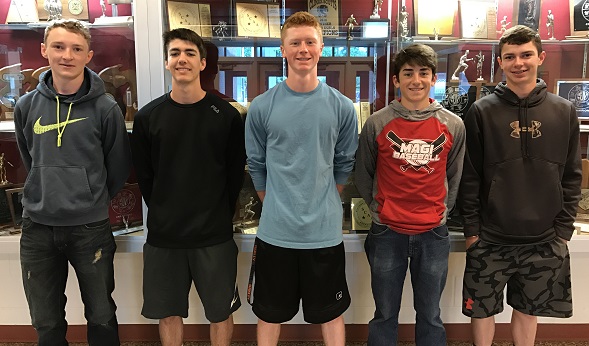
Since, Smolarz and his “Yard Squad” – sophomores Isaiah Fellers and Andy Stoll and freshmen Philip Alva and Austin Stoll – have taken their cleaning talents to two more homes, with three more and a restaurant also on the schedule.

Colon’s Yard Squad is a recipient of an inaugural MHSAA/Lake Trust Credit Union “Community Service Award” recognizing contributions by Michigan’s high school student-athletes away from the field. The Yard Squad will receive $1,000, which will go toward Colon’s athletic department and equipment for the track & field and baseball teams. Six honorees total are receiving awards this spring; Second Half will feature one a day this week.

While there are a multitude of ways to serve one’s community – over the next few days we will feature some incredibly impressive campaigns to raise money, awareness and donate goods to those in need – Colon’s Yard Squad found a way to help that students at any school can replicate, and to the same unexpected benefits.

That first call ended up on the ear of Colon athletic director Paige Smolarz – also Andrew’s mother and the school’s boys track & field coach – and when she offered the opportunity, these five underclassmen stepped up. It’s not that they don’t have other things going on; all five are dual sport athletes also playing baseball or golf, so clean-ups so far have come on Sundays adding up to about 15 hours total by each student with many more yet to be worked this spring.

Among others they’ve helped were a second elderly woman and her disabled husband, and a young couple where the wife is fighting cancer and the husband is working long shifts to support the family.

The village of Colon, tucked south of Kalamazoo and north of Sturgis, has roughly 1,200 residents, and word quickly gets around. The first woman helped by the Yard Squad told her friends, and there was some Facebook buzz as well. Smolarz said he and the “squad” are just a bunch of friends (and the Stolls are cousins) having fun working together to do something good.

“People think so much more of the little things you do for them than I actually thought (they would),” Andrew Smolarz said. “I just thought we’d go clean up, say thanks, and leave. But they thought so much more over it.

“It’s gotten a lot more fun in my opinion. The reaction is really cool to see on people’s faces. People just can’t believe we’d come out and do that for them.”

The Community Service Awards are sponsored by the Michigan High School Athletic Association and Lake Trust Credit Union to recognize student-athletes' efforts to improve the lives of others in their communities. In addition to the $1,000 award, the Lake Trust Foundation is awarding an additional $500 to each honoree, to be donated to a non-profit, 501 (c)(3) organization of the awardee’s choice.

PHOTO: Colon High School's "Yard Squad" from left: Isaiah Fellers, Andy Stoll, Andrew Smolarz, Phillip Alva and Austin Stoll. (Photo courtesy of the Colon athletic department.)

Rep Council Wrap-Up: Spring 2017

May 18, 2017

By Geoff Kimmerly
Second Half editor

The adoption of a change in how basketball and volleyball teams will be classified for Michigan High School Athletic Association tournaments was among notable actions taken by the Representative Council during its annual Spring Meeting, May 7-8, in Glen Arbor, in addition to MHSAA Finals site changes announced in a previous release May 9

The Spring Meeting of the 19-member legislative body of the Association’s more than 1,400 member schools is generally the busiest of its three sessions each year. The Council considered 29 committee proposals and dealt with a variety of eligibility rule, postseason tournament and operational issues.

The tournaments in girls and boys basketball, and volleyball – the last to be organized based on traditional Class (A-B-C-D) enrollment breaks – instead will be conducted using equal divisions (1-2-3-4) beginning with the 2018-19 school year. The Council approved this change in response to a proposal by the Basketball Coaches Association of Michigan; Michigan’s interscholastic volleyball community also has expressed openness to equal divisions in the past. All other MHSAA tournaments, except for football, are conducted using equal divisions based on enrollment and determined prior to the school year. Football is the only sport requiring teams to qualify for postseason play, and its equal divisions are not determined until after the regular season ends.

After previously approving the addition of a second division to the 8-Player Football Playoffs for 2017-18 at its Winter Meeting, the Council approved the selection of the field after the ninth week of the regular season and based on playoff point average. The 32 teams with highest playoff point averages will be listed by enrollment, with the largest 16 placed in Division 1 and the smallest 16 in Division 2 of the 8-Player tournament.

Also concerning tournament setup, the Council chose to not adopt a Basketball Committee proposal that would have seeded both the girls and boys tournaments at the District and Regional levels. Instead, the Council instructed staff to examine seeding options for the District level only, to be presented at Council meetings during the 2017-18 school year.

Continuing a focus on athletes’ health and safety, and in the case of football reducing the number of collisions experienced by players, the Council approved a Football Committee recommendation that, after the first game of the regular season, limits teams to no more than 90 total minutes of collision practice in any week. Similar to the previous rule limiting teams to two days of collision contact per week after the first game, blocking and tackling techniques are allowed by the new rule – but full-speed contact is limited to players versus pads, shields, sleds or dummies. Players may continue to wear helmets and other protective pads for non-collision practice sessions.

Here is a summary of other actions taken by the Representative Council at the Spring Meeting, which will take effect during the 2017-18 school year unless noted: 

Sport Matters

• In competitive cheer, the Council approved a committee recommendation to allow forward/backward suspended rolls, in a double-braced pyramid, to be transitioned directly to a stunt. Those rolls are allowed to a cradle, sponge or stunt, but not the cheering surface.

• In football, the Council approved two recommendations, one by committee and one by staff, regarding the later rounds of the playoffs. For Semifinals and Finals, the home team and visitor will be determined by playoff point average instead of the previous Regional advancement. In addition, the Council also voted to allow 11-player Semifinals to be played either Friday night or Saturday, as opposed to only on Saturday.

• In golf, the Council approved a committee recommendation requiring a Golf Association of Michigan (GAM) rules official be present at each Lower Peninsula girls and boys Regional tournament to assist with rules issues and challenges.

• For hockey, the Council approved a recommendation that allows a 23rd active player to be dressed in uniform if that player is a goaltender. Previously, only 22 active players could dress and sit on the bench.

• Also for hockey, the Council approved a committee recommendation to add an MHSAA adaptation to a National Federation rule mandating helmets be worn by players and officials at all times on the ice, except while standing for the national anthem. The MHSAA adaptation adds postgame award ceremonies as another exception allowing helmets to be removed.

• In lacrosse, both boys and girls, the Council approved a recommendation from both sports’ committees to allow for multi-team tournaments on days not followed by school days (generally Fridays); currently they are allowed only on non-school days.

• In soccer, a committee recommendation was adopted eliminating overtime periods and shootouts during the regular season. Leagues and conferences will be allowed an overtime option for their end-of-season bracketed tournaments, but overtime in those cases must not exceed two 10-minute periods plus a shootout. Multi-team regular-season tournaments also may receive waivers to employ a shootout if it is used to determine the winner of a game.

• A swimming & diving committee recommendation was approved that reduces the number of regular-season wins required by a diver from five to four for that diver to qualify for the Diving Qualification Meet. A diver also may qualify for the Diving Qualification Meet if he or she places ahead of all divers from opposing schools in varsity competition in at least four meets, even if he or she does not finish ahead of his or her teammates.

• In tennis, the Council approved to adjust the limited team membership rule as it applies to tennis to go into effect on the first allowable date of competition for any student, as opposed to the current first day of allowable practice.

• In girls volleyball, a committee recommendation was approved allowing graduating 12th-grade athletes with no remaining interscholastic eligibility in any sport to wear school uniforms in one all-star game sponsored and conducted during the summer by the Michigan Interscholastic Volleyball Coaches Association, effective immediately.

• The Council approved two Wrestling Committee recommendations. The first changes the Team Regional hosting format so that a host will be selected from the four qualifying teams based on a yearly rotation among those Districts.

• The Council also approved a recommendation to revise the Weigh-In Form/Process to include a section for inspection, where all participating wrestlers would be subject to inspection by officials.

Junior High/Middle Schools

• The Council approved a Junior High/Middle School Committee recommendation urging each MHSAA sport committee to consider opportunities to add more games and dates to middle school schedules while not extending the length of the 13-week season for those sports. This likely would include expanding the number of multi-game events (all games played on the same day and on a day not followed by a day of school) from two to four events.

• For both girls and boys junior high/middle school lacrosse, the Council approved committee recommendations to increase the number of multi-team tournaments allowed. Both will be allowed four multi-team tournaments. One-day multi-team tournaments in both boys and girls lacrosse will be counted as one competition date. Also approved for boys junior high/middle school lacrosse were committee proposals upping the number of maximum game dates from 12 to 15 over the same 13-week season, and an increase in running time minutes during multi-team events from 150 to 160 minutes to allow for four games with 20-minute running-time halves.

The Council also reviewed reports on membership, with 750 senior high schools and 740 junior high/middle schools in 2016-17 plus 24 elementary schools with 6th-grader participation; eligibility advancement applications, which totaled five for the second straight school year; the use of Educational Transfer Forms, which fell 13 percent this year; school violations, attendance at athletic director in-service workshops and Coaches Advancement Program sessions, officials’ registrations, rules meetings attendance and officials reports submitted for the past three sports seasons. The Association’s $11.1 million budget for the 2017-18 school year also was approved. 

The Representative Council is the 19-member legislative body of the MHSAA. All but five are elected by member schools. Four members are appointed by the Council to facilitate representation of females and minorities, and the 19th position is occupied by the Superintendent of Public Instruction or designee.

The MHSAA is a private, not-for-profit corporation of voluntary membership by more than 1,400 public and private senior high schools and junior high/middle schools which exists to develop common rules for athletic eligibility and competition. No government funds or tax dollars support the MHSAA, which was the first such association nationally to not accept membership dues or tournament entry fees from schools. Member schools which enforce these rules are permitted to participate in MHSAA tournaments, which attract more than 1.4 million spectators each year.