

Mourning Those Who Contributed Much
April 14, 2014
By Geoff Kimmerly
Second Half editor
This weekend was a sad one for those who work in Michigan high school athletics or have appreciated the contributions from three who gave significantly to our games but died after long fights with cancer.
Mount Pleasant Sacred Heart's Keisha Brown, Grand Haven's Robin Bye and Haslett's Jamie Gent left memorable legacies in their passing – Brown on Thursday, Gent on Friday and Bye on Saturday.
Following are just a few details of their contributions to schools and sports, followed by a handful of Twitter posts celebrating their commitments.
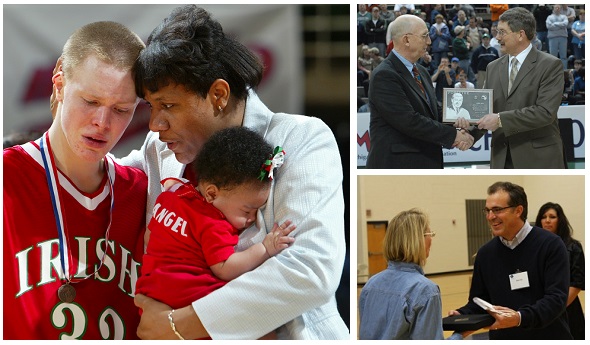
- Brown in 2006 became the first and only female coach to lead a boys team to the MHSAA Basketball Finals, guiding the Irish to the Class D Final before they fell to Wyoming Tri-unity Christian. She also served as principal and athletic director at Sacred Heart and coached the boys basketball team to a 114-30 record before taking over the Alma College women’s program, which she coached through this season. Click to read the memorial column from the Mount Pleasant Morning Sun’s Jim Lahde.
"RIP Keisha Brown. What a truly inspiring human being that battled cancer with courage and strength. My thoughts are with her family.” – Oakland Press reporter Drew Ellis, formerly of the Morning Sun
“Rest in Peace Keisha Brown #TrueWarrior. Words cannot express my sadness #HeartBroken.” – Alma College Sports Information Director Mike Hanson
- Bye worked in the Grand Haven school system for 34 years, including the last two-plus as athletic director after formerly serving as an assistant and a girls basketball coach. He also had been a middle school art teacher in the district, and last year received its “Spirit of Grand Haven” award for commitment and dedication to Grand Haven schools. Click to read the story on his passing from the Muskegon Chronicle’s Scott Brandenburg.
“Thinking of the Bye family tonight. Robin will be missed. As a person and an AD, he made me want to be better a person/coach. God Bless.” – Grand Haven boys basketball coach Steve Hewitt.
“I will miss Robin Bye. He made a big difference for the youth in our town, more than an athletic director; an inspiration.” – Grand Haven parent Pat McGinnis
- Gent began his career at Haslett in 1967 as a middle school teacher and high school coach in three sports. He was head coach of the track and field, boys basketball and football varsity teams at different times and began his second stint as the school’s athletic director in 1991. He also was an MHSAA registered official for more than 15 years and a mentor to many both in the Lansing area and statewide through his contributions to the Michigan Interscholastic Athletic Administrators Association. He received the MHSAA’s Charles E. Forsythe Award in 2008. See below for a video posted that year in honor of Gent as he retired as athletic director, and click for Dick Hoekstra's piece in the Lansing State Journal posted today.
“Sad to hear of the passing of Jamie Gent, long time Haslett HS athletic director. Really great guy, very kind hearted.” – former Haslett athlete, current White Pigeon teacher/coach Kurt Twichell
“Jamie Gent was one of the best ADs I had the privilege to know. A great loss tonight for the Haslett community.” – Chelsea football coach Brad Bush
PHOTOS: (Clockwise from left) Former Mount Pleasant Sacred Heart boys basketball coach Keisha Brown comforts one of her players after the Irish fell in the Class D Final in 2006. Jamie Gent, left, receives his Charles E. Forsythe Award from Negaunee's Jim Derocher during the 2008 Boys Basketball Finals. Grand Haven athletic director, Robin Bye, is recognized as an assistant coach on the 1981 girls basketball team inducted into the Grand Haven sports Hall of Fame.

5 Strategies To Improve Range Of Motion
March 6, 2024
When it comes to health and fitness, regular exercise and strength training get the most attention. But it turns out that improving your range of motion may pay greater dividends, particularly over the long haul.
“All kinds of things can impact our range of motion,” says Jennifer Burnham, an athletic trainer at Henry Ford Health. “As we age, our joints become less pliable, but any kind of surgery or injury can also impact our range of motion. And if you're somebody who sits at a desk all day long, that can affect your range of motion as well.”
Why Is Improving Flexibility Important?
Staying active with regular cardiovascular exercise and strength training is a great way to maintain your overall physical health. But it’s important to remember that flexibility exercises come with plenty of perks, too, including:
- Preventing injury
- Staving off arthritis by lubricating joints and tissues
- Improving posture and balance
"Unfortunately, if you have limited range of motion, you may perform tasks incorrectly, causing other muscles and joints to overcompensate for the lack of mobility,” Burnham says. “Over time, that compensation mechanism can increase the risk of injury.”
To complicate matters, our lifestyles often don’t support our range of motion goals. Many of us spend most of our days sitting at a desk or hunched over a screen. And when we’re not sitting still, most of us are slouching.
What Are Some Ways To Improve Range Of Motion?
You don’t have to be able to twist your limbs into a pretzel to achieve full range of motion. Instead, try to improve on your current level of flexibility with these five simple strategies:
- Pay attention to timing. If you’re not ready to add a stretching day to your workout regimen, consider adding a set of flexibility exercises at the end of every session. Pre-workout stretching is helpful, too, but stretching when your muscles are warm is a more effective way to stave off injuries.
- Focus on mobility and stability. Even if you can do the splits or touch your toes to the back of your head, you won’t be able to hold the position if you don’t also have strong core muscles. “Most people do stabilizing exercises such as strength training and lifting weights without paying much attention to mobilizing activities like stretching and yoga,” Burnham says. “But you really need to do both stabilizing and flexibility exercises to get an effective workout.”
- Do a mix of dynamic and static stretches. Two types of stretches can help you gain an edge when it comes to improving range of motion: Dynamic (an active type of stretching where you’re moving within your range of motion) and static stretching (where you hold a stretch). Dynamic stretching with arm and head circles, side stretches, and hip circles before exercise is a good way to warm up cool muscles and help lubricate the joints. With static stretching such as touching your toes to stretch your hamstrings, the goal is to hold a position for 30 seconds or more. Static stretches are often best performed after a workout when your muscles are warm.
- Try foam rolling. Foam rollers act almost like a rolling pin to smooth out tight muscles. Used correctly, they can help improve range of motion — and release stress and tension. You can use foam rollers to prime your body for exercise, or to recover after a workout.
- Aim for balance. If one part of your body is super flexible, focus on increasing range of motion in the opposing muscle group. “So, for example, if your hamstrings are very flexible, make sure to target your quadriceps with flexibility exercises,” Burnham says. “The goal is to make sure you’re aiming for balancing in your body.”
While stretching is an important way to achieve and maintain balance, flexibility and range of motion, it isn’t always intuitive. Not sure where to begin? Consider meeting with a personal trainer or athletic trainer to help you devise a program.
“Watching YouTube videos can be helpful, but if you’ve never done flexibility exercises before, you could overstretch your muscles or find yourself in an incorrect position to stretch,” Burnham says. “And yes, you can create bodily injury by overstretching.”
To find a sports medicine provider at Henry Ford Health, visit henryford.com/sportsmedicine or call 313-651-1969.
Reviewed by Jennifer Burnham, MS, AT, ATC, CSCS, a certified athletic trainer at the Henry Ford Center for Athletic Medicine.