

Mourning Those Who Contributed Much
April 14, 2014
By Geoff Kimmerly
Second Half editor
This weekend was a sad one for those who work in Michigan high school athletics or have appreciated the contributions from three who gave significantly to our games but died after long fights with cancer.
Mount Pleasant Sacred Heart's Keisha Brown, Grand Haven's Robin Bye and Haslett's Jamie Gent left memorable legacies in their passing – Brown on Thursday, Gent on Friday and Bye on Saturday.
Following are just a few details of their contributions to schools and sports, followed by a handful of Twitter posts celebrating their commitments.
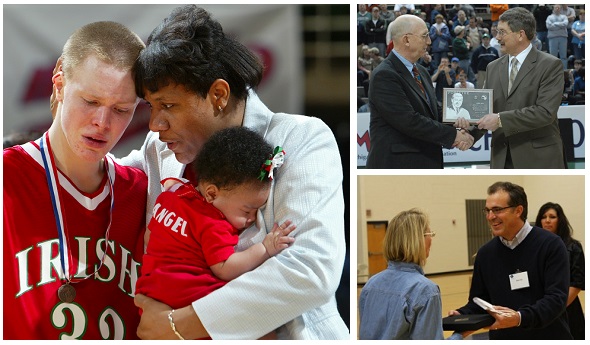
- Brown in 2006 became the first and only female coach to lead a boys team to the MHSAA Basketball Finals, guiding the Irish to the Class D Final before they fell to Wyoming Tri-unity Christian. She also served as principal and athletic director at Sacred Heart and coached the boys basketball team to a 114-30 record before taking over the Alma College women’s program, which she coached through this season. Click to read the memorial column from the Mount Pleasant Morning Sun’s Jim Lahde.
"RIP Keisha Brown. What a truly inspiring human being that battled cancer with courage and strength. My thoughts are with her family.” – Oakland Press reporter Drew Ellis, formerly of the Morning Sun
“Rest in Peace Keisha Brown #TrueWarrior. Words cannot express my sadness #HeartBroken.” – Alma College Sports Information Director Mike Hanson
- Bye worked in the Grand Haven school system for 34 years, including the last two-plus as athletic director after formerly serving as an assistant and a girls basketball coach. He also had been a middle school art teacher in the district, and last year received its “Spirit of Grand Haven” award for commitment and dedication to Grand Haven schools. Click to read the story on his passing from the Muskegon Chronicle’s Scott Brandenburg.
“Thinking of the Bye family tonight. Robin will be missed. As a person and an AD, he made me want to be better a person/coach. God Bless.” – Grand Haven boys basketball coach Steve Hewitt.
“I will miss Robin Bye. He made a big difference for the youth in our town, more than an athletic director; an inspiration.” – Grand Haven parent Pat McGinnis
- Gent began his career at Haslett in 1967 as a middle school teacher and high school coach in three sports. He was head coach of the track and field, boys basketball and football varsity teams at different times and began his second stint as the school’s athletic director in 1991. He also was an MHSAA registered official for more than 15 years and a mentor to many both in the Lansing area and statewide through his contributions to the Michigan Interscholastic Athletic Administrators Association. He received the MHSAA’s Charles E. Forsythe Award in 2008. See below for a video posted that year in honor of Gent as he retired as athletic director, and click for Dick Hoekstra's piece in the Lansing State Journal posted today.
“Sad to hear of the passing of Jamie Gent, long time Haslett HS athletic director. Really great guy, very kind hearted.” – former Haslett athlete, current White Pigeon teacher/coach Kurt Twichell
“Jamie Gent was one of the best ADs I had the privilege to know. A great loss tonight for the Haslett community.” – Chelsea football coach Brad Bush
PHOTOS: (Clockwise from left) Former Mount Pleasant Sacred Heart boys basketball coach Keisha Brown comforts one of her players after the Irish fell in the Class D Final in 2006. Jamie Gent, left, receives his Charles E. Forsythe Award from Negaunee's Jim Derocher during the 2008 Boys Basketball Finals. Grand Haven athletic director, Robin Bye, is recognized as an assistant coach on the 1981 girls basketball team inducted into the Grand Haven sports Hall of Fame.
The Dangers of Returning to a Sport Too Soon After an Injury
September 12, 2023
 When you've been hit with an injury, it's natural to want to get back to your regular activities as soon as possible. In fact, it's not uncommon for athletes to sidestep doctors' orders and return to the field or the court before an injury has healed.
"It doesn’t matter how much you train, or how much you prepare, injuries are going to happen, especially if you're an athlete," says Jamie Schwab, an athletic trainer at Henry Ford Health System. "But the real trouble arises when athletes try to play through their pain without allowing sufficient time for recovery."
Risks Of Returning Too Soon After Injury
If you sprain your ankle during a cross country run, it can be tempting to finish the race. Unfortunately, hiding your pain and powering through the activity can actually make matters worse.
"If you continue to work out after suffering from an injury, you run the risk of furthering that injury," Schwab says. So what began as a minor ankle sprain can evolve into a major sprain that sidelines you for weeks.
Returning to play after surgery demands extra precautions. "Athletes are a lot more susceptible to re-injury after returning from surgery, especially if they don't complete the entire 9-month or year-long rehabilitation protocol," Schwab says. In some cases, you can exacerbate an injury to such a degree that you'll never be able to participate in the same capacity.
A Safe Return To Play
The road back to play after an injury is a long and winding one. Before you can even consider returning to exercise, you need to reduce swelling, get pain under control and get your range of motion back to almost normal.
"The recovery process takes time," Schwab says. "But if you stick with it, and you take it seriously, it's going to be a whole lot easier for you to return to the playing field in a timely manner."
Once you get pain and swelling under control, you can focus on agility and weight exercises that will help you regain strength and slowly return to baseline. The key tenets for a safer return to play:
► Be honest about your abilities: "So many athletes are afraid to tell the truth," Schwab says. "But if you're hurting and you're not competing at your full potential, you're letting your team down and yourself down, too." Even worse, you could increase your risk of further injury.
► Focus on building strength: Strength training is critical. It can help you become faster, stronger and more agile on the field. It can also help you recover more quickly after an injury.
► Listen to your body: If something doesn't feel right, pay attention to it. Talk to your athletic trainer or a physical therapist to get to the bottom of what's bugging you and put a plan in place to address it.
Boosting Performance Over The Long Haul
Unfortunately, not every coach and athletic trainer stresses the importance of a maintenance program. In fact, focused training and maintenance exercises are key to preventing injuries in the first place.
"The rehabilitation exercises you begin doing on day one after injury need to be maintained at least three to four times each week, indefinitely," Schwab says. "If you follow that regimen, all of your muscular nagging strains will no longer be a problem because your body is constantly adapting to the stresses. It's conditioned, it's strong, it can withstand the constant changes in direction."
Most importantly, don't be afraid to try complementary strategies. Practice using a foam roller, try cupping to release tension in the muscles and enhance blood flow and consider getting a monthly massage.
Jamie Schwab, AT, ATC, SCAT, CSCS, is an athletic trainer with Henry Ford Sports Medicine and works with student athletes at Edsel Ford High School. She is a National Strength and Conditioning Association-certified strength and conditioning specialist.
To find a sports medicine doctor or athletic trainer at Henry Ford, visit henryford.com/sports.