


Mourning Those Who Contributed Much
April 14, 2014
By Geoff Kimmerly
Second Half editor
This weekend was a sad one for those who work in Michigan high school athletics or have appreciated the contributions from three who gave significantly to our games but died after long fights with cancer.
Mount Pleasant Sacred Heart's Keisha Brown, Grand Haven's Robin Bye and Haslett's Jamie Gent left memorable legacies in their passing – Brown on Thursday, Gent on Friday and Bye on Saturday.
Following are just a few details of their contributions to schools and sports, followed by a handful of Twitter posts celebrating their commitments.
- Brown in 2006 became the first and only female coach to lead a boys team to the MHSAA Basketball Finals, guiding the Irish to the Class D Final before they fell to Wyoming Tri-unity Christian. She also served as principal and athletic director at Sacred Heart and coached the boys basketball team to a 114-30 record before taking over the Alma College women’s program, which she coached through this season. Click to read the memorial column from the Mount Pleasant Morning Sun’s Jim Lahde.
"RIP Keisha Brown. What a truly inspiring human being that battled cancer with courage and strength. My thoughts are with her family.” – Oakland Press reporter Drew Ellis, formerly of the Morning Sun
“Rest in Peace Keisha Brown #TrueWarrior. Words cannot express my sadness #HeartBroken.” – Alma College Sports Information Director Mike Hanson
- Bye worked in the Grand Haven school system for 34 years, including the last two-plus as athletic director after formerly serving as an assistant and a girls basketball coach. He also had been a middle school art teacher in the district, and last year received its “Spirit of Grand Haven” award for commitment and dedication to Grand Haven schools. Click to read the story on his passing from the Muskegon Chronicle’s Scott Brandenburg.
“Thinking of the Bye family tonight. Robin will be missed. As a person and an AD, he made me want to be better a person/coach. God Bless.” – Grand Haven boys basketball coach Steve Hewitt.
“I will miss Robin Bye. He made a big difference for the youth in our town, more than an athletic director; an inspiration.” – Grand Haven parent Pat McGinnis
- Gent began his career at Haslett in 1967 as a middle school teacher and high school coach in three sports. He was head coach of the track and field, boys basketball and football varsity teams at different times and began his second stint as the school’s athletic director in 1991. He also was an MHSAA registered official for more than 15 years and a mentor to many both in the Lansing area and statewide through his contributions to the Michigan Interscholastic Athletic Administrators Association. He received the MHSAA’s Charles E. Forsythe Award in 2008. See below for a video posted that year in honor of Gent as he retired as athletic director, and click for Dick Hoekstra's piece in the Lansing State Journal posted today.
“Sad to hear of the passing of Jamie Gent, long time Haslett HS athletic director. Really great guy, very kind hearted.” – former Haslett athlete, current White Pigeon teacher/coach Kurt Twichell
“Jamie Gent was one of the best ADs I had the privilege to know. A great loss tonight for the Haslett community.” – Chelsea football coach Brad Bush
PHOTOS: (Clockwise from left) Former Mount Pleasant Sacred Heart boys basketball coach Keisha Brown comforts one of her players after the Irish fell in the Class D Final in 2006. Jamie Gent, left, receives his Charles E. Forsythe Award from Negaunee's Jim Derocher during the 2008 Boys Basketball Finals. Grand Haven athletic director, Robin Bye, is recognized as an assistant coach on the 1981 girls basketball team inducted into the Grand Haven sports Hall of Fame.
Hastings' Life-Saving Response Reinforces Vital Importance of Being Prepared
By
Geoff Kimmerly
MHSAA.com senior editor
August 23, 2022
HASTINGS – Preseason silence, mixed with anticipation, made Hastings High School’s gym feel especially pristine last week.
 The raucousness is returning soon as the school’s volleyball teams are into their first matches of a new season, with winter sports bringing everyone inside in a few months. This is a place where big-game memories are made – but one from a scrimmage June 14 certainly will stick with many who were at Hastings High that day.
That evening, Potterville junior Da’Marion Hicks was playing in a basketball scrimmage when he suffered a heart attack due to a valve that later required open-heart surgery.
During a period of just a few minutes that could have meant his life, Hastings staff, students and a doctor who fortunately happened to be watching his son’s team from the stands, responded to assist Hicks before it was too late. In fact, he’s expected to be cleared to return this upcoming basketball season.
It’s a situation everyone hopes will never happen, but very occasionally it does. And when it did this time, Hastings – with crucial assistance coming out of the bleachers – showed what can be done to assure a best-possible result.
“We debriefed after this whole thing, and we actually had six people from our school (there) trained in CPR and AED use. Enough people felt comfortable enough to take some action to cause it to have a good outcome,” Hastings athletic director Mike Goggins said. “I think more times than not in a situation like this, bad results don’t come from people trying to help. Bad results come from people being afraid to help. What was great about this situation was … lots of people took the initiative to jump in.”
As another school year begins, Hastings’ ready response should continue to reinforce the importance of being prepared for the scariest of situations. (The Grand Rapids Press spoke with Hicks as he was beginning his recovery; click here to read.)
Emergency planning for sports venues has emerged as an important topic especially over the last decade, and the National Federation of State High School Associations (NFHS) and National Athletic Trainers’ Association (NATA) detail how these should work, with the “Anyone Can Save A Life” plan provided to all member schools by the MHSAA at the start of the 2015-16 school year.
Goggins said that while Hastings doesn’t necessarily have a “formal” plan like those linked above, what his department does is “saturate” his teams’ coaches and athletes with knowledge of where to find AEDs – and Hastings also has created a setup whereby a person is never more than one minute from an AED while on school property.
That evening, four boys basketball teams were playing on adjacent courts – including Potterville against Wyoming Tri-unity Christian. Goggins himself wasn’t at the school at the time (although he quickly arrived after being notified of the situation), but the following is the collection of information he has gathered over the last two months.
- Hicks had felt especially fatigued that evening and actually had mentioned to a few Hastings players during their scrimmage earlier that night that he was having a hard time catching his breath – definitely rare for a three-sport athlete who had run the 400 meters at an MHSAA Track & Field Finals a few weeks earlier.
- Hicks went to his bench for a break during the Tri-unity scrimmage, and laid down. Goggins said Potterville teammates thought Hicks was just gassed, but then noticed his eyes rolling back into his head. They started yelling for help.
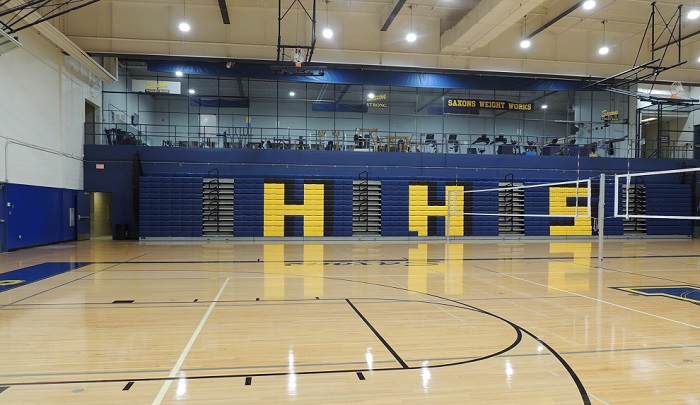
- Hastings boys basketball coach Rich Long sprang into action, running over to the Potterville bench and then calling into the crowd to see if anyone with medical expertise could help a student in distress. Meanwhile, Long was joined by Hastings’ strength coach (and U.S. Marine) James Avery – who was training athletes in the weight room in the balcony overlooking the gym – and Dr. Luke Van Klompenberg, an emergency medicine physician at Holland Hospital who was there watching his son play for Tri-unity.
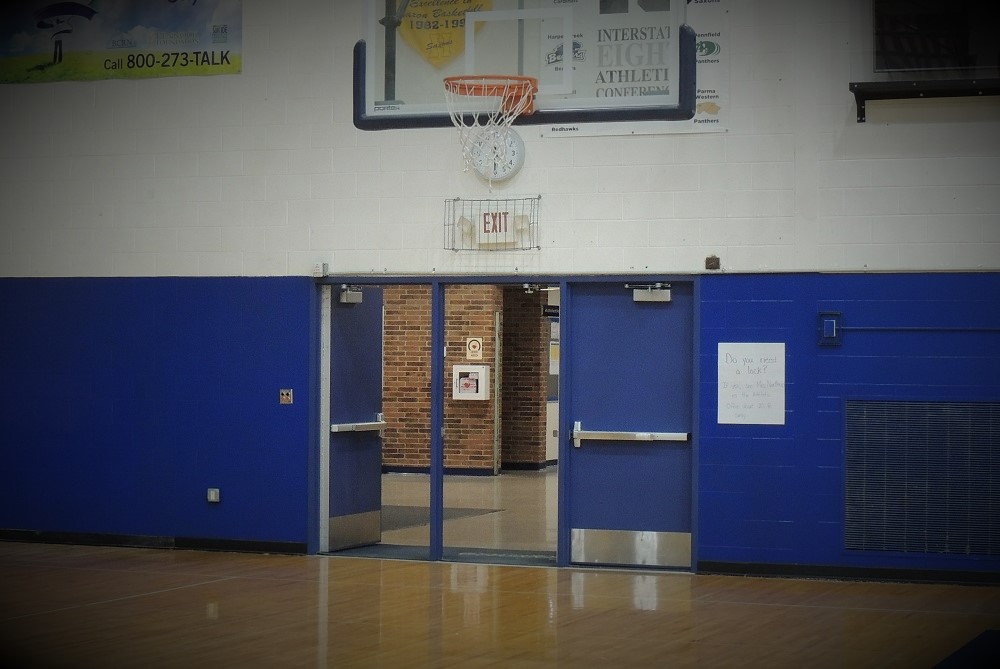
- Long sent an athlete to retrieve the closest AED, located on the wall just outside the gym doors. He also sent a parent to call 9-1-1, and Saxons boys track & field coach Lin Nickels sent multiple athletes to set up a relay near the school’s doors to direct paramedics when they arrived.
- Van Klompenberg, meanwhile, couldn’t find Hicks’ pulse, and the athlete’s breathing was shallow. Avery had begun chest compressions, the AED was used, and as the ambulance arrived Hicks was beginning to regain some consciousness. He was transported to the local Spectrum Health Pennock hospital, then to Helen DeVos Children's Hospital in Grand Rapids.
“It was one of those things where it just worked,” Goggins said. “My message, if nothing else, is we all practice it for a time that may never come – but the more you can saturate your people with the idea of A, being prepared, and B, don’t be afraid to take action … that’s really I think the key.”
 Beginning this year, the MHSAA is requiring all head coaches at the varsity, junior varsity and freshman levels to have CPR certification. That training almost always includes direction in the use of an AED.
Hastings has been on this track for a while. The MHSAA’s first CPR requirement for coaches was added for the 2015-16 school year, just for varsity head coaches – but Goggins made it a requirement for all of his coaches at all levels at that time.
Hastings also has taken AED prep to another level. There are 16 throughout the district – one each at the four elementary schools, two at the middle school and 10 at the high school – and they represent an even bigger investment in the life-saving technology as the district’s school board purchased those 16 a year ago to replace 12 that were nearing their expirations.
Goggins said doctors have told him that if Hicks had not received care for even 4-5 more minutes, he would not have survived because of the damage done to his heart and brain. Potterville athletic director and boys basketball coach Jake Briney said surgeons have broken things down to a 45-second window that made the difference between a good result and a sad one.
Coincidentally, Briney had scheduled a game this upcoming season against Wyoming Tri-unity Christian; Potterville should be tough, and Tri-unity is last season’s Division 4 runner-up. But the events of June 14 will make the events of this upcoming Jan. 14 much more meaningful.
Briney said Potterville also has formed a close relationship with Hastings. Multiple Saxons administrators have checked in, including Goggins almost daily during the first weeks after the incident.
Briney is filled with nothing but praise for Hastings’ preparation. And both athletic directors noted a similar effect at their schools as another school year begins.
“It really, really made the training, made you look at it through a different lens,” Briney said.
“Our fall coaches are now like, ‘You know, if Heather (Coipel, Hastings’ trainer) wanted to stop by and run through the AED procedure again, that would be great,’” Goggins said. “(Or) ‘Where is the AED? We have one at the fieldhouse, right? Where’s the closest one for me again?’ They’re just doublechecking.”
 Geoff Kimmerly joined the MHSAA in Sept. 2011 after 12 years as Prep Sports Editor of the Lansing State Journal. He is a senior editor of MHSAA.com's editorial content and has served as MHSAA Communications Director since January 2021. Contact him at [email protected] with story ideas for the Barry, Eaton, Ingham, Livingston, Ionia, Clinton, Shiawassee, Gratiot, Isabella, Clare and Montcalm counties.
PHOTOS (Top) An AED, located just outside the doors to Hastings’ gymnasium, was used to save Da’Marion Hicks’ life June 14. (Middle) Strength coach James Avery emerged from the balcony weight room to assist in Hicks’ care that evening. (Photos by Geoff Kimmerly.)