

Mourning Those Who Contributed Much
April 14, 2014
By Geoff Kimmerly
Second Half editor
This weekend was a sad one for those who work in Michigan high school athletics or have appreciated the contributions from three who gave significantly to our games but died after long fights with cancer.
Mount Pleasant Sacred Heart's Keisha Brown, Grand Haven's Robin Bye and Haslett's Jamie Gent left memorable legacies in their passing – Brown on Thursday, Gent on Friday and Bye on Saturday.
Following are just a few details of their contributions to schools and sports, followed by a handful of Twitter posts celebrating their commitments.
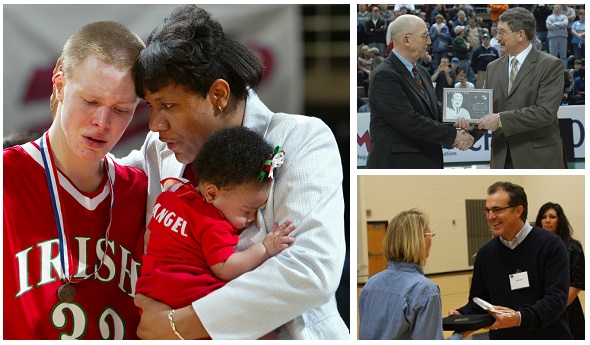
- Brown in 2006 became the first and only female coach to lead a boys team to the MHSAA Basketball Finals, guiding the Irish to the Class D Final before they fell to Wyoming Tri-unity Christian. She also served as principal and athletic director at Sacred Heart and coached the boys basketball team to a 114-30 record before taking over the Alma College women’s program, which she coached through this season. Click to read the memorial column from the Mount Pleasant Morning Sun’s Jim Lahde.
"RIP Keisha Brown. What a truly inspiring human being that battled cancer with courage and strength. My thoughts are with her family.” – Oakland Press reporter Drew Ellis, formerly of the Morning Sun
“Rest in Peace Keisha Brown #TrueWarrior. Words cannot express my sadness #HeartBroken.” – Alma College Sports Information Director Mike Hanson
- Bye worked in the Grand Haven school system for 34 years, including the last two-plus as athletic director after formerly serving as an assistant and a girls basketball coach. He also had been a middle school art teacher in the district, and last year received its “Spirit of Grand Haven” award for commitment and dedication to Grand Haven schools. Click to read the story on his passing from the Muskegon Chronicle’s Scott Brandenburg.
“Thinking of the Bye family tonight. Robin will be missed. As a person and an AD, he made me want to be better a person/coach. God Bless.” – Grand Haven boys basketball coach Steve Hewitt.
“I will miss Robin Bye. He made a big difference for the youth in our town, more than an athletic director; an inspiration.” – Grand Haven parent Pat McGinnis
- Gent began his career at Haslett in 1967 as a middle school teacher and high school coach in three sports. He was head coach of the track and field, boys basketball and football varsity teams at different times and began his second stint as the school’s athletic director in 1991. He also was an MHSAA registered official for more than 15 years and a mentor to many both in the Lansing area and statewide through his contributions to the Michigan Interscholastic Athletic Administrators Association. He received the MHSAA’s Charles E. Forsythe Award in 2008. See below for a video posted that year in honor of Gent as he retired as athletic director, and click for Dick Hoekstra's piece in the Lansing State Journal posted today.
“Sad to hear of the passing of Jamie Gent, long time Haslett HS athletic director. Really great guy, very kind hearted.” – former Haslett athlete, current White Pigeon teacher/coach Kurt Twichell
“Jamie Gent was one of the best ADs I had the privilege to know. A great loss tonight for the Haslett community.” – Chelsea football coach Brad Bush
PHOTOS: (Clockwise from left) Former Mount Pleasant Sacred Heart boys basketball coach Keisha Brown comforts one of her players after the Irish fell in the Class D Final in 2006. Jamie Gent, left, receives his Charles E. Forsythe Award from Negaunee's Jim Derocher during the 2008 Boys Basketball Finals. Grand Haven athletic director, Robin Bye, is recognized as an assistant coach on the 1981 girls basketball team inducted into the Grand Haven sports Hall of Fame.
Speakers Bureau Helps Generate Conversation
December 30, 2019
By Rob Kaminski
MHSAA benchmarks editor
As student mental health climbs the list of health and safety concerns, the MHSAA and state associations across the country are taking measures to provide resources and guidance aimed to keep school sports an enjoyable and valuable experience.
In sports, coaches and athletes learn to expect the unexpected. It’s the nature of competition; constructing gameplans tailored to utilize team strengths and expose opponents’ weaknesses. Often times this entails doing things that opponents won’t expect. Participants then learn and prepare for the next time; it’s one of the ways athletics prepares participants for life, as educational leaders often preach.
Today’s ever-changing culture recently threw such a curveball at the young people who populate our hallways and playing surfaces, calling for statewide associations and organizations to shift focuses and prepare for a new opponent while attempting to keep school sports one of the best means to a healthy adolescent lifestyle.
“I was at the NCAA summer meeting in 2017, discussing health and safety issues and the topic of concussions came up, as it often does. I assumed that concussions was the No. 1 health and safety issue,” said MHSAA Executive Director Mark Uyl. “I was quickly corrected that it’s student mental health; that knocked me back.”
It would not be an uncommon reaction, given the amount of information, media coverage and programs designed to recognize and reduce concussion incidents in recent years.
All the while, anxiety, depression and stress had been creeping into the picture beneath the surface. Such disorders are much more difficult to detect, as there are few visible symptoms when compared to sprains, fatigue, head injuries and other physical ailments.
“I became interested and began to research the topic. The more I read, the more concerned I became,” Uyl said. “The MHSAA, with a great deal of help and cooperation from our school leaders, has done a tremendous job educating and providing resources for health-related issues such as heat management, concussion reporting and practice policies, and now we have a new challenge.”
Fortunately, as has often been the case, there are knowledgeable and qualified people throughout Michigan’s roster of educational leaders who are willing to assist.
As word spread regarding the student mental health initiative, the MHSAA was able to establish a Mental Health Speakers Bureau composed of several experienced individuals willing to assist (see below).
“Our speakers bureau really grew by word of mouth,” Uyl said. “A school would bring in a speaker, or a league would invite a speaker, and once we were connected with them, then those people would share names and it grew from there.”
The resources range from former professional athletes, to behavioral specialists, to current MHSAA coaches.
Dave Ingles, basketball coach at Kent City, is one such individual. His credibility comes from first-hand experience.
“I privately struggled with deep depression for six years,” Ingles said. “Be alert. Talk to your athletes and students and actually listen to what they are saying. I always used the phrase, ‘I’m fine;’ that is not an acceptable answer to me anymore when I hear it.”
The National Institute of Mental Health reveals that most mental health conditions begin around the time children are transitioning from middle school to high school. The more people trained to identify symptoms and behavior, the better the chance to reduce or reverse some of the following numbers:
• 50% of all lifetime cases of mental illness begin by age 14
• 37% of students with a mental health condition age 14 or older drop out of school
• 20% of students ages 13-18 live with a mental health condition
• 11% of youth have a mood disorder and 8% have an anxiety disorder
• Suicide is the third leading cause of death for ages 10-24
Non-visible ailments always have been most difficult to detect, and today’s proliferation of technology – from streaming to social media – can serve to further mask symptoms.
“The more kids spend time with their devices, staring at their screens, isolation can be quick to take hold,” Uyl said. “Everything is instant. It used to be if our friends didn’t invite us somewhere, we didn’t worry about it; we probably wouldn’t find out for a couple days and had already moved on. Today, in about 10 minutes, there’s a picture on Instagram or Snapchat and kids instantly know, ‘I’m not included.’ Isolation leads to depression and anxiety, and in the worst cases can even lead to suicide.”
That message might sound familiar. Segments of the 2019-20 MHSAA online rules meetings include Uyl emphasizing student mental health and a video clip produced by benice.org promoting a mental health action plan endorsed by four of the state’s most recognized collegiate coaches.
It’s all part of the plan to promote awareness and generate conversation surrounding this serious health and safety issue during 2019-20 and beyond.
“We’re not going to try to do this all by ourselves,” Uyl said. “There are plenty of experts in the field, and we’re going to utilize their knowledge. We’ll build relationships and align ourselves with these people to provide a foundation. We need to become a resource center for our membership.”
In addition to the rules meetings messages, the MHSAA also partnered with the Michigan Association of Secondary School Principals Student Mental Health Summit on Oct. 8 in Lansing. This event – sold out within weeks of posting – invited principals, counselors, student leadership advisers and student leaders to come together to discuss and seek solutions for student mental health concerns impacting schools. The MHSAA lined up Eric Hipple, one of its speaker bureau members, who delivered a keynote, “Depression and Suicidal Awareness.”
Student mental health was among topics during the MHSAA Update and AD In-Service tour around the state this fall as well. The meeting at Comstock Park on Sept. 30 included a presentation from the Mental Health Foundation of West Michigan to introduce the be nice® action plan and encourage schools to take advantage of that and other resources the group has to offer.
The rise of mental health as one of the more prominent medical concerns nationally has occurred, as Ingles sees it, “because more people are talking about it now.”
Leaders like Ingles and those in numerous organizations have begun to assist the MHSAA in identifying and treating cases in our schools.
MHSAA Mental Health Speakers Bureau
Below is a list of individuals and organizations partnering with the MHSAA to assist in promoting mental well-being for students around the state. The MHSAA encourages school personnel to reach out to any of these experienced leaders in the field for programming in your buildings and districts.
• Christy Buck, Executive Director – Mental Health Foundation of West Michigan - be nice.® [email protected]
• Brooke Buys, Mental & Behavioral Health Specialist – BLND Health [email protected]
• Eric Hipple, former Detroit Lions quarterback [email protected]
• Dave Ingles, Basketball Coach & Speaker – Kent City High School [email protected]
• Cat Lanting, Program Coordinator – Mental Health Foundation of West Michigan - be nice.® [email protected]
• Halle Wangler, former University of Michigan basketball player [email protected]
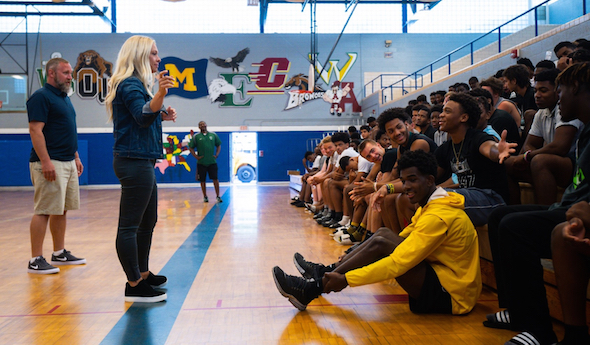
PHOTO: Brooke Buys, a mental and behavioral health specialist and founder of BLND Health, speaks with students. (Photo courtesy of BLND Health.)