

Mourning Those Who Contributed Much
April 14, 2014
By Geoff Kimmerly
Second Half editor
This weekend was a sad one for those who work in Michigan high school athletics or have appreciated the contributions from three who gave significantly to our games but died after long fights with cancer.
Mount Pleasant Sacred Heart's Keisha Brown, Grand Haven's Robin Bye and Haslett's Jamie Gent left memorable legacies in their passing – Brown on Thursday, Gent on Friday and Bye on Saturday.
Following are just a few details of their contributions to schools and sports, followed by a handful of Twitter posts celebrating their commitments.
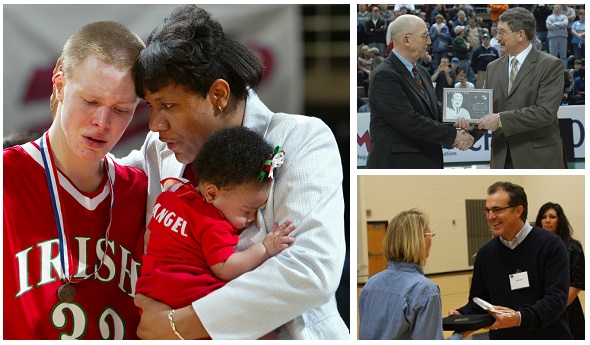
- Brown in 2006 became the first and only female coach to lead a boys team to the MHSAA Basketball Finals, guiding the Irish to the Class D Final before they fell to Wyoming Tri-unity Christian. She also served as principal and athletic director at Sacred Heart and coached the boys basketball team to a 114-30 record before taking over the Alma College women’s program, which she coached through this season. Click to read the memorial column from the Mount Pleasant Morning Sun’s Jim Lahde.
"RIP Keisha Brown. What a truly inspiring human being that battled cancer with courage and strength. My thoughts are with her family.” – Oakland Press reporter Drew Ellis, formerly of the Morning Sun
“Rest in Peace Keisha Brown #TrueWarrior. Words cannot express my sadness #HeartBroken.” – Alma College Sports Information Director Mike Hanson
- Bye worked in the Grand Haven school system for 34 years, including the last two-plus as athletic director after formerly serving as an assistant and a girls basketball coach. He also had been a middle school art teacher in the district, and last year received its “Spirit of Grand Haven” award for commitment and dedication to Grand Haven schools. Click to read the story on his passing from the Muskegon Chronicle’s Scott Brandenburg.
“Thinking of the Bye family tonight. Robin will be missed. As a person and an AD, he made me want to be better a person/coach. God Bless.” – Grand Haven boys basketball coach Steve Hewitt.
“I will miss Robin Bye. He made a big difference for the youth in our town, more than an athletic director; an inspiration.” – Grand Haven parent Pat McGinnis
- Gent began his career at Haslett in 1967 as a middle school teacher and high school coach in three sports. He was head coach of the track and field, boys basketball and football varsity teams at different times and began his second stint as the school’s athletic director in 1991. He also was an MHSAA registered official for more than 15 years and a mentor to many both in the Lansing area and statewide through his contributions to the Michigan Interscholastic Athletic Administrators Association. He received the MHSAA’s Charles E. Forsythe Award in 2008. See below for a video posted that year in honor of Gent as he retired as athletic director, and click for Dick Hoekstra's piece in the Lansing State Journal posted today.
“Sad to hear of the passing of Jamie Gent, long time Haslett HS athletic director. Really great guy, very kind hearted.” – former Haslett athlete, current White Pigeon teacher/coach Kurt Twichell
“Jamie Gent was one of the best ADs I had the privilege to know. A great loss tonight for the Haslett community.” – Chelsea football coach Brad Bush
PHOTOS: (Clockwise from left) Former Mount Pleasant Sacred Heart boys basketball coach Keisha Brown comforts one of her players after the Irish fell in the Class D Final in 2006. Jamie Gent, left, receives his Charles E. Forsythe Award from Negaunee's Jim Derocher during the 2008 Boys Basketball Finals. Grand Haven athletic director, Robin Bye, is recognized as an assistant coach on the 1981 girls basketball team inducted into the Grand Haven sports Hall of Fame.

NFHS Voice: No HS Football Link to CTE
October 21, 2019
By Karissa Niehoff
NFHS Executive Director
When it comes to the long-term effects of concussions in sports, there is a wide range of information published – almost on a daily basis. Unfortunately, much of the media coverage as it relates to high school sports – and particularly the sport of football – is misleading.
Last week, the Concussion Legacy Foundation introduced its new public-service announcement that compared youth football dangers to smoking. As the pre-teen football players puff on cigarettes, the voiceover says, “Tackle football is like smoking, the younger I start, the longer I’m exposed to danger.”
The “Tackle Can Wait” campaign by the foundation is an attempt to steer children under the age of 14 into flag football. Although establishing a finite age may be difficult, reducing contact at youth levels is certainly a positive. USA Football is doing just that nationally through its Football Development Model. Likewise, the 51 member state associations of the National Federation of State High School Associations (NFHS) have enacted limitations on contact during preseason and practice sessions.
Our concern is the term “exposed to danger.” These types of messages continue to spread unwarranted fear to parents of high school student-athletes. The “danger” refers to reports that players who incur repeated concussions can develop chronic traumatic encephalopathy (CTE).
A 2017 study from the Journal of American Medical Association (JAMA) linked CTE in the brains of deceased National Football League players. Even if this report is accurate, these are individuals who endured repeated blows to the head for 20 to 25 years BEFORE any concussion protocols were in place.
Less publicized is a study by Dr. Munro Cullum and his colleagues at the Peter O’Donnell Jr. Brain Institute, which is a part of the University of Texas Southwestern Medical Center in Dallas. Cullum’s group studied 35 former NFL players age 50 and older who had sustained multiple concussions throughout their careers. The findings showed no significant association between the length of the individuals’ careers, the number of concussions and their cognitive function later in life.
Two studies, two different conclusions. Regardless of the outcome, however, they are not applicable to kids playing football before and during high school. There is absolutely no linkage to CTE at these levels, and the word “danger” should not be a part of the discussion.
A more applicable and significant study was also published in JAMA in 2017. In a study of about 4,000 men who graduated from Wisconsin high schools in 1957, there was no difference in cognitive function or decline between those who played football and those who did not as they reached 65 years of age. We would assume the majority of these individuals discontinued football after high school.
With more than one million boys – and girls – playing the contact sport of football each year, severe injuries do occur from time to time, but parents should know that efforts to lessen the risk of a catastrophic injury, including head injuries, have never been stronger than they are today.
In fact, new data from the National High School Sports-Related Injury Surveillance Study indicates some positive trends in concussion rates. The study, which was released in the American Academy of Pediatrics online issue of Pediatrics last week, indicated that concussion rates during football practices dropped from 5.47 to 4.44 concussions per 10,000 athletic exposures between the 2013-14 and 2017-18 seasons.
In addition, repeat concussion rates across all sports declined from 0.47 to 0.28 per 10,000 exposures during the same time period.
Concussion laws are in place in every state. All NFHS sports rules books have concussion management protocols. Helmet-to-helmet hits are not allowed in football. Limits on contact in preseason and practice in football are in place in every state.
After considering all the available research, we encourage parents to let their kids play their sport of choice in high school, but we would discourage moving away from football – or any contact sport – solely based on the fear of developing CTE later in life.
Dr. Karissa L. Niehoff is in her second year as executive director of the National Federation of State High School Associations (NFHS) in Indianapolis, Indiana. She is the first female to head the national leadership organization for high school athletics and performing arts activities and the sixth full-time executive director of the NFHS, which celebrated its 100th year of service during the 2018-19 school year. She previously was executive director of the Connecticut Association of Schools-Connecticut Interscholastic Athletic Conference for seven years.