

Mourning Those Who Contributed Much
April 14, 2014
By Geoff Kimmerly
Second Half editor
This weekend was a sad one for those who work in Michigan high school athletics or have appreciated the contributions from three who gave significantly to our games but died after long fights with cancer.
Mount Pleasant Sacred Heart's Keisha Brown, Grand Haven's Robin Bye and Haslett's Jamie Gent left memorable legacies in their passing – Brown on Thursday, Gent on Friday and Bye on Saturday.
Following are just a few details of their contributions to schools and sports, followed by a handful of Twitter posts celebrating their commitments.
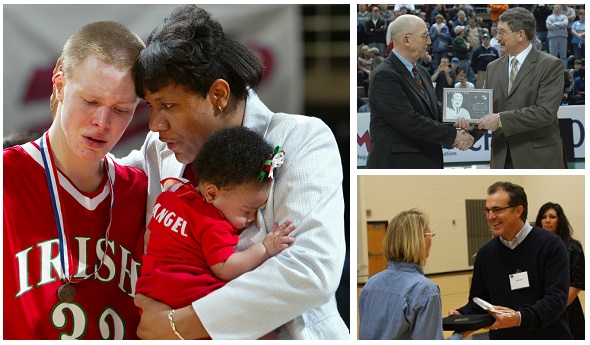
- Brown in 2006 became the first and only female coach to lead a boys team to the MHSAA Basketball Finals, guiding the Irish to the Class D Final before they fell to Wyoming Tri-unity Christian. She also served as principal and athletic director at Sacred Heart and coached the boys basketball team to a 114-30 record before taking over the Alma College women’s program, which she coached through this season. Click to read the memorial column from the Mount Pleasant Morning Sun’s Jim Lahde.
"RIP Keisha Brown. What a truly inspiring human being that battled cancer with courage and strength. My thoughts are with her family.” – Oakland Press reporter Drew Ellis, formerly of the Morning Sun
“Rest in Peace Keisha Brown #TrueWarrior. Words cannot express my sadness #HeartBroken.” – Alma College Sports Information Director Mike Hanson
- Bye worked in the Grand Haven school system for 34 years, including the last two-plus as athletic director after formerly serving as an assistant and a girls basketball coach. He also had been a middle school art teacher in the district, and last year received its “Spirit of Grand Haven” award for commitment and dedication to Grand Haven schools. Click to read the story on his passing from the Muskegon Chronicle’s Scott Brandenburg.
“Thinking of the Bye family tonight. Robin will be missed. As a person and an AD, he made me want to be better a person/coach. God Bless.” – Grand Haven boys basketball coach Steve Hewitt.
“I will miss Robin Bye. He made a big difference for the youth in our town, more than an athletic director; an inspiration.” – Grand Haven parent Pat McGinnis
- Gent began his career at Haslett in 1967 as a middle school teacher and high school coach in three sports. He was head coach of the track and field, boys basketball and football varsity teams at different times and began his second stint as the school’s athletic director in 1991. He also was an MHSAA registered official for more than 15 years and a mentor to many both in the Lansing area and statewide through his contributions to the Michigan Interscholastic Athletic Administrators Association. He received the MHSAA’s Charles E. Forsythe Award in 2008. See below for a video posted that year in honor of Gent as he retired as athletic director, and click for Dick Hoekstra's piece in the Lansing State Journal posted today.
“Sad to hear of the passing of Jamie Gent, long time Haslett HS athletic director. Really great guy, very kind hearted.” – former Haslett athlete, current White Pigeon teacher/coach Kurt Twichell
“Jamie Gent was one of the best ADs I had the privilege to know. A great loss tonight for the Haslett community.” – Chelsea football coach Brad Bush
PHOTOS: (Clockwise from left) Former Mount Pleasant Sacred Heart boys basketball coach Keisha Brown comforts one of her players after the Irish fell in the Class D Final in 2006. Jamie Gent, left, receives his Charles E. Forsythe Award from Negaunee's Jim Derocher during the 2008 Boys Basketball Finals. Grand Haven athletic director, Robin Bye, is recognized as an assistant coach on the 1981 girls basketball team inducted into the Grand Haven sports Hall of Fame.
2018-19 Concussion Data Reinforces Trends
September 26, 2019
By Geoff Kimmerly
Second Half editor
Data on student-athlete concussions collected by the Michigan High School Athletic Association from member high schools during the 2018-19 school year further reinforced findings from the first three years of reporting, and will contribute significantly as a number of MHSAA-associated groups work during the coming year to reduce the incidence of those injuries.
The 2018-19 concussion report found student-athletes at MHSAA member high schools encountered a total of 3,686 head injuries during the past school year – 3.0 percent more than in 2017-18. But that slight increase barely affected two key ratios. The number of injuries per member school was 4.9, up just a tenth of a percent from 2017-18, and for the second straight year only 1.3 percent of participants in MHSAA sports experienced a head injury, still down from 1.4 in 2016-17 and 1.6 percent the first year of the study. Total participation in MHSAA sports for 2018-19 was 281,992 – with students counted once for each sport they played.
The MHSAA has continued to invite Michigan’s universities, health care systems and the National Federation of State High School Associations (NFHS) to take part in analyzing the data and resulting questions that have arisen during the past three years. The 2018-19 results will be examined by the MHSAA’s newly-formed Sports Medicine Advisory Committee and also undergo analysis by representatives of Michigan State University’s Institute for the Study of Youth Sports. Furthermore, the MHSAA is directing its sport committees to study the data as they consider adjustments that could be made to rules for practice and competition.
“The 2018-19 concussion survey further reinforced the findings and trends we have seen emerge; not only in specific sports, but across all of our activities – and this latest set of results also raises new questions,” MHSAA Executive Director Mark Uyl said. “We must continue to look at how changes to playing rules and improvements in equipment may be beneficial moving forward, and also how we can further educate administrators, coaches, athletes and parents to identify and provide treatment for these injuries as soon as possible. We also are excited for the opportunity to have more eyes on these results as we continue to explore more ways to make our games safer.”
As first mandated in 2015-16, member schools are required to report head injuries to the MHSAA identifying the sport that each student-athlete was participating in and whether the injury was sustained during practice or competition. Schools also are required to designate at which level – varsity, junior varsity or freshman – the injury occurred.
The full report of all head injuries experienced during 2018-19 by student-athletes at MHSAA member high schools – including percentages by sport (per 1,000 participants), gender and team level, as well as data tracking when athletes returned to play – is available on the Health & Safety page of the MHSAA Website.
Keeping with the first three years of this survey, the MHSAA continued to receive data from more than 99 percent of its member high schools after the fall, winter and spring seasons. Member junior high and middle schools also were allowed, although not mandated, to report their head injuries; and those findings are not part of the published report.
Boys in 2018-19 experienced 2,404 – or 65 percent – of concussion injuries, just a percent less than during 2017-18, and not surprisingly as boys have a much higher participation in contact sports. More than half of head injuries – 59 percent – were experienced by varsity athletes, a slight increase of three percent from the previous year. A total of 2,441 head injuries – or 66 percent – came in competition as opposed to practice. Just more than half took place during either the middle of practice or middle of competition as opposed to the start or end, and 51 percent of injuries were a result of person-to-person contact.
The MHSAA also asked schools to report the number of days between the head injury and the athlete’s return to activity – and the two largest groups returned to activity after either 6 to 10 days of rest (24 percent) or 11 to 15 days (23 percent). All of these findings were within 1-3 percent of those discovered from the 2017-18 data.
Contact sports again revealed the most head injuries. Ranking first was football, 11 and 8-player combined, with 44 head injuries per 1,000 participants – an increase of three per 1,000 from 2017-18 but the same ratio as 2016-17 and still down from 49 head injuries per 1,000 football participants shown by the first study in 2015-16. Ice hockey again revealed the second-most injuries per 1,000, with 35 (also up three from a year ago but still down from 36 injuries per 1,000 from 2016-17 and 38 per 1,000 in 2015-16), and girls soccer was third with 25 head injuries per 1,000 participants for the second year in a row. Wrestling followed with 22 head injuries per 1,000 participants.
Continuing a noticeable trend of the last few years, the next three sports to show the highest incidences of head injuries were girls sports – girls lacrosse, competitive cheer and basketball also revealed 20 per 1,000 participants, although basketball was down two injuries per 1,000 participants or nearly 10 percent from the previous year. Boys lacrosse (16), boys soccer (14), girls volleyball (11), softball (11) and gymnastics (10) also showed double-digit head injuries per 1,000 participants.
Females again reported significantly more concussions than males playing the same or similar sports – soccer, basketball and baseball/softball. Female soccer players reported nearly double the concussions per 1,000 participants as male soccer players (25 to 14), while female basketball players reported nearly triple the number of concussions per 1,000 participants (20 to 7). Softball players also reported nearly triple the concussions per 1,000 participants of baseball players (11 to 4).
Schools report possible concussions online via the MHSAA Website. Reports are then examined by members of the MHSAA staff, who follow up with school administrators as those student-athletes continue to receive care and eventually return to play. Student privacy is protected.
The reporting of concussions is part of a three-pronged advance by the MHSAA in concussion care begun during the 2015-16 school year. The MHSAA completed in spring 2017 the largest-ever state high school association sideline concussion testing pilot program, with a sample of schools from across the state over two years using one of two screening tests designed to detect concussions. The MHSAA also was the first state association to provide all participants at every member high school and junior high/middle school with insurance intended to pay accident medical expense benefits – covering deductibles and co-pays left unpaid by other policies – resulting from head injuries sustained during school practices or competitions and at no cost to either schools or families.
Previously, the MHSAA also was among the first state associations to adopt a return-to-play protocol that keeps an athlete out of activity until at least the next day after a suspected concussion, and allows that athlete to return to play only after he or she has been cleared unconditionally for activity by a doctor (M.D. or D.O.), physician’s assistant or nurse practitioner.
In addition, the MHSAA’s Coaches Advancement Program – which includes courses that must be completed by all varsity head coaches hired for the first time at a member school – provides substantial instruction on concussion care. Separately, rules meetings that are required viewing for high school varsity and subvarsity head and assistant coaches at the start of each season include detailed training on caring for athletes with possible head injuries.