

New Math: Division & Multiplication Problems
July 25, 2017
By Jack Roberts
MHSAA Executive Director
This is the second part in a series on MHSAA tournament classification, past and present, that will be published over the next two weeks. This series originally ran in this spring's edition of MHSAA benchmarks.
High school tournament classifications went viral before there was social media and most of us knew what “viral” meant.
Much as a virus infects computers today or has created epidemics of disease around the world for centuries, high school tournament classification – once introduced – tends to spread uncontrollably. Once started, it tends to keep expanding and rarely contracts.
While we are still some distance from providing every team a trophy as a result of expanding high school tournament classification across the country, there is criticism nevertheless that we are headed in that direction – a philosophy which is supposed to exist only in local youth sports for our youngest children.
Michigan could be blamed for all this. Michigan is generally accepted as the first state to provide different classifications for season-ending tournaments for different sized schools. It started a century ago. Today, every state has various classifications for its tournaments in most if not all sports. And it is a bit ironic that Michigan – creator of the classification chaos – more than most other states has kept the number of tournament classes or divisions under control.
Yes, there is evidence that tournament classifications have expanded over the years in Michigan, especially with the relatively recent introduction of tournaments in football and the late 1990s’ move from classes to divisions in most MHSAA tournaments. But the MHSAA Representative Council has held true to its word when it expanded the playoffs for football from four classes to eight divisions: this is needed because of unique factors of football, factors that exist in no other sport; and all other sports should be capped at a maximum of four classes or divisions.
Kentucky is the preeminent defender of single-class basketball. All of its 276 high schools compete for the single state championship for each gender. In Indiana, there are still open wounds from its move in 1998 from one to four classes for its 400 schools in basketball.
Multi-class tournaments have tended to increase the number of non-public school champions, which some states are trying to lower through enrollment “multipliers,” and also tend to increase the number of repeat champions, which some states are trying to affect with “success factors” which lift smaller schools into classifications for larger schools if they take home too many trophies.
While there is considerable evidence that state tournaments do as much bad as good for educational athletics, state associations persist in providing postseason tournaments because, on balance, the experiences are supposed to be good for student-athletes. And once we reach that conclusion it is just a small leap to believe that if the tournaments are good for a few, they must be better for more – which leads to creating more and more tournament classifications. One becomes two classes, then three, then four and so forth.
While the argument is that more classifications or divisions provides more students with opportunities to compete and win, it is undeniable that the experience changes as the number of tournament classifications expands. It is not possible for state associations to provide the same level of support when tournament classifications expand to multiple venues playing simultaneously. For example, there is less audio and video broadcast potential at each venue, and less media coverage to each venue. Focus is diluted and fans diminished at each championship.
No one can argue reasonably that today's two-day MHSAA Football Finals of eight championship games has the same pizazz as the one-day, four-games event conducted prior to 1990.
In some states the number of divisions has grown so much that it is difficult to see much difference between the many season-ending state championship games and a regular-season event in the same sport.
It is a balancing act. And Michigan has been studying that balance longer than any other state, and charting a steadier course than most.
Addition by Division
The shift to Divisions for MHSAA Tournament play in numerous sports has added up to a greater number of champions for teams and individuals across the state. Following are the sports currently employing a divisional format, and the procedures for determining enrollment and classification.
In 23 statewide or Lower Peninsula tournaments, schools which sponsor the sport are currently divided into nearly equal divisions. They are:
- Baseball - 4 Divisions
- Boys Bowling - 4 Divisions
- Girls Bowling - 4 Divisions
- Girls Competitive Cheer - 4 Divisions
- LP Boys Cross Country - 4 Divisions
- LP Girls Cross Country - 4 Divisions
- LP Boys Golf - 4 Divisions
- LP Girls Golf - 4 Divisions
- Ice Hockey - 3 Divisions
- Boys Lacrosse - 2 Divisions
- Girls Lacrosse - 2 Divisions
- Boys Skiing - 2 Divisions
- Girls Skiing - 2 Divisions
- LP Boys Soccer - 4 Divisions LP
- Girls Soccer - 4 Divisions
- Girls Softball - 4 Divisions
- LP Boys Swimming & Diving - 3 Divisions
- LP Girls Swimming & Diving - 3 Divisions
- LP Boys Tennis - 4 Divisions
- LP Girls Tennis - 4 Divisions
- LP Boys Track & Field - 4 Divisions
- LP Girls Track & Field - 4 Divisions
- Wrestling - 4 Divisions
Lists of schools for each division of these 23 tournaments are posted on MHSAA.com approximately April 1. Listings of schools in Upper Peninsula tournaments for their sports are also posted on MHSAA.com. The lists are based on school memberships and sports sponsorships in effect or anticipated for the following school year, as known to the MHSAA office as of a date in early March.
In football, the 256 schools which qualify for MHSAA 11-player playoffs are placed in eight equal divisions annually on Selection Sunday. Beginning in 2017, the 8-player divisions will be determined in a like manner on Selection Sunday as well, with 32 qualifying schools placed in two divisions.
Schools have the option to play in any higher division in one or more sports for a minimum of two years.
The deadlines for "opt-ups" are as follows:
- Applications for fall sports must be submitted by April 15
- Applications for winter sports must be submitted by Aug. 15
- Applications for spring sports must be submitted by Oct. 15
Subsequent to the date of these postings for these tournaments, no school will have its division raised or lowered by schools opening or closing, schools adding or dropping sports, schools exercising the option to play in a higher division, or approval or dissolution of cooperative programs.
When the same sport is conducted for boys and girls in the same season (e.g., track & field and cross country), the gender that has the most sponsoring schools controls the division breaks for both genders.
Novi Ace Set to Close Prep Career Among Wildcats' All-Time Greats
By
Keith Dunlap
Special for MHSAA.com
May 1, 2025
NOVI — Ironically, what’s likely to go down as one of the most accomplished baseball careers in Novi High School history began during football season.
 During a fall ball session back in 2021, Novi baseball coach Rick Green was summoned to watch a bullpen session of then-freshman left-hander Uli Fernsler, a player he and others on the coaching staff figured was pegged for a spot on the junior varsity roster.
“My pitching coach at the time said to ‘come down to the bullpen, you need to see this kid,’” Green said. “He was just so poised when he threw, especially with me there. He didn’t throw hard at the time, but he had good location.”
Come the following spring, Fernsler added some velocity and couldn’t be left off the varsity team. Since then, the Novi community has come to find out why he’ll soon graduate as one of the school’s all-time athletic greats.
So far this year, Fernsler has 55 strikeouts, four walks and just two earned runs allowed. It’s no wonder pro scouts have flocked to his starts, with Hometown Life reporting more than 20 showed up to watch him pitch against Canton in March.
Signed to play collegiately for Texas Christian, Fernsler has a shot to establish Novi school records for strikeouts and earned-run average depending on how the rest of the season unfolds.
However, his biggest claim to fame is that he was the winning pitcher for the Wildcats in both the 2023 Division 1 championship game and also Novi’s Semifinal win at McLane Stadium, something that has become rare since pitch-count limits were instituted in 2017.
In an 8-3 championship game win over Woodhaven, Fernsler tossed a complete game, striking out eight, walking none and allowing two earned runs.
However, his under-the-radar performance in the Semifinal was arguably more important.
In that game, Novi tied Mattawan 1-1 with two outs in the top of the seventh on an RBI single, and then starter Andrew Abler pitched a scoreless seventh to force extra innings.
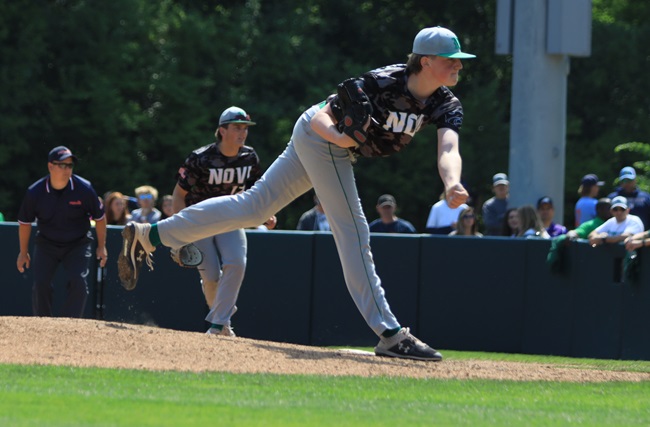 From there Fernsler took over, pitching three scoreless innings of relief under immense pressure. Novi didn’t score in the eighth and ninth innings, so Fernsler couldn’t afford to even let in one run or else the Wildcats’ dream would be over.
Fernsler held firm, and then after being staked to a three-run lead in the top of the 10th, shut the door in the bottom half to preserve a 4-1 Novi win. He allowed just one hit over his three innings of relief, and more importantly, did so efficiently enough to stay under the 49-pitch limit that would’ve prevented him from taking the mound in the championship game.
Fernsler recalls warming up in the bullpen with Novi still down 1-0, thinking that all he wanted was a chance to pitch on a college mound at Michigan State.
“I was just really hoping we would score a run, which we did,” he said. “There was definitely some nerves. But it wasn’t too bad. I had some confidence I could do what I was able to do.”
All in all, Fernsler allowed just nine hits, two earned runs and struck out 10 in 10 innings of work on the state’s biggest stage as a sophomore.
He also had an excellent junior year, but Novi’s hopes of repeating were derailed in a 3-1 loss to rival and eventual Division 1 champion Northville in a District Final.
He’s been dazzling so far as a senior, helped by a new pitch Green recommended he try after last season to complement his fastball, slider and changeup.
“I told him to try and throw a curveball to get another pitch to get hitters off-balance in addition to the changeup,” Green said. “We worked on it all summer, and he’s really done a nice job with it this year.”
Fernsler said coaches at TCU have come to see him throw a couple of times this season, but haven’t really offered advice or instructions and have pretty much let him do his thing.
Eventually, Fernsler hopes further doing his thing will result in leading Novi to another appearance at Michigan State for another Finals weekend, although the 2023 run is not familiar to the majority of Novi’s current roster.
“It’s kind of a new team,” Fernsler said. “I don’t think we are carrying momentum from that. We are just trying to figure out what we can do to get back.”
 Keith Dunlap has served in Detroit-area sports media for more than two decades, including as a sportswriter at the Oakland Press from 2001-16 primarily covering high school sports but also college and professional teams. His bylines also have appeared in USA Today, the Washington Post, the Detroit Free Press, the Houston Chronicle and the Boston Globe. He served as the administrator for the Oakland Activities Association’s website from 2017-2020. Contact him at [email protected] with story ideas for Oakland, Macomb and Wayne counties.
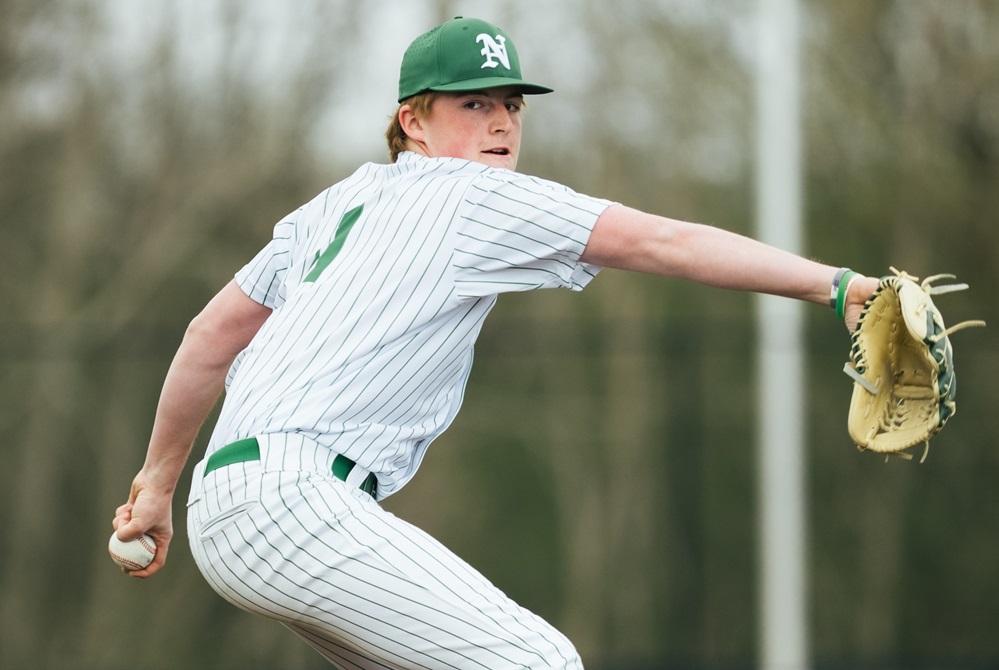
PHOTOS (Top) Novi pitcher Uli Fernsler makes his move toward the plate this season. (Middle) Fernsler follows through on a pitch during the 2023 Division 1 Final. (Top photo courtesy of the Novi athletic department.)