

New Math: Division & Multiplication Problems
July 25, 2017
By Jack Roberts
MHSAA Executive Director
This is the second part in a series on MHSAA tournament classification, past and present, that will be published over the next two weeks. This series originally ran in this spring's edition of MHSAA benchmarks.
High school tournament classifications went viral before there was social media and most of us knew what “viral” meant.
Much as a virus infects computers today or has created epidemics of disease around the world for centuries, high school tournament classification – once introduced – tends to spread uncontrollably. Once started, it tends to keep expanding and rarely contracts.
While we are still some distance from providing every team a trophy as a result of expanding high school tournament classification across the country, there is criticism nevertheless that we are headed in that direction – a philosophy which is supposed to exist only in local youth sports for our youngest children.
Michigan could be blamed for all this. Michigan is generally accepted as the first state to provide different classifications for season-ending tournaments for different sized schools. It started a century ago. Today, every state has various classifications for its tournaments in most if not all sports. And it is a bit ironic that Michigan – creator of the classification chaos – more than most other states has kept the number of tournament classes or divisions under control.
Yes, there is evidence that tournament classifications have expanded over the years in Michigan, especially with the relatively recent introduction of tournaments in football and the late 1990s’ move from classes to divisions in most MHSAA tournaments. But the MHSAA Representative Council has held true to its word when it expanded the playoffs for football from four classes to eight divisions: this is needed because of unique factors of football, factors that exist in no other sport; and all other sports should be capped at a maximum of four classes or divisions.
Kentucky is the preeminent defender of single-class basketball. All of its 276 high schools compete for the single state championship for each gender. In Indiana, there are still open wounds from its move in 1998 from one to four classes for its 400 schools in basketball.
Multi-class tournaments have tended to increase the number of non-public school champions, which some states are trying to lower through enrollment “multipliers,” and also tend to increase the number of repeat champions, which some states are trying to affect with “success factors” which lift smaller schools into classifications for larger schools if they take home too many trophies.
While there is considerable evidence that state tournaments do as much bad as good for educational athletics, state associations persist in providing postseason tournaments because, on balance, the experiences are supposed to be good for student-athletes. And once we reach that conclusion it is just a small leap to believe that if the tournaments are good for a few, they must be better for more – which leads to creating more and more tournament classifications. One becomes two classes, then three, then four and so forth.
While the argument is that more classifications or divisions provides more students with opportunities to compete and win, it is undeniable that the experience changes as the number of tournament classifications expands. It is not possible for state associations to provide the same level of support when tournament classifications expand to multiple venues playing simultaneously. For example, there is less audio and video broadcast potential at each venue, and less media coverage to each venue. Focus is diluted and fans diminished at each championship.
No one can argue reasonably that today's two-day MHSAA Football Finals of eight championship games has the same pizazz as the one-day, four-games event conducted prior to 1990.
In some states the number of divisions has grown so much that it is difficult to see much difference between the many season-ending state championship games and a regular-season event in the same sport.
It is a balancing act. And Michigan has been studying that balance longer than any other state, and charting a steadier course than most.
Addition by Division
The shift to Divisions for MHSAA Tournament play in numerous sports has added up to a greater number of champions for teams and individuals across the state. Following are the sports currently employing a divisional format, and the procedures for determining enrollment and classification.
In 23 statewide or Lower Peninsula tournaments, schools which sponsor the sport are currently divided into nearly equal divisions. They are:
- Baseball - 4 Divisions
- Boys Bowling - 4 Divisions
- Girls Bowling - 4 Divisions
- Girls Competitive Cheer - 4 Divisions
- LP Boys Cross Country - 4 Divisions
- LP Girls Cross Country - 4 Divisions
- LP Boys Golf - 4 Divisions
- LP Girls Golf - 4 Divisions
- Ice Hockey - 3 Divisions
- Boys Lacrosse - 2 Divisions
- Girls Lacrosse - 2 Divisions
- Boys Skiing - 2 Divisions
- Girls Skiing - 2 Divisions
- LP Boys Soccer - 4 Divisions LP
- Girls Soccer - 4 Divisions
- Girls Softball - 4 Divisions
- LP Boys Swimming & Diving - 3 Divisions
- LP Girls Swimming & Diving - 3 Divisions
- LP Boys Tennis - 4 Divisions
- LP Girls Tennis - 4 Divisions
- LP Boys Track & Field - 4 Divisions
- LP Girls Track & Field - 4 Divisions
- Wrestling - 4 Divisions
Lists of schools for each division of these 23 tournaments are posted on MHSAA.com approximately April 1. Listings of schools in Upper Peninsula tournaments for their sports are also posted on MHSAA.com. The lists are based on school memberships and sports sponsorships in effect or anticipated for the following school year, as known to the MHSAA office as of a date in early March.
In football, the 256 schools which qualify for MHSAA 11-player playoffs are placed in eight equal divisions annually on Selection Sunday. Beginning in 2017, the 8-player divisions will be determined in a like manner on Selection Sunday as well, with 32 qualifying schools placed in two divisions.
Schools have the option to play in any higher division in one or more sports for a minimum of two years.
The deadlines for "opt-ups" are as follows:
- Applications for fall sports must be submitted by April 15
- Applications for winter sports must be submitted by Aug. 15
- Applications for spring sports must be submitted by Oct. 15
Subsequent to the date of these postings for these tournaments, no school will have its division raised or lowered by schools opening or closing, schools adding or dropping sports, schools exercising the option to play in a higher division, or approval or dissolution of cooperative programs.
When the same sport is conducted for boys and girls in the same season (e.g., track & field and cross country), the gender that has the most sponsoring schools controls the division breaks for both genders.
- Volleyball
- Girls Track & Field
- Boys Track & Field
- Girls Swim & Dive
- Boys Swim & Dive
- Girls Cross Country
- Boys Cross Country
- Officials
Livonia's Karabees-Betts Named 35th Vern L. Norris Award Honoree
By
Geoff Kimmerly
MHSAA.com senior editor
April 15, 2025
Debby Karabees-Betts has dedicated more than 50 years to serving high school and middle school students, often in several roles simultaneously to provide opportunities to learn and compete both academically and athletically.
To celebrate especially her 30-plus years as a Michigan High School Athletic Association-registered game official and her immense impact on that community, Karabees-Betts will be honored with the 35th Vern L. Norris Leadership in Officiating Award during the MHSAA’s Officials Awards & Alumni Banquet on April 26 in East Lansing.
The Norris Award is presented annually to a veteran official who has been active in a local officials association, has mentored other officials, and has been involved in officials’ education. It is named for Vern L. Norris, who served as executive director of the MHSAA from 1978-86 and was well-respected by officials on the state and national levels. Karabees-Betts will be honored at Michigan State University’s Kellogg Center along with high school game officials with 20, 30, 40, 45, 50, 55 and 60 years of service.
She began her career in education in 1973 and spent the next 40 years as a teacher and later guidance counselor. Her contributions to school sports also began in 1973 with her first of what would become several coaching tenures. She became an MHSAA-registered official first during the late 1970s, then returned to officiating in 1990-91 – first in swimming and track & field, later adding volleyball and cross country – and has officiated a combined five MHSAA Finals – two each in volleyball and boys swimming & diving and one in girls swimming & diving.
But that covers only one area of her influence on statewide officiating. Also a collegiate volleyball line judge in the Big Ten Conference over the last 16 years, Karabees-Betts co-wrote the “Best Practices for Line Judges” protocol adhered to at MHSAA Finals and has been an MHSAA officials trainer in the sport since 2010. She has conducted more than 100 officiating and line judging clinics over the last two decades, mentored several school-aged officials as part of the MHSAA Legacy Program and spoken to numerous high school classes on the benefits of becoming an official.
“The (essence of) officiating is that you bring sportsmanship, safety and respect and love for the games,” said Karabees-Betts, who first met Vern Norris while officiating an MHSAA Finals at Eastern Michigan University. “I have so many former players’ children that I’m officiating now. … You want that knowledge to make sure they have the most fair playing field that you could possibly give them.
“It’s kind of a legacy of love for the sport, the participation in the sport, the growth and knowledge of the sport and safety of the sport – because throughout 50 years, the safety factor has increased in almost every sport.”
Karabees-Betts, who lives in Livonia but did the majority of her teaching and counseling at Taylor public schools, first stepped into educational athletics as a professional in 1973 when, as a first-year teacher, she also took on the head coaching positions at Taylor Truman for girls swimming, volleyball and track & field during the early years of those programs.
She made the former Inkster Cherry Hill High School a force in boys swimming & diving, coaching that program to 10 straight Tri-River League titles and a Lower Peninsula Class B-C-D runner-up finish in 1977 before that school closed in 1985. She was named Coach of the Year in that league multiple times for that sport and also girls track & field.
She also earned multiple Western Wayne Athletic Conference Coach of the Year honors during a decade-long run at Taylor Center from 1986-96, where she led the boys cross country, swimming & diving and track & field programs. Karabees-Betts would later coach the Dearborn Divine Child volleyball team to a Catholic High School League title and take the Riverview Gabriel Richard girls basketball team on a long Class C Tournament run. She also coached at Taylor Kennedy and Garden City high schools and middle school swimming and cross country in the Taylor district.
Karabees-Betts moved on to coaching volleyball at Schoolcraft College, serving as an assistant coach for a decade through 2010 and helping that program reach the National Junior College Athletic Association Tournament. She continued officiating MHSAA events during that time and became a collegiate volleyball official in 1996.
She has served as an officials observer at the MHSAA Volleyball Semifinals and Finals the last four seasons and also several more as the officials crew chief for that high-profile event. She served as board secretary and awards chairperson for the Michigan Interscholastic Swimming Coaches Association from 1979-84 and has served as board secretary/treasurer for the Capital Area Association of Volleyball Officials since 2013.
“Debby Karabees-Betts has brought her expertise and dedication as an educator into the athletic classroom, especially as one of our state’s most respected and admired teaching officials and mentors in volleyball,” MHSAA Executive Director Mark Uyl said. “Her work across several sports has had a far-reaching impact stretching decades and continuing to this day, and her approach not only to officiating, but to teaching and mentoring is admired across her several sports communities.”
Karabees-Betts graduated from Taylor Center High School in 1969. She earned her bachelor’s and education specialist degrees from Michigan State University in 1973, the former in physical education, health and recreation and the latter in exercise physiology and science. She later earned master’s degrees in educational guidance and counseling, and athletic administration, from Eastern Michigan University, and then her doctorate in education and guidance and counseling from EMU in 1990.
She has contributed to her community in several more ways, including as a member of the Taylor Jaycees organization and president of its women’s club where she participated in some of the many charity efforts she’s been part of locally. She served on the Taylor Schools and Community Council and volunteered as part of the district’s crisis team, organized a traveling theatre troupe that performed at local elementary schools and taught first-aid classes at the local community center. She also served as director for the Dearborn Heights summer recreation department’s track & field program.
Karabees-Betts has been honored several times for her service, including with 12 Golden Apple Awards from the Wayne Regional Educational Service Agency. She received the Michigan Exceptional Educator of the Year Award from EMU in 2003 and the Guidance Counselor of the Year Award from the Wayne County Intermediate School District in 2010.
She is married to husband Dennis, who also is an MHSAA-registered swimming & diving official and worked the Lower Peninsula Finals to conclude both the girls and boys seasons this school year. They have two daughters, Desiree McMahon and Lori Hall, and a son Greg Betts.
Previous recipients of the Norris Award
1992 – Ted Wilson, East Detroit
1993 – Fred Briggs, Burton
1994 – Joe Brodie, Flat Rock
1995 – Jim Massar, Flint
1996 – Jim Lamoreaux, St. Ignace
1997 – Ken Myllyla, Escanaba
1998 – Blake Hagman, Kalamazoo
1999 – Richard Kalahar, Jackson
2000 – Barb Beckett, Traverse City; Karl Newingham, Bay City
2001 – Herb Lipschultz, Kalamazoo
2002 – Robert Scholie, Hancock
2003 – Ron Nagy, Hazel Par
2004 – Carl Van Heck, Grand Rapids
2005 – Bruce Moss, Alma
2006 – Jeanne Skinner, Grand Rapids
2007 – Terry Wakeley, Grayling
2008 – Will Lynch, Honor
2009 – James Danhoff, Richland
2010 – John Juday Sr., Petoskey
2011 – Robert Williams, Redford
2012 – Lyle Berry, Rockford
2013 – Tom Minter, Okemos
2014 – Hugh R. Jewell, West Bloomfield
2015 – Sam Davis, Lansing
2016 – Linda Hoover, Marshall
2017 – Michael Gentry, Shelby Township
2018 – Jill Baker-Cooley, Big Rapids
2019 – David Buck, St. Joseph
2020 – Hugh Matson, Saginaw
2021 – Lewis Clingman, Grand Rapids
2022 – Pat Hayes, Birmingham
2023 – Chuck D. Walters, Jackson
2024 – Candace Cox, Quincy
High school game officials with 20, 30, 40, 45, 50, 55 and 60 years of service also will be honored at the Officials Awards & Alumni Banquet on April 26. Eight officials with 60 years of service will be honored, as will 15 with 55 years of service, 70 with 50 years of service, 72 officials with 45 years and 90 officials with 40 years of service. A 30-year award will be presented to 164 officials, and 287 officials with 20 years of experience will be honored.
Also being honored during the Awards & Alumni Banquet is Legacy Program official Avery Beach, a senior at Mason High School who also is dually enrolled at Ferris State University. Beach carries a 3.96 grade-point average and is a member of both the National Honor Society and National Technical Honor Society as she plans to pursue a career in education. An all-state bowler and four-year varsity softball starter for the Bulldogs, Beach has officiated middle school volleyball as part of the Legacy Program, and also youth softball.
20, 30, 40, 45, 50, 55 & 60-YEAR OFFICIALS
The officials on this list are receiving their 20, 30, 40, 45, 50, 55 and 60-year service awards.
20-YEAR OFFICIALS
Ada - Rick F. Hert
Allegan - Arthur K. Ziemelis
Allen Park - Kim A. Viculin
Alpena - John A. Anderson
Ann Arbor - Dennis J. Busse Jr.
Ann Arbor - Edward H. Rodenhouse
Ann Arbor - Shane J. Smith
Ann Arbor - Daniel H. Tarrant
Athens - Vergne C. Gregrich
Battle Creek - Cork Baker
Battle Creek - Harvey L. Glass
Battle Creek - April D. Hooker
Battle Creek - Nicholas C. Metheny
Battle Creek - Timothy J. Rizor
Battle Creek - Brenton T. Watkins
Battle Creek - Augie Zapata
Bay City - Josh A. Bauer
Bay City - David M. Bublitz
Bay City - Jeff A. Doan
Bay City - David M. Pietryga
Bay City - Dale E. Sneller II
Bay City - Jeff J. Zalucha
Bellaire - John F. Hanson
Belleville - Greg R. Reynolds
Belleville - Harold Rochon
Bellevue - Sarah M. VandenHeuvel
Berkley - Mark W. Steffens
Berkley - Mark R. Williams
Bloomfield - Thomas B. Wolford
Boyne City - Cindi L. Place
Bridgman - Robert S. Clark
Brighton - Scott D. Kelley
Brighton - Shanda Willis
Brownstown - Kenneth A. Stephens
Buchanan - Mark L. Soltys
Burton - Jamie S. Galant
Burton - Rojelio D. Lara
Byron Center - David M. Meltzer
Byron Center - Helga Roelofs
Byron Center - Timothy K. Smeby
Cadillac - William Anderson
Cadillac - Timothy L. Fekete
Caledonia - David M. Bommarito
Caledonia - Thomas J. Buist
Canton - Donald G. Dukes
Canton - Scott M. Shaw
Carney - Jeff C. Stage
Carsonville - Tom S. Nowotny
Charlotte - Jenny A. Granger
Chassell - James K. Tervo
Chesaning - John F. Ebenhoeh II
Chesterfield - Edmund J. Kordas
Clarkston - Thomas J. Giannaris
Clarkston - Ted S. Rozwadowski
Clinton Township - Christopher M. Catenaro
Clinton Township - David A. Clifton
Clinton Township - Bradley A. Jarson
Clinton Township - Robert T. Joyce
Clinton Township - Patricia J. Rigterink
Coldwater - Eric M. Anglin
Coldwater - William H. DeBeau
Coldwater - Chad A. Rakocy
Coleman - Jason F. Harper
Coloma - Jamie S. Riley
Commerce Township - Dennis A. Sartor
Concord - Kevin Herendeen
Corunna - Benjamin J. Hall
Corunna - Robert L. Hinojosa Jr.
Davison - Robert W. Myers
Davison - Wally Rose
Davison - Dana E. Rouse
Dearborn - John P. Satko
Detroit - Harold B. Bettie III
Detroit - Shawn A. Crawford
Detroit - Quincy R. Jones
Detroit - Warren Pettaway
Detroit - Lawrence E. Roberts
DeWitt - Randy L. Puffenberger
Dimondale - Dana M. Kirk
Dimondale - Scott E. McKimmy
Eastpointe - Brian A. Smith
Eau Claire - Ted R. Parker
Escanaba - Robert S. Johnson
Evart - Susan J. Guiney
Farmington Hills - Timothy E. Hay
Farmington Hills - Gary C. Maike
Fennville - Paul A. Marfia
Flint - Sims Johnson III
Flushing - Kenneth R. Tucker
Flushing - Roger L. Winfield Jr
Freeland - Sharon Sawyers
Gaylord - Douglas L. Curtis
Gaylord - David M. Johnson
Gaylord - Richard D. Marshall
Gladstone - Eric J. VanDamme
Gladwin - David P. Volk
Goodrich - Gaye L. TenBrink
Gowen - Casey N. Lake
Grand Blanc - Jerry L. Balogh
Grand Blanc - William N. Hoffmann
Grand Haven - Donald G. Verwey
Grand Ledge - Tim W. Bedford
Grand Rapids - Daniel C. Anderson
Grand Rapids - Greg James
Grand Rapids - Ryan P. Levitt
Grand Rapids - Jeffrey P. Simmons
Grand Rapids - Bert J. Smith
Grand Rapids - Cory D. Smith
Grand Rapids - Scott L. Stabler
Grand Rapids - Paul M. Wiercinski
Grand Rapids - Onesiphorus B. Burrel II
Grand Rapids - Johnny E. Davidson Sr.
Grandville - Douglas C. Diekman
Grandville - Natasha L. Phose
Grass Lake - James (Ed) E. Earley II
Greenville - Jeffrey Brown
Greenville - Andrew J. Krey
Grosse Ile - Christopher C. Vigh
Grosse Pointe - Brian A. Effinger
Grosse Pointe Farms - Larry A. Klimek
Grosse Pointe Woods - Thomas P. McCabe
Hamilton - Larry A. Meiste
Hamilton - Terry L. Perysian
Hancock - David C. Dow
Hancock - Jason J. Parker
Harper Woods - Mychael D. Foster
Hart - Brandon W. Bruce
Hartland - Roger T. Luck
Haslett - Deborah L. Traxinger
Highland - David E. Crow
Hillsdale - Lance E. Benzing
Hillsdale - Timothy J. Frosch
Holland - Douglas L. Bazan
Holland - Robert T. Carlson
Holly - Dave M. Thatcher
Holt - Jim E. Moreno Sr.
Holt - Jessie D. Read
Holton - Robert J. Stitt
Hudsonville - Arlyn J. Bohl
Hudsonville - Nathan Topie
Hudsonville - Roberto Ortega-Ramos
Interlochen - Gregory W. Allar
Iron Mountain - John L. Benzie
Ithaca - Rex L. Beracy
Jackson - James K. Haehnle
Jackson - Dale B. Lehman
Jackson - Corey C. McCave
Jenison - Chad J. Essebaggers
Jenison - Kip E. Haverdink
Jenison - James E. Krol
Jonesville - Eric P. Swihart
Kalamazoo - Michael A. Bailey
Kalamazoo - Patrick T. Cronin
Kalamazoo - Raynard A. Dunigan Jr.
Kalamazoo - Larry H. Ollie
Kalamazoo - David B. Saunders
Kalamazoo - Christopher A. Furlong
Kentwood - Glenn E. Ingram
Kentwood - Timmy D. Dickens
Kimball - Michael T. Roosen
Lake Orion - Brenton T. Bailo
Lakeview - Timothy A. Reed
Lansing - Jason R. Baley
Lansing - Steven L. Edgerly
Lansing - Melvin W. Eiland Sr.
Lansing - Robert W. Linman
Lansing - Roderick Turner
Livonia - John E. Eberhart
Livonia - Keith D. Riling
Macomb - Richard J. Moceri
Macomb - Jennifer L. Zacharzewski
Manchester - William T. Coggins
Manistique - John H. Ziemba
Marinette (Wis.) - Fred A. Furton
Marquette - Mark A. Petrie
Marshall - James R. DeBrabander
Marshall - Jon K. Morris
Mattawan - April C. Davenport
Mattawan - Mickey F. Peter
Mendon - Donald K. Koole III
Mendon - Donald K. Koole Jr.
Middleville - Joseph A. Broussard
Midland - Zachary A. Eagly
Midland - Mark E. Howison
Midland - Ian K. Lundquist
Midland - Kevin M. Nehil
Midland - Andy Reyes
Midland - Laurie A. Smith
Milan - Edward J. Marx Jr
Monroe - Steven A. Sowatsky
Monroe - Dale A. Stringham|
Moran - Gregg P. Fettig
Mt. Clemens - Kenneth Wynn
Mt. Morris - Shannon M. Smith
Mt. Pleasant - Cindy Verwey
Mt. Pleasant - James J. Waters
Muskegon - Troy A. Gardner
Muskegon - Gordon J. Hansen
Negaunee - Bobbi E. Ayotte
Negaunee - Mark A. Marana
Novi - Ned D. Harrington
Oak Park - Daniel Silva
Ontonagon - Allen A. Graham
Ortonville - Laurel M. Kobe
Oxford - Robert M. Kelly
Parchment - Thomas A. Jordan
Paw Paw - Barbara J. Alden
Paw Paw - George W. Kilts
Petoskey - Shane P. Brown
Petoskey - Paul D. Tunison
Pewamo - Michael A. Weber
Pickford - Rodney W. Priskorn
Plymouth - Greg W. Hames
Plymouth - Leslie S. English
Pontiac - Darris L. Finney
Pontiac - Trevor K. Williamson
Port Huron - Stephen F. Dusellier
Portage - Larry L. Allgaier
Portage - James P. Eichstaedt
Portage - Harley J. Franks
Ray - Jill M. White
Redford - Michael J. Laird
Riverview - Jason C. Gribble
Rochester Hills - Robert P. Bowery
Rochester Hills - Richard P. Burns
Rochester Hills - Kimberly A. Tobin
Rockford - Alex O. Briggs
Rockford - David M. Carattini
Rockford - Michael H. Jacobs
Rockford - John G. Mowat
Rockford - Seth D. Powell
Romulus - John C. Graham Sr.
Royal Oak - Paul M. Hayner
Royal Oak - Michael R. Pomroy
Rudyard - Tracy R. Peterson
Rudyard - Ron Vansloten
Saginaw - Brian W. Galsterer
Saginaw - Joel A. Keup
Saginaw - James J. Wood
Saline - William H. Kahn
Sandusky - Michael D. Dreyer
Saranac - Robert W. Simpson
Sears - Karen S. Ehl
Sheridan - Lorri A. Snyder
South Lyon - David Arvo
South Lyon - Amy E. Braun
Southfield - Berwyn Ellis
Southfield - Darcy A. Gitchuway
Southfield - Joseph L. Hamblin
Southfield - Justin M. Marshall
Southgate - Robert J. Tarabula
Spring Lake - Dennis R. Masson
St. Ignace - Denise E. Freed
St. Johns - Kevin P. Smith
St. Joseph - Robert Cultice
St. Clair Shores - Brandon A. Baetens
Sterling Heights - Russell P. Carl
Sterling Heights - Cliff T. Whiteside
Sturgis - Ron C. Abbs
Sturgis - Mark W. VanDosen
Swartz Creek - Mark W. Grantham
Sylvania (Ohio) - Andrew M. Dier
Taylor - Anthony Maffesoli
Temperance - Larry A. Nocella Jr.
Traverse City - Mike F. Wolf
Trenton - Brien R. Baeckeroot
Troy - Peter R. Bucheli
Troy - Thomas D. Jendrusch
Twin Lake - Douglas A. Prim
Union City - Daniel J. Hanna
Vassar - Mark Dowe
Warren - Daswell L. Campbell
West Bloomfield - Alan K. Murray
West Branch - Jeremy M. Bewley
West Olive - Steve J. Bazan
West Olive - Rich Johnson
Westland - Jeremy L. Jozefczak
Westland - Kenneth G. Smith
Westphalia - Kenneth J. Spitzley
Whitehall - Harold F. Schneider
Whitmore Lake - James F. Kreklau Jr.
Wyandotte - Dawn R. Manthei
Wyoming - Edward J. Howes
Wyoming - Andrew W. McKellar
Ypsilanti - Alexander M. Bade
Ypsilanti - David P. Lascewski
Zeeland - Justin S. Bazan
30-YEAR OFFICIALS
Ada - Christopher R. Becker
Allegan - Rick Lee
Allendale - Matthew R. Carlson
Allendale - Gregory D. VanderGoot
Alma - Kathleen A. Paul
Alpena - Mark S. Uekman
Ann Arbor - Eric D. Zemper
Baroda - Richard D. Albers
Baroda - Jerry T. Nitz
Bay City - Robert O. Huddleston
Bay City - Ronald L. Leahy
Belleville - Terry Landoski
Big Rapids - James N. Turner
Birmingham - Leon O. Braisted III
Bridgman - Dennis R. Ott
Brooklyn - Gary L. Schuch
Brownstown Township - Todd D. Skopczynski
Burton - Donald K. McCombs
Byron Center - Glennon W. Eckelkamp
Byron Center - John D. Philo
Byron Center - Jaime A. Pilbeam
Caledonia - Tina J. Hamp
Caledonia - Walter E. Van Wyngarden
Canton - Kenneth M. Letts
Canton - John J. Vichinsky Jr.
Carsonville - Roy D. Calahan
Charlevoix - Martin B. Seyfried
Cheboygan - Jason R. Friday
Chelsea - Keith M. DePaoli
Clawson - Rene C. Brooks
Coopersville - Joseph E. Meerman
Coopersville - Lynn K. VanSickle
Detroit - Donta Favors
Detroit - Joseph R. Flowers Jr.
Detroit - Jo Ann Jones
Detroit - Lawrence W. Miller
Dexter - Douglas A. Kelly
Dorr - Randy Kasper
Dowagiac - Scott E. Wiltse
East Lansing - David M. Hallman
East Lansing - Theresa S. Shepard
East Tawas - Joseph M. Cano Jr.
Eaton Rapids - Joe H. Dixon Jr
Eau Claire - Dennis F. Ostyn
Ecorse - James I. Cooley
Escanaba - John F. Ziemba
Farmington Hills - Diane M. Klucka
Fenton - Phillip J. Diener
Fenton - Thomas E. King Jr.
Flint - Terry A. DeCaire
Flint - Darrell A. Young
Flushing - Richard J. Murphy
Fountain - Duane R. Wolf
Frankenmuth - John W. Shelton
Garden City - Mark K. Mazzon
Gaylord - John M. Tithof
Grand Blanc - Stanley Beard
Grand Blanc - Sami Khal
Grand Ledge - Mary K. Gavitt
Grand Rapids - Patrick G. McLaughlin
Grand Rapids - Jane C. Plaisted
Grand Rapids - Robert S. Ruschmann
Grand Rapids - Randy R. Sheahan
Grand Rapids - Brett A. Svacha
Grandville - James J. Backowski Jr.
Hamilton - Kenneth W. Demann
Henderson - Karen A. Shuster
Hillsdale - William J. Mullaly
Holland - Peggy A. Lintemuth
Holland - Matthew M. McCrea
Holland - John L. Robertson
Holland - Scott W. Vanderstoep
Houghton - John B. Sanregret
Houghton - James A. Weiler
Howell - Frank A. Dame
Howell - Craig R. Williams
Hudsonville - Dale J. Heyboer
Hudsonville - Matthew D. Kuiper
Huntington Woods - Joseph J. Rozell
Ithaca - Rodney W. Whitmore
Jackson - Marla E. Grant
Jackson - Nelson D. Negus III
Jerome - Brad L. Brown
Kalamazoo - Charlie D. Westervelt
Kawkawlin - Jack A. Servis
Kentwood - Robert A. Navarro
Kingsford - Jack B. Wallis
Lake Orion - Michael J. Ley
Lansing - Mark G. Simon
Lathrup Village - Darryl A. Alexander
Lawrence - Allan D. Wood
Lincoln - Troy M. Somers
Livonia - Debby E. Karabees-Betts
Lowell - Shane S. Risner
Luther - John J. Syrewicze
Macomb - Patrick J. Walsh
Mancelona - Edward L. McCarty
Manistique - Kevin K. Koski
Marinette (Wis.) - Keith Plude
Marquette - Michael J. Caster
Marquette - Todd E. Koski
Marquette - Brian W. Maki
Marquette - Charlie W. Morrison
Mason - Daniel P. Carmichael
Middleville - Steven P. Shutich
Midland - Gary R. Meredith
Midland - Jeffrey T. Servinski
Milan - Karen E. Draves
Milan - Larry D. Sanford
Monroe - Christopher H. Essex
Munising - Pete Kelto
Muskegon - Curtis L. Adams
Muskegon - Jeremy S. Goorman
Muskegon - Robert L. Graham
Newberry - Jason R. Depew
Niles - David Negron
Northville - Ronald R. Reinke
Norway - James J. Bal
Novi - Harold Butch Wingfield
Olivet - Jeff S. Smith
Ontonagon - Dr. Joseph A. Strong
Orleans - Michael K. Kapustka
Owosso - John T. Sandlin
Peck - William A. Burns
Plymouth - Pericles L. Chiatalas
Portage - Todd R. Gooding
Portage - Larry L. Wegener
Portland - Karen J. Dugan
Quinnesec - Robert D. Forstrom
Rockford - Brian L. Vogel
Rockford - Bruce F. Walterhouse
Romulus - Vincent B. Lewis
Royal Oak - James G. Demres
Saginaw - Barry L. Damzyn
Sanford - Dave A. Jezowski
Schoolcraft - Jeffry P. Morgan
Scottville - Matthew C. Miller
Shelby Twp. - Steven L. Wood
South Bend (Ind.) - James E. Arnett
Southfield - Raymond Kelser
Sparta - William Kotchka
St. Charles - Raymond F. Guzy
St. Clair Shores - Rick A. Fields
St. Joseph - Kenneth J. Baratta
St. Joseph - Richard L. Bloodworth
St. Joseph - Stephen D. Petlick
St. Clair - Ronald Churchill
Sterling Heights - Walter J. Kujawa
Taylor - Raymond C. Kuhr
Three Rivers - Robert J. Laverdure
Toledo (Ohio) - Tom M. Balas|
Traverse City - Bill Parker
Traverse City - John M. Sawyer
Troy - Robert L. Szmania
Vicksburg - James R. Boer
Vulcan - Alan W. Richards
Warren - Kenneth M. Stefanski
Washington - Jerome Angelo
Waterford - Ron H. Stafford
Waterford - Randy Welch
West Bloomfield - James M. Dworman
West Bloomfield - Brian C. Gurwin
West Branch - Michael R. Dematio
West Branch - David M. Gutierrez
40-YEAR OFFICIALS
Ada - Donald L. Slater
Battle Creek - Daniel L. Akins
Bay City - Charles A. Case
Bay City - William P. Heintskill
Bay City - Cindy L. Linton
Beaverton - Ross S. Martin
Blissfield - Patrick L. Seiser
Boyne Falls - Craig W. Oldham
Byron Center - Leroy M. Hackley Jr.
Cadillac - Kevin J. Hughes
Canton - James D. Gagleard
Caro - Mandy J. Knox
Cheboygan - Michael A. Grisdale
Coldwater - Ken Smoker
Comstock Park - Brian P. Macomber
Concord - Karen D. Anderson
Dearborn - Thomas P. Arsenault
Dearborn Heights - Algirdas P. Norkunas
Dearborn Heights - Paul Oshanski
Detroit - Kevin M. Hall
Detroit - Willie Hall Jr.
Detroit - Darryl C. Jones Sr.
DeWitt - Rob A. Stanaway
Dowagiac - Thomas W. Russom
Fennville - Lowell A. Winne Jr.
Fenton - Danny L. Harris
Fenton - Anthony M. Mora
Flint - Robert L. Farrar
Frankfort - Karen Leinaar
Fruitport - Jeff S. VanBeek
Gladstone - Michael F. Gobert
Gobles - Michael G. Long
Grand Haven - Patrick R. Hood
Greenville - Mark K. Schoenfelder
Grosse Pointe Farms - Margaret A. Gatliff
Hastings - Jason L. Sixberry
Holt - Jamie C. Evans
Howell - Janice B. Holda
Howell - Richard W. Humphries
Hurley (Wis.) - Greg Rigoni
Iron Mountain - Steve A. La Coursier
Ironwood - Dennis A. Mackey
Ithaca - James L. Gross
Jackson - Richard J. Eby
Kalamazoo - Mike L. Squires
Kawkawlin - William J. Jaynes
Lambertville - Mark J. Dushane
Lapeer - Robert W. Thomas
Lawton - Michael F. Garvey
Leesburg - Wallace J. Green Jr.
Linden - Gary R. Duke
Linden - Jeffery R. Prince
Manistee - John P. O'Hagan
Marlette - Fred Mroczek
Marysville - Patrick D. Sheehy
Mattawan - Robert M. Nicey
Mecosta - William O. Howes
Midland - Keith R. Netzley
Midland - Brian G. Roberts
Mt. Morris - Jeffery T. Flynn
Nashville - Tony M. Joostberns
Newaygo - Dean A. Duchemin
Oscoda - Duane W. Keck
Otisville - Frank R. Mar
Ottawa Lake - Jamie L. La Rocca
Plainwell - Lurinda A. Shrauger
Port Huron - Scott C. Tallmadge
Portage - Michael L. Bignell
Rochester Hills - Timothy J. Soave
Saugatuck - Ross J. Such
Saugatuck - Timothy J. Woodby
Sault Ste. Marie - David A. Blaskowski
South Lyon - Michael T. Schram
St. Clair Shores - Gary M. Gassen
St. Joseph - Gilbert J. Urban
St. Clair - David W. Baumgart
Stanton - Randy L. Reese
Sterling Heights - Edward S. MacKool Jr.
Stevensville - Fredrick J. Smith
Sylvania (Ohio) - William F. Bisbee Jr.
Taylor - Michael D. Mullin
Temperance - Carroll J. Selmek
Three Oaks - Michael J. Smith
Traverse City - Kenneth M. Allen
Utica - Carl W. Territo
Warren - Thomas J. Mastrovito
Washington - James A. Bade
West Bloomfield - Patrick B. Paul
Woodhaven - Michael A. VonLinsowe
Wyandotte - Michael J. Gniewek
45-YEAR OFFICIALS
Alger - Leroy A. Oliver
Alpena - Phil C. Schultz
Berrien Springs - Jamie L. Stacey
Big Rapids - Jill E. Baker-Cooley
Brighton - Thomas J. Mora
Brimley - Jerald P. Cook
Cadillac - William T. Bartholomew
Caledonia - Conroy Zuiderveen
Cheboygan - Lynwood Leightner Jr.
Clarksville - Jim D. Johnson
Concord - Charles T. Ewing
Daggett - Michael P. Lyons
Dearborn Heights - Kevin P. Kabacinski
Decatur - Patrick L. Boitnott
Delta - William H. Wiseman
Detroit - James E. Briggs
Fenton - Douglas M. Pastor
Flint - James V. Newell
Fremont - James M. Goorhouse
Galesburg - William W. Weese
Gaylord - Paul B. Holmes
Genesee - Douglas W. Tipton
Grosse Pointe Woods - Robert E. Zaranek
Harbor Beach - Steven M. Linn
Hillsdale - Bruce Caswell
Hudson - Fred C. Bowers
Hudson - Patrick W. Wollet
Hudsonville - Bob C. Wojcik
Iron Mountain - John R. Pucci
Jackson - Steven C. Town
Jackson - Chuck D. Walters
Kalamazoo - Willie B. Watson
Lake - Kathleen V. Hutfilz
Lake Orion - Michael J. Callahan
Lansing - Sam L. Davis
Lansing - Donald J. Yuvan
Madison Heights - Marie S. Bessler
Madison Heights - Richard L. Hillman
Manistee - Jo L. Arnold
Manistee - David A. Nemecek
Marshall - David N. Benham
Marshall - Linda K. Hoover
Marysville - Joel P. Venia
Mendon - Patrick J. Conroy
Midland - Ken P. Beaudin
Monroe - Barry Little
Niles - Michael J. Nate
Okemos - Jay Marcotullio
Portage - Richard M. Bird
Portage - Mike T. Hinga
Ravenna - Thomas C. Wright
Rochester - Brian E. York
Rochester Hills - Fred B. Castelvetere
Rockford - Timothy G. Erickson
Saginaw - Roberta A. Beyerlein
Sandusky - Alan DeMott
Scottville - Rodney D. Marshall
Shelby - Edmundo Flores
St. Clair Shores - Tom P. Frattini
St. Ignace - Donald P. Gustafson
St. Joseph - David J. Buck
Temperance - Randall A. Sehl
Toledo (Ohio) - Jon Everhart
Traverse City - Mark E. Stewart
Trenton - Frederick L. Bruley
Vicksburg - Timothy A. Baker
Wallace - Bruce A. Pearson
White Cloud - Tony A. McHattie
Whitmore Lake - David L. Wint
Zeeland - Marvin F. Hinga
Zeeland - Richard W. Lott
Zeeland - Eric D. Wills
50-YEAR OFFICIALS
Ada - Bryan D. Cullens Jr.
Adrian - Judith A. Walter-Kohn
Albion - Raymond Drysdale
Alpena - David M. Kuznicki
Ann Arbor - Jack L. Coffey
Battle Creek - Steven K. Higgs
Bay City - Thomas F. Cole
Berrien Springs - Timothy A. Krieger
Boyne City - Kirk D. Kujawski
Brighton - Bill T. Rubin
Brooklyn - Michael J. Timms
Byron Center - Andrew J. DeVries
Caledonia - Edward T. Hedgecock
Canton - Dennis J. Bostwick
Canton - Terry A. Wash
Clarkston - Eugene R. English Jr.
Clawson - Betty A. Wroubel
Davison - James L. Eastman
Dearborn Heights - Lou Giroux
Detroit - Lawrence D. Freeman
Detroit - Billy L. Waters
Dowagiac - Randy J. Melvin
East Leroy - James Alday
Fenton - Martin R. Covert
Grand Rapids - Robert G. Galvin
Grandville - Andrew J. Kovac
Grayling - Thomas A. Kemp
Grosse Ile - James R. Knopp
Grosse Pointe Farms - Mike C. Dempsey
Hemlock - Rudy Godefroidt
Holly - Paul W. Matson
Howell - Dennis M. Troshak
Hudsonville - Allan J. Owens
Jackson - Michael C. French
Kentwood - Betty J. Near
Lansing - Ken J. Sudall
Marysville - Mark A. Brochu
Mason - Victor T. Cena
Michigan Center - Charles D. Sprang
Middleville - Bruce F. Bender
Milan - Brad D. Susterka
Monroe - Eric E. Jenkins
Monroe - Joseph A. McCormick
Mt. Pleasant - Dale P. Brecht
Mt. Pleasant - James R. MacLean II
Muskegon - Craig W. Weirich
Negaunee - Steven R. Ayotte
Newaygo - Dave Baldus
Northville - Ann K. Hutchins
Ontonagon - Eugene Fiszer
Rives Junction - Dale A. Baum
Rochester Hills - Tom Delia Jr.
Rogers City - Gerald Purgiel
Royal Oak - Byron A. Photiades
Royal Oak - Carol A. Sheldon
Saginaw - Ronald L. Dressler
Saugatuck - Catherine Dritsas
South Haven - Henry L. Allen
Swartz Creek - Larry L. Schutt
Taylor - Terry H. Styer
Tekonsha - Daniel A. Washburn
Three Rivers - Richard L. Simon
Troy - Kenyon D. Shively
Warren - Hugh R. Jewell
Waterford - Frederick A. Cohen
Waterford - Burton Hurshe
Waterford - Thomas R. Sullivan Jr
Wayland - Norman L. Taylor
Whitmore Lake - Charles E. Lindsay
Wyandotte - Michael R. McMahon
55-YEAR OFFICIALS
Byron Center - Joe A. Zomerlei
Canton - Pamela G. Yockey
Custer - Edward C. Miller
Dryden - Louis W. Miramonti
Grand Rapids - Robert J. Rodenhouse
Kingsford - Joseph R. Reddinger
Lakeport - Donna H. Frohm
Lansing - Donald R. Murray
Lansing - Darwin S. Petersen
Monroe - Albert M. Fernandez
Muskegon - Larry T. Vaandering
New Baltimore - James C. Cleverley
Okemos - Tom Woiwode
Onsted - John M. Springer
Vassar - Harold (Dan) Johnson
60-YEAR OFFICIALS
Allegan - George R. Babcock
Boyne City - Gary L. Francis
Detroit - Geraldine Jackson
Grand Rapids - Frank E. Waskelis
Ithaca - Dean Parling
Niles - James G. Murray
Okemos - Thomas L. Minter
Swartz Creek - Phillip P. Long
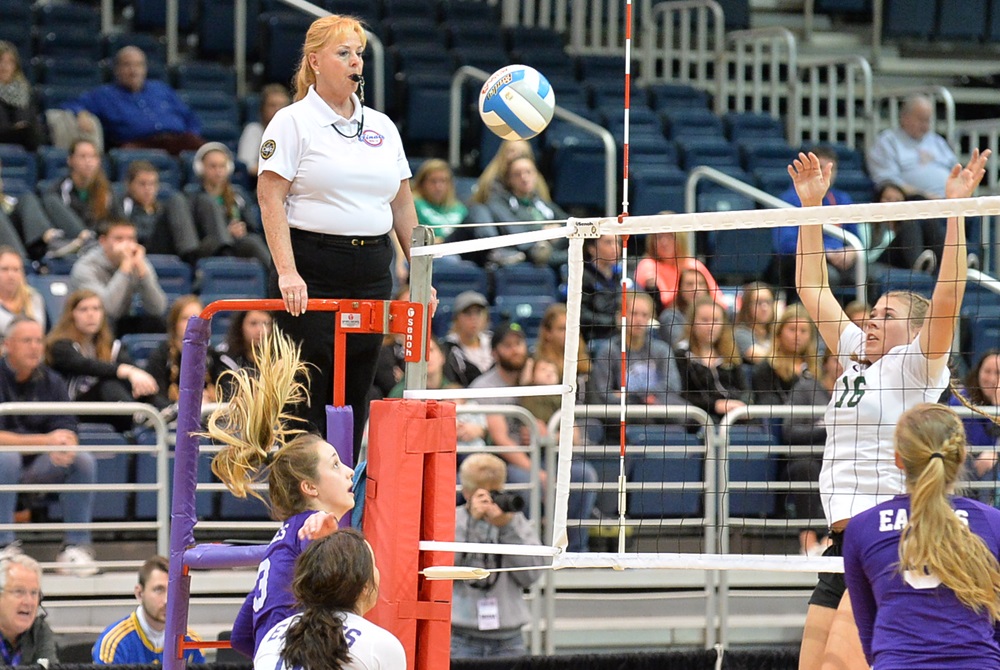
PHOTO Debby Karabees-Betts, standing above the net, officiates the 2016 MHSAA Division 4 Girls Volleyball Final.