

New Math: Division & Multiplication Problems
July 25, 2017
By Jack Roberts
MHSAA Executive Director
This is the second part in a series on MHSAA tournament classification, past and present, that will be published over the next two weeks. This series originally ran in this spring's edition of MHSAA benchmarks.
High school tournament classifications went viral before there was social media and most of us knew what “viral” meant.
Much as a virus infects computers today or has created epidemics of disease around the world for centuries, high school tournament classification – once introduced – tends to spread uncontrollably. Once started, it tends to keep expanding and rarely contracts.
While we are still some distance from providing every team a trophy as a result of expanding high school tournament classification across the country, there is criticism nevertheless that we are headed in that direction – a philosophy which is supposed to exist only in local youth sports for our youngest children.
Michigan could be blamed for all this. Michigan is generally accepted as the first state to provide different classifications for season-ending tournaments for different sized schools. It started a century ago. Today, every state has various classifications for its tournaments in most if not all sports. And it is a bit ironic that Michigan – creator of the classification chaos – more than most other states has kept the number of tournament classes or divisions under control.
Yes, there is evidence that tournament classifications have expanded over the years in Michigan, especially with the relatively recent introduction of tournaments in football and the late 1990s’ move from classes to divisions in most MHSAA tournaments. But the MHSAA Representative Council has held true to its word when it expanded the playoffs for football from four classes to eight divisions: this is needed because of unique factors of football, factors that exist in no other sport; and all other sports should be capped at a maximum of four classes or divisions.
Kentucky is the preeminent defender of single-class basketball. All of its 276 high schools compete for the single state championship for each gender. In Indiana, there are still open wounds from its move in 1998 from one to four classes for its 400 schools in basketball.
Multi-class tournaments have tended to increase the number of non-public school champions, which some states are trying to lower through enrollment “multipliers,” and also tend to increase the number of repeat champions, which some states are trying to affect with “success factors” which lift smaller schools into classifications for larger schools if they take home too many trophies.
While there is considerable evidence that state tournaments do as much bad as good for educational athletics, state associations persist in providing postseason tournaments because, on balance, the experiences are supposed to be good for student-athletes. And once we reach that conclusion it is just a small leap to believe that if the tournaments are good for a few, they must be better for more – which leads to creating more and more tournament classifications. One becomes two classes, then three, then four and so forth.
While the argument is that more classifications or divisions provides more students with opportunities to compete and win, it is undeniable that the experience changes as the number of tournament classifications expands. It is not possible for state associations to provide the same level of support when tournament classifications expand to multiple venues playing simultaneously. For example, there is less audio and video broadcast potential at each venue, and less media coverage to each venue. Focus is diluted and fans diminished at each championship.
No one can argue reasonably that today's two-day MHSAA Football Finals of eight championship games has the same pizazz as the one-day, four-games event conducted prior to 1990.
In some states the number of divisions has grown so much that it is difficult to see much difference between the many season-ending state championship games and a regular-season event in the same sport.
It is a balancing act. And Michigan has been studying that balance longer than any other state, and charting a steadier course than most.
Addition by Division
The shift to Divisions for MHSAA Tournament play in numerous sports has added up to a greater number of champions for teams and individuals across the state. Following are the sports currently employing a divisional format, and the procedures for determining enrollment and classification.
In 23 statewide or Lower Peninsula tournaments, schools which sponsor the sport are currently divided into nearly equal divisions. They are:
- Baseball - 4 Divisions
- Boys Bowling - 4 Divisions
- Girls Bowling - 4 Divisions
- Girls Competitive Cheer - 4 Divisions
- LP Boys Cross Country - 4 Divisions
- LP Girls Cross Country - 4 Divisions
- LP Boys Golf - 4 Divisions
- LP Girls Golf - 4 Divisions
- Ice Hockey - 3 Divisions
- Boys Lacrosse - 2 Divisions
- Girls Lacrosse - 2 Divisions
- Boys Skiing - 2 Divisions
- Girls Skiing - 2 Divisions
- LP Boys Soccer - 4 Divisions LP
- Girls Soccer - 4 Divisions
- Girls Softball - 4 Divisions
- LP Boys Swimming & Diving - 3 Divisions
- LP Girls Swimming & Diving - 3 Divisions
- LP Boys Tennis - 4 Divisions
- LP Girls Tennis - 4 Divisions
- LP Boys Track & Field - 4 Divisions
- LP Girls Track & Field - 4 Divisions
- Wrestling - 4 Divisions
Lists of schools for each division of these 23 tournaments are posted on MHSAA.com approximately April 1. Listings of schools in Upper Peninsula tournaments for their sports are also posted on MHSAA.com. The lists are based on school memberships and sports sponsorships in effect or anticipated for the following school year, as known to the MHSAA office as of a date in early March.
In football, the 256 schools which qualify for MHSAA 11-player playoffs are placed in eight equal divisions annually on Selection Sunday. Beginning in 2017, the 8-player divisions will be determined in a like manner on Selection Sunday as well, with 32 qualifying schools placed in two divisions.
Schools have the option to play in any higher division in one or more sports for a minimum of two years.
The deadlines for "opt-ups" are as follows:
- Applications for fall sports must be submitted by April 15
- Applications for winter sports must be submitted by Aug. 15
- Applications for spring sports must be submitted by Oct. 15
Subsequent to the date of these postings for these tournaments, no school will have its division raised or lowered by schools opening or closing, schools adding or dropping sports, schools exercising the option to play in a higher division, or approval or dissolution of cooperative programs.
When the same sport is conducted for boys and girls in the same season (e.g., track & field and cross country), the gender that has the most sponsoring schools controls the division breaks for both genders.
Vicksburg's Offord Jr. Beginning 50th, Final Season Coaching Teams to Net Gains
By
Pam Shebest
Special for MHSAA.com
March 26, 2025
VICKSBURG — Warner Offord Jr.’s was hardly impressed the first time he played tennis.
 That was 55 years ago, when he was heading into his sophomore year at Paw Paw High School.
Still, he continued to play with neighbor boys all that summer, and figured it would end there – until the following spring sports season, when he joined the tennis team.
“I go, it’s not a bad sport after all,” he laughed.
Offord ended up at No. 1 singles his final three years at Paw Paw, graduating in 1973.
Now, at age 70, he is ready to retire at the end of the upcoming Vicksburg’s girls season after 50 years of coaching tennis.
After graduating from Paw Paw, Offord stayed in the area, helping the basketball team and coaching boys and girls tennis there. He coached at his alma mater 28 years, first as an assistant before taking over the tennis programs.
When he heard about a basketball coaching opening at Vicksburg 22 years ago, he applied for the job.
He did not get the head hoops gig, but athletic director Mike Roy offered him a job coaching the girls tennis team.
“I said I’ve got to talk to my wife (Linda Connor-Offord),” Offord said. “I don’t do nothing without talking to my wife, or I’ll be in the doghouse.”
Two days later, the boys tennis coach resigned and Roy offered Offord that job as well.
 Once again he consulted his wife, who he gave him the thumbs up.
Offord soon discovered there is a bit of a difference between coaching boys and girls.
“Girls are feisty,” he said. “Girls listen to you. Boys, sometimes they want to do their own thing. When they do that, I say ‘end zone to end zone’ and then they get back to, ‘OK, we’re going to listen to our coach now.’”
He also has rules on the court.
“I believe in discipline. If you curse on the court, it’s an automatic two miles,” he said. “If you throw your racket, it’s an automatic two miles.
“No matter what, we’re going to run. I try to get the kids in shape for the third set.”
With the girls season just underway, Offord has some definite goals.
“We’re going to try to win (Wolverine) conference for the first time in school history,” he said. “The boys did it last year for the first time.
“Before I leave, I’d like to bring home that Regional trophy for the girls. It would be nice to bring home that trophy my last year.”
He is also challenging the girls not only to get back to the MHSAA Finals, but to improve on last year’s finish.
“Two years ago we finished 18th (in Lower Peninsula Division 3). Last year, I told the girls, let’s get up to 15th of 24 teams, and we got 14th.
“This year, if we go to state again, I’m going to tell then, let’s get down to 10.”
Game changer
Offord said today’s high school players are faster and stronger than when he picked up tennis because they use the weight room and do conditioning.
The equipment also has evolved.
“If I had the racket they have now and I could take that back in the ’70s, the racket is so big,” he said. “I had an Arthur Ashe (wooden) racket, I had a Wilson T3000 racket, I had a Kramer and I had a Davis.
“The technology now is unbelievable.”
Offord, who is affectionately called “Doctor O” or the abbreviated “Doc O” by the Vicksburg community, has changed with the times.
 “Dr. O’s unwavering passion and exceptional dedication have transformed the program,” Roy said. “His deep understanding of the game, paired with his ability to teach strategy at an elite level, sets him apart.
“Beyond his technical expertise, Dr. O instills a culture of excellence by holding athletes to high standards while maintaining fairness, consistency, and approachability – earning the trust and respect of his team.”
Roy noted that Offord has support around him.
“Since taking the reins, Dr. O has cultivated a winning culture, building on the foundation laid by coach Scott Wills, who continues to lead our summer youth programs,” Roy said.
“Recognizing the importance of strong leadership, Dr. O brought in Nick Foley, a former standout at Sturgis, as his assistant. Together these three men have ignited a culture shift, elevating the team to compete at an exceptional level. Their collective vision, tireless work ethic and commitment to growth has positioned the program for sustained success.”
Offord said he learned from the coaches he had growing up, who instilled not only a competitive spirit but confidence in playing and acceptable conduct on the court.
He mentioned retired Allegan tennis coach Gary Ellis as a mentor.
“Anytime I needed to know anything about tennis, I’d call him and he always had the answer,” Offord said. “I thought the world of him and what he did for that program. I’m trying to do the same thing at Vicksburg.”
Ellis said that Offord “definitely got the kids excited about playing tennis for Vicksburg and enjoying the sport. His kids get better and better during the season.”
The players at Vicksburg and Paw Paw are not the only ones who blossomed under Offord’s coaching.
His son, Warner Offord III, is an assistant to Matt Boven at Mattawan and has been a certified tennis pro for 20 years.
One final run
Offord Jr.’s decision to retire after half a century came at a perfect time, said senior Scarlett Hosner, the Bulldogs’ No. 1 singles player.
 “I feel it’s a good ending point because he coached my sister (Josephine, a 2016 grad), too, and he saw me growing up playing tennis,” Hosner said. “It’s like a full-circle moment because it’s my last year and his last year.
“He brings really positive energy. He’s such a nice, fun guy. He makes us enjoy the game, but he can also be serious at times. When we’re not doing what we’re supposed to be doing, he’s like getting on us.”
In retirement, Offord and his wife plan to do some traveling because “we want to enjoy life while we’re young,” he said.
“It’s been a wonderful 50 years coaching tennis, and it’s going to be sad. It hasn’t hit me yet for the boys, and once the girls season is over, then it will probably really hit me.
“I take great pride in seeing my players excel professionally, academically and as an athlete. I feel good knowing I played a part in that person’s success.”
 Pam Shebest served as a sportswriter at the Kalamazoo Gazette from 1985-2009 after 11 years part-time with the Gazette while teaching French and English at White Pigeon High School. She can be reached at [email protected] with story ideas for Calhoun, Kalamazoo and Van Buren counties.
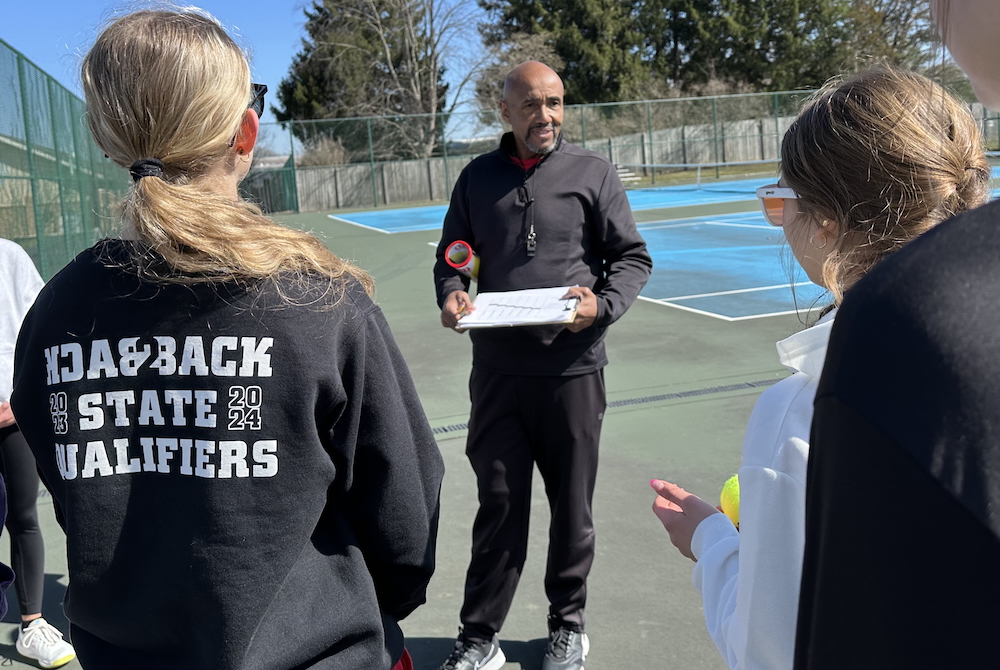
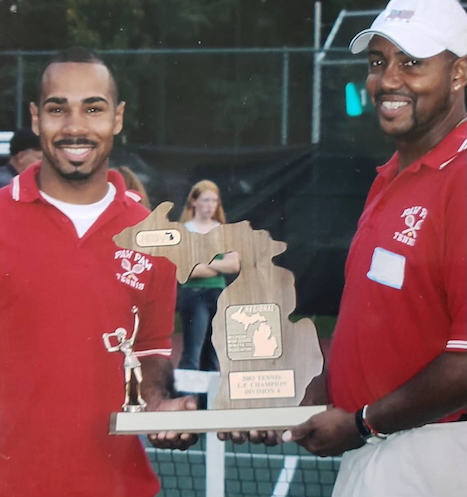
PHOTOS (Top) Vicksburg girls tennis coach Warner Offord Jr. talks with his team at the start of this spring season. (2) Offord and son Warner Offord III hold up their Regional championship trophy won for Paw Paw in 2003. (3) Offord hits with his players during practice. (4) Scarlett Hosner headshot. (Current photos by Pam Shebest; 2003 photo courtesy of Warner Offord Jr.)