

New Math: Division & Multiplication Problems
July 25, 2017
By Jack Roberts
MHSAA Executive Director
This is the second part in a series on MHSAA tournament classification, past and present, that will be published over the next two weeks. This series originally ran in this spring's edition of MHSAA benchmarks.
High school tournament classifications went viral before there was social media and most of us knew what “viral” meant.
Much as a virus infects computers today or has created epidemics of disease around the world for centuries, high school tournament classification – once introduced – tends to spread uncontrollably. Once started, it tends to keep expanding and rarely contracts.
While we are still some distance from providing every team a trophy as a result of expanding high school tournament classification across the country, there is criticism nevertheless that we are headed in that direction – a philosophy which is supposed to exist only in local youth sports for our youngest children.
Michigan could be blamed for all this. Michigan is generally accepted as the first state to provide different classifications for season-ending tournaments for different sized schools. It started a century ago. Today, every state has various classifications for its tournaments in most if not all sports. And it is a bit ironic that Michigan – creator of the classification chaos – more than most other states has kept the number of tournament classes or divisions under control.
Yes, there is evidence that tournament classifications have expanded over the years in Michigan, especially with the relatively recent introduction of tournaments in football and the late 1990s’ move from classes to divisions in most MHSAA tournaments. But the MHSAA Representative Council has held true to its word when it expanded the playoffs for football from four classes to eight divisions: this is needed because of unique factors of football, factors that exist in no other sport; and all other sports should be capped at a maximum of four classes or divisions.
Kentucky is the preeminent defender of single-class basketball. All of its 276 high schools compete for the single state championship for each gender. In Indiana, there are still open wounds from its move in 1998 from one to four classes for its 400 schools in basketball.
Multi-class tournaments have tended to increase the number of non-public school champions, which some states are trying to lower through enrollment “multipliers,” and also tend to increase the number of repeat champions, which some states are trying to affect with “success factors” which lift smaller schools into classifications for larger schools if they take home too many trophies.
While there is considerable evidence that state tournaments do as much bad as good for educational athletics, state associations persist in providing postseason tournaments because, on balance, the experiences are supposed to be good for student-athletes. And once we reach that conclusion it is just a small leap to believe that if the tournaments are good for a few, they must be better for more – which leads to creating more and more tournament classifications. One becomes two classes, then three, then four and so forth.
While the argument is that more classifications or divisions provides more students with opportunities to compete and win, it is undeniable that the experience changes as the number of tournament classifications expands. It is not possible for state associations to provide the same level of support when tournament classifications expand to multiple venues playing simultaneously. For example, there is less audio and video broadcast potential at each venue, and less media coverage to each venue. Focus is diluted and fans diminished at each championship.
No one can argue reasonably that today's two-day MHSAA Football Finals of eight championship games has the same pizazz as the one-day, four-games event conducted prior to 1990.
In some states the number of divisions has grown so much that it is difficult to see much difference between the many season-ending state championship games and a regular-season event in the same sport.
It is a balancing act. And Michigan has been studying that balance longer than any other state, and charting a steadier course than most.
Addition by Division
The shift to Divisions for MHSAA Tournament play in numerous sports has added up to a greater number of champions for teams and individuals across the state. Following are the sports currently employing a divisional format, and the procedures for determining enrollment and classification.
In 23 statewide or Lower Peninsula tournaments, schools which sponsor the sport are currently divided into nearly equal divisions. They are:
- Baseball - 4 Divisions
- Boys Bowling - 4 Divisions
- Girls Bowling - 4 Divisions
- Girls Competitive Cheer - 4 Divisions
- LP Boys Cross Country - 4 Divisions
- LP Girls Cross Country - 4 Divisions
- LP Boys Golf - 4 Divisions
- LP Girls Golf - 4 Divisions
- Ice Hockey - 3 Divisions
- Boys Lacrosse - 2 Divisions
- Girls Lacrosse - 2 Divisions
- Boys Skiing - 2 Divisions
- Girls Skiing - 2 Divisions
- LP Boys Soccer - 4 Divisions LP
- Girls Soccer - 4 Divisions
- Girls Softball - 4 Divisions
- LP Boys Swimming & Diving - 3 Divisions
- LP Girls Swimming & Diving - 3 Divisions
- LP Boys Tennis - 4 Divisions
- LP Girls Tennis - 4 Divisions
- LP Boys Track & Field - 4 Divisions
- LP Girls Track & Field - 4 Divisions
- Wrestling - 4 Divisions
Lists of schools for each division of these 23 tournaments are posted on MHSAA.com approximately April 1. Listings of schools in Upper Peninsula tournaments for their sports are also posted on MHSAA.com. The lists are based on school memberships and sports sponsorships in effect or anticipated for the following school year, as known to the MHSAA office as of a date in early March.
In football, the 256 schools which qualify for MHSAA 11-player playoffs are placed in eight equal divisions annually on Selection Sunday. Beginning in 2017, the 8-player divisions will be determined in a like manner on Selection Sunday as well, with 32 qualifying schools placed in two divisions.
Schools have the option to play in any higher division in one or more sports for a minimum of two years.
The deadlines for "opt-ups" are as follows:
- Applications for fall sports must be submitted by April 15
- Applications for winter sports must be submitted by Aug. 15
- Applications for spring sports must be submitted by Oct. 15
Subsequent to the date of these postings for these tournaments, no school will have its division raised or lowered by schools opening or closing, schools adding or dropping sports, schools exercising the option to play in a higher division, or approval or dissolution of cooperative programs.
When the same sport is conducted for boys and girls in the same season (e.g., track & field and cross country), the gender that has the most sponsoring schools controls the division breaks for both genders.
Byiringiro's Journey Now Includes Arrival Among State's Diving Champions
By
Steve Vedder
Special for MHSAA.com
March 20, 2025
KENTWOOD – Fidele Byiringiro remembers lounging in a middle school lunchroom shooting the breeze with friends and discussing the range of topics that interest most teenage boys.
Stuff about the toughest class in school. A favorite teacher. Who had a couple extra bucks they could blow. Maybe a serious conversation of who the cutest girl at Valleywood Middle School happened to be.
But when a few of Byiringiro's buddies began extolling the virtues of being on the school’s swimming & diving team, they might as well have been talking about what it’s like to live on Mars.
Born in a Rwandan refugee camp in the Republic of the Congo, Byiringiro said water was thought of more as a critical life-saver than something associated with sports. Still, talk of diving’s somersaults, twists and flips intrigued Byiringiro, who at the time had designs on becoming a professional soccer player.
"I heard about it at a lunch table, and I said, 'I can do that,'" he said.
So Byiringiro, whose parents escaped the horrors of the Rwandan genocide which by several estimates claimed nearly 1 million lives in 1994, decided to follow up on this diving idea. He joined the Kentwood Middle School swim team as an eighth grader and quickly became hooked on the sport.
"I just liked flipping," Byiringiro recalled of why he opted to dive. "I'd do it in my free time after practices. I just kept doing flips."
And how's this for a flip: Five years later, Byiringiro has gone from complete novice to just the second boys diving Finals champion during the 50-plus year history of East Kentwood High School, and the first since 1997.
As he climbed the Holland Aquatic Center podium at Saturday’s MHSAA Lower Peninsula Division 1 meet to receive his first-place medal, Byiringiro capped a story few athletes in any sport can match.
His parents and siblings had fled Rwanda to the refugee camp, where his mother worked as a nurse and his father repairing water distribution facilities. Byiringiro was born in the camp, and with the help of Christian organizations, eventually immigrated with the family to Philadelphia in 2015. The family wound up in Grand Rapids, and Byiringiro entered school in the Kentwood system and was encouraged by friends to join the swim team.
Since he had never been around lakes or pools in Rwanda, adapting to water wasn't exactly a stroll in the park. But guided by his fascination with turning flips, he eventually became good enough to place in a couple middle school events.
At first, Byiringiro by his own admission wasn't very good. But he stuck with it, eventually getting hooked up with Falcons diving coach Eric Gale as a freshman. While Gale could plainly see Byiringiro was raw, he also believed that with a little teaching, dedication and experience-building – both mentally and physically – there might be something there.
 "Things like a half-somersault and maybe adding a twist," Gale said of his first impressions of Byiringiro.
So Byiringiro began to get serious about the sport and slowly improved. He scored at the conference meet as a freshman, qualified for the MHSAA Finals but didn't place as a sophomore, and last year took eighth in Division 1 while placing fourth in the conference.
Nice credentials to be sure, but nothing yet to indicate visions of a state title.
Even the start of his senior year wasn't enough for Byiringiro to become a household name among state divers. It wasn't until he swept the conference meet and finished first at his Regional qualifier at the end of the season that the first tepid thoughts of a Finals title emerged. Byiringiro said the difference between his first 3½ varsity seasons and the final couple of weeks before the LPD1 championship meet can be summed up in a single word.
"It was mental," he said. "Coach has told us never go into a meet focused on winning. Go in and just do what you're capable of. At the conference meet I learned how to believe in myself and what confidence can do for you. It begins with confidence."
So true, Gale said.
"I saw at least a year earlier that the talent was there and that he wanted to get better," said Gale, East Kentwood's diving coach for 37 years and still the school's record holder in the 6 and 11-dive events.
"I would see greatness every day, and I just kept harping to him to be more consistent."
Right up until the Finals meet, there were doubts Byiringiro would pull off his rags-to-riches story. But a late conversation with legendary Falcons swim coach Jock Ambrose boosted his confidence level. He said Ambrose talked about being surrounded by greatness, and while athletes are constantly plagued with the "what if" question, Ambrose stressed "why not?"
"He said there was no reason not to do my best," Byiringiro said. "It kind of woke me up."
Based on season finishes, Byiringiro was the 34th of 36 divers to participate in Friday's prelims. He had an outstanding prelim with 321 points which seeded him first going into the final rounds. With three dives to go Saturday, the title was Byiringiro's to lose.
He proceeded to nail a front one-and-a-half twist, an inward one-and-a-half and finished off his day with an inward two-and-a-half. He won the meet with a 448.80.
"I knew I wasn't favored to win," he said, "but I knew anything could happen."
Like many athletes who compete individually at a high level, Byiringiro said he was flooded with emotion as he stood on the Holland podium. He flashed for a second on how far he'd come from a Rwandan refugee camp, an unlikely original attraction to diving, putting in hours of hard work and ultimately walking away with the top prize in high school diving.
His reaction was predictable.
"I was probably more relieved than happy, but I definitely was happy. Things all went blurry," he said. "It took a couple days to sink in."
There could be a couple chapters left in Byiringiro's story. He wants to dive in college and schools such as Oakland University, Grand Valley State University, Davenport University and Kalamazoo College have recruited him.
Gale said any of those schools would be getting a diver who works diligently to improve his craft. That attitude, Gale said, should lead to additional success at the next level.
"He got a late start to diving, so he really hasn't bloomed yet," Gale said. "Each year he's gotten better, and we're just now seeing what he can do. With good coaching, he could really blossom."
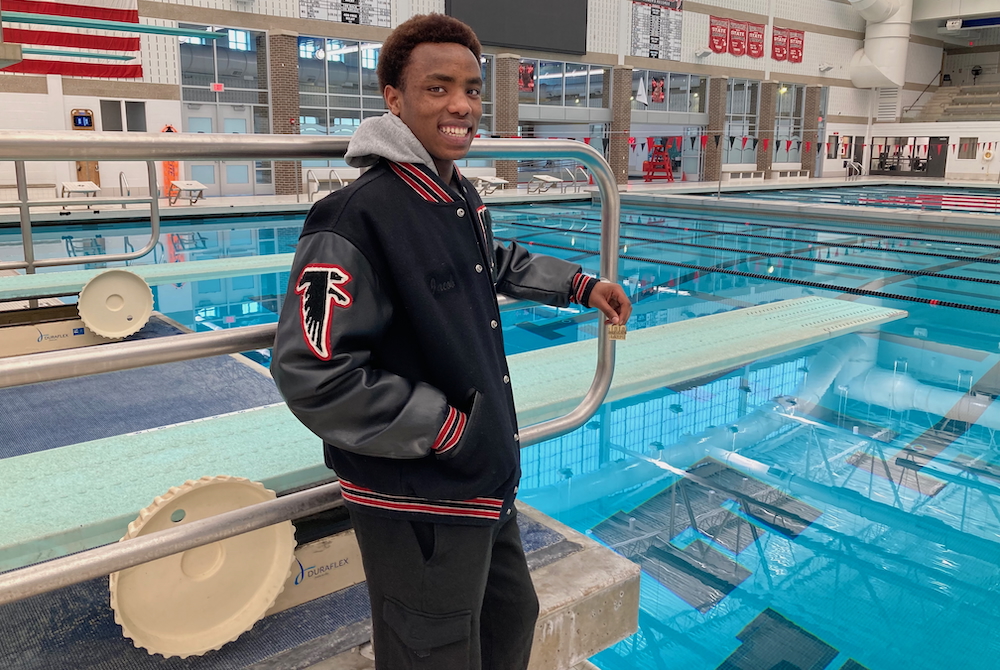
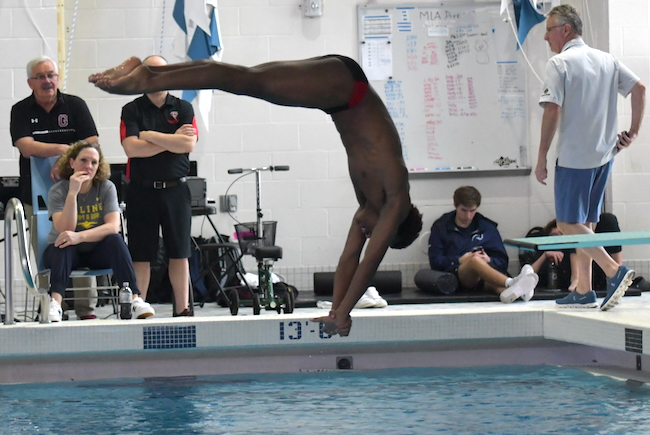
PHOTOS (Top) East Kentwood’s Fidele Byiringiro stands for a photo recently at his school’s pool. (Middle) Byiringiro dives during last weekend’s Lower Peninsula Division 1 Finals at Holland Aquatic Center. (Click for more Finals photos from High School Sports Scene.)