

New Math: Division & Multiplication Problems
July 25, 2017
By Jack Roberts
MHSAA Executive Director
This is the second part in a series on MHSAA tournament classification, past and present, that will be published over the next two weeks. This series originally ran in this spring's edition of MHSAA benchmarks.
High school tournament classifications went viral before there was social media and most of us knew what “viral” meant.
Much as a virus infects computers today or has created epidemics of disease around the world for centuries, high school tournament classification – once introduced – tends to spread uncontrollably. Once started, it tends to keep expanding and rarely contracts.
While we are still some distance from providing every team a trophy as a result of expanding high school tournament classification across the country, there is criticism nevertheless that we are headed in that direction – a philosophy which is supposed to exist only in local youth sports for our youngest children.
Michigan could be blamed for all this. Michigan is generally accepted as the first state to provide different classifications for season-ending tournaments for different sized schools. It started a century ago. Today, every state has various classifications for its tournaments in most if not all sports. And it is a bit ironic that Michigan – creator of the classification chaos – more than most other states has kept the number of tournament classes or divisions under control.
Yes, there is evidence that tournament classifications have expanded over the years in Michigan, especially with the relatively recent introduction of tournaments in football and the late 1990s’ move from classes to divisions in most MHSAA tournaments. But the MHSAA Representative Council has held true to its word when it expanded the playoffs for football from four classes to eight divisions: this is needed because of unique factors of football, factors that exist in no other sport; and all other sports should be capped at a maximum of four classes or divisions.
Kentucky is the preeminent defender of single-class basketball. All of its 276 high schools compete for the single state championship for each gender. In Indiana, there are still open wounds from its move in 1998 from one to four classes for its 400 schools in basketball.
Multi-class tournaments have tended to increase the number of non-public school champions, which some states are trying to lower through enrollment “multipliers,” and also tend to increase the number of repeat champions, which some states are trying to affect with “success factors” which lift smaller schools into classifications for larger schools if they take home too many trophies.
While there is considerable evidence that state tournaments do as much bad as good for educational athletics, state associations persist in providing postseason tournaments because, on balance, the experiences are supposed to be good for student-athletes. And once we reach that conclusion it is just a small leap to believe that if the tournaments are good for a few, they must be better for more – which leads to creating more and more tournament classifications. One becomes two classes, then three, then four and so forth.
While the argument is that more classifications or divisions provides more students with opportunities to compete and win, it is undeniable that the experience changes as the number of tournament classifications expands. It is not possible for state associations to provide the same level of support when tournament classifications expand to multiple venues playing simultaneously. For example, there is less audio and video broadcast potential at each venue, and less media coverage to each venue. Focus is diluted and fans diminished at each championship.
No one can argue reasonably that today's two-day MHSAA Football Finals of eight championship games has the same pizazz as the one-day, four-games event conducted prior to 1990.
In some states the number of divisions has grown so much that it is difficult to see much difference between the many season-ending state championship games and a regular-season event in the same sport.
It is a balancing act. And Michigan has been studying that balance longer than any other state, and charting a steadier course than most.
Addition by Division
The shift to Divisions for MHSAA Tournament play in numerous sports has added up to a greater number of champions for teams and individuals across the state. Following are the sports currently employing a divisional format, and the procedures for determining enrollment and classification.
In 23 statewide or Lower Peninsula tournaments, schools which sponsor the sport are currently divided into nearly equal divisions. They are:
- Baseball - 4 Divisions
- Boys Bowling - 4 Divisions
- Girls Bowling - 4 Divisions
- Girls Competitive Cheer - 4 Divisions
- LP Boys Cross Country - 4 Divisions
- LP Girls Cross Country - 4 Divisions
- LP Boys Golf - 4 Divisions
- LP Girls Golf - 4 Divisions
- Ice Hockey - 3 Divisions
- Boys Lacrosse - 2 Divisions
- Girls Lacrosse - 2 Divisions
- Boys Skiing - 2 Divisions
- Girls Skiing - 2 Divisions
- LP Boys Soccer - 4 Divisions LP
- Girls Soccer - 4 Divisions
- Girls Softball - 4 Divisions
- LP Boys Swimming & Diving - 3 Divisions
- LP Girls Swimming & Diving - 3 Divisions
- LP Boys Tennis - 4 Divisions
- LP Girls Tennis - 4 Divisions
- LP Boys Track & Field - 4 Divisions
- LP Girls Track & Field - 4 Divisions
- Wrestling - 4 Divisions
Lists of schools for each division of these 23 tournaments are posted on MHSAA.com approximately April 1. Listings of schools in Upper Peninsula tournaments for their sports are also posted on MHSAA.com. The lists are based on school memberships and sports sponsorships in effect or anticipated for the following school year, as known to the MHSAA office as of a date in early March.
In football, the 256 schools which qualify for MHSAA 11-player playoffs are placed in eight equal divisions annually on Selection Sunday. Beginning in 2017, the 8-player divisions will be determined in a like manner on Selection Sunday as well, with 32 qualifying schools placed in two divisions.
Schools have the option to play in any higher division in one or more sports for a minimum of two years.
The deadlines for "opt-ups" are as follows:
- Applications for fall sports must be submitted by April 15
- Applications for winter sports must be submitted by Aug. 15
- Applications for spring sports must be submitted by Oct. 15
Subsequent to the date of these postings for these tournaments, no school will have its division raised or lowered by schools opening or closing, schools adding or dropping sports, schools exercising the option to play in a higher division, or approval or dissolution of cooperative programs.
When the same sport is conducted for boys and girls in the same season (e.g., track & field and cross country), the gender that has the most sponsoring schools controls the division breaks for both genders.
Preview: Rivalries Ready to Reignite, Historic Opportunities Await at CMU
By
Geoff Kimmerly
MHSAA.com senior editor
February 27, 2025
All of the rivalries that annually reignite at the MHSAA Competitive Cheer Finals are expected to do so again, with the Rochester schools battling in Division 1, Allen Park and Gibraltar Carlson among favorites in Division 2, and Pontiac Notre Dame Prep and Richmond back among the top-ranked in Division 3.
But several eyes will be watching the state’s smallest schools as they chase historic opportunities – amid perhaps the most wide-open race – in Division 4.
Hudson has won five straight Division 4 titles, and a sixth would tie the MHSAA record set by Carlson from 2011-16. But the Tigers are up against a high-scoring field that includes another of the all-time winningest champs in Pewamo-Westphalia and six teams all seeking their first title.
Among other Division 4 hopefuls are Coloma and Marion, both making their first Finals appearances, as is Zeeland West in Division 2.
Division 4 leads off the weekend at 2 p.m. Friday at Central Michigan University’s McGuirk Arena, followed by Division 1 at 6:30 p.m. Division 3 starts Saturday’s competitions at 11 a.m., with Division 2 finishing the weekend at 3:30 p.m. The full schedule, plus information on purchasing tickets and how to watch online are all available on the Competitive Cheer page of MHSAA.com.
Division 1
BRIGHTON
Ranking: No. 3
League finish: First in Kensington Lakes Activities Association West
Coach: Christine Wilson-Peacock, 13th season
Championship history: Class A runner-up 1999.
Top score: 788.80.
Team composition: 21 total (six seniors, six juniors, seven sophomores, two freshmen).
Outlook: Brighton finished sixth last season and fourth in 2023, and has finished first or second at all but one of its competitions this season with runner-up finishes at both its District and Regional. The Bulldogs have been remarkably consistent scoring between 787-788 points in four straight competitions and six of their last seven. Senior Kadyn Robertson earned all-Regional recognition last season, and senior Adrianna Pembroke earned all-state honorable mention in 2023.
GRANDVILLE
Ranking: No. 7
League finish: First in Ottawa-Kent Conference Red
Coach: Julie Smith-Boyd, 44th season
Championship history: Six MHSAA titles (most recent 2015), 10 runner-up finishes.
Top score: 789.08 at Regional.
Team composition: 24 (three seniors, eight juniors, six sophomores, seven freshmen).
Outlook: The Bulldogs graduated 17 from the team that finished eighth a year ago, but they haven’t slowed down. Grandville has finished first or second at all but two competitions this season and has won five straight and seven of its last eight. The Bulldogs are trending in the right direction on the scoresheet as well, posting their top two overall scores this season in claiming District and Regional titles. Juniors Maddy Denman, Olivia Talsma and Lauren Elder and senior Ava Wohlfert earned all-District recognition last season.
HARTLAND
Ranking: No. 5
League finish: Second in KLAA West
Coach: Candace Fahr, eighth season
Championship history: Division 1 runner-up 2013.
Top score: 790.46.
Team composition: 24 total (seven seniors, seven juniors, five sophomores, five freshmen).
Outlook: Hartland is back after finishing fourth at last year’s Final for the second time over the last three seasons. The Eagles finished first or second in all of their competitions this winter before placing third at their Regional, but their Regional score of 787.34 also was their third-highest this season after breaking 790 twice. Senior Makayla Prevo made the all-state first team last season, and senior Charleigh Ross made the second team.
MACOMB DAKOTA
Rank: No. 8
League finish: First in Macomb Area Conference Red
Coach: Michela Worthy, 23rd season
Championship history: Seeking first top-two MHSAA Finals finish.
Top score: 786.48 at Regional.
Team composition: 27 total (seven seniors, 11 juniors, five sophomores, four freshmen).
Outlook: Dakota is returning to the Finals for the first time since 2014, posting its top two scores this season in winning its District and then finishing fourth at its Regional. The Cougars followed at the Regional three of the top-four ranked teams in Division 1 and finished ahead of No. 6 Utica Eisenhower, No. 9 Macomb L’Anse Creuse North and No. 10 Wyandotte Roosevelt to qualify. Senior Ashley Pioch and sophomore Nicole Nehra earned all-District recognition in 2024.
ROCHESTER
Ranking: No. 1
League finish: First in Oakland Activities Association Red
Coach: Samantha Dean, third season
Championship history: 15 MHSAA titles (most recent 2023).
Top score: 793.68.
Team composition: 28 total (10 seniors, 10 juniors, eight sophomores).
Outlook: Rochester finished third last season, and a large group of juniors has become a sizable senior crew that has the Falcons arguably the favorites again. Rochester won all of its competitions before finishing second at its Regional and has scored at least 790 points in seven straight competitions. Seniors Natalia Grabovac and Isabella Gungab made the all-state second team last season, and senior Morgan Calcagno and junior Claire O’Neill earned honorable mentions. Senior Aubrey Hillard made the all-state second team in 2023.
ROCHESTER ADAMS
Ranking: No. 4
League finish: Third in OAA Red
Coach: Brooke Miller, 11th season
Championship history: Three MHSAA titles (most recent 2022), five runner-up finishes.
Top score: 792.76 at Regional.
Team composition: 26 total (six seniors, 13 juniors, five sophomores, two freshmen).
Outlook: Adams has finished Finals runner-up two straight seasons after winning three straight titles from 2020-22, and total the Highlanders have finished among the top two in seven consecutive Finals. They may be on the verge of extending that streak with their top two scores of the season – both surpassing 792 points – coming in finishing second at their District and third at their Regional. Senior Maria Caradonna and junior Nikala Hall made the all-state second team last season, and junior Libby Schultz and sophomore Gabriella Montgomery earned honorable mentions.
ROCHESTER HILLS STONEY CREEK
Ranking: No. 2
League finish: Second in OAA Red
Coach: Tricia Williams, 22nd season
Championship history: Three MHSAA titles (most recent 2024), Division 1 runner-up 2022.
Top score: 793.26 at Regional.
Team composition: 30 total (three seniors, 20 juniors, four sophomores, three freshmen).
Outlook: Reigning champion Stoney Creek made a loud statement at the Regional last week, becoming the only team to finish ahead of Rochester High in competition this winter. The Cougars have upped their top overall score this season in three straight competitions, breaking 792 twice before the Regional win by 38 hundredths of a point after posting the top-scoring routine in Round 3 to move ahead. Senior Sarah Adams made the all-state second team last season, and senior Sienna Wills and junior Natalie Marco earned honorable mentions.
ROCKFORD
Ranking: Unranked
League finish: Third in O-K Red
Coach: MeLisa Milanowski, fifth season
Championship history: Seeking first top-two Finals finish.
Top score: 780.64 at Regional.
Team composition: 23 total (10 seniors, five juniors, six sophomores, two freshmen).
Outlook: A team of nearly half seniors earned Rockford’s first trip to the Finals since 2006 and did so in dramatic fashion. The Rams finished fourth at their District with what was then a season-high score of 776.6, then buried that total by more than four points to earn the fourth-place Finals qualifying spot at the Regional. Sophomore Lila Gates earned all-District recognition last season.
Division 2
ALLEN PARK
Ranking: No. 1
League finish: First in Downriver League
Coach: Julie Goodwin, 21st season
Championship history: Six MHSAA titles (most recent 2024), five runner-up finishes.
Top score: 792.76 at District.
Team composition: 23 total (five seniors, three juniors, eight sophomores, seven freshmen).
Outlook: Allen Park has finished among the top two nine straight seasons and won four of the last five Division 2 titles. A roster of more than half underclassmen has achieved a near-perfect season, with only a second place in the Jaguars’ first competition followed by all firsts despite continuing their frequent matchups with similarly-powerful Gibraltar Carlson. Allen Park’s 785.78 at the Regional was more than seven points higher than the field. Senior Abigail Obrycki and junior Sophia Ramey made the all-state first team last season, and senior Peyton Will and sophomore Hazyl Hall earned honorable mentions.
CARLETON AIRPORT
Ranking: No. 6
League finish: First in Huron League
Coach: Emily Dusik, third season
Championship history: Division 2 runner-up 2024, Class B runner-up 2003.
Top score: 790.80.
Team composition: 23 total (two seniors, six juniors, 11 sophomores, four freshmen).
Outlook: Airport is coming off its best Finals finish in more than two decades and returns after emerging fourth from a Regional that included the top nine ranked teams in Division 2 – moving past No. 3 Fenton and No. 4 Southgate Anderson to claim the final qualifying spot. A third-highest Round 1 score at the Regional was especially impressive. Sophomore Isabella Mulvin and junior Sydney Linn made the all-state second team last season, and senior Ashleigh Bentley and junior Kadence McDonald earned honorable mentions.
CEDAR SPRINGS
Ranking: Unranked
League finish: First in River Cities Alliance
Coach: Katy Hradsky, fourth season
Championship history: Seeking first top-two Finals finish.
Top score: 750.86 at the Regional.
Team composition: 16 total (three seniors, four juniors, three sophomores, six freshmen).
Outlook: Cedar Springs returned to the Finals last season with a fifth-place finish and will attempt to build on that having posted their two highest scores this winter to win the District and finish third at the Regional – the latter with nearly a five-point jump. Junior Taylor Verduin made the all-state second team last season, and senior Sarah Buckley earned an honorable mention.
GIBRALTAR CARLSON
Ranking: No. 2
League finish: Second in Downriver League
Coach: Alyssa Tocco, fourth season
Championship history: 12 MHSAA titles (most recent 2023), seven runner-up finishes.
Top score: 795.26.
Team composition: 24 total (four seniors, three juniors, seven sophomores, 10 freshmen).
Outlook: Carlson has finished first or second at all of its competitions this season as it seeks to make another title push coming off last year’s fourth-place finish. The Marauders have scored fewer than 785 points only twice and broken 790 three times. Seniors Sofia Lanzini and Maranda Steinmetz made the all-state first team last season, while senior Haley Sanchez made the second team and senior Alaina Bucala earned an honorable mention.
MUSKEGON REETHS-PUFFER
Ranking: Unranked
League finish: Fourth in O-K Green
Coach: Lisabeth Smith, fourth season
Championship history: Seeking first top-two Finals finish.
Top score: N/A.
Team composition: 25 total (three seniors, 10 juniors, eight sophomores, four freshmen).
Outlook: Reeths-Puffer is returning to the Finals for the second-straight season and third time in Smith’s four leading the program. The Rockets improved on their District score by more than 16 points to earn the fourth-place qualifying spot for this weekend. Junior Madilynn Smith, senior Lorena Garcia and sophomore Malia McGuffey earned all-Regional recognition last season.
PLAINWELL
Ranking: No. 10
League finish: First in Wolverine Conference
Coach: Kylie Cook, sixth season
Championship history: Class B champion 2000, Class B runner-up 2001.
Top score: 767.68 at the Regional.
Team composition: 20 total (four seniors, nine juniors, two sophomores, five freshmen).
Outlook: Plainwell finished seventh last season at its first Final since 2003, and now the Trojans will return for the second-straight season coming off league, District and Regional titles and after posting their two highest scores this winter to win the latter two meets. They’ve won nine competitions, finished second twice and lower than that only once. Seniors Danika Sayles-Devine and Abigail Stewart and juniors Ella LaPenna, Mackenzie Meert and Alivia Meninga earned all-District recognition in 2024.
WALLED LAKE WESTERN
Ranking: No. 5
League finish: Second in Lakes Valley Conference
Co-coaches: Amber Stocks, 15th season; Michelle Frey, 13th season
Championship history: Seeking first top-two Finals finish.
Top score: 788.82.
Team composition: 21 total (six seniors, seven juniors, five sophomores, three freshmen).
Outlook: Western emerged third from the same loaded Regional as Airport filled with nine ranked teams, qualifying for the Finals for the first time since 2021and after missing by just one place a year ago. The Warriors also won their District this month with a score of 786.86. Seniors Emily Beaudoin and Zahylee Cox, junior Hannah Fore and sophomores Ella Spiess and Mariana Gonzalez earned all-Regional recognition last season.
ZEELAND WEST
Ranking: Unranked
League finish: First in O-K Black
Coach: Emillie Gort, third season
Championship history: Seeking first top-two Finals finish.
Top score: 761.36 at the District.
Team composition: 22 total (five seniors, four juniors, five sophomores, eight freshmen).
Outlook: West has earned its first trip to the Finals in this sport with runner-up finishes at its District and Regional, following its season-best score at the former with a 760.14 this past weekend to advance. The Dux have finished first or second at all of their competitions this season, including wins at all three league meets. West nearly reached the Finals a year ago, finishing fifth at its Regional, and seniors Riley Howe and Jordin Robelin and junior Addysen Miller earned all-Regional recognition.
Division 3
ARMADA
Ranking: No. 4
League finish: Second in Blue Water Area Conference
Coach: Deanna Misiak, ninth season
Championship history: Seeking first top-two Finals finish.
Top score: N/A.
Team composition: 24 total (five seniors, four juniors, three sophomores, 12 freshmen).
Outlook: Armada finished fourth last season in its first Finals trip since 2015, and returns this weekend coming off third-place finishes at its District and Regional against fields that included No. 1 Pontiac Notre Dame Prep and No. 2 Richmond – although the Tigers finished ahead of Richmond at the Regional. Armada scored an impressive 784.38 at the District and finished second in the BWAC as one of three top-10 teams in the league, including as well reigning two-time Finals champion Croswell-Lexington. Senior Alice Rhadigan made the all-state first team last season.
CHARLOTTE
Ranking: No. 9
League finish: First in Capital Area Activities Conference White
Coach: Jade Bowhall, second season
Championship history: Seeking first top-two Finals finish.
Top score: 760.44.
Team composition: 21 total (six seniors, five juniors, eight sophomores, two freshmen).
Outlook: Charlotte will make its first trip to the Finals since 2020 and has won or placed second at all but one competition this season – including a victory at its District and runner-up finish at its Regional. The Orioles have advanced to Regionals both seasons under Bowhall, and senior Brooke Tokar earned all-Regional recognition last season.
GLADSTONE
Ranking: Unranked
League finish: Does not compete in a conference.
Coach: Stacie Kitson, fourth season
Championship history: Seeking first top-two Finals finish.
Top score: 752.74
Team composition: 23 total (six seniors, three juniors, six sophomores, eight freshmen).
Outlook: Gladstone is making its first trip to the Finals since 2012, after taking third at both its District and Regional and finishing ahead of a ranked team at the latter. Kitson previously reached the Finals as both an athlete and assistant coach at Escanaba, as an athlete helping her school advance in 2016 for the first time. Senior Kristy Karl earned all-District recognition for Gladstone last season.
GROSSE ILE
Ranking: No. 3
League finish: Second in Huron League.
Coach: Angie Raithel, eighth season
Championship history: Two MHSAA titles (most recent 2010), Division 3 runner-up 2009.
Top score: 780.00.
Team composition: 23 total (seven seniors, two juniors, six sophomores, eight freshmen).
Outlook: After finishing third last season and only 1.18 points off the lead, Grosse Ile could make another serious title push. The Red Devils won a District that also included No. 6 Flat Rock and No. 10 Michigan Center and then finished second at a Regional just 2.64 points behind top-ranked Notre Dame Prep and ahead of five ranked teams including No. 2 Richmond. Senior Marissa Trombley and sophomore Laynie Gratz made the all-state first team last season, seniors Virginia West and Avelinn Flynn made the second team and senior Arianna Bianchi earned an honorable mention.
HOWARD CITY TRI COUNTY
Ranking: No. 5
League finish: First in Central State Activities Association
Coach: Jennifer Laskey, 21st season
Championship history: Seeking first top-two Finals finish.
Top score: N/A.
Team composition: 22 total (seven seniors, four juniors, two sophomores, nine freshmen).
Outlook: Tri County finished seventh last season and should bring plenty of momentum into this weekend coming off eight straight first-place finishes (and 11 in 12 competitions this season) including at its District and Regional. The Vikings won their Regional by nearly 27 points with a 760.06 – four points higher than their Finals score a year ago. Junior Briana Cheatham made the all-state first team last season, junior Jocelynn Olds made the second team and junior Violet Bellamy earned an honorable mention.
PONTIAC NOTRE DAME PREP
Ranking: No. 1
League finish: Does not compete in a conference.
Coach: Jocelyn Welsh, second season
Championship history: Five MHSAA titles (most recent 2018), five runner-up finishes.
Top score: 790.96 at the District.
Team composition: 28 total (seven seniors, six juniors, eight sophomores, seven freshmen).
Outlook: The Fighting Irish have finished Divisions 3 runners-up the last two seasons and four of the last six since completing a five-year title streak in 2018. They could start a new championship run this weekend having won all of their competitions so far this winter, including a Regional title against a fields that included No. 2 Richmond, No. 3 Grosse Ile and No. 4 Armada. Senior Grace Kinkade made the all-state first team last season, seniors Gabrielle Phillips and Paige Marlinga and junior Jenna Robin made the second team, and senior Lelia Mains and sophomore Eva Thomas earned honorable mentions.
PORTLAND
Ranking: Unranked
League finish: Third in CAAC White
Coach: Mindy Blaschka, 12th season
Championship history: Seeking first top-two Finals finish.
Top score: 730.96.
Team composition: 14 total (three seniors, four juniors, four sophomores, two freshmen).
Outlook: Portland improved to sixth place last season and will make its fourth-straight trip to the Finals after posting three of its top five overall scores of the season over the last three competitions. The Raiders have steadily improved their scores after graduating nine from last year’s team. Senior Karter Edwards earned all-Regional recognition last season.
RICHMOND
Ranking: No. 2
League finish: First in Blue Water Area Conference
Coach: Kelli Matthes, 17th season
Championship history: Six MHSAA titles (most recent 2022), five runner-up finishes.
Top score: 786.50 at the District.
Team composition: 27 total (four seniors, six juniors, seven sophomores, 10 freshmen).
Outlook: After a rare year away, Richmond is returning to the Finals and capable again of being in the championship mix with six scores over 770 points this winter. The Blue Devils have finished first or second at all of their competitions except the Regional, where they placed fourth among a field that included seven of the top 10 ranked teams. Seniors Faith Thompson and Autumn Rands, junior Ava Widmaier and sophomore Khloe Allison earned all-Regional honors in 2024.
Division 4
COLOMA
Ranking: No. 9
League finish: First in Southwestern Athletic Conference
Coach: Christin Smith, 16th season
Championship history: Seeking first top-two Finals finish.
Top score: 735.54 at the District.
Team composition: 18 total (five seniors, three juniors, six sophomores, four freshmen).
Outlook: Coloma’s run to its first Finals has included first or second places at all but one competition, including a District championship win by nearly 47 points. The Comets then placed fourth at their Regional against a field that included three more top-10 teams. Seniors Makenna Baryo, Olivia DeChant and Makenna Baker and junior Cassidy Emrath earned all-District honors last season.
GRAND RAPIDS NORTHPOINTE CHRISTIAN
Ranking: No. 6
League finish: Second in O-K Silver
Coach: Sue Smith, 12th season
Championship history: Seeking first top-two Finals finish.
Top score: 747.10 at the District.
Team composition: Nine total (three seniors, four juniors, two sophomores).
Outlook: NorthPointe will compete at the Finals for the first time since 2021 thanks to a second-place at its District and championship at its Regional against a field that included three more top-10 teams. NorthPointe won that Regional by five points after just missing making the Finals the year prior. Seniors Lindsay Ulstad, Addison Bey and Riley Paulk and junior Bella Barnett earned all-Regional honors last year.
HANOVER-HORTON
Ranking: No. 2
League finish: First in Cascades Conference
Coach: Sarah DuBois, 25th season
Championship history: Seeking first top-two Finals finish.
Top score: 768.40 at the District.
Team composition: 21 total (eight seniors, four juniors, five sophomores, four freshmen).
Outlook: Hanover-Horton finished sixth last season at its first Final, and the Comets have continued to climb this winter with nine straight overall scores of 740 or higher – after reaching 739.86 for a high score last season. Hanover-Horton has finished first or second at all of its competitions and broken 760 points each of its last three including while winning its District and finishing second at its Regional. Senior Alexyn DuBois made the all-state first team last season, senior Maddy Sauber made the second team and senior Reyna Collins earned honorable mention.
HUDSON
Ranking: No. 4
League finish: Second in Lenawee County Athletic Association
Coach: Kelly Bailey, 28th season
Championship history: Six MHSAA titles (most recent 2024), six runner-up finishes.
Top score: 758.08 at the District.
Team composition: 18 total (five seniors, four juniors, seven sophomores, two freshmen).
Outlook: Hudson ran its championship streak to five last season, winning by more than seven points. But the Tigers may have to climb this time after finishing second at their District and fourth at their Regional. Hudson did post its top scores of the season at those two most recent competitions, topping 754 points at both. Seniors Jayla Bright and Courtney Rodifer made the all-state first team last season, while sophomore Emmalin Rodifer made the second team and senior Kristtany Higgins, junior Emerson Sholl and sophomore Paige Butts earned honorable mentions.
MARION
Ranking: No. 10
League finish: Does not compete in a conference.
Coach: Danyel Prielipp, 27th season
Championship history: Seeking first top-two Finals finish.
Top score: 762.40 at the District.
Team composition: 12 total (four seniors, two juniors, one sophomore, five freshmen).
Outlook: Marion is another first-time Finals qualifier, advancing by winning its District by 15.3 points and then finishing third at its Regional among four ranked teams at the top. The District win was the team’s sixth in 11 competitions total. Seniors J’Lynn Schoonmaker, Malley Raymond and Ella Wilson and junior Aaliyah Nealey earned all-District honors last season.
NORWAY
Ranking: No. 8
League finish: Does not compete in a conference.
Coach: Hailey Micoley, third season
Championship history: Seeking first top-two Finals finish.
Top score: 751.78.
Team composition: 22 total (two seniors, five juniors, 10 sophomores, five freshmen).
Outlook: Norway finished its second-straight regular season having won all of its competitions, and also repeated as District champion. But this time the Knights jumped from seventh to second at their Regional to earn a return to the Finals for the first time since 2009. Senior Paige Roberts earned all-Regional recognition last season and is one of just seven upperclassmen on a team that finished 5.64 points behind winner NorthPointe at their Regional and should continue to build.
PEWAMO-WESTPHALIA
Ranking: No. 3
League finish: Does not compete in a conference.
Coach: Staci Myers, 18 season
Championship history: Nine MHSAA titles (most recent 2019), 13 runner-up finishes.
Top score: 771.14 at the Regional.
Team composition: 23 total (five seniors, six juniors, two sophomores, 10 freshmen).
Outlook: Last season’s runner-up appears plenty capable of making the jump to win its first championship since 2019, especially coming off a Regional-winning score that was more than 12 points higher than its previous best this season. The Pirates had finished second at their District by 12.11 points before winning the Regional by 5.08, and they’ve finished first or second at every competition this season. Seniors Addison Hengesbach and Caidence Nyhus and junior Karsyn Simmon made the all-state first team last season, seniors Jayde Ferguson and Miriam Downs made the second team, and junior Taryn Schafer and sophomore Brynn Feldpausch earned honorable mentions.
SANFORD MERIDIAN
Ranking: No. 1
League finish: First in Jack Pine Conference
Coach: Val MacKenzie, 35th season
Championship history: Division 4 runner-up 2018.
Top score: 772.88.
Team composition: 18 total (six seniors, two juniors, eight sophomores, two freshmen).
Outlook: Meridian – fifth a year ago – has not scored below 704 points at a competition this season, and is averaging an overall 745 –with three straight rounds of 760 or higher heading into this weekend. The Mustangs had won all of their meets before finishing third at their Regional. Senior Lexi Cryderman made the all-state first team last season, sophomores Marlee Kelly and Alyza Molski made the second team, and sophomores Ellie Beach and Payton Mathe earned honorable mentions.
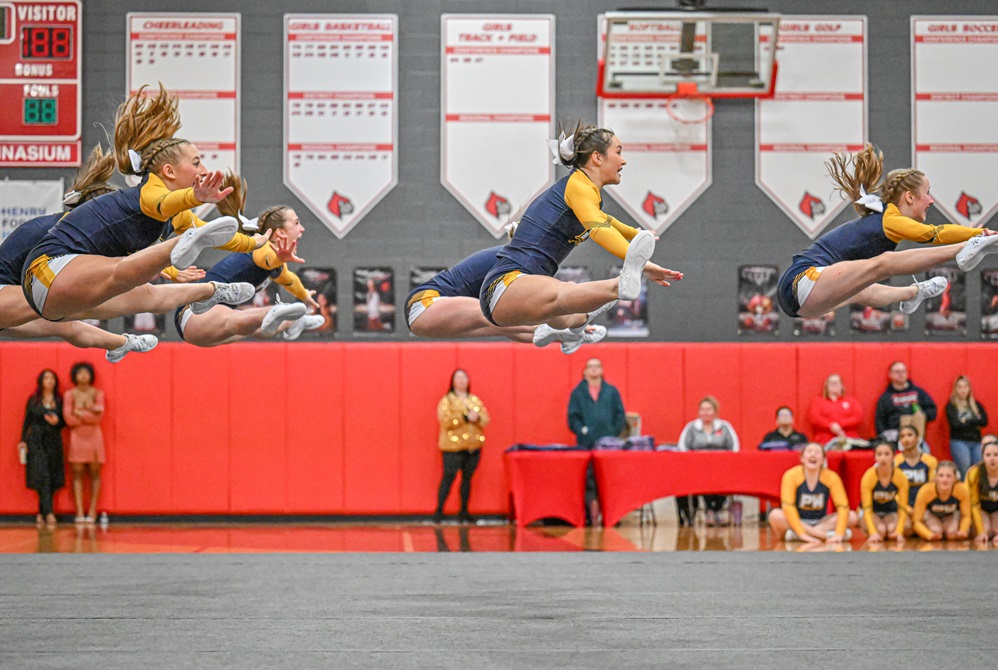
PHOTO: Pewamo-Westphalia competes during its Regional last week at Michigan Center. (Photo by Jim Pivarnik.)