

New Math: Division & Multiplication Problems
July 25, 2017
By Jack Roberts
MHSAA Executive Director
This is the second part in a series on MHSAA tournament classification, past and present, that will be published over the next two weeks. This series originally ran in this spring's edition of MHSAA benchmarks.
High school tournament classifications went viral before there was social media and most of us knew what “viral” meant.
Much as a virus infects computers today or has created epidemics of disease around the world for centuries, high school tournament classification – once introduced – tends to spread uncontrollably. Once started, it tends to keep expanding and rarely contracts.
While we are still some distance from providing every team a trophy as a result of expanding high school tournament classification across the country, there is criticism nevertheless that we are headed in that direction – a philosophy which is supposed to exist only in local youth sports for our youngest children.
Michigan could be blamed for all this. Michigan is generally accepted as the first state to provide different classifications for season-ending tournaments for different sized schools. It started a century ago. Today, every state has various classifications for its tournaments in most if not all sports. And it is a bit ironic that Michigan – creator of the classification chaos – more than most other states has kept the number of tournament classes or divisions under control.
Yes, there is evidence that tournament classifications have expanded over the years in Michigan, especially with the relatively recent introduction of tournaments in football and the late 1990s’ move from classes to divisions in most MHSAA tournaments. But the MHSAA Representative Council has held true to its word when it expanded the playoffs for football from four classes to eight divisions: this is needed because of unique factors of football, factors that exist in no other sport; and all other sports should be capped at a maximum of four classes or divisions.
Kentucky is the preeminent defender of single-class basketball. All of its 276 high schools compete for the single state championship for each gender. In Indiana, there are still open wounds from its move in 1998 from one to four classes for its 400 schools in basketball.
Multi-class tournaments have tended to increase the number of non-public school champions, which some states are trying to lower through enrollment “multipliers,” and also tend to increase the number of repeat champions, which some states are trying to affect with “success factors” which lift smaller schools into classifications for larger schools if they take home too many trophies.
While there is considerable evidence that state tournaments do as much bad as good for educational athletics, state associations persist in providing postseason tournaments because, on balance, the experiences are supposed to be good for student-athletes. And once we reach that conclusion it is just a small leap to believe that if the tournaments are good for a few, they must be better for more – which leads to creating more and more tournament classifications. One becomes two classes, then three, then four and so forth.
While the argument is that more classifications or divisions provides more students with opportunities to compete and win, it is undeniable that the experience changes as the number of tournament classifications expands. It is not possible for state associations to provide the same level of support when tournament classifications expand to multiple venues playing simultaneously. For example, there is less audio and video broadcast potential at each venue, and less media coverage to each venue. Focus is diluted and fans diminished at each championship.
No one can argue reasonably that today's two-day MHSAA Football Finals of eight championship games has the same pizazz as the one-day, four-games event conducted prior to 1990.
In some states the number of divisions has grown so much that it is difficult to see much difference between the many season-ending state championship games and a regular-season event in the same sport.
It is a balancing act. And Michigan has been studying that balance longer than any other state, and charting a steadier course than most.
Addition by Division
The shift to Divisions for MHSAA Tournament play in numerous sports has added up to a greater number of champions for teams and individuals across the state. Following are the sports currently employing a divisional format, and the procedures for determining enrollment and classification.
In 23 statewide or Lower Peninsula tournaments, schools which sponsor the sport are currently divided into nearly equal divisions. They are:
- Baseball - 4 Divisions
- Boys Bowling - 4 Divisions
- Girls Bowling - 4 Divisions
- Girls Competitive Cheer - 4 Divisions
- LP Boys Cross Country - 4 Divisions
- LP Girls Cross Country - 4 Divisions
- LP Boys Golf - 4 Divisions
- LP Girls Golf - 4 Divisions
- Ice Hockey - 3 Divisions
- Boys Lacrosse - 2 Divisions
- Girls Lacrosse - 2 Divisions
- Boys Skiing - 2 Divisions
- Girls Skiing - 2 Divisions
- LP Boys Soccer - 4 Divisions LP
- Girls Soccer - 4 Divisions
- Girls Softball - 4 Divisions
- LP Boys Swimming & Diving - 3 Divisions
- LP Girls Swimming & Diving - 3 Divisions
- LP Boys Tennis - 4 Divisions
- LP Girls Tennis - 4 Divisions
- LP Boys Track & Field - 4 Divisions
- LP Girls Track & Field - 4 Divisions
- Wrestling - 4 Divisions
Lists of schools for each division of these 23 tournaments are posted on MHSAA.com approximately April 1. Listings of schools in Upper Peninsula tournaments for their sports are also posted on MHSAA.com. The lists are based on school memberships and sports sponsorships in effect or anticipated for the following school year, as known to the MHSAA office as of a date in early March.
In football, the 256 schools which qualify for MHSAA 11-player playoffs are placed in eight equal divisions annually on Selection Sunday. Beginning in 2017, the 8-player divisions will be determined in a like manner on Selection Sunday as well, with 32 qualifying schools placed in two divisions.
Schools have the option to play in any higher division in one or more sports for a minimum of two years.
The deadlines for "opt-ups" are as follows:
- Applications for fall sports must be submitted by April 15
- Applications for winter sports must be submitted by Aug. 15
- Applications for spring sports must be submitted by Oct. 15
Subsequent to the date of these postings for these tournaments, no school will have its division raised or lowered by schools opening or closing, schools adding or dropping sports, schools exercising the option to play in a higher division, or approval or dissolution of cooperative programs.
When the same sport is conducted for boys and girls in the same season (e.g., track & field and cross country), the gender that has the most sponsoring schools controls the division breaks for both genders.
Thankful for Lifesavers Who Rushed to His Aid, Sanders Aims to Officiate Again
By
Doug Donnelly
Special for MHSAA.com
January 14, 2025
Doug Sanders sat quietly thinking about how to best describe what he went through the day after Thanksgiving at Monroe Jefferson High School.
 Finally, he just said it.
“Basically, I died twice,” he said, almost apologetically.
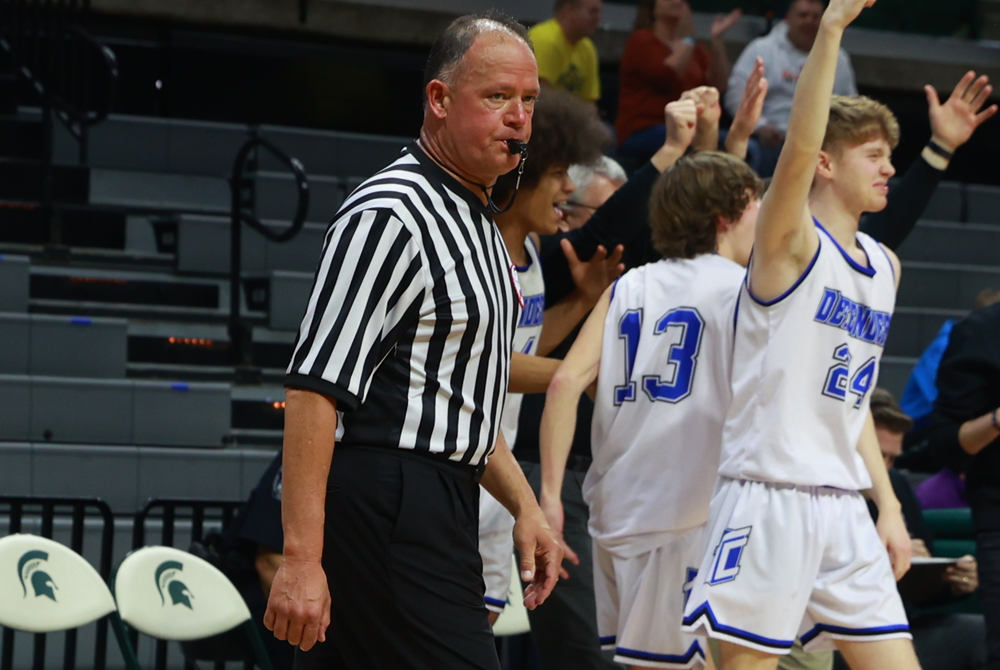
Sanders, 56, was officiating a boys varsity basketball game between Petersburg-Summerfield and Jefferson when he collapsed. First responders who were in attendance quickly got to Sanders and began performing life-saving procedures.
Responders performed chest compressions. Twice they used a defibrillator to shock him. He regained consciousness once only to inform the responders they were hurting his chest, then his heart stopped again.
When he left Jefferson that night on a stretcher, he was alert.
“I’ve never seen anything like that in my 24 years coaching,” Summerfield coach Phil Schiffler said. “I’ve seen gruesome things, compound fractures and things, but never someone pass like that, especially someone who was an official, in charge of the game.
“Thank God for the first responders there that night.”
Petersburg residents Matt LaRocca and Aaron Myshock were the first to assist Sanders on the court. Others helped as well, including Summerfield athletic director Kelly Kalb, former Summerfield athlete Brendan Dafoe, a nurse; and Angela Prush, who works at Monroe County Community College as a clinical educator in the respiratory therapy program. Jefferson athletic director Alyssa Eppler helped on the scene as well.
“There was no hesitation,” Kalb said. “As soon as Doug went down, Matt and Aaron took off to the court and got to Doug. Everyone played a role. It was a great collaboration."
 Kalb said the MHSAA this year implemented a new policy requiring schools to have an Emergency Action Plan in the event of this very type of emergency. That plan, she said, definitely helped both schools as they responded.
“We lost him a couple of times,” she said. “It was scary.”
Sanders knew something was wrong during the game. Moments before falling to the floor he called over one of his officiating partners, Steve Rechsteiner, and said something was wrong. He asked him to get him some water and said he felt light-headed.
“I said, ‘Help me,’” Sanders said. Moments later, he went to the floor.
As responders attended to Sanders, officials from both schools cleared the gymnasium of spectators and players, and the game was called. Players and fans left the gymnasium that night unsure of the events that had just unfolded in front of them.
“It’s amazing how it all happened,” said Sanders, who has been a registered MHSAA official for more than 30 years. “If I would have been driving or anywhere else when it happened, I may not be here today to talk about it.”
Sanders has had a history of heart problems, and those run in his family. About four years ago, he had open-heart surgery. Officiating another game a few nights before the incident at Jefferson, he had collapsed during a timeout. He was under doctor’s care but felt well enough to return to the court after enjoying Thanksgiving with his family.
The game between Summerfield and Jefferson went into the fourth quarter. That’s when Sanders began to feel something was wrong.
“I am so blessed and grateful to be where the right people were with me,” Sanders said. “I had the right people there at the right time.”
After being transported to a nearby hospital in Monroe, he was sent to another in Toledo. He spent several days in the hospital undergoing heart tests and procedures. He went home for recovery and recently started attending basketball games in the area again.
“People have been so nice through all of this,” he said. “I’ve gotten messages and cards and calls and texts from people all over the place, people I don’t even know. A lot of the officials that I’ve worked with have reached out to me. It’s really a close-knit group.”
Thankfully, his heart is improving.
Sanders is a 1987 graduate of Ottawa Lake Whiteford. He got his start as a referee for youth basketball at Whiteford Elementary School. Then-athletic director John Flynn encouraged him to get his MHSAA registration, and helped him get it. Soon after, Flynn was assigning him middle school games.
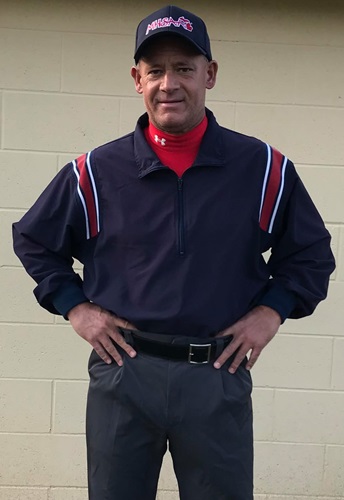
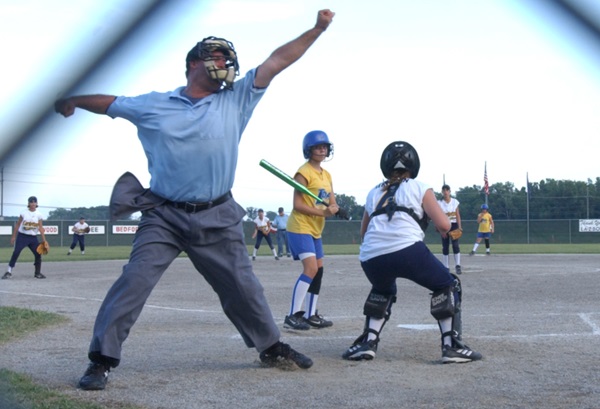 Over the years, Sanders began umpiring baseball and added refereeing football a few years ago.
He loves sports and being close to the game.
“That’s why I do it,” he said. “I wanted to be a basketball official because I enjoy working with the student-athletes. I like the exercise, especially during the wintertime. Outside it’s snowy and wet, and this was a way to get out and do something.”
He’s busiest during basketball season where he is assigned as many as four or five games a week. In 2022, he officiated a boys Semifinal game at the Breslin Center. He rarely slows down or takes nights off.
Since the incident, Sanders has been going through a series of tests on his heart and has had an ICD – or implantable cardioverter defibrillator – installed in his chest. An elementary school teacher in Toledo, he expects to return to work soon.
He’s met some of the first responders who helped save him that night at Jefferson but still isn’t sure just how many people played a role. He’s grateful the district had a defibrillator nearby – and especially that people were there who knew how to use it.
Schiffler said people just sprang into action, like they were trained to do.
“I was shook. I’m not going to lie,” he said. “The people who were trained in that knew just what to do.”
LaRocca and Myshock were there watching their sons play on the Summerfield team. Dafoe, who played sports at Summerfield and with Sanders as his referee and umpire on a number of occasions, has a brother on the varsity team.
Sanders is tentatively scheduled to referee a game at Adrian Lenawee Christian on Monday, Jan. 20. He can’t wait to shake the rust off, put on the striped shirt and blow his whistle. He knows there will be eyes on him throughout the game.
“I’ve had so many people tell me, ‘Take the rest of the winter off, don’t come back too early,’” Sanders said. “I want to get back out there. Something tells me in my heart and soul that I’m ready. I had my stress test, and I did well. Am I ready? I want to say yes. I think so. Only time will tell.”
 Doug Donnelly has served as a sports and news reporter and city editor over 25 years, writing for the Daily Chief-Union in Upper Sandusky, Ohio from 1992-1995, the Monroe Evening News from 1995-2012 and the Adrian Daily Telegram since 2013. He's also written a book on high school basketball in Monroe County and compiles record books for various schools in southeast Michigan. E-mail him at [email protected] with story ideas for Jackson, Washtenaw, Hillsdale, Lenawee and Monroe counties.
PHOTOS (Top) MHSAA official Doug Sanders monitors the action during a 2022 Division 4 Semifinal between Wyoming Tri-unity Christian and Genesee Christian. (Middle) Bradley is in uniform for a baseball game. (Below) Bradley makes a call behind the plate during a Monroe County Fair youth softball tournament game at least a decade ago. (Middle photo courtesy of Doug Sanders. Below photo by Kim Brent, courtesy of the Monroe News.)