

New Math: Division & Multiplication Problems
July 25, 2017
By Jack Roberts
MHSAA Executive Director
This is the second part in a series on MHSAA tournament classification, past and present, that will be published over the next two weeks. This series originally ran in this spring's edition of MHSAA benchmarks.
High school tournament classifications went viral before there was social media and most of us knew what “viral” meant.
Much as a virus infects computers today or has created epidemics of disease around the world for centuries, high school tournament classification – once introduced – tends to spread uncontrollably. Once started, it tends to keep expanding and rarely contracts.
While we are still some distance from providing every team a trophy as a result of expanding high school tournament classification across the country, there is criticism nevertheless that we are headed in that direction – a philosophy which is supposed to exist only in local youth sports for our youngest children.
Michigan could be blamed for all this. Michigan is generally accepted as the first state to provide different classifications for season-ending tournaments for different sized schools. It started a century ago. Today, every state has various classifications for its tournaments in most if not all sports. And it is a bit ironic that Michigan – creator of the classification chaos – more than most other states has kept the number of tournament classes or divisions under control.
Yes, there is evidence that tournament classifications have expanded over the years in Michigan, especially with the relatively recent introduction of tournaments in football and the late 1990s’ move from classes to divisions in most MHSAA tournaments. But the MHSAA Representative Council has held true to its word when it expanded the playoffs for football from four classes to eight divisions: this is needed because of unique factors of football, factors that exist in no other sport; and all other sports should be capped at a maximum of four classes or divisions.
Kentucky is the preeminent defender of single-class basketball. All of its 276 high schools compete for the single state championship for each gender. In Indiana, there are still open wounds from its move in 1998 from one to four classes for its 400 schools in basketball.
Multi-class tournaments have tended to increase the number of non-public school champions, which some states are trying to lower through enrollment “multipliers,” and also tend to increase the number of repeat champions, which some states are trying to affect with “success factors” which lift smaller schools into classifications for larger schools if they take home too many trophies.
While there is considerable evidence that state tournaments do as much bad as good for educational athletics, state associations persist in providing postseason tournaments because, on balance, the experiences are supposed to be good for student-athletes. And once we reach that conclusion it is just a small leap to believe that if the tournaments are good for a few, they must be better for more – which leads to creating more and more tournament classifications. One becomes two classes, then three, then four and so forth.
While the argument is that more classifications or divisions provides more students with opportunities to compete and win, it is undeniable that the experience changes as the number of tournament classifications expands. It is not possible for state associations to provide the same level of support when tournament classifications expand to multiple venues playing simultaneously. For example, there is less audio and video broadcast potential at each venue, and less media coverage to each venue. Focus is diluted and fans diminished at each championship.
No one can argue reasonably that today's two-day MHSAA Football Finals of eight championship games has the same pizazz as the one-day, four-games event conducted prior to 1990.
In some states the number of divisions has grown so much that it is difficult to see much difference between the many season-ending state championship games and a regular-season event in the same sport.
It is a balancing act. And Michigan has been studying that balance longer than any other state, and charting a steadier course than most.
Addition by Division
The shift to Divisions for MHSAA Tournament play in numerous sports has added up to a greater number of champions for teams and individuals across the state. Following are the sports currently employing a divisional format, and the procedures for determining enrollment and classification.
In 23 statewide or Lower Peninsula tournaments, schools which sponsor the sport are currently divided into nearly equal divisions. They are:
- Baseball - 4 Divisions
- Boys Bowling - 4 Divisions
- Girls Bowling - 4 Divisions
- Girls Competitive Cheer - 4 Divisions
- LP Boys Cross Country - 4 Divisions
- LP Girls Cross Country - 4 Divisions
- LP Boys Golf - 4 Divisions
- LP Girls Golf - 4 Divisions
- Ice Hockey - 3 Divisions
- Boys Lacrosse - 2 Divisions
- Girls Lacrosse - 2 Divisions
- Boys Skiing - 2 Divisions
- Girls Skiing - 2 Divisions
- LP Boys Soccer - 4 Divisions LP
- Girls Soccer - 4 Divisions
- Girls Softball - 4 Divisions
- LP Boys Swimming & Diving - 3 Divisions
- LP Girls Swimming & Diving - 3 Divisions
- LP Boys Tennis - 4 Divisions
- LP Girls Tennis - 4 Divisions
- LP Boys Track & Field - 4 Divisions
- LP Girls Track & Field - 4 Divisions
- Wrestling - 4 Divisions
Lists of schools for each division of these 23 tournaments are posted on MHSAA.com approximately April 1. Listings of schools in Upper Peninsula tournaments for their sports are also posted on MHSAA.com. The lists are based on school memberships and sports sponsorships in effect or anticipated for the following school year, as known to the MHSAA office as of a date in early March.
In football, the 256 schools which qualify for MHSAA 11-player playoffs are placed in eight equal divisions annually on Selection Sunday. Beginning in 2017, the 8-player divisions will be determined in a like manner on Selection Sunday as well, with 32 qualifying schools placed in two divisions.
Schools have the option to play in any higher division in one or more sports for a minimum of two years.
The deadlines for "opt-ups" are as follows:
- Applications for fall sports must be submitted by April 15
- Applications for winter sports must be submitted by Aug. 15
- Applications for spring sports must be submitted by Oct. 15
Subsequent to the date of these postings for these tournaments, no school will have its division raised or lowered by schools opening or closing, schools adding or dropping sports, schools exercising the option to play in a higher division, or approval or dissolution of cooperative programs.
When the same sport is conducted for boys and girls in the same season (e.g., track & field and cross country), the gender that has the most sponsoring schools controls the division breaks for both genders.
1st & Goal: 2024 Finals in Review
By
Geoff Kimmerly
MHSAA.com senior editor
December 4, 2024
The story of the 50th MHSAA Football Playoffs may have been driven as much by the run-up to the Finals of these last two weekends as by those 10 championship games themselves.
 But those games at Ford Field and the Superior Dome left us with their shares of unforgettable moments as we celebrated another special moment of this overall 100th MHSAA anniversary.
Goodrich, Pontiac Notre Dame Prep and Millington celebrated championships for the first time. Jackson Lumen Christi moved into first all-time with its 14th Finals title. The average margin of victory may not have been close this time around – winners did so by nearly 24 points, and we had just one single-digit game out of 10 – but consider as well the excitement generated on the way to these concluding weekends. Of the 20 teams ranked Nos. 1 or 2 by the Michigan High School Football Coaches Association at the end of the regular season, only five reached championship games – and only three won them.
We had senior standouts rewrite the scoring side of our 11-player Finals record book, star quarterbacks face off in an 8-player classic, and an uncountable number of unforgettable moments as nearly 45,000 fans traveled to witness the beginnings of our latest trophy celebrations.
MHSAA.com once again covered all 10 championship games, with quick recaps and links to those stories below followed by notations of performances entered into the MHSAA Finals record books and a report on some of the main storylines to emerge as those championships were being decided.
Finals in Review
11-Player Division 1: Detroit Cass Tech 42, Hudsonville 20 – Read
The Technicians won their fourth championship and first since 2016 by shutting down Hudsonville’s powerful rushing attack and dominating the air with freshman quarterback Donald Tabron II completing 15 of 20 passes for 176 yards and three touchdowns to arguably the top receiving group in the state. Cass Tech built a 35-0 lead by a minute into the second half.
11-Player Division 2: Orchard Lake St. Mary’s 35, Byron Center 19 – Read
Orchard Lake St. Mary’s also won its first championship since 2016 with a mostly second-half burst after trailing 13-7 until the final minutes of the second quarter. Darrin Jones and Bryson Williams both ran for more than 100 yards and a pair of touchdowns as the Eaglets also shut down a Byron Center offense that averaged nearly 40 points per game entering championship weekend.
11-Player Division 3: Zeeland West 42, Detroit Martin Luther King 22 – Read
Paced by a record-setting performance by running back Keaton Hendricks, Zeeland West and its T-formation attack defeated a fourth top-seven ranked team during this playoffs. The Dux presented a look King hadn’t seen in years and turned it into not only a 352-295 total yardage advantage but also a 30:10-17:50 edge in time of possession as it piled up points against a King defense that had given up just 13.6 per game on the way to the Final.
11-Player Division 4: Goodrich 35, Niles 6 – Read
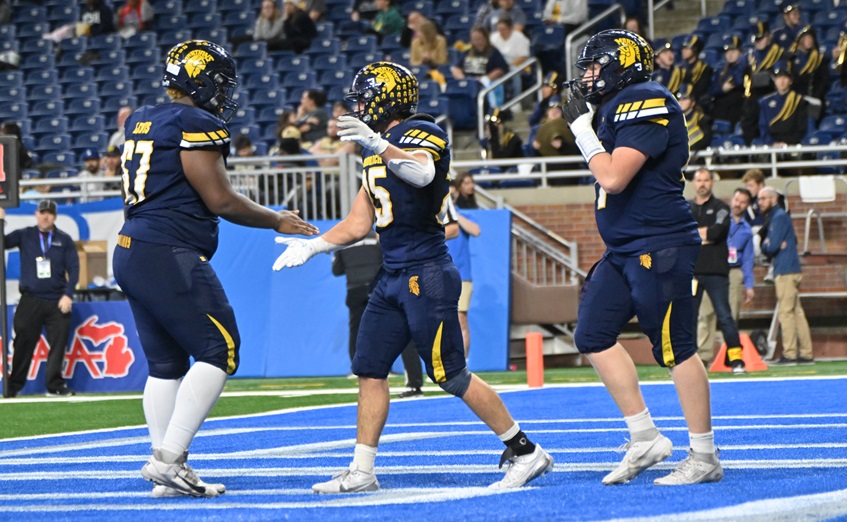
Goodrich won this matchup of finalists seeking their first championship, dominating the line of scrimmage to the tune of a 424-96 advantage in total yardage. Chase Burnett did the most damage of a talented Martians group of playmakers, running for 157 yards and a pair of scores while their defense locked down a Niles attack that averaged 41 points per game entering this matchup.
11-Player Division 5: Pontiac Notre Dame Prep 42, Frankenmuth 7 – Read
This also featured a pair of first-title hopefuls, and Notre Dame Prep took one home coached by Pat Fox, who grew up in and has since moved back to Frankenmuth. Quarterback Sam Stowe starred for the Fighting Irish, throwing four touchdown passes as NDP took a 35-0 lead into the fourth quarter and frustrated a Frankenmuth attack that had outscored its opponents by 31 points per game.
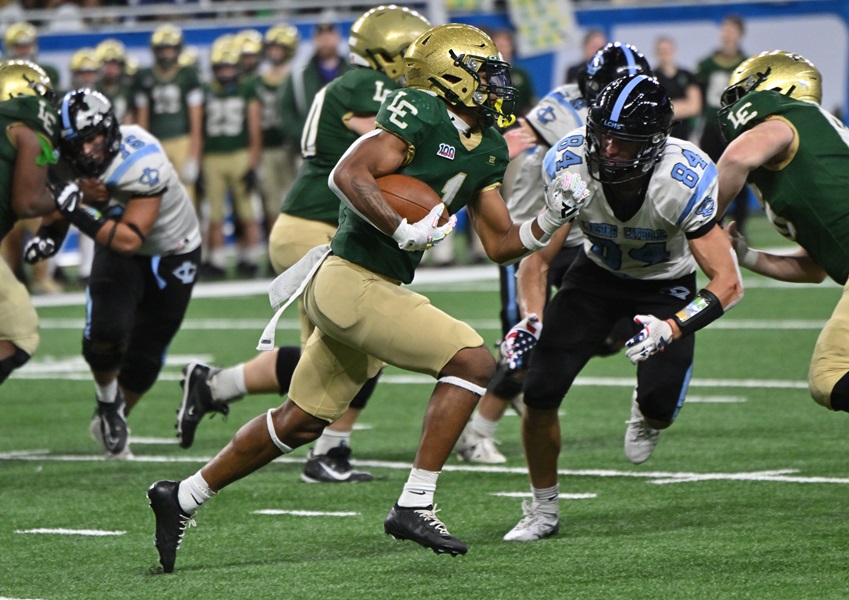
11-Player Division 6: Jackson Lumen Christi 56, Lansing Catholic 18 – Read
Lumen Christi’s record-setting win came on a record-setting performance by running back Kadale Williams, who ended up with a combined 590 yards and eight rushing touchdowns over his last two Finals appearances after also carrying the ball once in the Titans’ 2022 championship game. Lumen’s title was its third-straight with the first two of this string coming in Division 7
11-Player Division 7: Millington 24, Monroe St. Mary Catholic Central 0 – Read
Millington finished its first championship run as also the only undefeated 11-player champion this season. The Cardinals were physically dominant as they posted their fifth shutout and lowered their points allowed per game average to 7.7. In this win, they allowed just 3.2 yards per carry and forced three turnovers, limiting an SMCC offense averaging 36 points per game entering the weekend.
11-Player Division 8: Beal City 43, Riverview Gabriel Richard 14 – Read
Physical play and a strong running game were the story of this championship decider as well as Beal City won its third title and first since 2009 behind 315 rushing yards. The Aggies strung together unanswered runs of 21 and 17 points and held Gabriel Richard scoreless for the final 22 minutes of the first half and final 12 of the second.
8-Player Division 1: Deckerville 30, Pickford 28 – Read
Pickford led until the opening seconds of the fourth quarter as Deckerville came back from a double-digit third-quarter deficit to win its first championship since 2012. Both teams entered the matchup undefeated, and both relied on star quarterbacks who wrote their names into the Finals record book.
8-Player Division 2: Crystal Falls Forest Park 42, Morrice 20 – Read
The Trojans played in their 15th championship game and won for the fifth time after taking a 28-0 lead into the break and running for 184 of their total 291 yards during the first two quarters. Coach Brian Fabbri, who had played for Forest Park in 11-Player Finals in 2004 and 2005, became the fourth title-winning coach in program history.
Records Report
Zeeland West senior Keaton Hendricks scored a Finals record six touchdowns – to also give him a Finals-record 36 points. He rushed for three and caught three scores, and the three receiving touchdowns tied for second-most on that list.
Before Hendricks’ accomplishments a day later, Jackson Lumen Christi senior Kadale Williams briefly sat atop four record book lists. He remains the record holder with 314 rushing yards and five rushing touchdowns and sits tied for second with five total touchdowns and 30 points scored in a championship game. His 314 rushing yards also put him on the total yardage list.
Junior quarterback Sam Stowe directed Notre Dame’s offense during the championship drive, reaching the record book with 293 yards passing and four touchdowns through the air including one score on one of the longest completions in Finals history – 87 yards to Billy Collins. Stowe also ran for eight yards, making the total yardage list with 301.
Lansing Catholic senior quarterback Alex Fernandez earned multiple record listings with 284 passing yards, 21 passing completions and 366 total yards; he also ran for 82. Senior receiver Xavier Luea tied for the fifth-most receptions in a championship game, pulling in 10 for the Cougars.
Four kickers reached the record book list for most extra points in one game. Jackson Lumen Christi senior Andy Salazar tied two others for the record with eight extra points, making all eight kicks he took in the Division 6 Final. Notre Dame Prep junior Owen Fulsher made six extra points in six attempts, and Orchard Lake St. Mary’s freshman Beckett Kiefer, Beal City senior Kyle Martin and Goodrich senior Landon Williams all made the list with five extra points in five tries.
As noted above, Jackson Lumen Christi set a record for championships with 14, breaking its tie with Farmington Hills Harrison (which closed at the end of the 2018-19 school year). Lumen scored 42 points during the first half of its Division 6 win, tying for third-most in one half, and its 56 total points tied for second-most for a full title game. The Titans also tied a record with seven rushing touchdowns total and made the list – with Niles in Division 4 as well – for fewest pass attempts, with three.
Lansing Catholic made the team list for most pass completions with 21, and Notre Dame Prep made the team list for passing yards with 293.
As seems to make sense with some of our winning teams’ offensive successes, four made the list of those to not punt during a Final – Zeeland West, Beal City, Goodrich and Jackson Lumen Christi. West also combined with Detroit Martin Luther King, and Beal City with Riverview Gabriel Richard, to make the list for fewest punts by both opposing teams combined. Both pairs had just one in their games.
Although in defeat, Pickford senior quarterback Tommy Storey was one of the stars of the 8-Player Finals, making lists with four total touchdowns, 304 rushing yards (ranking second), four rushing touchdowns and 312 total yards. His opposing quarterback, Deckerville senior Hunter Garza, also made multiple lists with 323 total yards and 225 rushing.
Crystal Falls Forest Park sophomore Dietrich Rasner made the extra points list, tying for second with six in six attempts, and Morrice senior Joel Fisher had the second-longest punt return in 8-Player Finals history bringing one back 85 yards for a score.
Pickford and Deckerville both reached 300 yards rushing in the Division 1 game, Pickford with 322 and Deckerville just missing the record book yardage list but setting a record with 60 rushing attempts. Deckerville also made the first downs list with 21.
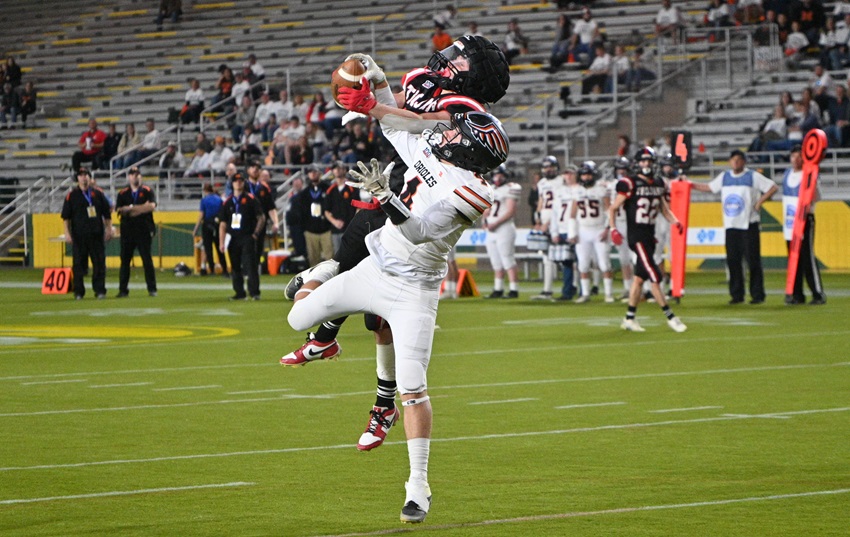
Crystal Falls Forest Park made a rushing list, with six touchdowns running the ball. The Trojans also set a record by not allowing Morrice to gain a yard passing – with the Orioles becoming the first 8-player team to not complete a pass in a Final, attempting just four.
Stories Behind the Scores
Lumen Legend: Of Jackson Lumen Christi’s now-14 Finals championships, 12 came under the leadership of coach Herb Brogan, who took over the program in 1980 after Jim Crowley led the Titans to titles in 1977 and 1979. They finished this season 13-1, putting Brogan’s career record at 421-96. He’s third in football coaching wins in Michigan high school history, trailing Al Fracassa (Royal Oak Shrine Catholic/Bloomfield Hills Brother Rice) by nine and John Herrington (Farmington Hills Harrison) by 22. Brogan’s all-time winning percentage of .814 has him fourth all-time on that list for coaches with at least 200 victories.
Welcome to the Finals: Of the 20 teams that played in championship games (11 and 8-player combined), only Lumen Christi was returning from 2023. Compare that to two years ago, when we had four repeat champions, or last year with six returning teams and two repeat champs. Over the last two weekends, five teams played in championship games for the first time, and as mentioned above, three celebrated their first titles.
Return of the Rush: Wide-open pass-heavy offenses have been a trend going on two decades. But the ground game may be making a comeback. Lumen Christi’s Williams set the individual rushing record in his team’s win over Lansing Catholic, and it’s fair to consider the offenses of at least 15 of the 20 finalists (11 and 8-player combined) as rush-based. Six teams reached 300 yards rushing in championship games, with Lumen leading the way with 435 on 47 carries.
MHSAA.com's weekly “1st & Goal” previews and reviews are powered by MI Student Aid, a division within the Department of Lifelong Education, Advancement, and Potential (MiLEAP). MI Student Aid encourages students to pursue postsecondary education by providing access to student financial resources and information. MI Student Aid administers the state’s scholarship and grant programs that help make college Accessible, Affordable and Attainable for you. Click to connect with MI Student Aid and find more information on Facebook and Twitter @mistudentaid.
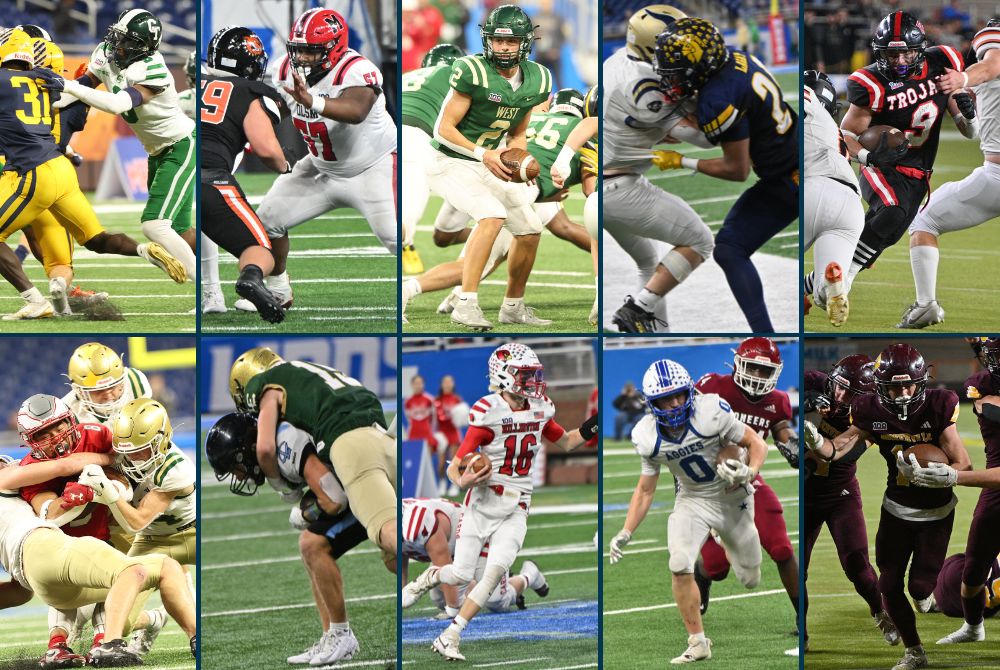
PHOTOS (Top) This collage shows action photos from all 10 MHSAA Finals played this season. (2) Goodrich's Chase Burnett, middle, celebrates his touchdown with two of his linemen. (3) Forest Park and Morrice players get tangled up jumping near the goal line to pull down a pass. (4) Lumen Christi's Kadale Williams (1) works to get to the edge against Lansing Catholic. (11-player photos by Hockey Weekly Action Photos; 8-player photos by Cara Kamps.)