

New Math: Division & Multiplication Problems
July 25, 2017
By Jack Roberts
MHSAA Executive Director
This is the second part in a series on MHSAA tournament classification, past and present, that will be published over the next two weeks. This series originally ran in this spring's edition of MHSAA benchmarks.
High school tournament classifications went viral before there was social media and most of us knew what “viral” meant.
Much as a virus infects computers today or has created epidemics of disease around the world for centuries, high school tournament classification – once introduced – tends to spread uncontrollably. Once started, it tends to keep expanding and rarely contracts.
While we are still some distance from providing every team a trophy as a result of expanding high school tournament classification across the country, there is criticism nevertheless that we are headed in that direction – a philosophy which is supposed to exist only in local youth sports for our youngest children.
Michigan could be blamed for all this. Michigan is generally accepted as the first state to provide different classifications for season-ending tournaments for different sized schools. It started a century ago. Today, every state has various classifications for its tournaments in most if not all sports. And it is a bit ironic that Michigan – creator of the classification chaos – more than most other states has kept the number of tournament classes or divisions under control.
Yes, there is evidence that tournament classifications have expanded over the years in Michigan, especially with the relatively recent introduction of tournaments in football and the late 1990s’ move from classes to divisions in most MHSAA tournaments. But the MHSAA Representative Council has held true to its word when it expanded the playoffs for football from four classes to eight divisions: this is needed because of unique factors of football, factors that exist in no other sport; and all other sports should be capped at a maximum of four classes or divisions.
Kentucky is the preeminent defender of single-class basketball. All of its 276 high schools compete for the single state championship for each gender. In Indiana, there are still open wounds from its move in 1998 from one to four classes for its 400 schools in basketball.
Multi-class tournaments have tended to increase the number of non-public school champions, which some states are trying to lower through enrollment “multipliers,” and also tend to increase the number of repeat champions, which some states are trying to affect with “success factors” which lift smaller schools into classifications for larger schools if they take home too many trophies.
While there is considerable evidence that state tournaments do as much bad as good for educational athletics, state associations persist in providing postseason tournaments because, on balance, the experiences are supposed to be good for student-athletes. And once we reach that conclusion it is just a small leap to believe that if the tournaments are good for a few, they must be better for more – which leads to creating more and more tournament classifications. One becomes two classes, then three, then four and so forth.
While the argument is that more classifications or divisions provides more students with opportunities to compete and win, it is undeniable that the experience changes as the number of tournament classifications expands. It is not possible for state associations to provide the same level of support when tournament classifications expand to multiple venues playing simultaneously. For example, there is less audio and video broadcast potential at each venue, and less media coverage to each venue. Focus is diluted and fans diminished at each championship.
No one can argue reasonably that today's two-day MHSAA Football Finals of eight championship games has the same pizazz as the one-day, four-games event conducted prior to 1990.
In some states the number of divisions has grown so much that it is difficult to see much difference between the many season-ending state championship games and a regular-season event in the same sport.
It is a balancing act. And Michigan has been studying that balance longer than any other state, and charting a steadier course than most.
Addition by Division
The shift to Divisions for MHSAA Tournament play in numerous sports has added up to a greater number of champions for teams and individuals across the state. Following are the sports currently employing a divisional format, and the procedures for determining enrollment and classification.
In 23 statewide or Lower Peninsula tournaments, schools which sponsor the sport are currently divided into nearly equal divisions. They are:
- Baseball - 4 Divisions
- Boys Bowling - 4 Divisions
- Girls Bowling - 4 Divisions
- Girls Competitive Cheer - 4 Divisions
- LP Boys Cross Country - 4 Divisions
- LP Girls Cross Country - 4 Divisions
- LP Boys Golf - 4 Divisions
- LP Girls Golf - 4 Divisions
- Ice Hockey - 3 Divisions
- Boys Lacrosse - 2 Divisions
- Girls Lacrosse - 2 Divisions
- Boys Skiing - 2 Divisions
- Girls Skiing - 2 Divisions
- LP Boys Soccer - 4 Divisions LP
- Girls Soccer - 4 Divisions
- Girls Softball - 4 Divisions
- LP Boys Swimming & Diving - 3 Divisions
- LP Girls Swimming & Diving - 3 Divisions
- LP Boys Tennis - 4 Divisions
- LP Girls Tennis - 4 Divisions
- LP Boys Track & Field - 4 Divisions
- LP Girls Track & Field - 4 Divisions
- Wrestling - 4 Divisions
Lists of schools for each division of these 23 tournaments are posted on MHSAA.com approximately April 1. Listings of schools in Upper Peninsula tournaments for their sports are also posted on MHSAA.com. The lists are based on school memberships and sports sponsorships in effect or anticipated for the following school year, as known to the MHSAA office as of a date in early March.
In football, the 256 schools which qualify for MHSAA 11-player playoffs are placed in eight equal divisions annually on Selection Sunday. Beginning in 2017, the 8-player divisions will be determined in a like manner on Selection Sunday as well, with 32 qualifying schools placed in two divisions.
Schools have the option to play in any higher division in one or more sports for a minimum of two years.
The deadlines for "opt-ups" are as follows:
- Applications for fall sports must be submitted by April 15
- Applications for winter sports must be submitted by Aug. 15
- Applications for spring sports must be submitted by Oct. 15
Subsequent to the date of these postings for these tournaments, no school will have its division raised or lowered by schools opening or closing, schools adding or dropping sports, schools exercising the option to play in a higher division, or approval or dissolution of cooperative programs.
When the same sport is conducted for boys and girls in the same season (e.g., track & field and cross country), the gender that has the most sponsoring schools controls the division breaks for both genders.
1st & Goal: 2024 11-Player Semifinals Preview
By
Geoff Kimmerly
MHSAA.com senior editor
November 22, 2024
It’s pretty simple for football teams still playing this late into November.
 All 32 that have reached this season’s MHSAA 11-Player Semifinals have accomplished something special while taking their communities on an unforgettable ride.
But those 16 that emerge victorious Saturday will have an opportunity to finish this four-month drive with the ultimate experience in Michigan high school football.
All 16 Semifinals kick off at 1 p.m. except for the Division 7 matchup between Schoolcraft and Monroe St. Mary Catholic Central, which will begin at noon. Follow along in person or watch all of them on MHSAA.tv, and keep up with the scores as they come in on the Football Playoff Scoreboard. See below for a glance at all 16 Semifinals.
Division 1
Rochester Adams (10-2) vs. Hudsonville (11-1) at Okemos
Hudsonville’s first Semifinal run since 2005 saw the Eagles avenge their lone loss this fall, downing undefeated Howell last week 35-6 after falling to the Highlanders in their season opener. Senior quarterback Griffin Baker has thrown for 1,105 yards and 10 touchdowns and run for 13 scores leading a balanced attack. Adams is back in the Semifinals for the first time since 2021, with two midseason losses by a combined four points. Senior Matteo Humbert carries a lot of the offensive load, rushing for 1,204 yards and 18 TDs.
Detroit Cass Tech (10-2) vs. Detroit Catholic Central (12-0) at Troy Athens
These two are playing each other for the first time since the 2016 Division 1 championship game. Detroit Catholic Central gives up only 10.5 points per game and attacks on the ground and through the air, with senior running back Jaden Pydyn (1,158 yards, 23 TDs rushing) among notable standouts. Cass Tech is giving up only 6.8 points per game and has avenged one of its two losses, with freshman quarterback Donald Tabron II quickly drawing attention throwing for 1,318 yards and 13 TDs to arguably the strongest group of receivers in the state.
Division 2
East Lansing (9-3) vs. Byron Center (11-1) at Greenville
East Lansing is playing in a Semifinal for the second straight season, and these teams have some familiarity with each other as the Trojans won their Regional matchup a year ago 42-20. East Lansing senior running back Jace Clarizio has remained one of the state’s elite with 1,574 yards and 28 TDs rushing. Byron Center will counter with senior quarterback Landon Tungate, who will go down as one of the best in his program’s history throwing for 1,727 yards and 23 scores this fall and running for 1,237 yards and 19 more TDs.
Orchard Lake St. Mary’s (9-3) vs. Birmingham Groves (12-0) at West Bloomfield
Groves defeated reigning champion Warren De La Salle Collegiate last week 21-19 to advance to its second Semifinal in three seasons. The Falcons also rely on a balanced offensive attack, led by senior running back Noah Sanders (821 yards/11 TDs rushing) and senior quarterback Ryan Counts (1,363 yards/16 TDs passing). St. Mary’s has reached the Semifinals for the first time since 2016, giving up only a combined 10 points over three playoff wins, and with senior receiver Bryson Williams a dynamic playmaker with nine touchdowns receiving, four rushing and two apiece on kickoff and punt returns.
Division 3
Zeeland West (11-1) vs. DeWitt (12-0) at Ada Forest Hills Eastern
After missing last season, DeWitt will play in its sixth Semifinal over the last seven years, and with an offense that upped its average scoring this fall to nearly 57 points per game with 70 more last week. Senior quarterback Elliott Larner is one of several standouts and has thrown for 2,085 yards and 32 touchdowns and run for 1,812 yards and 24 scores. Zeeland West’s power running style could help keep the Panthers’ offense off the field; the Dux have run for 3,458 yards led by senior Keaton Hendricks with 1,419 and 18 touchdowns on the ground.
Mason (10-2) vs. Detroit Martin Luther King (9-3) at Chelsea
These two have met in the playoffs three years in a row, with the Bulldogs emerging 25-20 in a Semifinal last fall. While Mason graduated most of the starting lineup that led the team to a Division 3 runner-up finish, senior quarterback Cason Carswell is finishing his fourth as a starter in a big way with 1,989 yards and 31 scores through the air as his younger teammates have grown into another standout unit. King’s defense perhaps stands out most this season, as senior defensive ends Xavier Newsome (6-foot-6, 230 pounds) and Willie Fletcher (6-2, 230) are one of the state’s top pairs.
Division 4
Grand Rapids South Christian (8-4) vs. Niles (11-1) at Three Rivers
South Christian emerged from a four-game losing streak near the end of the regular season to reach the Semifinals for the third straight, and will attempt to make it three straight trips to Ford Field. Senior quarterback Carson Vis continues to impress with 2,371 yards and 22 touchdowns passing and 1,186 yards and 18 scores rushing. Niles’ season-opening loss to St. Joseph proved to be just a momentary detour during its first trip to the Semifinals. Seniors Peyton Gordon, Paul Hess and Sam Rucker have combined to run for 2,738 yards and 44 touchdowns,
Goodrich (11-1) vs. Harper Woods (9-3) at Rochester Hills Stoney Creek
This is a rematch of a 2023 Semifinal, won by Harper Woods 35-24 on the way to claiming the Division 4 title. Many of the major players are the same. Senior Chase Burnett is the top rusher behind an impressive offensive line for Goodrich, powering for 1,340 yards and 22 scores. Harper Woods’ attack is again directed by junior quarterback Nate Rocheleau, who has thrown for 1,503 yards and 29 touchdowns. Goodrich’s lone loss and two of Harper Woods’ came to teams still playing.
Division 5
Grand Rapids Catholic Central (8-4) vs. Frankenmuth (12-0) at Mount Pleasant
This will be the fourth time these two have met in the playoffs over the last five seasons. Grand Rapids Catholic Central won their Semifinal meeting last season 35-0 and rebounded from three straight losses to finish this regular season to claim a ninth-straight Regional title. Odin Spencer is another impressive freshman quarterback, throwing for 1,585 yards and 17 touchdowns and running for 531 yards and three scores. Frankenmuth has given up only 13 points through three playoff games, with senior Derrick Simmons (6-4/275) a force at defensive end. The Eagles have won five straight Regional championships.
Flat Rock (10-2) vs. Pontiac Notre Dame Prep (10-1) at Westland John Glenn
Notre Dame Prep showed itself to be a title contender with back-to-back wins over Jackson Lumen Christi and Grand Rapids Catholic Central in Weeks 2 and 3, respectively, and hasn’t let up. Junior quarterback Sam Stowe has thrown for 2,249 yards and 30 touchdowns and run for six scores. Flat Rock is playing in a Semifinal for the second-straight season, this time with its most wins since 1976. Senior Graham Junge is another standout quarterback, throwing for 2,468 yards and 36 touchdowns and also running for six scores.
Division 6
Boyne City (10-2) vs. Lansing Catholic (9-3) at Clare
Both of these contenders have recaptured past success to return to the Semifinals, Boyne City for the first time since 2014 and Lansing Catholic for the second time in four seasons but after going only 4-7 a year ago. Senior running back Ryan Spate is one from a collection of playmakers who have emerged for the Ramblers, running for 1,809 yards and 20 touchdowns. Senior Alex Fernandez has powered the Cougars, throwing for 2,664 yards and 28 touchdowns and rushing for 925 yards and 16 scores.
Marine City (10-2) vs. Jackson Lumen Christi (11-1) at Novi
Lumen Christi moved to Division 6 this fall after winning Division 7 the last two seasons, and hasn’t been stopped aside from a four-point loss to Pontiac Notre Dame Prep in Week 2. The Titans have their highest-powered offense in a decade and have scored at least 42 points in all three of their playoff wins. Marine City is back in a Semifinal for the first time since 2021, powered by a high-scoring offense as well. The Mariners have topped 50 points seven times this season, including twice during the playoffs, led by a pair of 1,000-yard rushers in senior Paul Muscat (1,237/22 TDs) and junior Austin Brown (1,042/17).
Division 7
North Muskegon (11-1) vs. Millington (11-0) at Lansing Eastern
Millington is seeking a first trip to the Finals, and North Muskegon its first since 1981. Both also played in Semifinals a year ago, on opposite sides of the Division 7 bracket. Senior quarterback Truk Terbush is part of a loaded Cardinals backfield, throwing for 1,298 yards and 19 touchdowns and running for 453 yards and 10 scores. The Norsemen turn to a standout quarterback as well, as junior Bryce Colbert has thrown for 2,003 yards and 22 scores. North Muskegon’s lone defeat came in its season opener, by a point, to Pewamo-Westphalia.
Schoolcraft (11-1) vs. Monroe St. Mary Catholic Central (12-0) at Battle Creek Harper Creek
Monroe St. Mary is making its longest playoff run since its most recent championship season in 2019 and has scored more points this fall than the last two combined. Senior running back Drew Harris has played a large role in that resurgence, rushing for 1,348 yards and 21 touchdowns. Schoolcraft is back in a Semifinal for the first time since 2020, its only loss to Constantine by two points in Week 3. Sophomore quarterback Jack DeVries has emerged impressively, throwing for 1,402 yards and 15 scores.
Division 8
Beal City (10-2) vs. Fowler (12-0) at Ithaca
Fowler’s first trip to the Semifinals since 2019 got a bit of a jumpstart in Week 9 with a 35-28 win over McBain – one of the two teams to defeat Beal City, 29-25 in Week 4. But like Fowler, the Aggies also eliminated an undefeated opponent to win a Regional title last week. They’ve both continued to be known for strong running games as well, Beal City following seniors Drew Block and Owen McKenny (1,625 yards/22 TDs rushing combined) while Fowler has had a bit more balance but also must replace injured lead rusher Ford Phillips (1,153 yards/25 TDs rushing). The Eagles also have been able to turn to senior quarterback Jacob Halfmann (1,671 yards/18 TDs passing, 8 TDs rushing).
Decatur (11-1) vs. Riverview Gabriel Richard (10-1) at Jackson
Decatur has advanced to the Semifinals for the first time since 2002, its only loss to White Pigeon by just eight points in Week 4. The Raiders have three rushers who have combined for more than 3,000 yards, led by junior Brody Mead (1,152/18 TDs) and senior Danny Camarillo (1,047/10). Gabriel Richard is returning to the Semifinals for the second-straight season, improving statistically on both sides of the ball from last fall and with its only loss to a Division 4 District champ in Macomb Lutheran North. Senior Joey Calhoun has averaged more than nine yards per carry for 1,140 and 16 TDs total on the ground.
MHSAA.com's weekly “1st & Goal” previews and reviews are powered by MI Student Aid, a division within the Department of Lifelong Education, Advancement, and Potential (MiLEAP). MI Student Aid encourages students to pursue postsecondary education by providing access to student financial resources and information. MI Student Aid administers the state’s scholarship and grant programs that help make college Accessible, Affordable and Attainable for you. Click to connect with MI Student Aid and find more information on Facebook and Twitter @mistudentaid.
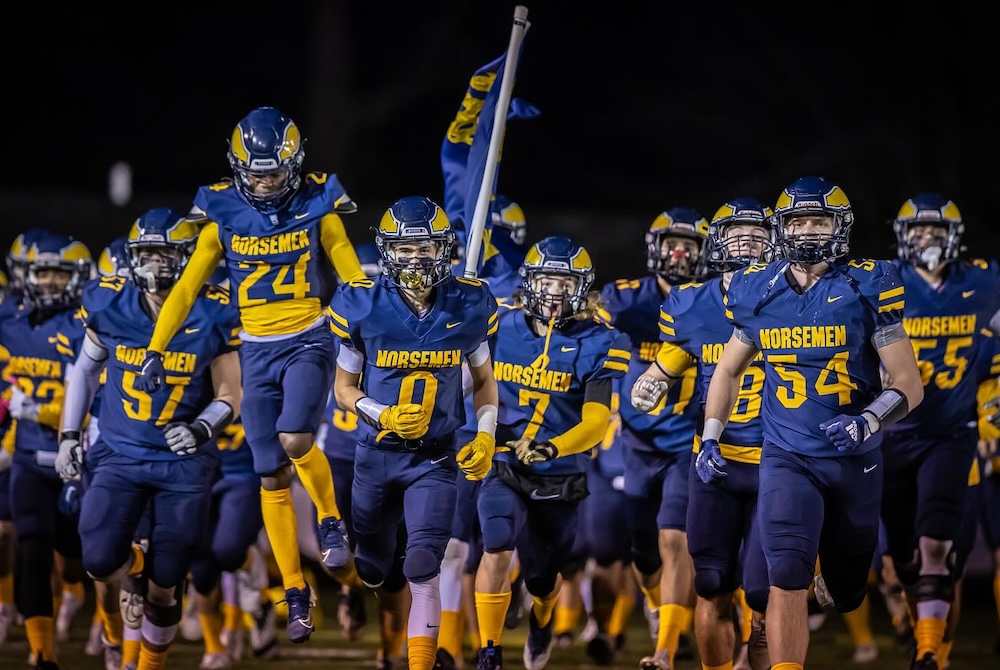
PHOTO North Muskegon takes the field for its District Final against McBain on Nov. 8. (Photo by Tim Reilly.)