

New Math: Division & Multiplication Problems
July 25, 2017
By Jack Roberts
MHSAA Executive Director
This is the second part in a series on MHSAA tournament classification, past and present, that will be published over the next two weeks. This series originally ran in this spring's edition of MHSAA benchmarks.
High school tournament classifications went viral before there was social media and most of us knew what “viral” meant.
Much as a virus infects computers today or has created epidemics of disease around the world for centuries, high school tournament classification – once introduced – tends to spread uncontrollably. Once started, it tends to keep expanding and rarely contracts.
While we are still some distance from providing every team a trophy as a result of expanding high school tournament classification across the country, there is criticism nevertheless that we are headed in that direction – a philosophy which is supposed to exist only in local youth sports for our youngest children.
Michigan could be blamed for all this. Michigan is generally accepted as the first state to provide different classifications for season-ending tournaments for different sized schools. It started a century ago. Today, every state has various classifications for its tournaments in most if not all sports. And it is a bit ironic that Michigan – creator of the classification chaos – more than most other states has kept the number of tournament classes or divisions under control.
Yes, there is evidence that tournament classifications have expanded over the years in Michigan, especially with the relatively recent introduction of tournaments in football and the late 1990s’ move from classes to divisions in most MHSAA tournaments. But the MHSAA Representative Council has held true to its word when it expanded the playoffs for football from four classes to eight divisions: this is needed because of unique factors of football, factors that exist in no other sport; and all other sports should be capped at a maximum of four classes or divisions.
Kentucky is the preeminent defender of single-class basketball. All of its 276 high schools compete for the single state championship for each gender. In Indiana, there are still open wounds from its move in 1998 from one to four classes for its 400 schools in basketball.
Multi-class tournaments have tended to increase the number of non-public school champions, which some states are trying to lower through enrollment “multipliers,” and also tend to increase the number of repeat champions, which some states are trying to affect with “success factors” which lift smaller schools into classifications for larger schools if they take home too many trophies.
While there is considerable evidence that state tournaments do as much bad as good for educational athletics, state associations persist in providing postseason tournaments because, on balance, the experiences are supposed to be good for student-athletes. And once we reach that conclusion it is just a small leap to believe that if the tournaments are good for a few, they must be better for more – which leads to creating more and more tournament classifications. One becomes two classes, then three, then four and so forth.
While the argument is that more classifications or divisions provides more students with opportunities to compete and win, it is undeniable that the experience changes as the number of tournament classifications expands. It is not possible for state associations to provide the same level of support when tournament classifications expand to multiple venues playing simultaneously. For example, there is less audio and video broadcast potential at each venue, and less media coverage to each venue. Focus is diluted and fans diminished at each championship.
No one can argue reasonably that today's two-day MHSAA Football Finals of eight championship games has the same pizazz as the one-day, four-games event conducted prior to 1990.
In some states the number of divisions has grown so much that it is difficult to see much difference between the many season-ending state championship games and a regular-season event in the same sport.
It is a balancing act. And Michigan has been studying that balance longer than any other state, and charting a steadier course than most.
Addition by Division
The shift to Divisions for MHSAA Tournament play in numerous sports has added up to a greater number of champions for teams and individuals across the state. Following are the sports currently employing a divisional format, and the procedures for determining enrollment and classification.
In 23 statewide or Lower Peninsula tournaments, schools which sponsor the sport are currently divided into nearly equal divisions. They are:
- Baseball - 4 Divisions
- Boys Bowling - 4 Divisions
- Girls Bowling - 4 Divisions
- Girls Competitive Cheer - 4 Divisions
- LP Boys Cross Country - 4 Divisions
- LP Girls Cross Country - 4 Divisions
- LP Boys Golf - 4 Divisions
- LP Girls Golf - 4 Divisions
- Ice Hockey - 3 Divisions
- Boys Lacrosse - 2 Divisions
- Girls Lacrosse - 2 Divisions
- Boys Skiing - 2 Divisions
- Girls Skiing - 2 Divisions
- LP Boys Soccer - 4 Divisions LP
- Girls Soccer - 4 Divisions
- Girls Softball - 4 Divisions
- LP Boys Swimming & Diving - 3 Divisions
- LP Girls Swimming & Diving - 3 Divisions
- LP Boys Tennis - 4 Divisions
- LP Girls Tennis - 4 Divisions
- LP Boys Track & Field - 4 Divisions
- LP Girls Track & Field - 4 Divisions
- Wrestling - 4 Divisions
Lists of schools for each division of these 23 tournaments are posted on MHSAA.com approximately April 1. Listings of schools in Upper Peninsula tournaments for their sports are also posted on MHSAA.com. The lists are based on school memberships and sports sponsorships in effect or anticipated for the following school year, as known to the MHSAA office as of a date in early March.
In football, the 256 schools which qualify for MHSAA 11-player playoffs are placed in eight equal divisions annually on Selection Sunday. Beginning in 2017, the 8-player divisions will be determined in a like manner on Selection Sunday as well, with 32 qualifying schools placed in two divisions.
Schools have the option to play in any higher division in one or more sports for a minimum of two years.
The deadlines for "opt-ups" are as follows:
- Applications for fall sports must be submitted by April 15
- Applications for winter sports must be submitted by Aug. 15
- Applications for spring sports must be submitted by Oct. 15
Subsequent to the date of these postings for these tournaments, no school will have its division raised or lowered by schools opening or closing, schools adding or dropping sports, schools exercising the option to play in a higher division, or approval or dissolution of cooperative programs.
When the same sport is conducted for boys and girls in the same season (e.g., track & field and cross country), the gender that has the most sponsoring schools controls the division breaks for both genders.
Century of School Sports: Good Sports Are Winners Then, Now & Always
By
Geoff Kimmerly
MHSAA.com senior editor
November 12, 2024
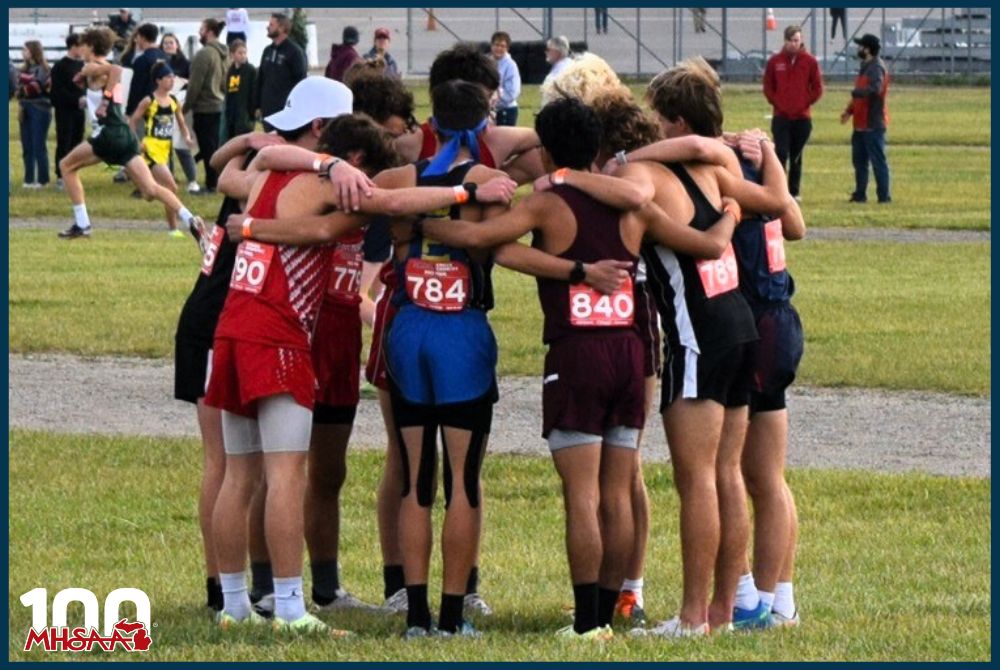
The above photo came to us two years ago this fall, from a now-retired athletic director, who was especially taken by these 10 runners from eight schools huddling together before their races during the 2022 Lower Peninsula Boys Cross Country Finals at Michigan International Speedway.
Representing Bloomingdale, Bridgman, Centreville, Coloma, Constantine, Parchment, Schoolcraft and Watervliet, these racers had competed against each other all season, and for some several seasons. But during these moments before what would be the most high-profile event of their athletic careers, they joined together for support, motivation and camaraderie.
Sportsmanship is one of the MHSAA’s core values – the “4 S’s” – of educational athletics. It has served as part of the bedrock of this organization from its beginning 100 years ago, and should remain so as long as school sports are considered a valued part of the educational experience.
Two weeks ago, we covered in this #MHSAA100 space the history of the MHSAA Sportsmanship Summit – first conducted in 1997 – and our latest statewide tour concludes Thursday in Grand Rapids. But those sessions welcoming student leaders every year are just one of many efforts the MHSAA has made to continue teaching sportsmanship through athletics over the last century.
An essay, “Athletics – Why and How” by Grand Rapids Union athletic director John Truesdale, was included with the November 1925 edition of the Bulletin of the Michigan High School Athletic Association and addresses how the creation of the MHSAA from its predecessor organization played a part in immediately improving sportsmanship in school sports during that first year:
“Because of (the creation and fulltime nature of the MHSAA), the standards of sportsmanship are more nearly approached. Bickerings have been reduced to a minimum. Better understanding exists between schools. The conducting of games has become the exhibition not only of skill, strength and wisdom, but of sportsmanship, obedience to accepted rules, and consideration of those who for the moment are in the position of enemies, although friendly.
“In fact, athletics in Michigan are in position now to accomplish the purpose for which they were designed – the building of character. … It is entirely reasonable that each, the player and spectator, emerges from a contest a better citizen because of his experiences.”
High Schools change over entire student bodies every four years. Freshman eventually become seniors, and when they leave take their parents and others who have spent a portion of time in the school sports space, to be replaced by the next classes of athletes and families playing, cheering and altogether carrying forward our time-cherished activities.
And as such, the lessons of sportsmanship are constantly in need of renewal.
After both arrived during the mid 1980s, retired MHSAA Executive Director John E. “Jack” Roberts and retired Communications Director John Johnson embarked on a mission to transform sportsmanship in Michigan school sports – and in doing so, made the MHSAA a national leader in that work, which continues today.
These MHSAA sportsmanship campaigns from the last 30 years should ring at least a few bells for those who have spent time around our games:
“Good Sports are Winners” – Beginning in 1989 and over the following two decades, the MHSAA (and with help from the Michigan Interscholastic Athletic Administrators Association and multiple sponsors) annually distributed 100+ page sportsmanship kits to member schools which included materials to assist in promoting good sportsmanship, including letters to be sent out to various stakeholders, public address announcements for events and other content for programs and publications.
An awards program celebrated teams best displaying these ideals from every season – Fall, Winter and Spring – with those winners receiving recognition across statewide media and MHSAA publications through the conclusion of this campaign during the 2010-11 school year.
“What Kids Wish Their Parents Knew About Sportsmanship” – This six-minute video produced for the start of the 1999-2000 school year featured students addressing adult behavior at their events. The video was designed to be shown as preseason meetings, booster clubs, school board meetings and similar athletic department or school gatherings.
“Battle of the Fans” Fast forward to 2012. The MHSAA’s Student Advisory Council, in an effort to affect sportsmanship especially among peers, created a statewide competition to promote positive cheering from the growing number of student sections across the state.
The “Battle of the Fans” continued for 10 years (skipping 2021 due to COVID-19 precautions) and annually recognized not only a champion but additional finalists with banners during the Basketball Finals at Breslin Center. The contest was almost entirely video and social media-driven, and during later years of the competition included multiple rounds that required sections to complete challenges to advance.
The BOTF program also was recognized nationally and copied by other states after seeing what Michigan’s student leaders were capable of influencing.
And that work continues.
The following was created this summer by the Student Advisory Council based on 10 pages of notes from their experiences at 2023 Sportsmanship Summits.
One of the most revealing truths in studying the 100-year history of the MHSAA is that many issues of the day then and now are remarkably similar. It’s not that there haven’t been improvements along the way. But rather, the process of educational athletics is ongoing as generations of students take their turns and continue on – and the work to keep sportsmanship at the heart of competition remains of great importance.
To that end, let’s allow Truesdale to close this latest history lesson.
“Let us then, in this year of 1925, demonstrate to the people as a whole that victory is not all we seek.
“Let each of us, whether superintendent, principal, coach, player or spectator, emphasize the point that to win is welcome, that to demonstrate superiority is one goal we are after. But let us not lose sight of the fact that the means employed are of great consequence, and that the results we seek are not championships alone but victory of the player and the team and the school over the temptations of unfair tactics.
“Championships will be forgotten but character is lasting.”
Previous "Century of School Sports" Spotlights
Nov. 5: MHSAA's Home Sweet Home - Read
Oct. 29: MHSAA Summits Draw Thousands to Promote Sportsmanship - Read
Oct. 23: Cross Country Finals Among MHSAA's Longest Running - Read
Oct. 15: State's Storytellers Share Fall Memories - Read
Oct. 8: Guided by 4 S's of Educational Athletics - Read
Oct. 1: Michigan Sends 10 to National Hall of Fame - Read
Sept. 25: MHSAA Record Books Filled with 1000s of Achievements - Read
Sept. 18: Why Does the MHSAA Have These Rules? - Read
Sept. 10: Special Medals, Patches to Commemorate Special Year - Read
Sept. 4: Fall to Finish with 50th Football Championships - Read
Aug. 28: Let the Celebration Begin - Read
PHOTO A group of Southwestern Athletic Conference runners huddle up before their races at the 2022 Lower Peninsula Boys Cross Country Finals at Michigan International Speedway, including Bloomingdale’s Jaden Barnes and Joe Stocchiero, Bridgman’s Andrew Mabry and John Sanderson, Centreville’s Logan Weis, Coloma’s Boden Genovese, Constantine’s Ethan Glick, Parchment’s William Winter, Schoolcraft’s Dante Pilot and Watervliet’s Daniel Mandujano. (Photo by Alan Bobalik/Bloomingdale cross country.)