

New Math: Division & Multiplication Problems
July 25, 2017
By Jack Roberts
MHSAA Executive Director
This is the second part in a series on MHSAA tournament classification, past and present, that will be published over the next two weeks. This series originally ran in this spring's edition of MHSAA benchmarks.
High school tournament classifications went viral before there was social media and most of us knew what “viral” meant.
Much as a virus infects computers today or has created epidemics of disease around the world for centuries, high school tournament classification – once introduced – tends to spread uncontrollably. Once started, it tends to keep expanding and rarely contracts.
While we are still some distance from providing every team a trophy as a result of expanding high school tournament classification across the country, there is criticism nevertheless that we are headed in that direction – a philosophy which is supposed to exist only in local youth sports for our youngest children.
Michigan could be blamed for all this. Michigan is generally accepted as the first state to provide different classifications for season-ending tournaments for different sized schools. It started a century ago. Today, every state has various classifications for its tournaments in most if not all sports. And it is a bit ironic that Michigan – creator of the classification chaos – more than most other states has kept the number of tournament classes or divisions under control.
Yes, there is evidence that tournament classifications have expanded over the years in Michigan, especially with the relatively recent introduction of tournaments in football and the late 1990s’ move from classes to divisions in most MHSAA tournaments. But the MHSAA Representative Council has held true to its word when it expanded the playoffs for football from four classes to eight divisions: this is needed because of unique factors of football, factors that exist in no other sport; and all other sports should be capped at a maximum of four classes or divisions.
Kentucky is the preeminent defender of single-class basketball. All of its 276 high schools compete for the single state championship for each gender. In Indiana, there are still open wounds from its move in 1998 from one to four classes for its 400 schools in basketball.
Multi-class tournaments have tended to increase the number of non-public school champions, which some states are trying to lower through enrollment “multipliers,” and also tend to increase the number of repeat champions, which some states are trying to affect with “success factors” which lift smaller schools into classifications for larger schools if they take home too many trophies.
While there is considerable evidence that state tournaments do as much bad as good for educational athletics, state associations persist in providing postseason tournaments because, on balance, the experiences are supposed to be good for student-athletes. And once we reach that conclusion it is just a small leap to believe that if the tournaments are good for a few, they must be better for more – which leads to creating more and more tournament classifications. One becomes two classes, then three, then four and so forth.
While the argument is that more classifications or divisions provides more students with opportunities to compete and win, it is undeniable that the experience changes as the number of tournament classifications expands. It is not possible for state associations to provide the same level of support when tournament classifications expand to multiple venues playing simultaneously. For example, there is less audio and video broadcast potential at each venue, and less media coverage to each venue. Focus is diluted and fans diminished at each championship.
No one can argue reasonably that today's two-day MHSAA Football Finals of eight championship games has the same pizazz as the one-day, four-games event conducted prior to 1990.
In some states the number of divisions has grown so much that it is difficult to see much difference between the many season-ending state championship games and a regular-season event in the same sport.
It is a balancing act. And Michigan has been studying that balance longer than any other state, and charting a steadier course than most.
Addition by Division
The shift to Divisions for MHSAA Tournament play in numerous sports has added up to a greater number of champions for teams and individuals across the state. Following are the sports currently employing a divisional format, and the procedures for determining enrollment and classification.
In 23 statewide or Lower Peninsula tournaments, schools which sponsor the sport are currently divided into nearly equal divisions. They are:
- Baseball - 4 Divisions
- Boys Bowling - 4 Divisions
- Girls Bowling - 4 Divisions
- Girls Competitive Cheer - 4 Divisions
- LP Boys Cross Country - 4 Divisions
- LP Girls Cross Country - 4 Divisions
- LP Boys Golf - 4 Divisions
- LP Girls Golf - 4 Divisions
- Ice Hockey - 3 Divisions
- Boys Lacrosse - 2 Divisions
- Girls Lacrosse - 2 Divisions
- Boys Skiing - 2 Divisions
- Girls Skiing - 2 Divisions
- LP Boys Soccer - 4 Divisions LP
- Girls Soccer - 4 Divisions
- Girls Softball - 4 Divisions
- LP Boys Swimming & Diving - 3 Divisions
- LP Girls Swimming & Diving - 3 Divisions
- LP Boys Tennis - 4 Divisions
- LP Girls Tennis - 4 Divisions
- LP Boys Track & Field - 4 Divisions
- LP Girls Track & Field - 4 Divisions
- Wrestling - 4 Divisions
Lists of schools for each division of these 23 tournaments are posted on MHSAA.com approximately April 1. Listings of schools in Upper Peninsula tournaments for their sports are also posted on MHSAA.com. The lists are based on school memberships and sports sponsorships in effect or anticipated for the following school year, as known to the MHSAA office as of a date in early March.
In football, the 256 schools which qualify for MHSAA 11-player playoffs are placed in eight equal divisions annually on Selection Sunday. Beginning in 2017, the 8-player divisions will be determined in a like manner on Selection Sunday as well, with 32 qualifying schools placed in two divisions.
Schools have the option to play in any higher division in one or more sports for a minimum of two years.
The deadlines for "opt-ups" are as follows:
- Applications for fall sports must be submitted by April 15
- Applications for winter sports must be submitted by Aug. 15
- Applications for spring sports must be submitted by Oct. 15
Subsequent to the date of these postings for these tournaments, no school will have its division raised or lowered by schools opening or closing, schools adding or dropping sports, schools exercising the option to play in a higher division, or approval or dissolution of cooperative programs.
When the same sport is conducted for boys and girls in the same season (e.g., track & field and cross country), the gender that has the most sponsoring schools controls the division breaks for both genders.
1st & Goal: 2024 Playoffs Week 1 Review
By
Geoff Kimmerly
MHSAA.com senior editor
November 4, 2024
The ability to play another day obviously is the best reward for 288 teams that qualify for the MHSAA Football Playoffs.
 But another of the greatest gifts is the chance to make up for a missed opportunity from the regular season.
We highlight below 40 of our 144 first-round games from this past weekend. Of those 40, 15 were rematches – and of those rematches, nine were won the second time by the team that lost the first.
11-Player Division 1
HEADLINER Grandville 24, Rockford 14 For the second-straight season, Grandville (6-4) opened the playoffs with a win – and this time with its first over the Rams since 2019. Rockford (7-3) had defeated Grandville 37-20 in Week 3, but with Tank Terry scoring twice during the third quarter the Bulldogs brought a lead into the second half of this rematch and never trailed again. Click for more from the Grand Rapids Press.
🏈 GRANDVILLE WITH THE UPSET OVER ROCKFORD🔥
Check out the highlights of Grandville beating Rockford 24-14 in the Division 1 @MHSAA Football District Semifinal on November 1st, 2024@GrandvilleFB
🎥 WXMI-TV pic.twitter.com/v9dcweL43k— STATE CHAMPS! Michigan (@statechampsmich) November 2, 2024
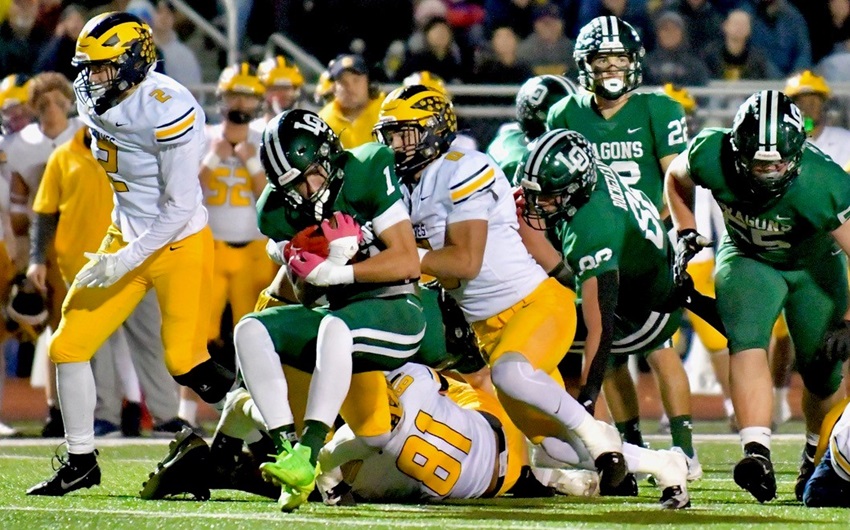
District Digest Hudsonville 25, East Kentwood 23 On the other side for Grandville in their District bracket, Ottawa-Kent Conference Red champion Hudsonville (9-1) held off a strong challenge from the Falcons (5-5) after having defeated them 35-6 in their Week 5 meeting. Oxford 21, Davison 14 Oxford (7-3) went on the road, and coming off a Week 9 loss, to win its first playoff game since 2021 and guarantee its best record since 2018 – when the Wildcats also opened the playoffs with a win over Davison (7-3). Clarkston 34, Lake Orion 16 The Wolves (7-3) are surging with five wins over their last six gams and this avenging their only loss during that string, a 20-13 defeat to the Dragons (6-4) in Week 7.
11-Player Division 2
HEADLINER Byron Center 38, Grand Rapids Northview 17 Byron Center (9-1) just missed on a league championship this fall but will play for a second-straight District title after pulling away to hand O-K Black champion Northview (9-1) its only loss this fall. The Bulldogs earned a rematch this week with O-K Green rival Muskegon Mona Shores, which won their Week 4 meeting 14-12. Northview closed its first winning season since 2019 with more victories than the last two combined. Click for more from FOX 17.
Byron Center with a 38-17 win over Northview in the Division 2 District Semifinal on November 1st, 2024. Powered by @Reactiontech @BCCoachCisco | @gobcbulldogs pic.twitter.com/UvbmwLHmQp
— STATE CHAMPS! Michigan (@statechampsmich) November 3, 2024
District Digest Grosse Pointe South 27, Roseville 26 South (10-0) at one point led 24-6 and held on to reach double-digit wins for the first time – and after going 9-2 a year ago and losing to Roseville (7-3) in a District Final, 24-17. Mattawan 27, Lansing Everett 21 Mattawan (7-3) is enjoying its winningest season since 2017, with this its first playoff victory since 2012. Everett (6-4) improved a win from a year ago to tie its highest total since 2014. Farmington 39, White Lake Lakeland 13 Farmington (7-3) earned its first playoff win since 2019 – continuing a rebound from 2-7 a year ago – and defeated a Lakeland team (6-4) that made the playoffs for the seventh time over the last eight seasons.
11-Player Division 3
HEADLINER Linden 42, Fenton 14 Linden (5-5) opened this season 0-2 and finished the regular season with two defeats and three over its last four games. But all of that may have paid off with this win to avenge a 24-21 Week 6 loss to the Tigers (7-3) that ended up deciding the Flint Metro League Stripes championship. That loss to Fenton was one of four three-point heartbreakers the Eagles endured this fall, but they will play for a District title this week. Click for more from the Tri-County Times.
District Digest Riverview 22, Trenton 21 Riverview quarterback Lucas Thompson put his team ahead to stay with a 2-point conversion run with 20 seconds to play, giving the Pirates (9-1) a close playoff win over Trenton for the second-straight season after they defeated the Trojans (6-4) by two in a District opener a year ago. Grand Rapids Forest Hills Central 7, East Grand Rapids 0 The reigning Division 3 champion Rangers (8-2) followed up a 24-0 win over EGR in Week 9 by just getting past the Pioneers (5-5) again. Walled Lake Western 49, Garden City 7 The Warriors (10-0) are expected to be top contenders in this division and reached 10 wins for the second straight season, but Garden City (7-3) deserves recognition as well for completing its winningest campaign since 2000.
11-Player Division 4
HEADLINER Dearborn Divine Child 42, Madison Heights Lamphere 6 Lamphere (8-2) entered the postseason No. 3 in the coaches poll and completed its third eight-win season over the last five. But Divine Child will play on after freshman quarterback Drew Sheridan threw five touchdown passes to send the Falcons (7-3) into a District Final matchup with reigning Division 4 champion Harper Woods. Click for more from the Dearborn Press & Guide.
Dearborn Divine Child starts the 2024 Division 4 Football Playoffs with a BIG 42-6 win over Lamphere in the District Semifinal on November 1st, 2024. Freshman quarterback Drew Sheridan threw 5 touchdown passes in the victory. Powered by @altaequipment @DCHS_Football14 |… pic.twitter.com/iZABbYwEse
— STATE CHAMPS! Michigan (@statechampsmich) November 2, 2024
District Digest Edwardsburg 29, Battle Creek Harper Creek 8 Edwardsburg (7-3) has shown plenty of times over the last 15 years why it is a scary playoff opponent, and this became another example as Harper Creek (8-2) entered the weekend coming off a league title and finished with its best record since 2017. Niles 42, Paw Paw 14 The two teams that finished ahead of Edwardsburg in the Wolverine Conference met for the second week in a row, with Niles (9-1) adding to its 21-0 win from Week 9 to end Paw Paw’s season at 8-2. Harper Woods 46, Redford Union 6 Harper Woods (7-3) entered the playoffs ranked No. 5 by the coaches, and Redford Union (8-2) was No. 2 and also had lost to the Pioneers in their season opener 43-21.
11-Player Division 5
HEADLINER Gladwin 18, Kingsford 15 When a team moves to 7-3 with all three of its losses to league champions, it’s difficult to call it a stunner. But Gladwin can claim it as Kingsford (9-1) also was a league champion, undefeated and ranked No. 3 entering this District Semifinal. Eric Roggow’s fourth-quarter field goal was the decider for the Flying Gs. Click for more from the Bay City Times.
District Digest Ogemaw Heights 21, Clare 13 Just as the Week 5 matchup went to Ogemaw Heights, 41-34, so too did the rematch between the Jack Pine Conference Division 1 co-champions. Clare finished 7-3 for the second-straight year after completing its 19th-straight winning regular season. Romulus 26, Detroit Lincoln-King 24 Romulus (5-5) earned its first playoff win since 2016, and in doing so handed Lincoln-King (9-1) its only loss of what was by far the most successful season of its three-year varsity history. Lincoln-King was 0-9 two seasons ago and 3-6 last fall. Flat Rock 40, Detroit Denby 22 Flat Rock (8-2) advanced by defeating a league title winner in Detroit Public School League Gold co-champion Denby (6-4), putting the Rams in position to play for a third-straight District trophy.
11-Player Division 6
HEADLINER Ovid-Elsie 44, Almont 21 The Mid-Michigan Activities Conference saw its undefeated champion fall (see below) but its runner-up down another undefeated league title winner as Ovid-Elsie handed No. 2 Almont its only loss. This was a rematch of a 2023 Semifinal won by the Raiders 45-21, but this time the Marauders put up their most points since mid-September and the most Blue Water Area Conference champ Almont (9-1) had given up in a game since 2021. Click for more from Lansing State Journal.
District Digest Lansing Catholic 36, Chesaning 29 The Cougars (7-3) have won at least one playoff game now eight seasons in a row, and this one came against MMAC champion Chesaning (9-1) and a defense that otherwise gave up just 12 points per game this fall. Detroit Central 34, Detroit Edison 16 Central (7-3) shared the PSL Gold title with Denby and then won the PSL Gold City championship, and this victory over No. 9 Edison (6-4) ranks right up there as well. Constantine 39, Parchment 14 Just because Constantine (7-3) found itself outside a league title race this fall for the first time in a while doesn’t mean the Falcons were going to go quietly – and they made some serious noise in avenging a 51-30 loss to Parchment (7-3) from Week 7.
11-Player Division 7
HEADLINER Union City 42, Hanover-Horton 13 Big 8 Conference champ Union City (9-1) has scored nearly 36 points per game during its winningest season since 2011, and this was the Chargers’ fourth time reaching 42 as they bounced back from a Week 9 loss to Buchanan. Hanover-Horton (8-2) closed this season with two losses to teams a combined 18-2 but must be celebrated for its best showing since 2014, a run which included a Cascades Conference West title. Click for more from the Coldwater Daily Reporter.
District Digest Clinton 38, Ottawa Lake Whiteford 32 The former Tri-County Conference rivals met for the first time since 2019, Clinton’s last season in the TCC, and this time the Redwolves (7-3) came back from two straight losses to end the regular season to end Whiteford’s fall at 5-5. Traverse City St. Francis 41, Charlevoix 16 The Gladiators (7-3) won this matchup of Northern Michigan Football League divisional champions, having also defeated the Rayders (6-4) in the season opener 67-22. McBain 49, Harrison 6 McBain (9-1) bounced back from a Week 9 loss to reach a second-straight District Final. Harrison (7-3) finished this fall with three straight defeats to playoff teams but with its best record since 2015 and after going 2-7 both of the last two seasons.
11-Player Division 8
HEADLINER Saginaw Michigan Lutheran Seminary 21, Saginaw Nouvel Catholic Central 20 These neighbors have played one-point games three of the last five seasons, and Nouvel (8-2) actually won their regular-season meeting in Week 4, 23-14, and led this time 6-0 into the third quarter. But MLS (7-3) found its stride thereafter to earn its second trip to the District Finals in three seasons. Click for more from the Saginaw News.
District Digest Saugatuck 24, White Pigeon 22 After having three of its last four seasons ended by White Pigeon (8-2) in the playoffs, Saugatuck advanced to a second-straight District Final by winning the closest game for both this fall. Beal City 47, Frankfort 0 Beal City (8-2) faced Frankfort (7-3) in a playoff opener for the second-straight season, adding this win to last year’s 42-7 victory that started a Semifinal run. Harbor Beach 35, Ubly 0 The Pirates (10-0) posted their second-straight shutout and fifth of the season in ending this year’s run and a six-game winning streak for last fall’s Division 8 champion Bearcats (6-4).
8-Player Division 1
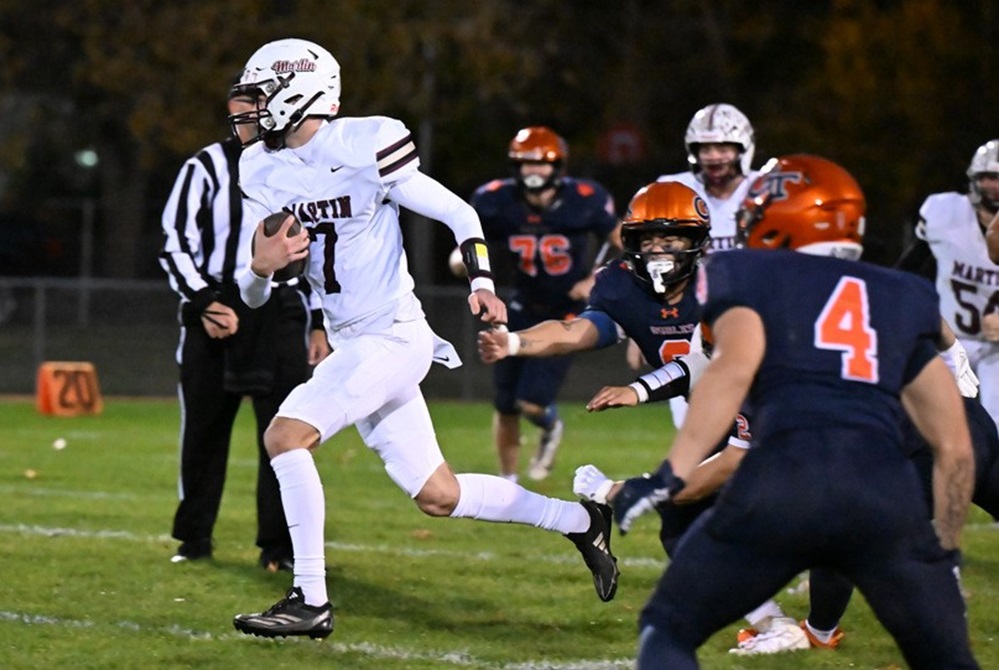
HEADLINER Martin 52, Gobles 22 The two-time reigning champion Clippers appear to be in playoff form again, as this avenged a 20-14 loss to Gobles from just three weeks earlier. This made it two seasons in a row that Martin (9-1) avenged a regular-season loss to the Tigers (9-1). The Clippers broke away with 30 second-half points to Gobles’ eight. Click for more from the Kalamazoo Gazette.
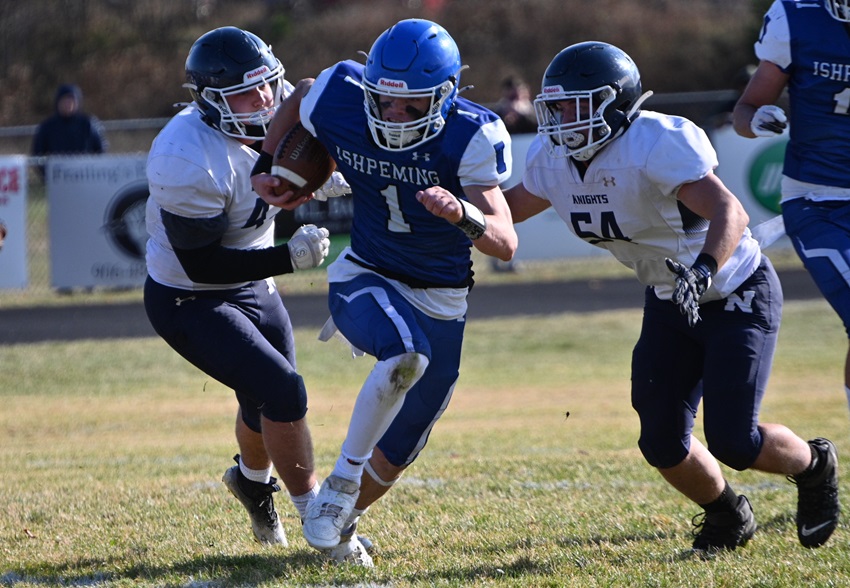
Regional Roundup Mendon 58, Climax-Scotts 50 Mendon’s Owen Gorham ran for 231 yards and five touchdowns, the last a four-yarder with three seconds to play followed by his 2-point conversion to push the Hornets (9-1) past Climax-Scotts just two weeks after losing to the Panthers (8-2) 46-44. Kingston 16, Fulton 14 The Cardinals (8-2) earned a rematch with rival Deckerville by handing the Pirates (8-2) just their second loss of their winningest season since 2010 in 11-player. Ishpeming 44, Norway 38 The Hematites’ first run into an 8-player bracket is off to the right start, with this win over the Knights (7-3) earning Ishpeming (6-2) a rematch with Week 4 opponent Pickford.
8-Player Division 2
HEADLINER Onekama 22, Marion 20 Both finalists for last season’s Division 2 championship were eliminated from this year’s bracket, and we’ll start with the reigning runner-up Marion (8-2) – which had defeated Onekama 44-8 in Week 2. The Eagles ended their season with two losses by a combined six points. But the Portagers improved to 9-1, one more win than their last four seasons’ totals combined. Click for more from the Manistee News Advocate.
Regional Roundup Mount Pleasant Sacred Heart 24, Grand Rapids Sacred Heart 21 After debuting in varsity play last season with a win by forfeit and two losses, Grand Rapids Sacred Heart (9-1) established itself with a perfect regular season and No. 1 ranking heading into this playoffs. But Mount Pleasant Sacred Heart (7-3) had seen plenty of top competition with its three losses to teams that all finished the regular season 8-1. Morrice 28, Portland St. Patrick 22 Two of those one-loss teams that had defeated MP Sacred Heart met on the other side of the bracket, with Morrice (9-1) avenging a 29-12 Week 4 defeat to the Shamrocks (8-2). Britton Deerfield 58, Adrian Lenawee Christian 15 The Patriots (9-1) reached nine wins for the second time in four seasons – and after finishing just 2-7 a year ago – completing a 2024 sweep of the 2023 Division 2 champion Cougars (4-6).
MHSAA.com's weekly “1st & Goal” previews and reviews are powered by MI Student Aid, a division within the Department of Lifelong Education, Advancement, and Potential (MiLEAP). MI Student Aid encourages students to pursue postsecondary education by providing access to student financial resources and information. MI Student Aid administers the state’s scholarship and grant programs that help make college Accessible, Affordable and Attainable for you. Click to connect with MI Student Aid and find more information on Facebook and Twitter @mistudentaid.
PHOTOS (Top) Martin’s Gavin Meyers (7) breaks through a gap in the Gobles defense Friday. (Middle) Clarkston’s Griffin Boman (0) wraps up Lake Orion’s Jayden Borrero. (Below) Ishpeming's Caden Luoma breaks away from Norway's Carter Cazzola (43) and Keith Burar, Jr. (54). (Top photo by Gary Shook. Clarkston/Lake Orion photo by Terry Lyons. Ishpeming/Norway photo by Cara Kamps.)