

New Math: Division & Multiplication Problems
July 25, 2017
By Jack Roberts
MHSAA Executive Director
This is the second part in a series on MHSAA tournament classification, past and present, that will be published over the next two weeks. This series originally ran in this spring's edition of MHSAA benchmarks.
High school tournament classifications went viral before there was social media and most of us knew what “viral” meant.
Much as a virus infects computers today or has created epidemics of disease around the world for centuries, high school tournament classification – once introduced – tends to spread uncontrollably. Once started, it tends to keep expanding and rarely contracts.
While we are still some distance from providing every team a trophy as a result of expanding high school tournament classification across the country, there is criticism nevertheless that we are headed in that direction – a philosophy which is supposed to exist only in local youth sports for our youngest children.
Michigan could be blamed for all this. Michigan is generally accepted as the first state to provide different classifications for season-ending tournaments for different sized schools. It started a century ago. Today, every state has various classifications for its tournaments in most if not all sports. And it is a bit ironic that Michigan – creator of the classification chaos – more than most other states has kept the number of tournament classes or divisions under control.
Yes, there is evidence that tournament classifications have expanded over the years in Michigan, especially with the relatively recent introduction of tournaments in football and the late 1990s’ move from classes to divisions in most MHSAA tournaments. But the MHSAA Representative Council has held true to its word when it expanded the playoffs for football from four classes to eight divisions: this is needed because of unique factors of football, factors that exist in no other sport; and all other sports should be capped at a maximum of four classes or divisions.
Kentucky is the preeminent defender of single-class basketball. All of its 276 high schools compete for the single state championship for each gender. In Indiana, there are still open wounds from its move in 1998 from one to four classes for its 400 schools in basketball.
Multi-class tournaments have tended to increase the number of non-public school champions, which some states are trying to lower through enrollment “multipliers,” and also tend to increase the number of repeat champions, which some states are trying to affect with “success factors” which lift smaller schools into classifications for larger schools if they take home too many trophies.
While there is considerable evidence that state tournaments do as much bad as good for educational athletics, state associations persist in providing postseason tournaments because, on balance, the experiences are supposed to be good for student-athletes. And once we reach that conclusion it is just a small leap to believe that if the tournaments are good for a few, they must be better for more – which leads to creating more and more tournament classifications. One becomes two classes, then three, then four and so forth.
While the argument is that more classifications or divisions provides more students with opportunities to compete and win, it is undeniable that the experience changes as the number of tournament classifications expands. It is not possible for state associations to provide the same level of support when tournament classifications expand to multiple venues playing simultaneously. For example, there is less audio and video broadcast potential at each venue, and less media coverage to each venue. Focus is diluted and fans diminished at each championship.
No one can argue reasonably that today's two-day MHSAA Football Finals of eight championship games has the same pizazz as the one-day, four-games event conducted prior to 1990.
In some states the number of divisions has grown so much that it is difficult to see much difference between the many season-ending state championship games and a regular-season event in the same sport.
It is a balancing act. And Michigan has been studying that balance longer than any other state, and charting a steadier course than most.
Addition by Division
The shift to Divisions for MHSAA Tournament play in numerous sports has added up to a greater number of champions for teams and individuals across the state. Following are the sports currently employing a divisional format, and the procedures for determining enrollment and classification.
In 23 statewide or Lower Peninsula tournaments, schools which sponsor the sport are currently divided into nearly equal divisions. They are:
- Baseball - 4 Divisions
- Boys Bowling - 4 Divisions
- Girls Bowling - 4 Divisions
- Girls Competitive Cheer - 4 Divisions
- LP Boys Cross Country - 4 Divisions
- LP Girls Cross Country - 4 Divisions
- LP Boys Golf - 4 Divisions
- LP Girls Golf - 4 Divisions
- Ice Hockey - 3 Divisions
- Boys Lacrosse - 2 Divisions
- Girls Lacrosse - 2 Divisions
- Boys Skiing - 2 Divisions
- Girls Skiing - 2 Divisions
- LP Boys Soccer - 4 Divisions LP
- Girls Soccer - 4 Divisions
- Girls Softball - 4 Divisions
- LP Boys Swimming & Diving - 3 Divisions
- LP Girls Swimming & Diving - 3 Divisions
- LP Boys Tennis - 4 Divisions
- LP Girls Tennis - 4 Divisions
- LP Boys Track & Field - 4 Divisions
- LP Girls Track & Field - 4 Divisions
- Wrestling - 4 Divisions
Lists of schools for each division of these 23 tournaments are posted on MHSAA.com approximately April 1. Listings of schools in Upper Peninsula tournaments for their sports are also posted on MHSAA.com. The lists are based on school memberships and sports sponsorships in effect or anticipated for the following school year, as known to the MHSAA office as of a date in early March.
In football, the 256 schools which qualify for MHSAA 11-player playoffs are placed in eight equal divisions annually on Selection Sunday. Beginning in 2017, the 8-player divisions will be determined in a like manner on Selection Sunday as well, with 32 qualifying schools placed in two divisions.
Schools have the option to play in any higher division in one or more sports for a minimum of two years.
The deadlines for "opt-ups" are as follows:
- Applications for fall sports must be submitted by April 15
- Applications for winter sports must be submitted by Aug. 15
- Applications for spring sports must be submitted by Oct. 15
Subsequent to the date of these postings for these tournaments, no school will have its division raised or lowered by schools opening or closing, schools adding or dropping sports, schools exercising the option to play in a higher division, or approval or dissolution of cooperative programs.
When the same sport is conducted for boys and girls in the same season (e.g., track & field and cross country), the gender that has the most sponsoring schools controls the division breaks for both genders.

1st & Goal: 2024 Week 8 Review
By
Geoff Kimmerly
MHSAA.com senior editor
October 21, 2024
This forecast for late October never fails:
 As expected, championships were celebrated and big playoff pushes were made all over the state during Week 8 of another football regular season that will be over by this time next week.
This week's "Review" details several of those league races now decided, but also the movements of several teams in, or out, of the potential playoff field as we inch closer to Sunday's selection announcement.
Bay & Thumb
HEADLINER Frankenmuth 21, Freeland 20 Frankenmuth (8-0) clinched the Tri-Valley Conference Red title and extended its league winning streak to 66 games, but with Freeland (7-1) providing one of the strongest challenges to the decade-plus run. Logan Diener’s second touchdown, with 3:58 to play, and Aiden Labissoniere’s go-ahead extra point helped put the game, and title, away. Click for more from the Saginaw News.
It's always a heated battle when @FrankenmuthF and Freeland square off!
Freeland battle tested the Eagles going into the second half as they took the lead, 20-14.
However, Frankenmuth would prevail to secure their 13th straight conference title, 21-20. pic.twitter.com/LRV2sjhRyn— Miriam Bingham (@mbinghamreports) October 19, 2024
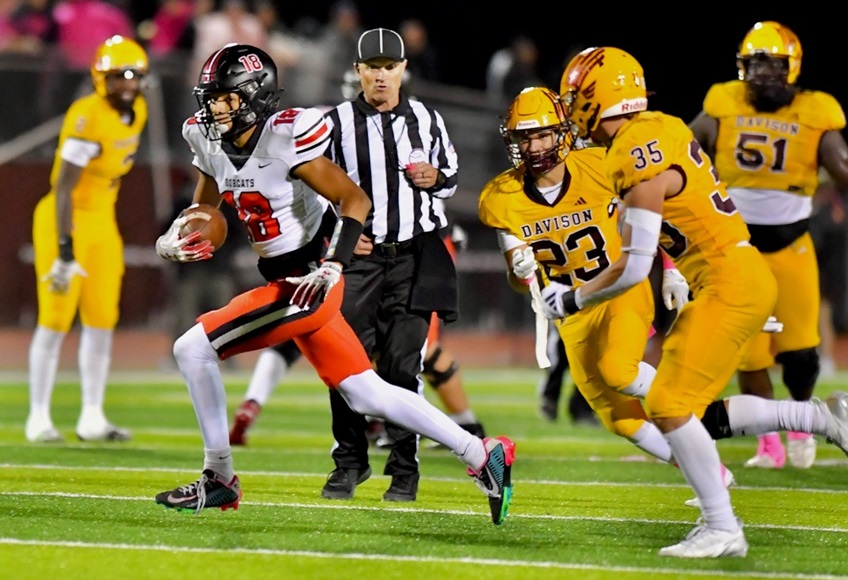
Watch list Grand Blanc 55, Davison 49 Grand Blanc (7-1) finished a perfect run through the Saginaw Valley League Red by handing Davison its lone Valley loss, although the Cardinals (6-2) finish with Lapeer this week. The Bobcats’ championship was their first since 2021 and came after finishing second to Davison a year ago.
On the move Goodrich 42, Fenton 3 Goodrich (7-1) won the overall Flint Metro League championship game and in doing so handed the Tigers (7-1) their first loss, finished a run of reaching 42 points in all seven league games and gave up a total of 45 points to Metro opponents. Ubly 30, Cass City 12 No one should have thought Ubly (5-3) was going away quietly with its 0-3 start this fall after last season’s Division 8 championship. Those first three opponents are a combined 23-1, and the Bearcats are up to No. 19 on the Division 8 playoff point list. Midland Dow 23, Lapeer 14 Dow (5-3) has won five of its last six games to jump into the Division 2 playoff picture for the first time this season, moving up seven spots to No. 26 while sending Lapeer to 5-3 and the No. 24 position on the Division 1 list.
Greater Detroit
HEADLINER Detroit Cass Tech 30, Detroit Martin Luther King 14 Cass Tech (6-2) again broke the recent trend in this rivalry, taking the Detroit Public School Blue City championship after King won their first meeting this season and finished with the PSL Blue regular-season title. It was the second time in three years the Technicians have avenged a King loss from a month earlier, and also only the second time in five years that the winner of the first matchup didn’t finish with a sweep. Cass Tech’s Alex Graham scored on a kickoff return and catching a pass as the Technicians reached the end zone three times through the air. Click for more from the Detroit News.
Check out the highlights of Detroit Cass Tech (@Detroit_CTFB) winning the City Championship for the 3rd straight year over rival King on October 18th, 2024. Powered by @altaequipment pic.twitter.com/ii4R1afVTH
— STATE CHAMPS! Michigan (@statechampsmich) October 19, 2024
Watch list Detroit Central 22, Detroit Denby 18 Central (6-2) has won six straight games and avenged a pair of losses from last season to Denby (5-3) to take the PSL Gold City championship after these two shared the regular-season title. The Trail Blazers gave up six points total with four shutouts over five division games and cooled a Denby offense that was averaging 33 points per game.
On the move Gibraltar Carlson 42, Allen Park 0 Carlson (7-1) clinched a share of the Downriver League title, its fourth straight, with Allen Park (6-2) holding out hope for a share as well if Lincoln Park can catch the Marauders this week. Clarkston Everest Collegiate 42, Royal Oak Shrine Catholic 3 The Mountaineers (8-0) finished off an outright title run in the Catholic High School League Intersectional #2, their second straight as they ran their league game winning streak to 12 with a seventh in a row over Shrine (6-2) – which has guaranteed its best record since 2020. Belleville 31, Dearborn Fordson 0 Belleville (8-0) closed out an eighth-straight league title by finishing another sweep of the Kensington Lakes Activities Association East, with this the Tigers’ second-straight shutout and third over seven KLAA games. Walled Lake Western 20, Mason 17 Walled Lake Western (8-0) entered the week No. 2 in the Division 3 coaches poll, and Mason (6-2) was No. 6 and had won both matchups with the Warriors last season including in a Regional Final.
Mid-Michigan
HEADLINER Howell 36, Brighton 14 The Highlanders (8-0) completed a KLAA West outright championship, defeating Brighton (6-2) for the second-straight season to avoid what would have been a shared league title with the Bulldogs. Justin Jones ran for three touchdowns and caught a fourth to pace Howell, which faces Belleville this week in the overall KLAA championship game. Click for more from the Livingston Daily Press & Argus.
Watch list Portland 33, Lansing Sexton 0 Portland coach John Novara reached 200 career wins as the Raiders (8-0) finished another perfect run through the Capital Area Activities Conference White, extending their league game winning streak to 20. The shutout kept Portland at No. 9 on the Division 4 playoff list and Sexton (4-4) just outside the field at No. 34.
On the move Clare 54, Pinconning 28 After sharing the Jack Pine Conference Division 1 title, Clare (7-1) won this matchup with JPC Division 2 runner-up Pinconning (5-3) to move up to No. 11 on the Division 5 playoff list. Ionia 16, St. Johns 13 After this close win over St. Johns (5-3), the Bulldogs (5-3) are a win away from guaranteeing their best record since 2013 with rival Lake Odessa Lakewood up next. Olivet 27, Lansing Catholic 14 Olivet has two wins over Lansing Catholic (5-3) in two seasons in the CAAC White, with this one giving the Eagles (6-2) second place in the league and sending the Cougars into a tie for third.
Northern Lower Peninsula
HEADLINER East Jordan 33, Frankfort 6 This could pay off in multiple ways for East Jordan (6-2). The Red Devils can continue to hold out hope of a title share in the Northern Michigan Football League Legacy (if Mancelona defeats first-place Maple City Glen Lake this week), and East Jordan also jumped past Frankfort on the Division 8 playoff list after trailing the Panthers (6-2) by one position entering Friday. Click for more from the Traverse City Record-Eagle.
Watch list Ogemaw Heights 64, Harrison 28 The JPC Division 1 co-champion Ogemaw Heights (7-1) handed Division 2 winner Harrison (7-1) its first loss and scored a season high in bouncing back from a Week 6 defeat to Standish-Sterling.
On the move Boyne City 36, Oscoda 0 Boyne City (6-2) has climbed the Division 6 playoff list for the fourth-straight week, this time up to No. 18 while sending Oscoda (5-3) down only two slots to No. 30 in Division 7. Maple City Glen Lake 32, Saginaw Valley Lutheran 13 Glen Lake (7-1) has put together its best season since 2019 and heads into a potential outright league title clincher after a solid win over the Chargers (4-4). Manistee 65, Montague 32 Manistee (5-4) moved up from No. 30 to 24 on the Division 6 playoff list and moved Montague (3-5) from 31 to just outside the field at No. 33.
Southeast & Border
HEADLINER Hudson 22, Clinton 6 Hudson (7-1) has a share of the Lenawee County Athletic Association championship and winless Hillsdale to play this week to make it outright, while Clinton and Ida are tied for second and likely the newest Hillsdale fans. Clinton (6-2) had won 24 straight LCAA games and the last two league titles. Click for more from the Adrian Daily Telegram.
Watch list Ottawa Lake Whiteford 30, White Pigeon 16 On paper, Whiteford (4-4) has had a tougher run than usual this fall. But its losses are to teams that are a combined 31-2, and the Bobcats are up to No. 21 on the Division 7 playoff list after handing White Pigeon (7-1) its lone defeat.
On the move Hanover-Horton 28, Brooklyn Columbia Central 19 The Cascades Conference West title belongs entirely to Hanover-Horton (8-0) as the Comets clinched it outright in sending Columbia Central (3-5) into third place and avoiding a potential three-team share. Grass Lake 28, Leslie 7 Leslie (7-1) already had the Cascades Conference East outright title in hand, but this is major win for Grass Lake (5-3) nonetheless as it bumped the Warriors up four spots to No. 37 on the Division 6 playoff list. Chelsea 21, Trenton 20 Division 4 contender Chelsea (7-1) needed a score during the final minutes to get past the Trojans (5-3), who remain No. 11 on the Division 3 playoff list.
Southwest Border
HEADLINER Kalamazoo United 35, Parchment 13 In a matchup of tough defenses, United’s was able to hold its ground most and slowed a Parchment offense that was averaging 42 points per game. In doing so, the Titans (7-1) clinched the outright Southwestern Athletic Conference Lakeshore championship, sending the Panthers (6-2) to second place with their only league defeat. Click for more from the Kalamazoo Gazette.
Watch list Mattawan 42, Kalamazoo Central 20 Over the last two weeks, Mattawan (5-3) has defeated leaders of both the Southwestern Michigan Athletic Conference West and now East, in the process jumping from No. 39 two weeks ago to No. 22 on the Division 2 playoff list. Central (5-3) is tied for first in the East and plays Loy Norrix this week for that outright title.
On the move Decatur 18, Hopkins 0 Decatur (7-1) may have fallen eight points shy of catching champion White Pigeon in the Southwest 10 Conference, but it earned this win over Ottawa-Kent Conference Silver co-leader Hopkins (6-2) to guarantee its winningest season since 2014. Portage Northern 45, Kalamazoo Loy Norrix 0 The SMAC West could send four of its five teams to the playoffs, with this win over the Knights (5-3) bumping Northern (5-3) up to No. 21 on the Division 2 playoff list. Lawton 26, Saugatuck 10 Lawton (6-2) concluded the SAC Valley schedule by winning this matchup for second in the standings, further solidifying itself in the middle of the Division 7 field while Saugatuck (5-3) occupies the same in Division 8.
Upper Peninsula
HEADLINER Kingsford 13, Menominee 12 This season’s Western Peninsula Athletic Conference Copper race couldn’t have been much closer, with champion Kingsford (8-0) edging Menominee (7-1) this time to go with its two-point win over Negaunee in Week 4. The Flivvers will face Marquette this week as they play for a perfect regular season. Click for more from the Iron Mountain Daily News.
Watch list Calumet 19, Gladstone 6 While just a notch below contending in the Copper, Calumet (5-3) gave Kingsford a 14-point game in Week 5 and won its three games since. The Copper Kings climbed the Division 6 playoff list for the third straight week, now to No. 26.
On the move Iron Mountain 42, Manistique 21 The Mountaineers (8-0) pulled within a win of a potential second-straight undefeated regular season. L’Anse 40, Gwinn 22 L’Anse not only reversed a 33-6 loss to Gwinn from Week 3, but ended a 15-game losing streak stretching back to 2022. Marquette 41, Cadillac 32 The Sentinels (6-2) bounced back from a heartbreaker against Petoskey to surpass last year’s victory total. Despite the loss, Cadillac (4-4) actually moved up a spot on the Division 3 playoff list, to No. 27.
West Michigan
HEADLINER Grand Rapids West Catholic 54, Hamilton 14 After edging Ada Forest Hills Eastern by a point to take over first place alone in the O-K White in Week 7, West Catholic (6-2) sent Hamilton into third place and clinched the outright championship – its second straight after winning the O-K Blue outright last season. Click for more from the Grand Rapids Press.
Watch list Byron Center 17, Muskegon 14 With Byron Center’s move into the O-K Green this season, these two met for the first time since 2017 – and the Bulldogs (7-1) put a serious dent in the reigning Division 2 champion’s hopes of extending its playoff qualification streak that began in 2000.
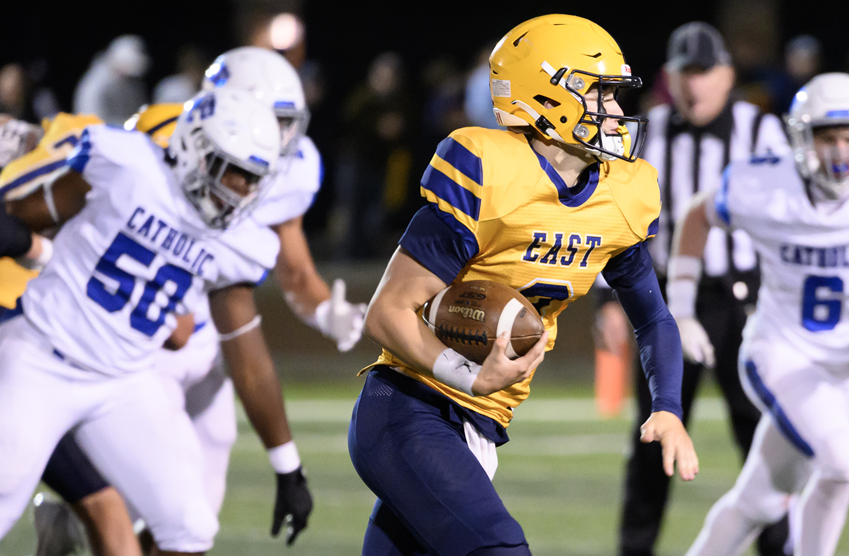
On the move Grand Rapids Northview 35, Holland Christian 20 Northview (8-0) finished an outright title run in the O-K Black while sending Holland Christian to 6-2. East Grand Rapids 31, Grand Rapids Catholic Central 28 East Grand Rapids (5-3) made second place in the O-K Black a three-team share with this win over the Cougars (5-3) in their first meeting since 2016. Big Rapids 24, Coopersville 7 Fresh off wrapping up a league title in Week 7, Big Rapids (7-1) handed a loss to River Cities Alliance co-leader Coopersville (5-3), which plays Cedar Springs this week for a potential outright league title.
8-Player
HEADLINER Climax-Scotts 46, Mendon 44 The Panthers (7-1) are outright Southern Central Athletic Association Red champions after handing the lone loss this fall to Mendon (7-1), with Jackson Bagwell scoring on a four-yard run and adding the winning 2-point conversion run with 55 seconds to play. Climax-Scotts scored first, and the teams then traded touchdowns all the way until the Panthers scored last. Click for more from WWMT.
Watch list Bay City All Saints 61, Kinde North Huron 22 The Cougars’ only loss this season came in Week 1 – to still-undefeated Deckerville – and they are Big Thumb Conference Red champions after this impressive winner-take-all performance against former co-leader North Huron (6-2).
On the move Pittsford 46, Waldron 14 The SCAA Blue belongs entirely to Pittsford (7-1), which clinched a share of the championship in Week 7 but needed to get past third-place Waldron (5-3) to finish the perfect run. Pickford 51, Norway 6 Pickford (8-0) clinched a share of the Great Lakes Eight Conference East title in this matchup of previous co-leaders. The Pirates may need to defeat third-place (tied) Munising this week to clinch it outright, with Norway (6-2) hoping to share with a win over the other third-place team, Rudyard, and a Munising victory. Indian River Inland Lakes 64, Bellaire 12 Inland Lakes (8-0) will play co-leader Gaylord St. Mary for the Ski Valley Conference title this week after turning back third-place Bellaire (6-2).
MHSAA.com's weekly “1st & Goal” previews and reviews are powered by MI Student Aid, a division within the Department of Lifelong Education, Advancement, and Potential (MiLEAP). MI Student Aid encourages students to pursue postsecondary education by providing access to student financial resources and information. MI Student Aid administers the state’s scholarship and grant programs that help make college Accessible, Affordable and Attainable for you. Click to connect with MI Student Aid and find more information on Facebook and Twitter @mistudentaid.
PHOTOS (Top) Detroit Cass Tech’s Alex Graham pulls away for a touchdown against Detroit Martin Luther King at Ford Field. (Middle) Grand Blanc’s Caseton Sendry (18) eludes a pair of Davison defenders. (Below) East Grand Rapids’ Carson Thornton (8) finds a gap in the Grand Rapids Catholic Central defense. (Top photo by Olivia B. Photography. Grand Blanc/Davison photo by Terry Lyons. EGR/Catholic Central photo by Michigan Sports Photo.)