

New Math: Division & Multiplication Problems
July 25, 2017
By Jack Roberts
MHSAA Executive Director
This is the second part in a series on MHSAA tournament classification, past and present, that will be published over the next two weeks. This series originally ran in this spring's edition of MHSAA benchmarks.
High school tournament classifications went viral before there was social media and most of us knew what “viral” meant.
Much as a virus infects computers today or has created epidemics of disease around the world for centuries, high school tournament classification – once introduced – tends to spread uncontrollably. Once started, it tends to keep expanding and rarely contracts.
While we are still some distance from providing every team a trophy as a result of expanding high school tournament classification across the country, there is criticism nevertheless that we are headed in that direction – a philosophy which is supposed to exist only in local youth sports for our youngest children.
Michigan could be blamed for all this. Michigan is generally accepted as the first state to provide different classifications for season-ending tournaments for different sized schools. It started a century ago. Today, every state has various classifications for its tournaments in most if not all sports. And it is a bit ironic that Michigan – creator of the classification chaos – more than most other states has kept the number of tournament classes or divisions under control.
Yes, there is evidence that tournament classifications have expanded over the years in Michigan, especially with the relatively recent introduction of tournaments in football and the late 1990s’ move from classes to divisions in most MHSAA tournaments. But the MHSAA Representative Council has held true to its word when it expanded the playoffs for football from four classes to eight divisions: this is needed because of unique factors of football, factors that exist in no other sport; and all other sports should be capped at a maximum of four classes or divisions.
Kentucky is the preeminent defender of single-class basketball. All of its 276 high schools compete for the single state championship for each gender. In Indiana, there are still open wounds from its move in 1998 from one to four classes for its 400 schools in basketball.
Multi-class tournaments have tended to increase the number of non-public school champions, which some states are trying to lower through enrollment “multipliers,” and also tend to increase the number of repeat champions, which some states are trying to affect with “success factors” which lift smaller schools into classifications for larger schools if they take home too many trophies.
While there is considerable evidence that state tournaments do as much bad as good for educational athletics, state associations persist in providing postseason tournaments because, on balance, the experiences are supposed to be good for student-athletes. And once we reach that conclusion it is just a small leap to believe that if the tournaments are good for a few, they must be better for more – which leads to creating more and more tournament classifications. One becomes two classes, then three, then four and so forth.
While the argument is that more classifications or divisions provides more students with opportunities to compete and win, it is undeniable that the experience changes as the number of tournament classifications expands. It is not possible for state associations to provide the same level of support when tournament classifications expand to multiple venues playing simultaneously. For example, there is less audio and video broadcast potential at each venue, and less media coverage to each venue. Focus is diluted and fans diminished at each championship.
No one can argue reasonably that today's two-day MHSAA Football Finals of eight championship games has the same pizazz as the one-day, four-games event conducted prior to 1990.
In some states the number of divisions has grown so much that it is difficult to see much difference between the many season-ending state championship games and a regular-season event in the same sport.
It is a balancing act. And Michigan has been studying that balance longer than any other state, and charting a steadier course than most.
Addition by Division
The shift to Divisions for MHSAA Tournament play in numerous sports has added up to a greater number of champions for teams and individuals across the state. Following are the sports currently employing a divisional format, and the procedures for determining enrollment and classification.
In 23 statewide or Lower Peninsula tournaments, schools which sponsor the sport are currently divided into nearly equal divisions. They are:
- Baseball - 4 Divisions
- Boys Bowling - 4 Divisions
- Girls Bowling - 4 Divisions
- Girls Competitive Cheer - 4 Divisions
- LP Boys Cross Country - 4 Divisions
- LP Girls Cross Country - 4 Divisions
- LP Boys Golf - 4 Divisions
- LP Girls Golf - 4 Divisions
- Ice Hockey - 3 Divisions
- Boys Lacrosse - 2 Divisions
- Girls Lacrosse - 2 Divisions
- Boys Skiing - 2 Divisions
- Girls Skiing - 2 Divisions
- LP Boys Soccer - 4 Divisions LP
- Girls Soccer - 4 Divisions
- Girls Softball - 4 Divisions
- LP Boys Swimming & Diving - 3 Divisions
- LP Girls Swimming & Diving - 3 Divisions
- LP Boys Tennis - 4 Divisions
- LP Girls Tennis - 4 Divisions
- LP Boys Track & Field - 4 Divisions
- LP Girls Track & Field - 4 Divisions
- Wrestling - 4 Divisions
Lists of schools for each division of these 23 tournaments are posted on MHSAA.com approximately April 1. Listings of schools in Upper Peninsula tournaments for their sports are also posted on MHSAA.com. The lists are based on school memberships and sports sponsorships in effect or anticipated for the following school year, as known to the MHSAA office as of a date in early March.
In football, the 256 schools which qualify for MHSAA 11-player playoffs are placed in eight equal divisions annually on Selection Sunday. Beginning in 2017, the 8-player divisions will be determined in a like manner on Selection Sunday as well, with 32 qualifying schools placed in two divisions.
Schools have the option to play in any higher division in one or more sports for a minimum of two years.
The deadlines for "opt-ups" are as follows:
- Applications for fall sports must be submitted by April 15
- Applications for winter sports must be submitted by Aug. 15
- Applications for spring sports must be submitted by Oct. 15
Subsequent to the date of these postings for these tournaments, no school will have its division raised or lowered by schools opening or closing, schools adding or dropping sports, schools exercising the option to play in a higher division, or approval or dissolution of cooperative programs.
When the same sport is conducted for boys and girls in the same season (e.g., track & field and cross country), the gender that has the most sponsoring schools controls the division breaks for both genders.
Similarities Tie Slugging Pair's 1991 Pursuit of .600 Average, Paths After
By
Steve Vedder
Special for MHSAA.com
June 11, 2024
They both remember chasing the identical goal 33 years ago.
It wasn't so much that Hastings' Nick Williams and Dwain Koscielniak of Gaylord St. Mary were aware in 1991 of becoming the first MHSAA-recognized .600 hitters in state history. What the two remember most about their magical final high school seasons has little to do with records, but simply closing out outstanding baseball careers with a bang.
"I think it was the same scenario for both of us," Williams said. "You just want to get a hit, drive the ball every time you're up."
It may be forgotten now, but in an era where tracking batting averages wasn't as simple as inserting a thumb drive and a couple clicks on a laptop, it's easy to see how the one-of-a-kind hitting exploits of Williams and Koscielniak may be overlooked. For instance, with just days left in their senior seasons neither knew they were closing in on the state record for batting average of .577 by Greg Atkinson of Maple City Glen Lake in 1985. The two were more focused on helping their teams win District titles and then beginning their summers.
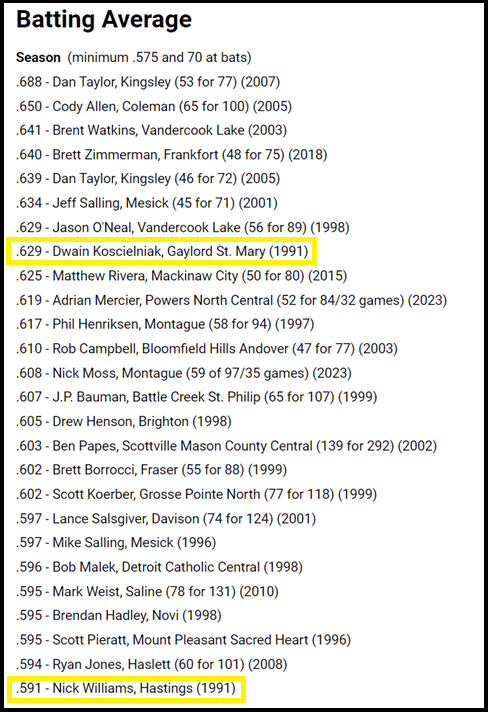
About all the pair really knew was that magical seasons were about to end. Both were batting over .600, but when ballplayers are hitting that well, there's a fine line in maintaining such rare territory. As both found out – one painfully so and the other happily – every at-bat is critical. Koscielniak wound up slugging a pair of homers in his final game to finish with a .629 mark while Williams, who started the last day of his senior season with a hefty .612 mark, went hitless for the first time all spring to finish at 591.
While the chase to hit .600 is obviously an entertaining story, it's only the tip of the iceberg in terms of the amazing parallels between the lives of Koscielniak and Williams, who lived 170 miles apart growing up in Gaylord and Hastings, respectively.
Both, for example, were outstanding dual-sport athletes. Koscielniak graduated second on the Michigan football career rushing list with 5,078 yards from 1987-90, and he still owns the state single-game record of 529 yards against Pellston on Oct. 26, 1990. Williams, meanwhile, averaged 24 points per game as a senior in basketball and could have been a dual-sport athlete at the next level if not for sticking with baseball.
In addition, both went on to stellar collegiate careers. Williams was a second-team all-Mid-American Conference selection in 1995 as a junior, and Central Michigan University captain as a senior. Koscielniak played two years at Mott Community College before becoming a slugging catcher/infielder at Ferris State. He was named Player of the Year in the Great Lakes Intercollegiate Athletic Conference in 1994 when he won the league’s triple crown hitting .403 with nine home runs and 37 RBIs.
 Both had flirtations with pro ball as Williams was taken by the Seattle Mariners in the 48th round of the 1991 MLB draft and later drew interest from Boston and Cincinnati following his time at CMU. Koscielniak was drafted by San Diego in the 32nd round in 1994 and reached High-A a year later. He batted .261 with 32 RBIs in 64 games over two minor league seasons.
Koscielniak and Williams, who unknowingly played against each other with their college teams in 1994, also both wound up in athletics after college. Williams became an associate athletic director at Central Michigan, while Koscielniak coached baseball at Gaylord St. Mary.
There's more as both players are fathers of college-level talents. Williams' daughter Jayden ran track at Central Michigan while another daughter, Taryn, is playing volleyball at Delta College. Koscielniak's sons Steven and Christopher both played baseball at Delta College, daughter Brooke is an equestrian at Saginaw Valley State, and youngest son Brett is a three-sport athlete at Gaylord St. Mary.
If there's one more nugget which Williams and Koscielniak have in common, it’s that both credit long hours of work for becoming outstanding hitters. Williams would use a tarp in the family garage for a makeshift hitting cage, while Koscielniak's offseason hitting quarters was a cage stuck away in a pole barn. Both said they would never have approached being .600 hitters without putting in loads of extra time.
"I got my swings in several times a week in the offseason, and that really helped me," said Koscielniak, whose professional career received its earliest spark when a Ferris State science teacher/part-time MLB scout wandered past the school's gymnasium and noticed Koscielniak practicing throws to second base from his spot as catcher during winter workouts.
Williams remembers getting in about 200 at-bats with summer travel teams in Hastings, Grand Rapids and Battle Creek between his junior and senior years.
"I had a lot of success as a hitter because I put the time in," said Williams, who remembers half a dozen scouts at every Saxons game as a senior. "I didn't play a fall sport, and I put in a lot of time just hitting. I became aware of being able to hit the ball the other way, and I think my confidence began to grow."
As for approaching the .600 mark during their final seasons, Williams and Koscielniak said they were blissfully unaware of any state batting records. Williams does recall never considering trying to preserve a .600 average by taking a game off down the stretch.
"No, I never (had) a thought of that – not even a conversation," he said. "A lot of time has passed since then, but I don't remember sitting out at all. No way. I was always going to play, and that's it."
Koscielniak also doesn't recall worrying about hitting 600. While Koscielniak was the first .600 hitter in state history, only 17 others have gone on to become MHSAA-recognized .600 batters. Dan Taylor of Kingsley holds the state record for highest average with a .688 mark in 2007.
Koscielniak also hit 17 home runs as a senior and finished his career with 35, which continues to rank eighth on that statewide all-time list.
"Back then if you loved the game, you just played. How it turned out for me is how it turned out," he said. "I was competitive and played hard. I played well at Mott and then Ferris State, and the door opened up for me a little."
Williams and Koscielniak remember one huge drawback in trying to hit .600: walks. Pitchers would simply not give them anything to hit. Williams remembers a doubleheader against Coldwater where he hit home runs in his first at-bats in both games, then received two intentional walks in both games. Koscielniak's two homers in his final game were followed by two intentional walks.
Such a stingy pitching philosophy was par for the course, they say.
"That becomes very difficult for a hitter," Williams said. "You have to be dialed in when you get your opportunities. It was a fun year for me, but a struggle at times because (the walks) make you feel like you're not doing your job for the team.
"I don't think hitting .600 was a big deal. We didn't talk about stats and those things. You keep track a little, but I had no idea till the end of the year. And in the end, it's not about stats. I loved playing baseball."
These days, Williams is an instructor as part of the physical education and sport faculty at CMU, teaching courses on professional and collegiate athletics. Koscielniak is an operation manager for Schwan’s Food Service and with his wife Liz owns the Gaylord Equestrian Center.
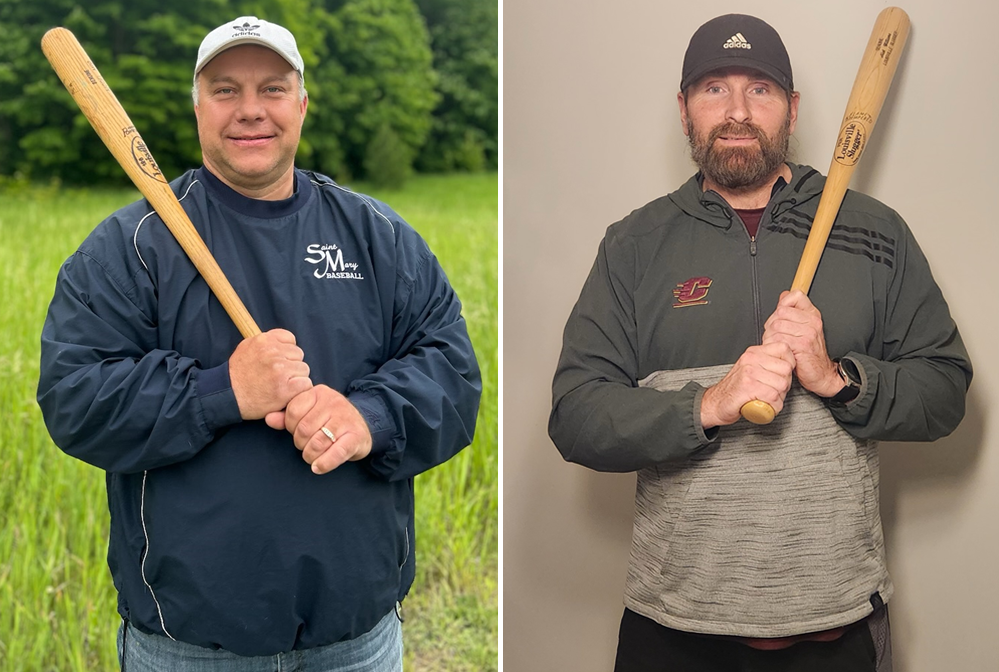
PHOTOS (Top) Dwain Koscielniak, left, and Nick Williams stand for recent photos; they were the state’s top high school hitters in 1991 as both pursued a .600 batting average. (Middle) They continue to rank among the elite on the MHSAA record book list for top batting averages for a single season. (Photos courtesy of Koscielniak and Williams.)