


New Math: Division & Multiplication Problems
July 25, 2017
By Jack Roberts
MHSAA Executive Director
This is the second part in a series on MHSAA tournament classification, past and present, that will be published over the next two weeks. This series originally ran in this spring's edition of MHSAA benchmarks.
High school tournament classifications went viral before there was social media and most of us knew what “viral” meant.
Much as a virus infects computers today or has created epidemics of disease around the world for centuries, high school tournament classification – once introduced – tends to spread uncontrollably. Once started, it tends to keep expanding and rarely contracts.
While we are still some distance from providing every team a trophy as a result of expanding high school tournament classification across the country, there is criticism nevertheless that we are headed in that direction – a philosophy which is supposed to exist only in local youth sports for our youngest children.
Michigan could be blamed for all this. Michigan is generally accepted as the first state to provide different classifications for season-ending tournaments for different sized schools. It started a century ago. Today, every state has various classifications for its tournaments in most if not all sports. And it is a bit ironic that Michigan – creator of the classification chaos – more than most other states has kept the number of tournament classes or divisions under control.
Yes, there is evidence that tournament classifications have expanded over the years in Michigan, especially with the relatively recent introduction of tournaments in football and the late 1990s’ move from classes to divisions in most MHSAA tournaments. But the MHSAA Representative Council has held true to its word when it expanded the playoffs for football from four classes to eight divisions: this is needed because of unique factors of football, factors that exist in no other sport; and all other sports should be capped at a maximum of four classes or divisions.
Kentucky is the preeminent defender of single-class basketball. All of its 276 high schools compete for the single state championship for each gender. In Indiana, there are still open wounds from its move in 1998 from one to four classes for its 400 schools in basketball.
Multi-class tournaments have tended to increase the number of non-public school champions, which some states are trying to lower through enrollment “multipliers,” and also tend to increase the number of repeat champions, which some states are trying to affect with “success factors” which lift smaller schools into classifications for larger schools if they take home too many trophies.
While there is considerable evidence that state tournaments do as much bad as good for educational athletics, state associations persist in providing postseason tournaments because, on balance, the experiences are supposed to be good for student-athletes. And once we reach that conclusion it is just a small leap to believe that if the tournaments are good for a few, they must be better for more – which leads to creating more and more tournament classifications. One becomes two classes, then three, then four and so forth.
While the argument is that more classifications or divisions provides more students with opportunities to compete and win, it is undeniable that the experience changes as the number of tournament classifications expands. It is not possible for state associations to provide the same level of support when tournament classifications expand to multiple venues playing simultaneously. For example, there is less audio and video broadcast potential at each venue, and less media coverage to each venue. Focus is diluted and fans diminished at each championship.
No one can argue reasonably that today's two-day MHSAA Football Finals of eight championship games has the same pizazz as the one-day, four-games event conducted prior to 1990.
In some states the number of divisions has grown so much that it is difficult to see much difference between the many season-ending state championship games and a regular-season event in the same sport.
It is a balancing act. And Michigan has been studying that balance longer than any other state, and charting a steadier course than most.
Addition by Division
The shift to Divisions for MHSAA Tournament play in numerous sports has added up to a greater number of champions for teams and individuals across the state. Following are the sports currently employing a divisional format, and the procedures for determining enrollment and classification.
In 23 statewide or Lower Peninsula tournaments, schools which sponsor the sport are currently divided into nearly equal divisions. They are:
- Baseball - 4 Divisions
- Boys Bowling - 4 Divisions
- Girls Bowling - 4 Divisions
- Girls Competitive Cheer - 4 Divisions
- LP Boys Cross Country - 4 Divisions
- LP Girls Cross Country - 4 Divisions
- LP Boys Golf - 4 Divisions
- LP Girls Golf - 4 Divisions
- Ice Hockey - 3 Divisions
- Boys Lacrosse - 2 Divisions
- Girls Lacrosse - 2 Divisions
- Boys Skiing - 2 Divisions
- Girls Skiing - 2 Divisions
- LP Boys Soccer - 4 Divisions LP
- Girls Soccer - 4 Divisions
- Girls Softball - 4 Divisions
- LP Boys Swimming & Diving - 3 Divisions
- LP Girls Swimming & Diving - 3 Divisions
- LP Boys Tennis - 4 Divisions
- LP Girls Tennis - 4 Divisions
- LP Boys Track & Field - 4 Divisions
- LP Girls Track & Field - 4 Divisions
- Wrestling - 4 Divisions
Lists of schools for each division of these 23 tournaments are posted on MHSAA.com approximately April 1. Listings of schools in Upper Peninsula tournaments for their sports are also posted on MHSAA.com. The lists are based on school memberships and sports sponsorships in effect or anticipated for the following school year, as known to the MHSAA office as of a date in early March.
In football, the 256 schools which qualify for MHSAA 11-player playoffs are placed in eight equal divisions annually on Selection Sunday. Beginning in 2017, the 8-player divisions will be determined in a like manner on Selection Sunday as well, with 32 qualifying schools placed in two divisions.
Schools have the option to play in any higher division in one or more sports for a minimum of two years.
The deadlines for "opt-ups" are as follows:
- Applications for fall sports must be submitted by April 15
- Applications for winter sports must be submitted by Aug. 15
- Applications for spring sports must be submitted by Oct. 15
Subsequent to the date of these postings for these tournaments, no school will have its division raised or lowered by schools opening or closing, schools adding or dropping sports, schools exercising the option to play in a higher division, or approval or dissolution of cooperative programs.
When the same sport is conducted for boys and girls in the same season (e.g., track & field and cross country), the gender that has the most sponsoring schools controls the division breaks for both genders.
Preview: Returning Champs Lined Up to Lead Again at LP Girls Track & Field Finals
By
Geoff Kimmerly
MHSAA.com senior editor
May 30, 2024
The power programs that led the way during the 2023 Lower Peninsula Girls Track & Field Finals could be the teams to chase again during this weekend’s meets across the Grand Rapids area.
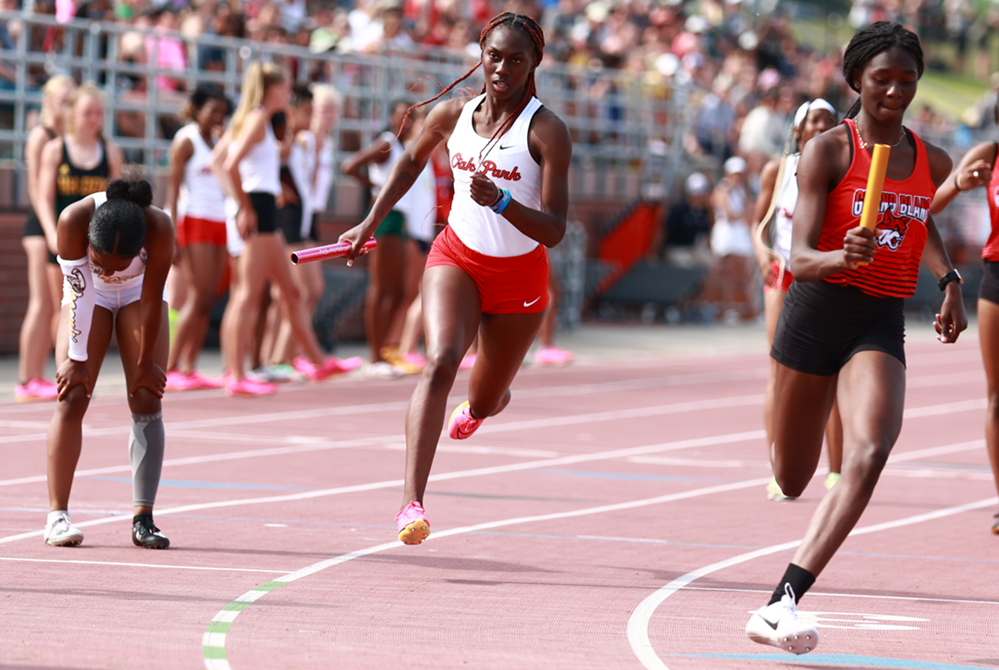
Buckley in Division 4 and Hart in Division 3 return significant point scorers from last year’s respective title runs, and Oak Park and Detroit Renaissance again look like strong pacesetters in Division 1.
Division 2 might be the most contested meet of the day in the Lower Peninsula – but it’s impossible to count out two-time reigning champion East Grand Rapids.
All four LP Finals will begin with pole vault and long jump beginning at 9 a.m., followed by race semifinals and the 3,200 relay at 10 a.m. and the rest of the running finals starting at noon. Tickets cost $11 and are available digitally only via GoFan.
MHSAA.tv will live-stream all four meets beginning at 10 a.m., viewable with subscription. Check out the Girls Track & Field page for meet information for all four sites and lists of all qualifiers. Those described as "seeded" below have received those seeds based on Regional performances.
Below is a glance at team contenders and individuals to watch in all four divisions:
LP Division 1 at East Kentwood
Team forecast: Oak Park or Detroit Renaissance has won the last five LPD1 team titles, with the other finishing runner-up the last four seasons (not counting COVID-canceled 2020). A year ago it was Oak Park first and Renaissance second, and the Knights have first or second seeds (or both) in five individual races and three relays this weekend. Renaissance has similarly-seeded contenders in three individual races and three relays. Holland West Ottawa is seeking its first team championship and will need some middle-seeded entries to climb but does have Helen Sachs seeded first in both distance races and as part of the top-seeded 3,200 relay.
Brooke Bowers, Grand Rapids Forest Hills Central senior – The reigning pole vault champion is top-seeded in that event at 13-0, nine inches higher than her Finals-winning height a year ago, and she’ll also run on the fifth-seeded 400 relay.
Milena Chevallier, Farmington Hills Mercy senior – She set the LPD1 Finals record at 5-foot-11 last year and was just a quarter-inch off tying the all-Finals all-time best height. She’ll also long jump.
Jayla Dace, Detroit Renaissance junior – She was first in the 100, third in the 200 and ran on two winning relays in 2023, and returns this weekend at the top seed in the 100 (12.05), one of several contenders in the 200 and running on the top-seeded 400 relay (47.19) and second-seeded 800 relay (1:40.41).
Rachel Forsyth, Ann Arbor Pioneer senior – The fastest champion in Michigan girls cross country history is looking to add to her 800 and 1,600 titles last season and 3,200 relay titles last year and in 2021. She’s seeded first in the 800 (2:11.26), second in the 1,600 (4:54.92) and 3,200 (10:35.05) and listed as likely to run on the second-seeded 3,200 relay (9:09.35).
Keyanna O’Tey, Sturgis junior – She won the 100 and 200 last season in LPD2, the 100 in a time that would’ve won LPD1 as well, and she’s top-seeded this weekend in this division in the 200 (24.77) and second-seeded in the 100 (12.10) while set to run on both sprint relays as well.
Morgan Roundtree, Oak Park senior – The 2022 champion in 300 hurdles finished second in that race last season and third in the 100 hurdles, but is seeded first the latter (14.08), second in the 300 (43.12) and will run on the top-seeded 800 relay (1:38.37) and second-seeded 400 relay (47.95).
Abigail Russell, Allen Park senior – She’s won the discus the last two seasons and also won shot put as a sophomore, and she enters this weekend as the top seed in both at 151-10 and 47-3½, respectively.
Kamryn Tatum, West Bloomfield sophomore – She made her Finals debut by winning the 200 and 400, and she’ll run both again plus on 400 and 800 relays.
LP Division 2 at Hamilton
Team forecast: East Grand Rapids has won the last two LPD2 Finals championships, last season followed by Sturgis, which is competing in Division 1 this weekend. The Pioneers’ strength has been in distance races, and they have possibilities again. But a couple of teams strong in the sprints could be leading the way this time. Romulus Summit Academy is seeking its first team championship and has the top-seeded 400 and 800 relays and contenders in the individual 100 and 200. Dearborn Divine Child last won a Finals in 2013 and has potential scorers in at least five individual races, plus the top-seeded 1,600 relay and two more seeded fourth or higher. Petosky is another to watch with competitors all over the meet.
Janae Hudson, Marysville senior – The reigning champion in the shot put and fourth-place finisher in discus is top-seeded in discus (146-10) by nearly nine feet and second-seeded in shot (43-3) with a toss six inches farther than last year’s winner.
Kaitlyn Molnar, Grosse Ile senior – Last season’s long jump champion is coming off Regional titles in that event and 300 hurdles.
Drew Muller, East Grand Rapids senior – She’s won the 1,600 the last two seasons and was the LPD2 cross country champion in 2022, and enters this weekend set to run the 1,600 and 800 and on two top-five seeded relays.
Allison Shelton, Ortonville Brandon senior – Last season’s pole vault champion at 12 foot is one of three coming into this meet after winning their Regionals at 11-3, joined by Cadillac’s Madisyn Lundquist and Plainwell’s Ava Collier.
Natalie VanOtteren, Grand Rapids Christian senior – The 2023 winner in the 3,200 and fifth-place finisher in the 1,600 is set to run both and as part of the 3,200 relay.
LP Division 3 at Kent City
Team forecast: Even with last season’s 3,200 winner Jessica Jazwinski out of the lineup this weekend, two-time reigning champion Hart may be the team favorite again. Contenders in two sprints and the two distance races plus the top-seeded 400 relay (50.51) and possible scorers in three field events should keep the Pirates in the mix. Jackson Lumen Christi was fifth last season and is seeking a first team title, and has the top-seeded 1,600 relay (4:09.36) and 3,200 relay (9:33.68) plus the favorite in the 800 among possible scorers throughout the distance portion of the meet. Traverse City St. Francis is seeking its first team title since 2013 and has competitors all over the meet to bolster the top-seeded 800 relay (1:47.11).
Addison Hovey, Hart junior – She won the high jump and was third in the 100 last year, and could supply many more points this time as the top seed in the 100 (12.4) and 200 (25.51) and part of the top-seeded 400 relay (50.51) as well as a strong contender again in her field event.
Destiny McDaniels, Bath junior – She’s looking to follow up last year’s 100 hurdles win and third place in long jump, and is a top-seven seeded contender in both.
Madison Osterberg, Jackson Lumen Christi senior – The reigning champion in the 1,600 also was second in the 800 and fifth in the 3,200 last season, and ran on the runner-up 3,200 relay. She’ll be a big part of any Titans team title pursuit as the top seed in the 800 (2:13.20), second seed in the 1,600 (5:02.97) and running on the top-seeded 1,600 relay (4:09.36) and 3,200 relay (9:33.68).
Emily Peters, Olivet sophomore – She won the 300 hurdles and was part of the winning 1,600 relay as a freshman, and finished seventh in the 100 hurdles as well, and she’ll enter this weekend top-seeded in the 300 (46.10), a potential placer again in the 100 hurdles and running on two top-six seeded relays.
Emmry Ross, Onsted junior – Her 400 and 800 wins last year supplied 20 of Onsted’s eighth-place 24 points, and as the team’s lone qualifier this spring she could make a solo run at an even higher team finish with the top seed in the 400 (56.62) and 1,600 (4:58.73), second seed in the 800 (2:13.79) and ninth seed in the 3,200.
LP Division 4 at Hudsonville Baldwin
Team forecast: Reigning champion Buckley won last season with 52 points, and the two runners who combined for 41 of those are back for the repeat pursuit. Portland St. Patrick was only three points back and has three top-four seeded relays and four individual racer entries seeded fourth or higher. Fowler was fourth last season and might be the strongest all-around hopeful with contenders in every race and relay plus two field events. Hillsdale Academy will look to move up from fifth last season with plenty of power in the distance races and all four relays seeded fourth or higher.
Molly Brown, Addison junior – Last season’s 100 hurdles champion and runner-up in the 100 dash and 300 hurdles is the top seed in the 100 hurdles (14.86) and the 100 dash (12.6) and third-seeded in the 200 (26.39) and 300 hurdles (47.04).
Aiden Harrand, Buckley senior – She’s won six track and two cross country championships total, including in the 800, 1,600 and 3,200 last spring. She’s top-seeded this weekend in the 400 (59.10) and second-seeded in the 800 (2:21.37) and 1,600 (5:09.42), the latter of which she’ll be trying to win for the fourth time.
Olivia Findlay, Marlette senior – The reigning high jump title winner at 5-4 jumped that at the Regional to receive the top seed this weekend and also could contend in long jump and the 100 hurdles.
Brooklyn Frazee, Buckley sophomore – She won the 100, was second in the 200 and sixth in the 400 as a freshman, and returns this weekend as the second seed in the 100 (12.67), fourth seed in the 200 and running the 400 again and competing in long jump unless she enters one or more qualifying relays.
Rebecca Moeller, Deckerville junior – She won the pole vault last season at 10-6 and is one of four who won their Regionals at 10-0 to tie for the top seed this time. She’ll also run both hurdles races and the 200.
Rylee Scheurer, Portland St. Patrick senior – The reigning champion in the 200 and third-place finisher in the 100 is top-seeded in the 200 (26.11), third-seeded in the 100 (12.74) and part of the top-seeded 800 relay (1:46.75) and third-seeded 400 relay (51.58).
PHOTO Oak Park’s Kelis Hunter-Young begins her leg of the 1,600 relay during last season’s LP Division 1 Finals. (Photo by Carter Sherline/RunMichigan.com.)