

New Math: Division & Multiplication Problems
July 25, 2017
By Jack Roberts
MHSAA Executive Director
This is the second part in a series on MHSAA tournament classification, past and present, that will be published over the next two weeks. This series originally ran in this spring's edition of MHSAA benchmarks.
High school tournament classifications went viral before there was social media and most of us knew what “viral” meant.
Much as a virus infects computers today or has created epidemics of disease around the world for centuries, high school tournament classification – once introduced – tends to spread uncontrollably. Once started, it tends to keep expanding and rarely contracts.
While we are still some distance from providing every team a trophy as a result of expanding high school tournament classification across the country, there is criticism nevertheless that we are headed in that direction – a philosophy which is supposed to exist only in local youth sports for our youngest children.
Michigan could be blamed for all this. Michigan is generally accepted as the first state to provide different classifications for season-ending tournaments for different sized schools. It started a century ago. Today, every state has various classifications for its tournaments in most if not all sports. And it is a bit ironic that Michigan – creator of the classification chaos – more than most other states has kept the number of tournament classes or divisions under control.
Yes, there is evidence that tournament classifications have expanded over the years in Michigan, especially with the relatively recent introduction of tournaments in football and the late 1990s’ move from classes to divisions in most MHSAA tournaments. But the MHSAA Representative Council has held true to its word when it expanded the playoffs for football from four classes to eight divisions: this is needed because of unique factors of football, factors that exist in no other sport; and all other sports should be capped at a maximum of four classes or divisions.
Kentucky is the preeminent defender of single-class basketball. All of its 276 high schools compete for the single state championship for each gender. In Indiana, there are still open wounds from its move in 1998 from one to four classes for its 400 schools in basketball.
Multi-class tournaments have tended to increase the number of non-public school champions, which some states are trying to lower through enrollment “multipliers,” and also tend to increase the number of repeat champions, which some states are trying to affect with “success factors” which lift smaller schools into classifications for larger schools if they take home too many trophies.
While there is considerable evidence that state tournaments do as much bad as good for educational athletics, state associations persist in providing postseason tournaments because, on balance, the experiences are supposed to be good for student-athletes. And once we reach that conclusion it is just a small leap to believe that if the tournaments are good for a few, they must be better for more – which leads to creating more and more tournament classifications. One becomes two classes, then three, then four and so forth.
While the argument is that more classifications or divisions provides more students with opportunities to compete and win, it is undeniable that the experience changes as the number of tournament classifications expands. It is not possible for state associations to provide the same level of support when tournament classifications expand to multiple venues playing simultaneously. For example, there is less audio and video broadcast potential at each venue, and less media coverage to each venue. Focus is diluted and fans diminished at each championship.
No one can argue reasonably that today's two-day MHSAA Football Finals of eight championship games has the same pizazz as the one-day, four-games event conducted prior to 1990.
In some states the number of divisions has grown so much that it is difficult to see much difference between the many season-ending state championship games and a regular-season event in the same sport.
It is a balancing act. And Michigan has been studying that balance longer than any other state, and charting a steadier course than most.
Addition by Division
The shift to Divisions for MHSAA Tournament play in numerous sports has added up to a greater number of champions for teams and individuals across the state. Following are the sports currently employing a divisional format, and the procedures for determining enrollment and classification.
In 23 statewide or Lower Peninsula tournaments, schools which sponsor the sport are currently divided into nearly equal divisions. They are:
- Baseball - 4 Divisions
- Boys Bowling - 4 Divisions
- Girls Bowling - 4 Divisions
- Girls Competitive Cheer - 4 Divisions
- LP Boys Cross Country - 4 Divisions
- LP Girls Cross Country - 4 Divisions
- LP Boys Golf - 4 Divisions
- LP Girls Golf - 4 Divisions
- Ice Hockey - 3 Divisions
- Boys Lacrosse - 2 Divisions
- Girls Lacrosse - 2 Divisions
- Boys Skiing - 2 Divisions
- Girls Skiing - 2 Divisions
- LP Boys Soccer - 4 Divisions LP
- Girls Soccer - 4 Divisions
- Girls Softball - 4 Divisions
- LP Boys Swimming & Diving - 3 Divisions
- LP Girls Swimming & Diving - 3 Divisions
- LP Boys Tennis - 4 Divisions
- LP Girls Tennis - 4 Divisions
- LP Boys Track & Field - 4 Divisions
- LP Girls Track & Field - 4 Divisions
- Wrestling - 4 Divisions
Lists of schools for each division of these 23 tournaments are posted on MHSAA.com approximately April 1. Listings of schools in Upper Peninsula tournaments for their sports are also posted on MHSAA.com. The lists are based on school memberships and sports sponsorships in effect or anticipated for the following school year, as known to the MHSAA office as of a date in early March.
In football, the 256 schools which qualify for MHSAA 11-player playoffs are placed in eight equal divisions annually on Selection Sunday. Beginning in 2017, the 8-player divisions will be determined in a like manner on Selection Sunday as well, with 32 qualifying schools placed in two divisions.
Schools have the option to play in any higher division in one or more sports for a minimum of two years.
The deadlines for "opt-ups" are as follows:
- Applications for fall sports must be submitted by April 15
- Applications for winter sports must be submitted by Aug. 15
- Applications for spring sports must be submitted by Oct. 15
Subsequent to the date of these postings for these tournaments, no school will have its division raised or lowered by schools opening or closing, schools adding or dropping sports, schools exercising the option to play in a higher division, or approval or dissolution of cooperative programs.
When the same sport is conducted for boys and girls in the same season (e.g., track & field and cross country), the gender that has the most sponsoring schools controls the division breaks for both genders.
Mendon Focused on Taking Last Remaining Step to Claim 1st Finals Championship
By
Scott Hassinger
Special for MHSAA.com
April 3, 2024
MENDON – Mendon's run to the Division 4 softball championship game last spring may have shocked outsiders, but it wasn't a surprise to the Hornets or co-coaches Steve Butler and Mike Smith.
 Mendon gave four-time reigning champion Unionville-Sebewaing a major scare before falling 5-4 to the Patriots in the Final at Michigan State University's Secchia Stadium.
But there could be a new Division 4 champion in the near future as Mendon, ranked No. 10 in the Michigan High School Softball Coaches Association preseason poll, returns all but two players from its 2023 squad.
In finishing 35-6, the Hornets set a program record for most wins in a single season last spring and also were Southwest 10 Conference champs, claimed District and Regional trophies, pulled off dramatic wins over Fowler (13-12) in the Quarterfinal and Johannesburg-Lewiston (4-2) in the Semifinal before a seventh-inning rally fell short in the loss to USA.
That was Mendon's first Finals appearance since 1992, when it lost in the Class D championship game 2-0 to Waterford Our Lady of the Lakes.
While Butler admits last year's run was a bit unexpected, he said the Hornets showed their potential by winning a prestigious early-season event. With a squad featuring just two seniors and 10 sophomores and freshmen, Mendon defeated three state-ranked teams, all via the 10-run mercy rule, to win the Holton Tournament.
 "Quite honestly, I figured we'd be lucky to go 8-5 those first couple of weeks last season. We had a difficult early-season schedule. Winning the Holton Tournament was a big momentum builder for us," Butler said.
Butler and Smith, both former standout athletes at Mendon, took over the softball program seven years ago.
"At Mendon, the goal is always to make it to the state championship no matter what sport you're in,” Butler said. “Mike and I have played a lot of baseball and softball over the years. We both had daughters coming up through the program. So when the coaching opening came up, we just felt our knowledge and desire to win would help us provide the program with the best experience and chance for the girls to get to the championship game.”
Modest goals were set the first few seasons of their coaching tenure.
"That first year we set a goal of winning 20 games, and we fell one game short of that. Then we set a goal of winning a District, getting state-ranked and getting that Regional trophy. Then the goal was to become state-ranked, win Districts and Regionals and then we set the bar higher and higher," Butler said.
The experienced Hornets hope to complete their mission of winning it all this spring.
"This is a special group of kids, probably one of the best to ever come through this school. The tenacity and ferociousness they show is amazing. There's no quit in them, and that's evident in every sport they play. They believe they can win every game, are calm under pressure and work hard. They just have that championship aura and won't be satisfied until they win one," Butler said.
Several Mendon softball players were members of the state-ranked volleyball team this past fall and the basketball squad that reached the Division 4 Quarterfinals last month.
Abby and Ally Butler, Steve's junior twin daughters, return for their third season on Mendon's softball varsity, along with classmates Brielle Bailey and Kaidee Gonser.
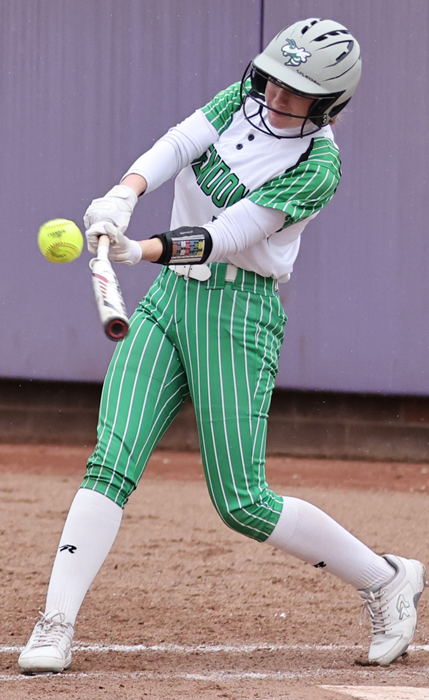
Abby, a two-year starter, can play all three outfield positions and is working hard on being a slap hitter.
"I feel like I'm very useful in right field, especially when Rowan (Allen) is pitching for us. Her speed is a big adjustment for teams with right-handed hitters, so they tend to hit the ball more to me," Abby Butler said. "I'd like to be a more versatile hitter at the plate. I enjoy the other team not really knowing what I'm gonna do when I'm up there."
Abby Butler hit .302, Ally Butler .287, and Bailey .330 last season. Ally Butler is 15-0 for her career as a varsity pitcher and has played in more than 50 games. She'll be Mendon's No. 2 pitcher.
 "We probably could've used her more as pitcher before now, but she is our biggest leader on the team. The kids really look up to her," Steve Butler said.
Ally Butler has a lot of trust in her teammates as well. "I think I communicate well with my team and lift them up when we're down. We have lots of trust in each other and are confident in ourselves," she said.
Bailey becomes the full-time starter at third after splitting time there with Carlie Doehring, who graduated.
"Brielle played third base and spent a lot of time as our designated hitter. She came up with a lot of big hits, including the game-winning RBI and a couple doubles in our Quarterfinal win over Fowler," Steve Butler said.
Gonser returns at catcher. She hit .496 with 60 hits and 34 runs scored last season. "Kaidee has improved defensively and is the best hitter on our team. She does a nice job back there for us. We hope to get her more rest this season so she's more effective for us the whole season," Butler said.
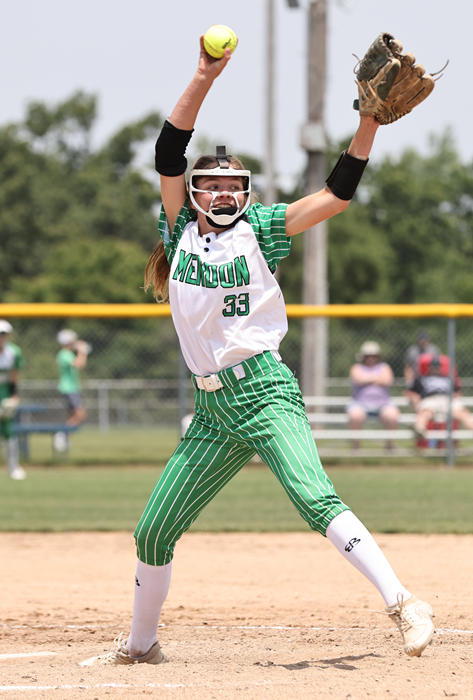
Sophomore Rowan Allen takes over as Mendon's No. 1 pitcher replacing Lauren Schabes, a three-time all-stater. Allen posted a 12-3 record with 150 strikeouts and a 1.64 ERA in 2023, and batted .419 with 44 hits, 49 runs scored and 31 RBI.
"Rowan had a phenomenal freshman season pitching. We're looking forward to seeing where she can take us this year. She's been in lots of big-pressure moments and has beaten many ranked teams," Butler said. "Her change-up pitch is her equalizer; it's nasty and she also throws a good fastball and dropball."
Allen closed out Mendon's Quarterfinal win over Fowler and locked down USA the last two innings in the championship game, giving the Hornets a chance to win in the seventh.
“My biggest strength is my fastball and being able to go to a changeup and being able to mix it up whenever I want,” Allen said. “Our teammates are always there to pick us up, and they never let us down. We have the confidence we need to reach our goals."
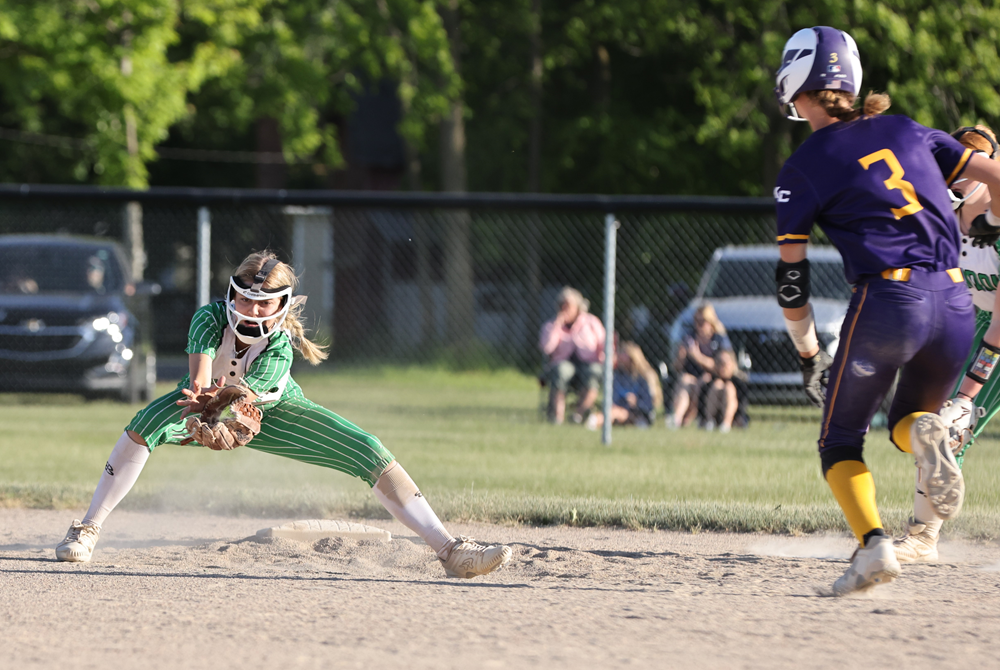
Other key sophomores include Mattea Bingaman, Gracie Schultz, Cienna Nightingale, Brooke Gerth and Jadyn Samson. Samson, Mendon's starting shortstop and No. 3 pitcher, fills another vital role as the lead-off hitter. She set a school record as a freshman with 46 stolen bases and was thrown out only once, also batting over .435 with 53 hits, 60 runs scored and 35 RBI.
"Jadyn is the leader of our infield. She covers a lot of ground and doesn't make many errors. We're looking forward to having her and our entire infield back the next two years. She threw only one inning for us last year, but she's another hidden gem on the mound and will see some time there as well," Butler said.
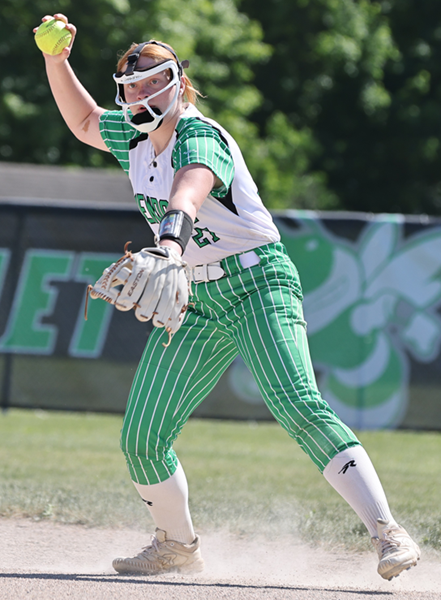 "The experience last year was huge,” Samson added. “I have to keep working hard to be productive. We're young, but I think everyone is going to continue to grow. I feel the energy I bring to my position is a big help, and I'm always talking to my teammates. We are all in this for each other, like family.”
Nightingale is another key returning starter at first base. "Cienna is the best defensive first baseman we've ever coached. It's not the easiest position to play. She's very agile, quick, can scoop balls out of the dirt, stretch high and makes everyone else look good," Butler said.
Bingaman is Mendon's centerfielder. She finished last spring with a .434 average, 52 hits and 31 runs scored. "Mattea has a really strong arm and is very fast," Butler noted.
Gerth is pegged as Mendon's top utility player, while Schultz is another valuable contributor in the outfield.
"Depending on who's pitching and where we move people around, I feel we are one of the best defensive teams in the state. Our pitchers don't give up many runs. Offensively, five of our top nine hitters batted over .400. I expect our lineup to have more power too. We're more of a gap-hitting team though. We take a lot of walks, and we stress being aggressive on the basepaths," Steve Butler said. "All 10 of our players are in the mix and could be starters.
"The biggest thing is these girls feel they should've won a state title last season. They were immediately focused on this season after that loss. After their basketball Quarterfinals loss, I got a text at work at 11 p.m. from one of them wanting to know when softball practice started the next day. They are ready to go."
Mendon joined the Southern Central Athletic Association at the beginning of this school year, and preseason Division 4 honorable mention Burr Oak is among opponents on the schedule. The Hornets’ goals are to win the league and get back to Michigan State with a chance to hoist the first-place trophy.
"Repeating what we accomplished last year won't be easy because now everyone expects it,” Butler said. “We won't sneak up on anyone. It's a tough road. All the teams we played last year will be there again in the championship hunt.”
 Scott Hassinger is a contributing sportswriter for Leader Publications and previously served as the sports editor for the Three Rivers Commercial-News from 1994-2022. He can be reached at [email protected] with story ideas for Berrien, Cass, St. Joseph and Branch counties.
PHOTOS (Top) Mendon starting shortstop Jadyn Samson fields a ground ball during a home game last season against Kalamazoo Christian. (2) Rowan Allen pitches for Mendon in a 2023 Regional game at Colon. (3) Abby Butler makes contact during last season’s Division 4 Final against USA. (4) Ally Butler readies to make a throw from her spot at second base. (Photos by Nicci Plummer.)