

New Math: Division & Multiplication Problems
July 25, 2017
By Jack Roberts
MHSAA Executive Director
This is the second part in a series on MHSAA tournament classification, past and present, that will be published over the next two weeks. This series originally ran in this spring's edition of MHSAA benchmarks.
High school tournament classifications went viral before there was social media and most of us knew what “viral” meant.
Much as a virus infects computers today or has created epidemics of disease around the world for centuries, high school tournament classification – once introduced – tends to spread uncontrollably. Once started, it tends to keep expanding and rarely contracts.
While we are still some distance from providing every team a trophy as a result of expanding high school tournament classification across the country, there is criticism nevertheless that we are headed in that direction – a philosophy which is supposed to exist only in local youth sports for our youngest children.
Michigan could be blamed for all this. Michigan is generally accepted as the first state to provide different classifications for season-ending tournaments for different sized schools. It started a century ago. Today, every state has various classifications for its tournaments in most if not all sports. And it is a bit ironic that Michigan – creator of the classification chaos – more than most other states has kept the number of tournament classes or divisions under control.
Yes, there is evidence that tournament classifications have expanded over the years in Michigan, especially with the relatively recent introduction of tournaments in football and the late 1990s’ move from classes to divisions in most MHSAA tournaments. But the MHSAA Representative Council has held true to its word when it expanded the playoffs for football from four classes to eight divisions: this is needed because of unique factors of football, factors that exist in no other sport; and all other sports should be capped at a maximum of four classes or divisions.
Kentucky is the preeminent defender of single-class basketball. All of its 276 high schools compete for the single state championship for each gender. In Indiana, there are still open wounds from its move in 1998 from one to four classes for its 400 schools in basketball.
Multi-class tournaments have tended to increase the number of non-public school champions, which some states are trying to lower through enrollment “multipliers,” and also tend to increase the number of repeat champions, which some states are trying to affect with “success factors” which lift smaller schools into classifications for larger schools if they take home too many trophies.
While there is considerable evidence that state tournaments do as much bad as good for educational athletics, state associations persist in providing postseason tournaments because, on balance, the experiences are supposed to be good for student-athletes. And once we reach that conclusion it is just a small leap to believe that if the tournaments are good for a few, they must be better for more – which leads to creating more and more tournament classifications. One becomes two classes, then three, then four and so forth.
While the argument is that more classifications or divisions provides more students with opportunities to compete and win, it is undeniable that the experience changes as the number of tournament classifications expands. It is not possible for state associations to provide the same level of support when tournament classifications expand to multiple venues playing simultaneously. For example, there is less audio and video broadcast potential at each venue, and less media coverage to each venue. Focus is diluted and fans diminished at each championship.
No one can argue reasonably that today's two-day MHSAA Football Finals of eight championship games has the same pizazz as the one-day, four-games event conducted prior to 1990.
In some states the number of divisions has grown so much that it is difficult to see much difference between the many season-ending state championship games and a regular-season event in the same sport.
It is a balancing act. And Michigan has been studying that balance longer than any other state, and charting a steadier course than most.
Addition by Division
The shift to Divisions for MHSAA Tournament play in numerous sports has added up to a greater number of champions for teams and individuals across the state. Following are the sports currently employing a divisional format, and the procedures for determining enrollment and classification.
In 23 statewide or Lower Peninsula tournaments, schools which sponsor the sport are currently divided into nearly equal divisions. They are:
- Baseball - 4 Divisions
- Boys Bowling - 4 Divisions
- Girls Bowling - 4 Divisions
- Girls Competitive Cheer - 4 Divisions
- LP Boys Cross Country - 4 Divisions
- LP Girls Cross Country - 4 Divisions
- LP Boys Golf - 4 Divisions
- LP Girls Golf - 4 Divisions
- Ice Hockey - 3 Divisions
- Boys Lacrosse - 2 Divisions
- Girls Lacrosse - 2 Divisions
- Boys Skiing - 2 Divisions
- Girls Skiing - 2 Divisions
- LP Boys Soccer - 4 Divisions LP
- Girls Soccer - 4 Divisions
- Girls Softball - 4 Divisions
- LP Boys Swimming & Diving - 3 Divisions
- LP Girls Swimming & Diving - 3 Divisions
- LP Boys Tennis - 4 Divisions
- LP Girls Tennis - 4 Divisions
- LP Boys Track & Field - 4 Divisions
- LP Girls Track & Field - 4 Divisions
- Wrestling - 4 Divisions
Lists of schools for each division of these 23 tournaments are posted on MHSAA.com approximately April 1. Listings of schools in Upper Peninsula tournaments for their sports are also posted on MHSAA.com. The lists are based on school memberships and sports sponsorships in effect or anticipated for the following school year, as known to the MHSAA office as of a date in early March.
In football, the 256 schools which qualify for MHSAA 11-player playoffs are placed in eight equal divisions annually on Selection Sunday. Beginning in 2017, the 8-player divisions will be determined in a like manner on Selection Sunday as well, with 32 qualifying schools placed in two divisions.
Schools have the option to play in any higher division in one or more sports for a minimum of two years.
The deadlines for "opt-ups" are as follows:
- Applications for fall sports must be submitted by April 15
- Applications for winter sports must be submitted by Aug. 15
- Applications for spring sports must be submitted by Oct. 15
Subsequent to the date of these postings for these tournaments, no school will have its division raised or lowered by schools opening or closing, schools adding or dropping sports, schools exercising the option to play in a higher division, or approval or dissolution of cooperative programs.
When the same sport is conducted for boys and girls in the same season (e.g., track & field and cross country), the gender that has the most sponsoring schools controls the division breaks for both genders.
Breslin Bound: 2023-24 Boys Semifinals Preview
By
Geoff Kimmerly
MHSAA.com senior editor
March 13, 2024
No reigning champs seeking to repeat as an MHSAA Finals champion, but nine hopefuls seeking a first boys basketball title. Six contenders hoping to play in a championship game for the first time, and at least one guaranteed to reach this season’s final day at Breslin Center.
Every team makes its own history, of course. But there are opportunities everywhere at Michigan State this weekend for the final 16 teams playing this season to accomplish something their schools have never achieved before – or at least, in a long time.
Among this group of 16, only three semifinalists are back from last year – Orchard Lake St. Mary’s in Division 1, Niles Brandywine in Division 3 and Wyoming Tri-unity Christian in Division 4. And in addition to those nine teams seeking a first championship, three others are seeking their first since 1985, 1975 and 1938.
DIVISION 1 - Friday
Orchard Lake St. Mary's (25-1) vs Ann Arbor Huron (22-4) - Noon
Zeeland West (20-7) vs North Farmington (23-2) - 2 p.m.
DIVISION 2 - Friday
Flint Powers Catholic (22-5) vs Warren Lincoln (22-4) - 5:30 p.m.
Grand Rapids Christian (25-2) vs Chelsea (21-6) - 7:30 p.m.
DIVISION 3 - Thursday
Niles Brandywine (24-3) vs McBain (25-2) - Noon
Detroit Old Redford (20-7) vs Riverview Gabriel Richard (23-3) - 2 p.m.
DIVISION 4 - Thursday
St. Ignace (21-6) vs Wyoming Tri-unity Christian (22-5) - 5:30 p.m.
Mount Pleasant Sacred Heart (25-2) vs Allen Park Inter-City Baptist (23-4) - 7:30 p.m.
Finals - Saturday
Division 1 - 12:15 p.m.
Division 2 - 6:45 p.m.
Division 3 - 4:30 p.m.
Division 4 - 10 a.m.
Tickets for this weekend’s games are $12 for both Semifinals and Finals and available via the Breslin Center ticket office; for information and links visit the Boys Basketball page.
All Semifinals will be broadcast and viewable with subscription on MHSAA.tv, and all four Finals will air live Saturday on Bally Sports Detroit – Divisions 4, 3 and 2 on the primary channel and Division 1 on BSD Extra – as well as on the BSD website and app. Audio broadcasts of all Semifinals and Finals will be available free of charge from the MHSAA Network.
The Boys Basketball Semifinals & Finals are sponsored by Sparrow Health System.
Here’s a look at the 16 semifinalists (with rankings by MPR and statistics through Regional Finals unless noted):
Division 1
ANN ARBOR HURON
Record/rank: 22-4, No. 15
League finish: Tied for second in Southeastern Conference Red
Coach: Mohammad Kasham, second season (45-7)
Championship history: Division 1 runner-up 2021, Class A runner-up 2010.
Best wins: 54-48 over No. 2 East Lansing in Quarterfinal, 53-50 over No. 35 Wayne Memorial in Regional Final, 54-53 over No. 10 Detroit Catholic Central in Regional Semifinal, 64-53 over No. 32 River Rouge, 59-57 over No. 33 Ann Arbor Pioneer in District Final, 72-71 over No. 19 Grand Rapids Northview, 65-52 over No. 14 Saline.
Players to watch: Macari Moore, jr. 6-3 G (23 ppg, 4.9 rpg, 3.6 apg, 2.3 spg); Justin Latham, 6-6 sr. F (7.5 ppg, 8.3 rpg); Kaleb Brown, 6-3 jr. G (6.4 ppg, 3.2 rpg).
Outlook: Huron has reached at least the Quarterfinals both seasons under Kasham, who previously served as an assistant coach for 16 years. The team’s only losses were twice to Pioneer – avenged in the District Final – and once to Saline and Bloomfield Hills Brother Rice. Huron also has wins over two teams playing at Breslin this weekend – Division 2 Chelsea 72-48 and Division 3 Detroit Old Redford 72-38. Junior 6-4 guard Jaydon Keefer (6.7 ppg, 47 3-pointers entering the week) gives the River Rats an all-junior starting backcourt.
NORTH FARMINGTON
Record/rank: 23-2, No. 3
League finish: Tied for first in Oakland Activities Association Red
Coach: Todd Negoshian, 13th season (209-73)
Championship history: Class A runner-up 2016.
Best wins: 62-51 over No. 32 River Rouge in Quarterfinal, 54-53 over No. 7 Warren De La Salle Collegiate in Regional Final, 47-28 over No. 27 Muskegon Reeths-Puffer, 61-46 over No. 11 West Bloomfield, 66-57 over No. 42 Zeeland West, 58-46 over No. 37 Detroit Martin Luther King, 67-62 (OT) and 54-51 over Division 2 No. 8 Ferndale.
Players to watch: Tyler Spratt, 6-5 G/F sr. (16 ppg, 8.0 rpg, 4.0 spg); Landon Williams, 6-4 sr. G (14.0 ppg, 5.0 apg, 4.0 spg); Dylan Smith, 6-9 sr. C (14.9 ppg, 9.0 rpg).
Outlook: North Farmington won its third-straight District title and second-straight league championship on the way to this first trip to Breslin since its 2016 runner-up finish. The Raiders navigated their annually tough schedule with the only losses to West Bloomfield and Grand Rapids Northview, both over the course of nine days midseason. Guard Will MacShara gives North Farmington a fourth senior in the starting lineup, and junior guard Rob Smith (12.4 ppg) gives the Raiders a fourth starter averaging double-digit scoring.
ORCHARD LAKE ST. MARY’S
Record/rank: 25-1, No. 1
League finish: First in Catholic High School League Central
Coach: Todd Covert, ninth season (151-54)
Championship history: Four MHSAA titles (most recent 2000), two runner-up finishes.
Best wins: 52-43 (Quarterfinal), 58-55, 59-41 and 66-47 over No. 6 Bloomfield Hills Brother Rice; 68-46 over No. 11 West Bloomfield in District Final, 73-41 over No. 9 Detroit Cass Tech, 56-37 over No. 2 East Lansing, 65-46, 68-55 and 54-40 over No. 7 Warren De La Salle Collegiate; 64-52 and 70-56 over No. 10 Detroit Catholic Central, 76-68 over No. 12 Detroit U-D Jesuit, 65-58 over Division 2 No. 2 Warren Lincoln.
Players to watch: Trey McKenney, 6-5 jr. G (22.6 ppg, 10.1 rpg); Sharod Barnes, 6-2 jr. G (12.5 ppg, 4.4 apg); Jayden Savoury, 6-6 jr. F (12.7 ppg, 6.8 rpg).
Outlook: St. Mary’s got on a roll at the end of the 2022-23 regular season and reached its first Semifinal since 2006, and the Eaglets haven’t slowed down this winter. The lone defeat came 60-55 on Dec. 18 to U-D Jesuit and was avenged a month later, and only five wins have been by single digits. McKenney was The Associated Press’ Division 1 Player of the Year last season as a sophomore and is sure to be the Mr. Basketball Award favorite next winter. Senior guard Daniel Smythe (7.7 ppg) is another top contributor, with three more players averaging at least five points per game.
ZEELAND WEST
Record/rank: 20-7, No. 42
League finish: Third in Ottawa-Kent Conference Green
Coach: David Klyn, eighth season (102-73)
Championship history: Has never played in an MHSAA Final.
Best wins: 53-52 over No. 17 Muskegon in Quarterfinal, 44-41 over No. 19 Grand Rapids Northview in Regional Semifinal, 61-42 over No. 9 Detroit Cass Tech, 58-44 over Division 2 No. 11 Hudsonville Unity Christian.
Players to watch: Lukas Bakker, 6-5 sr. F (13.2 ppg, 58 3-pointers); Myles Steffen, 6-3 sr. G (7.6 ppg, 3.5 apg); Merritt Alderink, 6-7 sr. F (13.1 ppg, 6.9 rpg).
Outlook: West this season has defeated both teams that played in last year’s Division 1 title game, reigning champion Cass Tech and runner-up Muskegon on Tuesday, with the latter victory landing the Dux in their first Semifinal after they won their first Regional title last week. The Muskegon win also avenged a pair of league losses, and all of West’s defeats came to opponents that won at least 16 games this season. The Dux start five seniors, with guard Trenten Bolhouse (6.9 ppg, 4.6 rpg) and 6-5 forward Orion Yant (7.7 ppg, 5.5 rpg) filling out the lineup with experience and additional scoring.
Division 2
CHELSEA
Record/rank: 21-6, No. 9
League finish: First in Southeastern Conference White
Coach: Andrea Cabana, second season (42-12)
Championship history: Has never played in an MHSAA Final.
Best wins: 68-53 over No. 22 Detroit University Prep in Quarterfinal, 75-53 over No. 10 Onsted in Regional Final, 70-62 and 97-87 over No. 12 Adrian, 59-57 over Division 1 No. 14 Saline.
Players to watch: Jake Stephens, 6-4 sr. G (25.3 ppg, 59 3-pointers, 11 rpg, 4.0 apg, 3.0 spg); Joey Cabana, 6-2 sr. G (21.3 ppg, 64 3-pointers, 4.0 apg); Drew Blanton, 6-2 jr. G (10.5 ppg, 5.0 apg).
Outlook: Chelsea is enjoying a school-record run after also making the Quarterfinals last season but reaching the Semifinals this week for the first time. Andrea Cabana led the Grass Lake girls to the Division 3 title in 2021 and is believed to be the second woman to coach a boys team to the Semifinals, after Mount Pleasant Sacred Heart’s Keisha Brown in 2006. Joey Cabana and Stephens both made the all-state first team last season and supply the bulk of the scoring for a contender that’s reached 70 points 10 times this winter. Chelsea has won 16 of its last 17 games, the lone loss during that time to Division 1 River Rouge by three points.
FLINT POWERS CATHOLIC
Record/rank: 22-5, No. 23
League finish: Tied for fifth in the Saginaw Valley League.
Coach: Zach Collins, third season (43-30)
Championship history: Class B champion 2009, Class B runner-up 2008.
Best wins: 81-77 over No. 4 Kingsford in Quarterfinal, 59-51 (Regional Final) and 72-67 over No. 25 Saginaw Arthur Hill, 62-58 (OT) over Division 1 No. 49 Grand Blanc, 81-78 (OT) over Division 1 No. 34 Hamtramck, 61-48 over Division 3 No. 3 Schoolcraft.
Players to watch: Jesse Cull, 6-5 jr. F (12.2 ppg, 4.0 rpg); Javontae Ross, 5-11 jr. G (16.4 ppg, 4.2 rpg, 5.4 apg, 3.1 spg); Connor Kelly, 6-3 sr. F (12.1 ppg, 8.2 rpg, 3.0 apg).
Outlook: Powers is returning to the Finals for the first time since its championship season after winning its first Regional title since 2013, and Collins has led a quick ascension as the team was 5-17 in his first season before jumping to 16-8 a year ago. The Chargers won 10 of their first 11 games this winter and navigated the mostly-Division 1 SVL before rumbling through a playoff run that’s seen all five opponents with winning records. Junior 6-6 center Demsey Cull adds 8.7 ppg and is the team’s second-leading 3-point shooter.
GRAND RAPIDS CHRISTIAN
Record/rank: 25-2, No. 3
League finish: First in O-K White
Coach: Eric Taylor, sixth season (108-24)
Championship history: Lower Peninsula Class B champion 1938, two runner-up finishes.
Best wins: 57-52 (Quarterfinal) and 69-50 over No. 22 Grand Rapids Catholic Central, 61-51 over No. 1 Benton Harbor in Regional Final, 52-49 (District Final) and 58-48 over No. 18 Grand Rapids South Christian, 46-42 and 54-43 over Division 1 No. 19 Grand Rapids Northview, 60-51 over Division 1 No. 17 Muskegon.
Players to watch: Nate Johnson, 6-6 sr. G (12.2 ppg, 5.0 rpg); Jaylan Ouwinga, 6-8 sr. F (11.7 ppg, 6.7 rpg); Malachi Hooser, 5-11 sr. G (8.9 ppg).
Outlook: The Eagles have been in the conversation of Division 2 favorites all season with their only losses 49-47 to Warren Lincoln and 49-43 to Division 1 Byron Center. They’ve won 11 straight games heading into their first trip to Breslin since finishing Class A runner-up in 2017. Guard Quintin Willis (6.0 ppg) and forward Carter Goodyke (6.3 ppg) fill out an all-senior starting lineup for a team that’s been especially impressive defensively, holding all opponents under 60 points with 18 games giving up fewer than 50.
WARREN LINCOLN
Record/rank: 22-4, No. 2
League finish: First in Macomb Area Conference White
Coach: Wydell Henry, sixth season (87-29)
Championship history: Has never played in an MHSAA Final.
Best wins: 61-42 over No. 28 Goodrich in Quarterfinal, 55-44 over No. 8 Ferndale in District Final, 49-47 over No. 3 Grand Rapids Christian, 62-54 over Division 1 No. 2 East Lansing, 56-51 over Division 1 No. 11 West Bloomfield, 49-46 over Division 1 No. 16 Grosse Pointe South.
Players to watch: Markus Blackwell, 6-2 jr. G (17 ppg, 4.0 apg, 3.0 spg); Da’Marion Bozeman, 6-5 jr. G (12.5 ppg, 4.5 rpg); Timarion Minor, 6-5 sr. F (11.2 ppg, 7.0 rpg, 3.5 apg).
Outlook: Warren Lincoln also is making its first trip to Breslin Center after upping its wins the last four seasons from eight to 17 to 19 to this winter’s 22 and counting. The Abes prepped for this run against another of the strongest schedules in the state, with a victory as well over Detroit Old Redford and the losses to Division 1 Orchard Lake St. Mary’s, Grosse Pointe South, Port Huron Northern and East Kentwood. Six players are scoring at least 7.4 points per game, and junior Moses Blackwell – Markus’ twin – had 68 3-pointers entering the week to lead three with at least 45 this season.
Division 3
DETROIT OLD REDFORD
Record/rank: 20-7, No. 18
League finish: Fourth in Charter School Conference Gold
Coach: Ray Reeves, third season (46-18)
Championship history: Has never played in an MHSAA Final.
Best wins: 45-44 over Flint Beecher in Quarterfinal, 52-51 over Division 2 No. 6 Romulus Summit Academy North, 61-59 over Division 2 No. 24 Detroit University Prep, 56-55 over Clarkston.
Players to watch: Arkell Boyd, 6-3 jr. G; Kason Mayes, 6-2 jr. G. (Statistics not submitted.)
Outlook: Old Redford clinched its first trip to the Semifinals by ending reigning champion Beecher’s repeat aspirations Tuesday. The Ravens have built steadily the last three seasons from 10 to 16 to 22 wins this winter and have won 12 straight games avenging losses to University Prep and Summit along the way. Three more defeats came to teams playing this weekend – Orchard Lake St. Mary’s, Ann Arbor Huron and Warren Lincoln.
MCBAIN
Record/rank: 25-2, No. 6
League finish: First in Highland Conference
Coach: Bruce Koopman, 30th season (549-158)
Championship history: Class C champion 2002, Class C runner-up 2011.
Best wins: 51-49 over No. 2 Menominee in Quarterfinal, 62-51 over No. 17 Sanford Meridian in Regional Final, 50-33 over No. 12 Benzie Central in District Final, 72-48 and 60-43 over No. 25 Beal City, 71-50 over Division 2 No. 15 Reed City.
Players to watch: Evan Haverkamp, 6-9 sr. C (16.8 ppg, 11.3 rpg, 1.5 bpg); Benjamin Rodenbaugh, 6-3 jr. G (7.4 ppg, 5.6 rpg, 5.2 apg); Nathan Koetje, 5-7 sr. G (6.9 ppg, 2.4 apg).
Outlook: McBain won its first Regional title since 2021 and will play in its first Semifinal since 2016 with its only losses this season to Division 1 Cadillac and Hamtramck. The Ramblers have had loads of success under longtime coach Koopman – who also has a 263-102 record as girls varsity coach over four stints – and the last four seasons have also seen two league and four District titles to go with the two Regional championships. Freshman 6-4 forward Clayton Heuker comes off the bench but is the team’s second-leading scorer at 8.1 ppg with 4.9 rebounds per game.
NILES BRANDYWINE
Record/rank: 24-3, No. 1
League finish: Tied for first in Lakeland Conference
Coach: Nate Knapp, 19th season (235-174)
Championship history: Has never played in an MHSAA Final.
Best wins: 58-34 over No. 21 Grand Rapids Covenant Christian in Quarterfinal, 41-32 over No. 3 Schoolcraft in Regional Final, 56-47 over No. 48 White Pigeon in District Final, 52-50 over No. 7 Jackson Lumen Christi, 74-34 over No. 36 Bronson, 64-53 over No. 13 Watervliet, 63-57 over Division 2 No. 1 Benton Harbor, 59-48 over Division 2 No. 19 Berrien Springs, 56-43 over Division 2 No. 27 Niles.
Players to watch: Jaremiah Palmer, 6-1 sr. F (13.8 ppg, 5.8 rpg, 3.4 apg); Nylen Goins, 6-0 soph. G (11 ppg); Byron Linley, 6-1 sr. G (13.4 ppg).
Outlook: Brandywine is back at the Semifinals for the second-straight season and with four starters back from a year ago, with senior guard Jamier Palmer (9.4 ppg, 4.6 apg, 3.5 spg) joining the three listed above. The Bobcats’ only losses were to Portage Central, Benton Harbor and Riverview Gabriel Richard – all league champions – and Brandywine split its Benton Harbor series to share their league title. Linley and Goins have both made more than 40 3-pointers to give the team some perimeter power.
RIVERVIEW GABRIEL RICHARD
Record/rank: 23-3, No. 5
League finish: Tied for first in CHSL AA
Coach: Kris Daiek, 13th season (204-73)
Championship history: Has never played in an MHSAA Final.
Best wins: 58-44 (Quarterfinal) and 54-48 over No. 7 Jackson Lumen Christi, 57-55 over No. 1 Niles Brandywine, 58-55 over Division 2 No. 6 Romulus Summit Academy North, 73-55 over Division 4 No. 5 Taylor Trillium Academy.
Players to watch: Nick Sobush, 5-10 jr. G (17.5 ppg, 3.8 apg, 2.9 spg); Luke Westerdale, 6-0 jr. G (16 ppg, 5.1 apg, 3.5 rpg); Charles Kage, 6-8 jr. F (10.6 ppg, 6.4 rpg).
Outlook: Richard is coming off its first Regional title since making the Semifinals as well in 1989, and by defeating Lumen Christi for a second time after sharing the CHSL AA title with the Titans this winter. The Pioneers have been on the verge after winning their District a year ago and going 19-1 in 2021-22. Junior forward Drew Everingham adds another eight points and 4.3 rebounds per game, and senior forward EJ Bennett at 3.1 assists is one of five players averaging at least two per game in that category.
Division 4
ALLEN PARK INTER-CITY BAPTIST
Record/rank: 23-4, No. 21
League finish: Second in Michigan Independent Athletic Conference Blue
Coach: Mark Kraatz, 35th season (560-288)
Championship history: Class D champion 1985.
Best wins: 68-48 over No. 15 Britton Deerfield in Regional Semifinal, 60-49 over No. 5 Taylor Trillium Academy in District Final, 55-44 and 66-54 over No. 29 Auburn Hills Oakland Christian, 37-35 over No. 35 Detroit Douglass in Regional Final, 52-38 over Division 3 No. 29 Rochester Hills Lutheran Northwest.
Players to watch: Carlos Jackson, 6-3 soph. F (8.5 ppg, 8.1 rpg, 3.0 apg); Ethan Esse, 5-10 soph. G (20.2 ppg, 74 3-pointers, 3.4 apg); Andrew Frank, 6-3 sr. F (10.7 ppg, 7.0 rpg).
Outlook: Inter-City Baptist has posted winning seasons 31 of Kraatz’s 35 and won 24 Districts during that time, and reached this week after its first Regional title since 2012. He played on the 1985 Class D championship team and also coached the school’s girls varsity for a pair of seasons. The Chargers avenged two of their losses this winter and navigated a postseason run that’s included an overtime win and another by two points. Esse is the long-distance ace, but five more teammates had at least 10 3-pointers entering the week.
MOUNT PLEASANT SACRED HEART
Record/rank: 25-2, No. 2
League finish: First in Mid-State Activities Conference
Coach: Justin Sherlock, fourth season (73-19)
Championship history: Two MHSAA titles (most recent 1975), Class D runner-up 2006.
Best wins: 63-51 over No. 8 Maple City Glen Lake in Quarterfinal, 66-51 over No. 4 Saginaw Nouvel in Regional Semifinal, 46-43 and 59-39 over No. 20 Fulton, 64-51 over Division 3 No. 25 Beal City.
Players to watch: Noah Zeien, soph. G; Grady Pieratt, jr. G. (Statistics not submitted.)
Outlook: Sacred Heart also reached the Semifinals in Sherlock’s first season as coach, 2021, and has won its five postseason games this winter by nearly 21 points on average. The only losses came to Division 1 Cadillac and Dec. 5 to possible Saturday opponent Wyoming Tri-unity Christian, 71-41. Center Aidan Halliday is the team’s lone senior starter.
ST. IGNACE
Record/rank: 21-6, No. 6
League finish: Second in Straits Area Conference
Coach: Doug Ingalls, 25th season (375-181)
Championship history: Two MHSAA runner-up finishes (most recent 1983).
Best wins: 68-51 over No. 12 Crystal Falls Forest Park in Quarterfinal, 58-42 over No. 10 Munising in Regional Final, 79-74 over No. 19 Onaway in Regional Semifinal, 65-60 over No. 28 Rudyard, 54-45 and 69-51 over No. 30 Pickford, 76-66 over Division 3 No. 26 Harbor Springs.
Players to watch: Jonny Ingalls, 6-0 sr. G (30 ppg, 59 3-pointers, 9.2 rpg, 5.3 apg, 4.0 spg, 2.5 bpg); Nick Halberg, 6-3 sr. F (10.3 ppg, 9.5 rpg, 1.5 bpg); Ethan McLean, 6-3 sr. G/F (11.6 ppg, 5.0 rpg).
Outlook: Ingalls originally took over the program in 1992-93 fresh off setting Northern Michigan University’s career assists record, and he returned for a third tenure in 2020-21 and has brought the Saints back to the Semifinals for the first time since the Class D runner-up season of 1983. This will be his final season as boys basketball coach; he’s also partnered with wife Dorene to lead the St. Ignace girls to 516 wins and five Finals titles. Jonny is their son and a stat sheet machine, and he has plenty of help including also senior forward Kordell KillsCrow (8.2 ppg, 4.1 rpg, 2.4 spg).
WYOMING TRI-UNITY CHRISTIAN
Record/rank: 22-5, No. 7
League finish: Second in Alliance League
Coach: Mark Keeler, 37th season (692-216)
Championship history: Five MHSAA titles (most recent 2022), six runner-up finishes.
Best wins: 65-29 over No. 34 St. Joseph Our Lady of the Lake Catholic in Quarterfinal, 46-39 over No. 23 Fowler in Regional Semifinal, 71-41 over No. 2 Mount Pleasant Sacred Heart, 52-41 over Wyoming Godwin Heights.
Players to watch: Jordan VanKlompenberg, 6-2 sr. G (12.8 ppg, 55 3-pointers, 5.0 rpg, 3.6 apg); Keaton Blanker, 5-10 jr. G (7.8 ppg, 4.6 apg); Wesley Kaman, 6-1 sr. G/F (10.5 ppg).
Outlook: Tri-unity Christian fell just a basket shy of a sixth championship a year ago, falling to Munising 39-37 in the Final, but is back at the Semifinals for the fifth-straight season (not counting COVID-canceled 2020). All of the team’s losses were to opponents from Divisions 1, 2 or 3, and the Defenders have won 12 of their last 13 games. Keeler is up to fourth on the list of winningest boys basketball coaches in state history. Seven players average at least five points per game, with 6-6 junior center Joey Mellon (7.0) providing a nice boost off the bench.
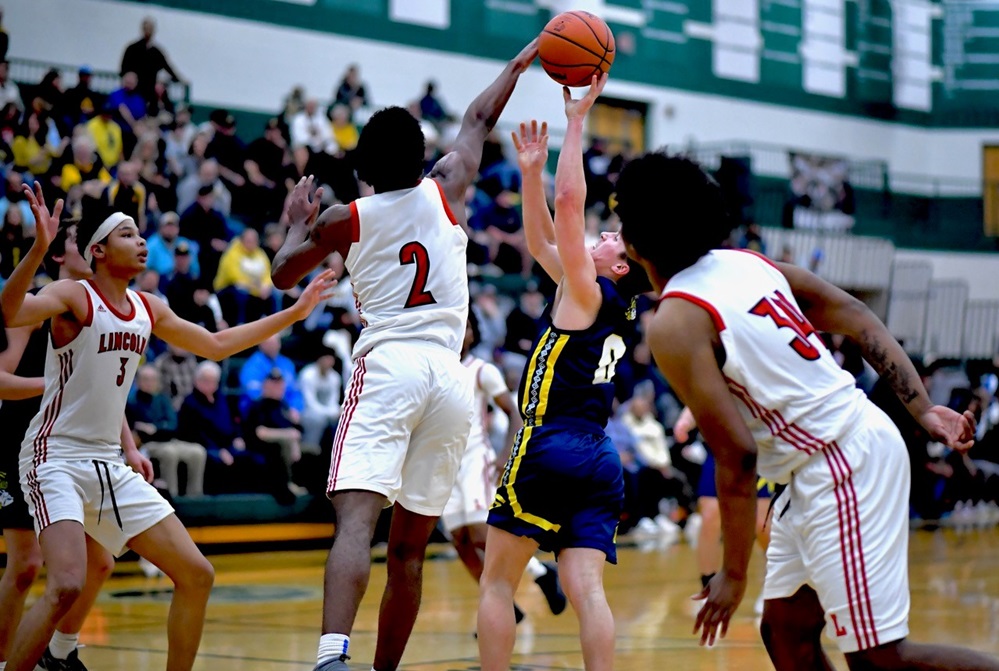
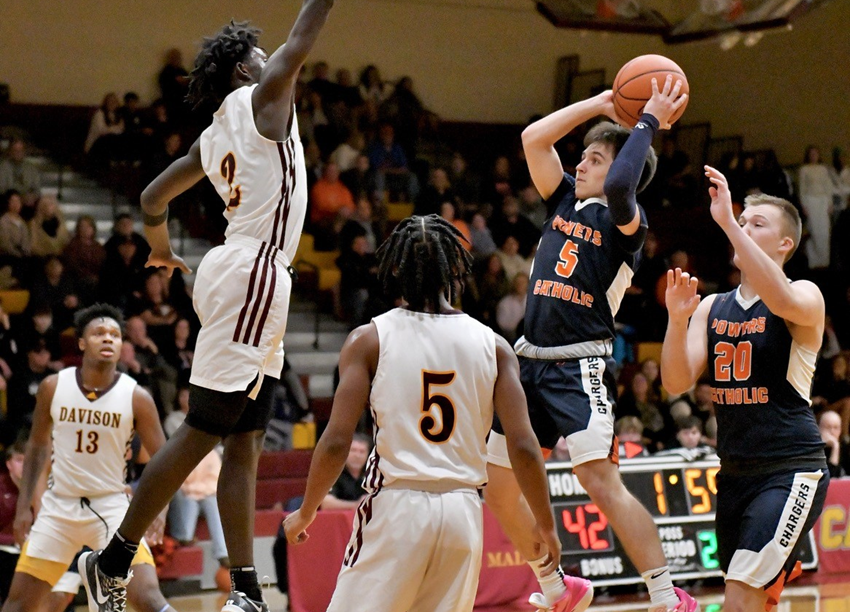
PHOTOS (Top) Warren Lincoln's Markus Blackwell (2) blocks a shot during the Abes' 61-42 Quarterfinal win over Goodrich on Tuesday. (Middle) Flint Powers Catholic's Baylor Cicalo (5) gets up a shot during a regular-season game against Davison. (Photos by Terry Lyons.)