

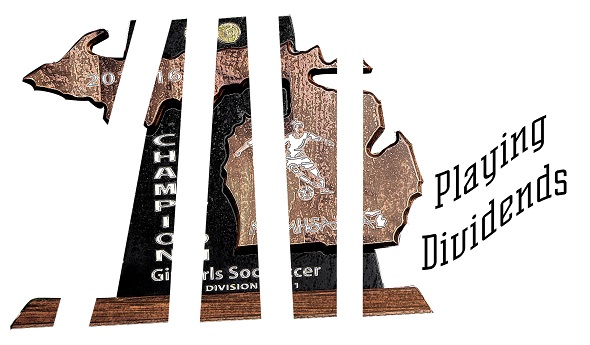
New Math: Division & Multiplication Problems

July 25, 2017

By Jack Roberts
MHSAA Executive Director 

This is the second part in a series on MHSAA tournament classification, past and present, that will be published over the next two weeks. This series originally ran in this spring's edition of MHSAA benchmarks.

High school tournament classifications went viral before there was social media and most of us knew what “viral” meant.

Much as a virus infects computers today or has created epidemics of disease around the world for centuries, high school tournament classification – once introduced – tends to spread uncontrollably. Once started, it tends to keep expanding and rarely contracts.

While we are still some distance from providing every team a trophy as a result of expanding high school tournament classification across the country, there is criticism nevertheless that we are headed in that direction – a philosophy which is supposed to exist only in local youth sports for our youngest children.

Michigan could be blamed for all this. Michigan is generally accepted as the first state to provide different classifications for season-ending tournaments for different sized schools. It started a century ago. Today, every state has various classifications for its tournaments in most if not all sports. And it is a bit ironic that Michigan – creator of the classification chaos – more than most other states has kept the number of tournament classes or divisions under control.

Yes, there is evidence that tournament classifications have expanded over the years in Michigan, especially with the relatively recent introduction of tournaments in football and the late 1990s’ move from classes to divisions in most MHSAA tournaments. But the MHSAA Representative Council has held true to its word when it expanded the playoffs for football from four classes to eight divisions: this is needed because of unique factors of football, factors that exist in no other sport; and all other sports should be capped at a maximum of four classes or divisions.

Kentucky is the preeminent defender of single-class basketball. All of its 276 high schools compete for the single state championship for each gender. In Indiana, there are still open wounds from its move in 1998 from one to four classes for its 400 schools in basketball.

Multi-class tournaments have tended to increase the number of non-public school champions, which some states are trying to lower through enrollment “multipliers,” and also tend to increase the number of repeat champions, which some states are trying to affect with “success factors” which lift smaller schools into classifications for larger schools if they take home too many trophies.

While there is considerable evidence that state tournaments do as much bad as good for educational athletics, state associations persist in providing postseason tournaments because, on balance, the experiences are supposed to be good for student-athletes. And once we reach that conclusion it is just a small leap to believe that if the tournaments are good for a few, they must be better for more – which leads to creating more and more tournament classifications. One becomes two classes, then three, then four and so forth.

While the argument is that more classifications or divisions provides more students with opportunities to compete and win, it is undeniable that the experience changes as the number of tournament classifications expands. It is not possible for state associations to provide the same level of support when tournament classifications expand to multiple venues playing simultaneously. For example, there is less audio and video broadcast potential at each venue, and less media coverage to each venue. Focus is diluted and fans diminished at each championship.

No one can argue reasonably that today's two-day MHSAA Football Finals of eight championship games has the same pizazz as the one-day, four-games event conducted prior to 1990.

In some states the number of divisions has grown so much that it is difficult to see much difference between the many season-ending state championship games and a regular-season event in the same sport.

It is a balancing act. And Michigan has been studying that balance longer than any other state, and charting a steadier course than most.

Addition by Division

The shift to Divisions for MHSAA Tournament play in numerous sports has added up to a greater number of champions for teams and individuals across the state. Following are the sports currently employing a divisional format, and the procedures for determining enrollment and classification. 

In 23 statewide or Lower Peninsula tournaments, schools which sponsor the sport are currently divided into nearly equal divisions. They are:

  • Baseball - 4 Divisions
  • Boys Bowling - 4 Divisions            
  • Girls Bowling - 4 Divisions
  • Girls Competitive Cheer - 4 Divisions
  • LP Boys Cross Country - 4 Divisions
  • LP Girls Cross Country - 4 Divisions
  • LP Boys Golf - 4 Divisions
  • LP Girls Golf - 4 Divisions
  • Ice Hockey - 3 Divisions
  • Boys Lacrosse - 2 Divisions
  • Girls Lacrosse - 2 Divisions
  • Boys Skiing - 2 Divisions
  • Girls Skiing - 2 Divisions
  • LP Boys Soccer - 4 Divisions LP
  • Girls Soccer - 4 Divisions
  • Girls Softball - 4 Divisions
  • LP Boys Swimming & Diving - 3 Divisions
  • LP Girls Swimming & Diving - 3 Divisions
  • LP Boys Tennis - 4 Divisions
  • LP Girls Tennis - 4 Divisions
  • LP Boys Track & Field - 4 Divisions
  • LP Girls Track & Field - 4 Divisions
  • Wrestling - 4 Divisions

Lists of schools for each division of these 23 tournaments are posted on MHSAA.com approximately April 1. Listings of schools in Upper Peninsula tournaments for their sports are also posted on MHSAA.com. The lists are based on school memberships and sports sponsorships in effect or anticipated for the following school year, as known to the MHSAA office as of a date in early March.

In football, the 256 schools which qualify for MHSAA 11-player playoffs are placed in eight equal divisions annually on Selection Sunday. Beginning in 2017, the 8-player divisions will be determined in a like manner on Selection Sunday as well, with 32 qualifying schools placed in two divisions.

Schools have the option to play in any higher division in one or more sports for a minimum of two years.

The deadlines for "opt-ups" are as follows:

  • Applications for fall sports must be submitted by April 15
  • Applications for winter sports must be submitted by Aug. 15
  • Applications for spring sports must be submitted by Oct. 15

Subsequent to the date of these postings for these tournaments, no school will have its division raised or lowered by schools opening or closing, schools adding or dropping sports, schools exercising the option to play in a higher division, or approval or dissolution of cooperative programs.

When the same sport is conducted for boys and girls in the same season (e.g., track & field and cross country), the gender that has the most sponsoring schools controls the division breaks for both genders.

Record-Setting Coach, Championship Program Leader Selected for 2024 WISL Awards

By Geoff Kimmerly
MHSAA.com senior editor

January 23, 2024

On the basketball court, no woman in Michigan high school history has led her team to more victories than Bloomfield Hills Marian’s Mary Cicerone. And few schools have stacked more championships over the last decade than Ann Arbor Pioneer under the guidance of athletic director Eve Claar.

To celebrate those accomplishments, and more significantly their impacts on thousands of students over decades in those leadership positions, Cicerone and Claar have been named the 37th and 38th recipients of the Michigan High School Athletic Association’s Women In Sports Leadership Award.

Each year, the Representative Council considers the achievements of women coaches, officials and athletic administrators affiliated with the MHSAA who show exemplary leadership capabilities and positive contributions to athletics. Cicerone and Claar will receive their awards during this year’s WISL Conference, Feb. 4-5 at the Crowne Plaza Lansing West.

Cicerone retired from coaching the Bloomfield Hills Marian girls basketball team after the 2021-22 season with a record of 707-233 since taking over the program in 1983 – making her the fourth-winningest coach in MHSAA girls basketball history, and the winningest woman to lead a program.

She guided the Mustangs to six Finals championships, in Class A in 1988, 1992, 1996 and 1998 and back-to-back in Division 1 in 2014 and 2015. Her teams also won 19 Catholic High School League Central division championships, 20 overall CHSL League titles and reached the MHSAA Semifinals seven times, also finishing Class A runner-up in 1997.

“Mary Cicerone is a legend because she’s won hundreds of games and many championships, and those measurables of her success speak for themselves,” MHSAA Executive Director Mark Uyl said. “But her commitment to her teams, her sport, and leadership in women’s athletics as a whole contributed just as significantly to her tremendous legacy.”

In addition to receiving several local and statewide coaching awards over the years, Cicerone has been inducted into Halls of Fame by the University of Detroit Mercy (2007) as a player and as a coach by the Catholic High School League (1998), Basketball Coaches Association of Michigan (2017) and Marian (2022).

She has served as an officer for the Catholic League Women’s Coaches Association and in 2009 received the CHSL’s Ed Lauer Person of the Year Award.

“Being a young girl wanting to play all kinds of activities, we never had much opportunity and I participated in whatever I was able and just felt like that was something that was important to me, my friends and everybody I was associated with was always part of the same group,” Cicerone said. “I felt like (advocating for women’s sports) was something I should do because it was so important for me, and I appreciated everything everybody did for me and my friends to be able to play.

“It’s not something I needed to do – just something I wanted to do. I stepped into that role, cherished it, worked really hard at it, and hopefully made great memories – for me, for sure – and for others.”

Claar is in her 21st year as an athletic director, and over the last decade has guided one of the state’s largest athletic programs in terms of both programs and student-athletes, with 36 varsity teams and nearly 1,110 participants. The Pioneers have had ample local and statewide success during her tenure, including claiming 16 MHSAA Finals championships across seven sports over the last eight school years (including this one). Most recently, Pioneer tied for most Finals championships among Lower Peninsula schools in 2020-21 with four, were second in 2021-22 with four more, and last school year tied for most in the Lower Peninsula again with three titles.

Claar began in athletic administration as Pioneer’s assistant director from 2003-06, and she became athletic director at Bloomfield Hills Lahser at the start of the 2006-07 school year. She took over the program at Ypsilanti Lincoln as athletic director in 2009 before returning to Pioneer in 2012.

“Eve Claar continues to show the way for her programs to succeed on the field while keeping in mind the big picture of what’s important in school sports,” Uyl said. “She’s invested in providing the best experiences for Pioneer’s student-athletes, and athletes competing throughout the Southeastern Conference, while also providing support to AD colleagues and coaches who look to her for leadership and expertise.”

Claar has served as the Southeastern Conference secretary since 2009 and is the league’s sport director for softball and field hockey. She has been president of the Michigan Field Hockey League since 2018 and has served on several MHSAA sport and site selection committees and as part of the MHSAA/Farm Bureau Insurance Scholar-Athlete Award selection committee. Before becoming an athletic director, Claar worked five years in the Detroit Pistons/Detroit Shock community relations department.

She was named a Regional Athletic Director of the Year in 2019 by the Michigan Interscholastic Athletic Administrators Association (MIAAA). In 2021, she helped found the Southeastern Conference’s Women in Sports Leadership Conference for student-athletes from the league’s 14 schools.

“I started with (longtime Pioneer AD) Lorin Cartwright before me, and she was always a mentor for me. I’ve always had female leaders and mentors whether in sports for high school, over to Pioneer, with the Shock with Nancy Lieberman – I’ve been around amazing female leaders,” Claar said. “I feel at this point, 21 years into doing this, now it’s upon me to do the same. I’ve been honored when I’ve had other athletic directors reach out, other female ADs ask for support, and I’ve been able to give the support that (my mentors) gave me.”

Cicerone is a 1978 graduate of Coopersville High School, where she was a basketball all-stater and ran track, and she then starred on the basketball court at Detroit Mercy, leading the Titans to three Association for Intercollegiate Athletics for Women (AIAW) state titles and graduating as Mercy’s all-time career assists leader while earning a bachelor’s degree in education. She won the 1982 President’s Award as U-D’s most outstanding female student-athlete.

She taught primarily physical education at Marian beginning with the 1983-84 school year through her retirement 39 years later, and also coached track & field for a season at the start of her teaching career.

Claar is a 1991 graduate of North Farmington High School and earned her bachelor’s degree in business administration from Central Michigan University and master’s from Detroit Mercy. She received a teaching certificate from Wayne State University and education leadership certificate from Eastern Michigan University, and earned her certified athletic administrator (CAA) designation in 2008. Claar played basketball, volleyball and softball at North Farmington and was a BCAM Miss Basketball Award finalist in 1990. She continued as a standout at CMU, finishing her playing career in 1995, and remains among the most accomplished 3-point shooters in program history. She also served as a graduate assistant women’s basketball coach at U-D for two seasons.

More than 800 participants – mostly female high school student-athletes from across the state – have registered to attend this year’s sold-out WISL Conference, the 26th in the series that remains the first, largest and longest-running program of its type in the country.

The opening address Feb. 4 will be presented by Cathy George, the all-time winningest volleyball coach in Michigan State University history and the first head coach of the newly-created Grand Rapids Rise professional volleyball franchise. Current MSU volleyball coach Leah Johnson will speak during the morning’s general session Feb. 5 on the conference’s theme “Share the Vision” – she finished her second season leading the Spartans in the fall after coaching Illinois State University from 2017-21 and taking ISU to the NCAA Tournament her last four seasons before leaving for East Lansing.

Several workshops will be offered over the two days, with topics including coaching, teaching and learning leadership; sports nutrition and performance, and empowerment and goal-setting. Presenters are accomplished in their fields and represent a wide range of backgrounds in sport. A complete itinerary is available on the WISL page.

The first Women In Sports Leadership Award was presented in 1990. 

Past recipients

1990 – Carol Seavoy, L’Anse 
1991 – Diane Laffey, Harper Woods
1992 – Patricia Ashby, Scotts
1993 – Jo Lake, Grosse Pointe
1994 – Brenda Gatlin, Detroit
1995 – Jane Bennett, Ann Arbor
1996 – Cheryl Amos-Helmicki, Huntington Woods
1997 – Delores L. Elswick, Detroit
1998 – Karen S. Leinaar, Delton
1999 – Kathy McGee, Flint 
2000 – Pat Richardson, Grass Lake
2001 – Suzanne Martin, East Lansing
2002 – Susan Barthold, Kentwood
2003 – Nancy Clark, Flint
2004 – Kathy Vruggink Westdorp, Grand Rapids 
2005 – Barbara Redding, Capac
2006 – Melanie Miller, Lansing
2007 – Jan Sander, Warren Woods
2008 – Jane Bos, Grand Rapids
2009 – Gail Ganakas, Flint; Deb VanKuiken, Holly
2010 – Gina Mazzolini, Lansing
2011 – Ellen Pugh, West Branch; Patti Tibaldi, Traverse City
2012 – Janet Gillette, Comstock Park
2013 – Barbara Beckett, Traverse City
2014 – Teri Reyburn, DeWitt
2015 – Jean LaClair, Bronson
2016 – Betty Wroubel, Pontiac
2017 – Dottie Davis, Ann Arbor
2018 – Meg Seng, Ann Arbor
2019 – Kris Isom, Adrian
2020 – Nikki Norris, East Lansing
2021 – Dorene Ingalls, St. Ignace
2022 – Lori Hyman, Livonia
2023 – Laurie Glass, Leland

PHOTOS Bloomfield Hills Marian coach Mary Cicerone, left, huddles with her team during an MHSAA Finals weekend, and Ann Arbor Pioneer athletic director Eve Claar welcomes John and Jim Harbaugh into the school's Pioneer Hall of Fame. (Claar photo courtesy of Ann Arbor Public Schools.)