

New Math: Division & Multiplication Problems
July 25, 2017
By Jack Roberts
MHSAA Executive Director
This is the second part in a series on MHSAA tournament classification, past and present, that will be published over the next two weeks. This series originally ran in this spring's edition of MHSAA benchmarks.
High school tournament classifications went viral before there was social media and most of us knew what “viral” meant.
Much as a virus infects computers today or has created epidemics of disease around the world for centuries, high school tournament classification – once introduced – tends to spread uncontrollably. Once started, it tends to keep expanding and rarely contracts.
While we are still some distance from providing every team a trophy as a result of expanding high school tournament classification across the country, there is criticism nevertheless that we are headed in that direction – a philosophy which is supposed to exist only in local youth sports for our youngest children.
Michigan could be blamed for all this. Michigan is generally accepted as the first state to provide different classifications for season-ending tournaments for different sized schools. It started a century ago. Today, every state has various classifications for its tournaments in most if not all sports. And it is a bit ironic that Michigan – creator of the classification chaos – more than most other states has kept the number of tournament classes or divisions under control.
Yes, there is evidence that tournament classifications have expanded over the years in Michigan, especially with the relatively recent introduction of tournaments in football and the late 1990s’ move from classes to divisions in most MHSAA tournaments. But the MHSAA Representative Council has held true to its word when it expanded the playoffs for football from four classes to eight divisions: this is needed because of unique factors of football, factors that exist in no other sport; and all other sports should be capped at a maximum of four classes or divisions.
Kentucky is the preeminent defender of single-class basketball. All of its 276 high schools compete for the single state championship for each gender. In Indiana, there are still open wounds from its move in 1998 from one to four classes for its 400 schools in basketball.
Multi-class tournaments have tended to increase the number of non-public school champions, which some states are trying to lower through enrollment “multipliers,” and also tend to increase the number of repeat champions, which some states are trying to affect with “success factors” which lift smaller schools into classifications for larger schools if they take home too many trophies.
While there is considerable evidence that state tournaments do as much bad as good for educational athletics, state associations persist in providing postseason tournaments because, on balance, the experiences are supposed to be good for student-athletes. And once we reach that conclusion it is just a small leap to believe that if the tournaments are good for a few, they must be better for more – which leads to creating more and more tournament classifications. One becomes two classes, then three, then four and so forth.
While the argument is that more classifications or divisions provides more students with opportunities to compete and win, it is undeniable that the experience changes as the number of tournament classifications expands. It is not possible for state associations to provide the same level of support when tournament classifications expand to multiple venues playing simultaneously. For example, there is less audio and video broadcast potential at each venue, and less media coverage to each venue. Focus is diluted and fans diminished at each championship.
No one can argue reasonably that today's two-day MHSAA Football Finals of eight championship games has the same pizazz as the one-day, four-games event conducted prior to 1990.
In some states the number of divisions has grown so much that it is difficult to see much difference between the many season-ending state championship games and a regular-season event in the same sport.
It is a balancing act. And Michigan has been studying that balance longer than any other state, and charting a steadier course than most.
Addition by Division
The shift to Divisions for MHSAA Tournament play in numerous sports has added up to a greater number of champions for teams and individuals across the state. Following are the sports currently employing a divisional format, and the procedures for determining enrollment and classification.
In 23 statewide or Lower Peninsula tournaments, schools which sponsor the sport are currently divided into nearly equal divisions. They are:
- Baseball - 4 Divisions
- Boys Bowling - 4 Divisions
- Girls Bowling - 4 Divisions
- Girls Competitive Cheer - 4 Divisions
- LP Boys Cross Country - 4 Divisions
- LP Girls Cross Country - 4 Divisions
- LP Boys Golf - 4 Divisions
- LP Girls Golf - 4 Divisions
- Ice Hockey - 3 Divisions
- Boys Lacrosse - 2 Divisions
- Girls Lacrosse - 2 Divisions
- Boys Skiing - 2 Divisions
- Girls Skiing - 2 Divisions
- LP Boys Soccer - 4 Divisions LP
- Girls Soccer - 4 Divisions
- Girls Softball - 4 Divisions
- LP Boys Swimming & Diving - 3 Divisions
- LP Girls Swimming & Diving - 3 Divisions
- LP Boys Tennis - 4 Divisions
- LP Girls Tennis - 4 Divisions
- LP Boys Track & Field - 4 Divisions
- LP Girls Track & Field - 4 Divisions
- Wrestling - 4 Divisions
Lists of schools for each division of these 23 tournaments are posted on MHSAA.com approximately April 1. Listings of schools in Upper Peninsula tournaments for their sports are also posted on MHSAA.com. The lists are based on school memberships and sports sponsorships in effect or anticipated for the following school year, as known to the MHSAA office as of a date in early March.
In football, the 256 schools which qualify for MHSAA 11-player playoffs are placed in eight equal divisions annually on Selection Sunday. Beginning in 2017, the 8-player divisions will be determined in a like manner on Selection Sunday as well, with 32 qualifying schools placed in two divisions.
Schools have the option to play in any higher division in one or more sports for a minimum of two years.
The deadlines for "opt-ups" are as follows:
- Applications for fall sports must be submitted by April 15
- Applications for winter sports must be submitted by Aug. 15
- Applications for spring sports must be submitted by Oct. 15
Subsequent to the date of these postings for these tournaments, no school will have its division raised or lowered by schools opening or closing, schools adding or dropping sports, schools exercising the option to play in a higher division, or approval or dissolution of cooperative programs.
When the same sport is conducted for boys and girls in the same season (e.g., track & field and cross country), the gender that has the most sponsoring schools controls the division breaks for both genders.
Laker Following Mother's Path as Wayland Multi-Sport Standout
By
Steve Vedder
Special for MHSAA.com
March 5, 2024
When Wayland junior Harmony Laker opted to embrace athletics many years ago, she never worried about following some pretty impressive footsteps nor matching the hefty accomplishments of someone very close to her, a mentor who had herself been a standout three-sport athlete in high school.
In fact, Laker has wound up starring in the same three sports in which her mother, 2000 Wayland grad Kara Potter, also excelled in high school – basketball, volleyball and softball.
Kara was all-conference in all three sports and earned all-state recognition in volleyball and basketball. Harmony has been all-league since her freshman season in the same three, and all-region in volleyball and basketball.
Just a chip off the old block? Maybe, says Harmony.
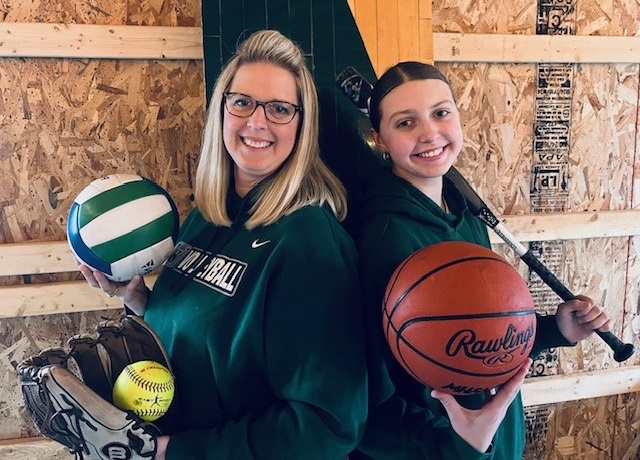 But if there is anything mother and daughter have in common it's a love of sports.
"They introduced me to sports, and I've always strived to be like my parents," Harmony Laker said. "I was always drawn toward basketball, volleyball and softball. That's where my heart has always been, on a court or a field.
"I always wanted to play three sports; that's been my goal since middle school. Like my mother, I've always taken them seriously."
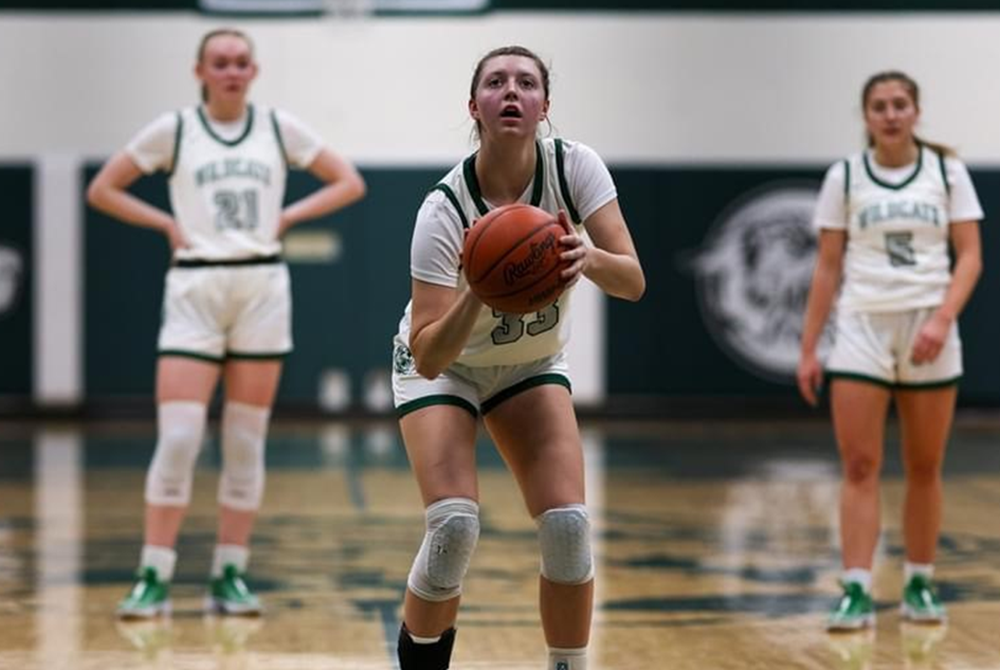
Like her mother, Laker hasn't just lettered in three sports – she's been outstanding. As a junior, she's already shattered the 1,000-point career basketball mark, reaching the milestone when she scored 38 points against Grand Rapids South Christian in late January. She's averaging 19 points, seven rebounds, four steals and three assists per game.
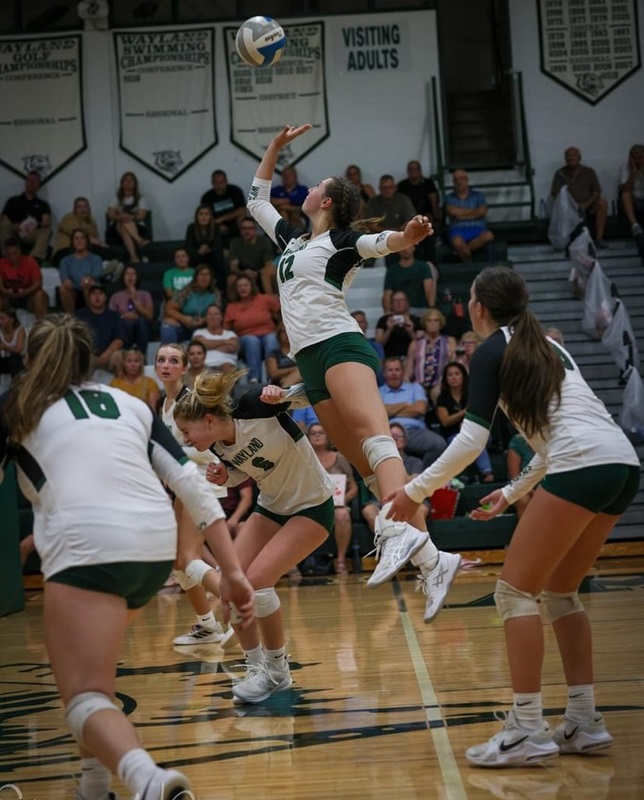
In volleyball, Laker had 864 kills, 513 digs, 80 blocks and 64 aces while serving 90 percent this season.
In softball, Laker has a 29-4 record as a pitcher over her first two seasons while batting .449 with six doubles and three homers as a sophomore. She's twice made all-conference in that sport, leading Wayland to two conference titles.
Kara Laker – also Wayland’s volleyball coach – said she and Harmony's father, Lance, a former varsity basketball coach at Middleville Thornapple Kellogg, never tried to edge their daughter toward athletics.
But when Harmony took up a variety of sports, the parents had one standing rule: Commit to the sport you're playing at the time. Worry about the other sports when it's time.
 "Sports has always been a big part of our lives," Kara said. "We've never pushed our kids, but we've told them if you're going to be successful, you have to put in the time. My parents wanted us to do what we could (in sports). It was always in our prayers that our kids would truly love all sports. We're a competitive family, and we've always been drawn to sports."
The Laker family navigates a busy sports schedule. Liberty Laker plays volleyball at Grace Christian University, eighth grader Charity plays the same three sports as her mother and sister, and third grader Christian plays football, baseball and basketball.
"We divide and conquer," Kara said of her and her husband following the robust schedules of four children.
Harmony's first memories of sports involve supplying water to her father's basketball players. From there, she progressed to copying the three sports in which her mother excelled.
Kara won Wayland's coveted Multer Award as the school's top multi-sport athlete. Harmony hasn't won the award yet, but seems a shoo-in before she graduates in 2025.
Kara said it's tougher for athletes now to play three sports as AAU and travel sports often collide with high school athletics. But in terms of playing three, she said that decision has always been left to the kids.
"It's harder these days, but we were three-sport athletes who wanted to be good in all three," said Kara, who admits she's had discussions with Harmony about narrowing her participation list.
"It's actually a discussion we're having at this moment," she said. "A lot of it comes down to coaches and having them all work together so Harmony can play."
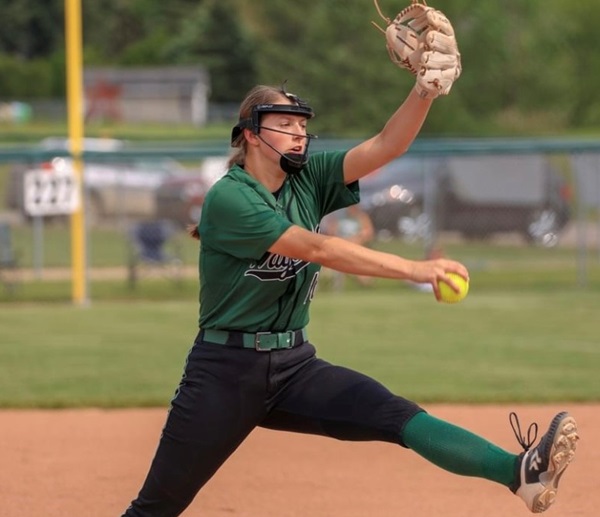 In order of preference, Harmony lists her favorite sports as basketball, volleyball and softball. But when it comes to cutting out a sport, Harmony hedges. If she plays all three as a senior – and that's currently the plan – she'll leave Wayland with 12 varsity letters, a rarity in today's high school sports world.
Harmony said the advice offered by her parents is the same that trickled down from their parents (her grandparents). Play as many sports as you choose, but also be well-rounded off the courts and fields.
Harmony is a member of the National Honor Society, leads the Wayland chapter of the Fellowship of Christian Athletes, is a member of the student council and has gone on numerous mission trips through her church.
But when it comes to athletics, Harmony is quick to revert to what she was taught early.
"I just want to work at my craft. You're only as good as the time you put in," she said. "My mom and dad have always said it's the heart that makes sports great. There are so many moments which are trials in sports and games, but ultimately that is what's going to make you better.
"Playing with pressure is a privilege. If a game is close and you have to execute, that's a privilege. God has put you out there for a reason, and you take the moments as they come."
PHOTOS (Top) Wayland’s Harmony Laker lines up for a free throw while playing her favorite sport, basketball. (2) Harmony, right, is successfully following in the multi-sport footsteps of her mother, Kara Laker. (3) Harmony Laker (12) soars to get a hand on a ball during volleyball season. (4) Laker makes her move toward the plate as a pitcher during the spring. (Action photos by Shannon N Jessica Photography.) mother/daughter photo courtesy of the Laker family.)