

New Math: Division & Multiplication Problems
July 25, 2017
By Jack Roberts
MHSAA Executive Director
This is the second part in a series on MHSAA tournament classification, past and present, that will be published over the next two weeks. This series originally ran in this spring's edition of MHSAA benchmarks.
High school tournament classifications went viral before there was social media and most of us knew what “viral” meant.
Much as a virus infects computers today or has created epidemics of disease around the world for centuries, high school tournament classification – once introduced – tends to spread uncontrollably. Once started, it tends to keep expanding and rarely contracts.
While we are still some distance from providing every team a trophy as a result of expanding high school tournament classification across the country, there is criticism nevertheless that we are headed in that direction – a philosophy which is supposed to exist only in local youth sports for our youngest children.
Michigan could be blamed for all this. Michigan is generally accepted as the first state to provide different classifications for season-ending tournaments for different sized schools. It started a century ago. Today, every state has various classifications for its tournaments in most if not all sports. And it is a bit ironic that Michigan – creator of the classification chaos – more than most other states has kept the number of tournament classes or divisions under control.
Yes, there is evidence that tournament classifications have expanded over the years in Michigan, especially with the relatively recent introduction of tournaments in football and the late 1990s’ move from classes to divisions in most MHSAA tournaments. But the MHSAA Representative Council has held true to its word when it expanded the playoffs for football from four classes to eight divisions: this is needed because of unique factors of football, factors that exist in no other sport; and all other sports should be capped at a maximum of four classes or divisions.
Kentucky is the preeminent defender of single-class basketball. All of its 276 high schools compete for the single state championship for each gender. In Indiana, there are still open wounds from its move in 1998 from one to four classes for its 400 schools in basketball.
Multi-class tournaments have tended to increase the number of non-public school champions, which some states are trying to lower through enrollment “multipliers,” and also tend to increase the number of repeat champions, which some states are trying to affect with “success factors” which lift smaller schools into classifications for larger schools if they take home too many trophies.
While there is considerable evidence that state tournaments do as much bad as good for educational athletics, state associations persist in providing postseason tournaments because, on balance, the experiences are supposed to be good for student-athletes. And once we reach that conclusion it is just a small leap to believe that if the tournaments are good for a few, they must be better for more – which leads to creating more and more tournament classifications. One becomes two classes, then three, then four and so forth.
While the argument is that more classifications or divisions provides more students with opportunities to compete and win, it is undeniable that the experience changes as the number of tournament classifications expands. It is not possible for state associations to provide the same level of support when tournament classifications expand to multiple venues playing simultaneously. For example, there is less audio and video broadcast potential at each venue, and less media coverage to each venue. Focus is diluted and fans diminished at each championship.
No one can argue reasonably that today's two-day MHSAA Football Finals of eight championship games has the same pizazz as the one-day, four-games event conducted prior to 1990.
In some states the number of divisions has grown so much that it is difficult to see much difference between the many season-ending state championship games and a regular-season event in the same sport.
It is a balancing act. And Michigan has been studying that balance longer than any other state, and charting a steadier course than most.
Addition by Division
The shift to Divisions for MHSAA Tournament play in numerous sports has added up to a greater number of champions for teams and individuals across the state. Following are the sports currently employing a divisional format, and the procedures for determining enrollment and classification.
In 23 statewide or Lower Peninsula tournaments, schools which sponsor the sport are currently divided into nearly equal divisions. They are:
- Baseball - 4 Divisions
- Boys Bowling - 4 Divisions
- Girls Bowling - 4 Divisions
- Girls Competitive Cheer - 4 Divisions
- LP Boys Cross Country - 4 Divisions
- LP Girls Cross Country - 4 Divisions
- LP Boys Golf - 4 Divisions
- LP Girls Golf - 4 Divisions
- Ice Hockey - 3 Divisions
- Boys Lacrosse - 2 Divisions
- Girls Lacrosse - 2 Divisions
- Boys Skiing - 2 Divisions
- Girls Skiing - 2 Divisions
- LP Boys Soccer - 4 Divisions LP
- Girls Soccer - 4 Divisions
- Girls Softball - 4 Divisions
- LP Boys Swimming & Diving - 3 Divisions
- LP Girls Swimming & Diving - 3 Divisions
- LP Boys Tennis - 4 Divisions
- LP Girls Tennis - 4 Divisions
- LP Boys Track & Field - 4 Divisions
- LP Girls Track & Field - 4 Divisions
- Wrestling - 4 Divisions
Lists of schools for each division of these 23 tournaments are posted on MHSAA.com approximately April 1. Listings of schools in Upper Peninsula tournaments for their sports are also posted on MHSAA.com. The lists are based on school memberships and sports sponsorships in effect or anticipated for the following school year, as known to the MHSAA office as of a date in early March.
In football, the 256 schools which qualify for MHSAA 11-player playoffs are placed in eight equal divisions annually on Selection Sunday. Beginning in 2017, the 8-player divisions will be determined in a like manner on Selection Sunday as well, with 32 qualifying schools placed in two divisions.
Schools have the option to play in any higher division in one or more sports for a minimum of two years.
The deadlines for "opt-ups" are as follows:
- Applications for fall sports must be submitted by April 15
- Applications for winter sports must be submitted by Aug. 15
- Applications for spring sports must be submitted by Oct. 15
Subsequent to the date of these postings for these tournaments, no school will have its division raised or lowered by schools opening or closing, schools adding or dropping sports, schools exercising the option to play in a higher division, or approval or dissolution of cooperative programs.
When the same sport is conducted for boys and girls in the same season (e.g., track & field and cross country), the gender that has the most sponsoring schools controls the division breaks for both genders.
FHC Caps Ford Field Return by Sending Out Coach, Seniors with 1st Finals Win
By
Paul Costanzo
Special for MHSAA.com
November 26, 2023
DETROIT – Ty Hudkins and his Forest Hills Central teammates were not going to be denied Sunday in the Division 3 Football Final.
Not even if it meant – in Hudkins’ case – having to drag a Mason defender 20 yards for a touchdown.
Not after coming up one win short of bringing their program its first Finals title a year ago.
And certainly not in the final game of their coach Tim Rogers’ career.
So Hudkins dragged that defender, the Rangers got that last win, and they sent Rogers out a winner, defeating Mason 27-10 at Ford Field.
“We’ve been talking about this since sixth grade,” Hudkins said, before pointing to his teammates assembled at the press conference. “We’ve been playing for each other since we can remember. All our dads have been the coaches – coach’s kid, coach’s kid, coach’s kid, coach’s kid – it’s just been a real blessing. (Rogers) has been around with us the entire time, as well. It’s just a great way to end. We’ve been talking about it since sixth grade, and the fact that it finally came true is just crazy. It’s a blessing.”
Forest Hills Central had lost to Warren De La Salle Collegiate in the Division 2 Final a year ago. After that game, Rogers told the assembled media that the Rangers would be back, and he was proven correct.
This year, he made another major statement following the game, when he announced that he had just coached his final game at Forest Hills Central, calling it the “worst-kept secret in the state.”
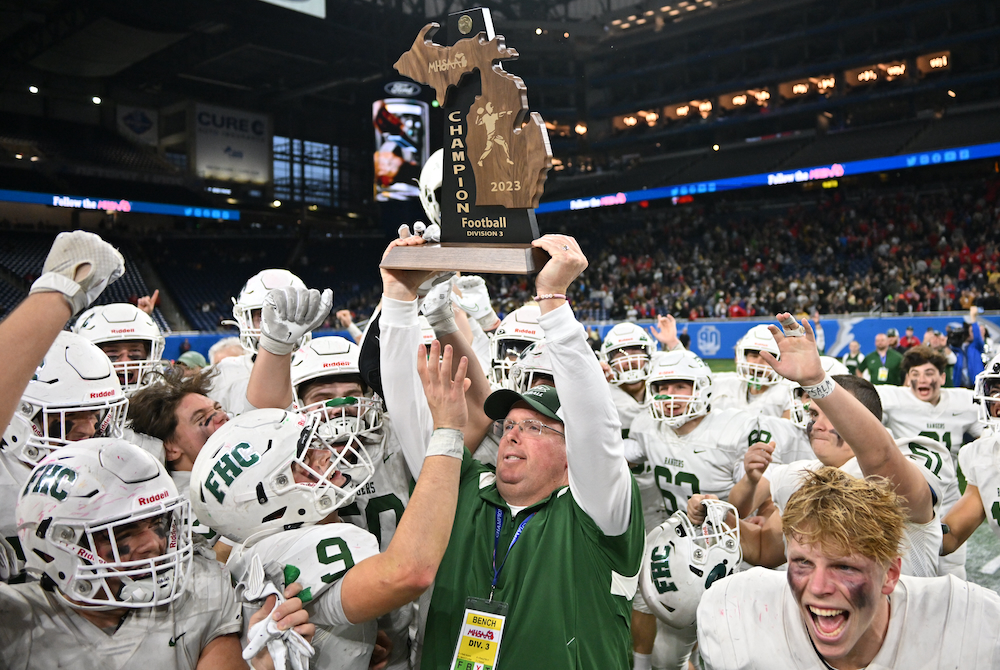
 “It’s tough,” Rogers said before taking a moment to collect himself. “Their fathers are dear friends, my assistant coaches. There’s been plenty of inquiries if I was stepping down this year, and the last thing I wanted to be was a distraction to our team. So, do what we always do, put our head down and grind. I feel great. I watched these kids grow up. I think I’m leaving it better than I found it. These assistant coaches I have are fantastic – great fathers, great people, great husbands. So, it was great in our final game to do that. Send them off the way they deserve to be sent off. This community has waited a long time for something like this, and they’re fantastic. The student body was fantastic, our administration was very supportive. Storybook ending for my career to finish with these guys and do what we just did today.”
The Rangers (13-1) did it with defense, holding Mason to 36 yards rushing and 4.3 yards per play. They also forced three turnovers, including a pick-six from linebacker Drew Fortino with 7 minutes, 13 seconds to play, which made the score 27-10 and essentially put the game away.
“I saw the guy across the field, and I saw him coming across, and I kind of just stuck my hand out and was like, ‘Shoot, I got the ball,’” Fortino said. “The whole team blocked really well, and I was able to get into the end zone and they were all in there celebrating with me.”
Mason coach Gary Houghton called the Rangers’ front seven the fastest his team had seen this season, including that of Detroit Martin Luther King, who the Bulldogs played in the Semifinal. As the Bulldogs struggled to find room to run – both with and without star running back AJ Martell, who had eight carries for 14 yards before leaving the game with an injury – that became more and more apparent. But Rogers said it went beyond his team’s athleticism.
“They’re talented for sure,” Rogers said. “But they’re smart. They do so much. The offense gets so much credit for checks at the line of scrimmage and all the things they do. We do that all the time on defense. If you watch me and you knew our signals, half the time you’d just think I was calling base. But these guys check everything at the line of scrimmage. It’s a testament to their football IQ, how they get us in the right play all the time on defense, and just a relentless pursuit of the football.”
JT Hartman led the defense with an interception, a sack, two tackles for loss and eight total tackles. Brady Drueke had a team-high 12 tackles, Fortino added a sack and Hudkins had a diving interception.
The defensive performance was a far cry from a year ago, when the Rangers allowed 52 points in the loss to De La Salle.
“We knew we had to be better, just this offseason, so we worked extra hard in the weight room,” Hartman said. “I think all the extra work made us better players and better people. That translated out on the field.”
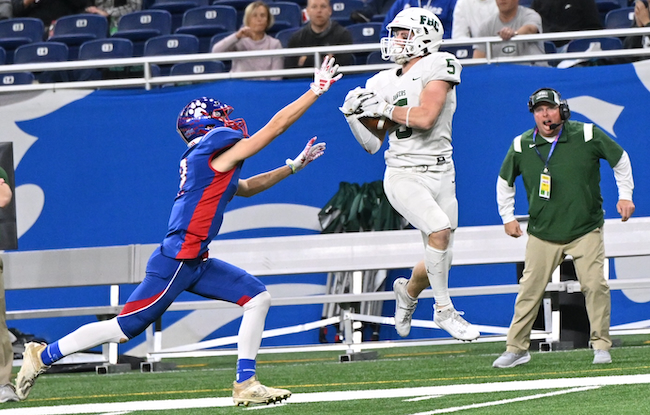
 While the Mason defense had a fine day itself, holding the Rangers to fewer than 300 yards of total offense and 5.5 yards per play, Central was able to break the game open in the second half thanks to a max-effort play from Hudkins. The Purdue commit hauled in a pass from quarterback Mason McDonald at the 28-yard line and was latched onto at the 20 by a Mason defender. Hudkins stayed on his feet, however, and powered his way into the end zone, diving for the pylon and giving his team a 20-3 lead.
“Just a touchdown in and of itself is a big deal, but to see the will – he was not going to be denied,” Rogers said. “With that, you could literally see the whole sideline just start to elevate. Ty was going to put us on his back literally and figuratively, and he wasn’t going to be denied.”
Hudkins finished the game with 115 yards on six receptions. McDonald led the Forest Hills rushing attack with 74 yards on 21 carries, while Hartman had 68 yards and a touchdown on the ground. Kicker Alex Moeller had a pair of field goals (35 and 27 yards).
For Mason (13-1), it was the end of its own storybook season, even if it didn’t come with the ultimate happy ending. The Bulldogs were playing in their first Final after knocking off King, the team that had ended their previous two seasons in Semifinals.
They had served as a rallying point for a community in mourning following the passing of classmates Lillian Klages and Amanda Blue, who died in an August car crash.
Mason players ran onto the field led by players carrying flags bearing their names.
“We gave it our best shot,” Mason senior receiver Kaleb Parrish said. “It wasn’t the outcome that we wanted, but we tried for the community. We knew this game was bigger than just a football game. At the end of the day, we all tried. When I looked up in the beginning, it was great to see all of the community that showed up. It was thousands – probably most of our community showed up.”
Parrish had a big day receiving in his final game at Mason, hauling in eight catches for 102 yards. Derek Badgley, who scored the Bulldogs’ lone touchdown on a 2-yard run late in the third quarter, added 71 yards on eight catches. Quarterback Cason Carswell was 22 of 40 passing for 229 yards. Kicker Collin Winters connected on a 26-yard field goal during the first quarter.
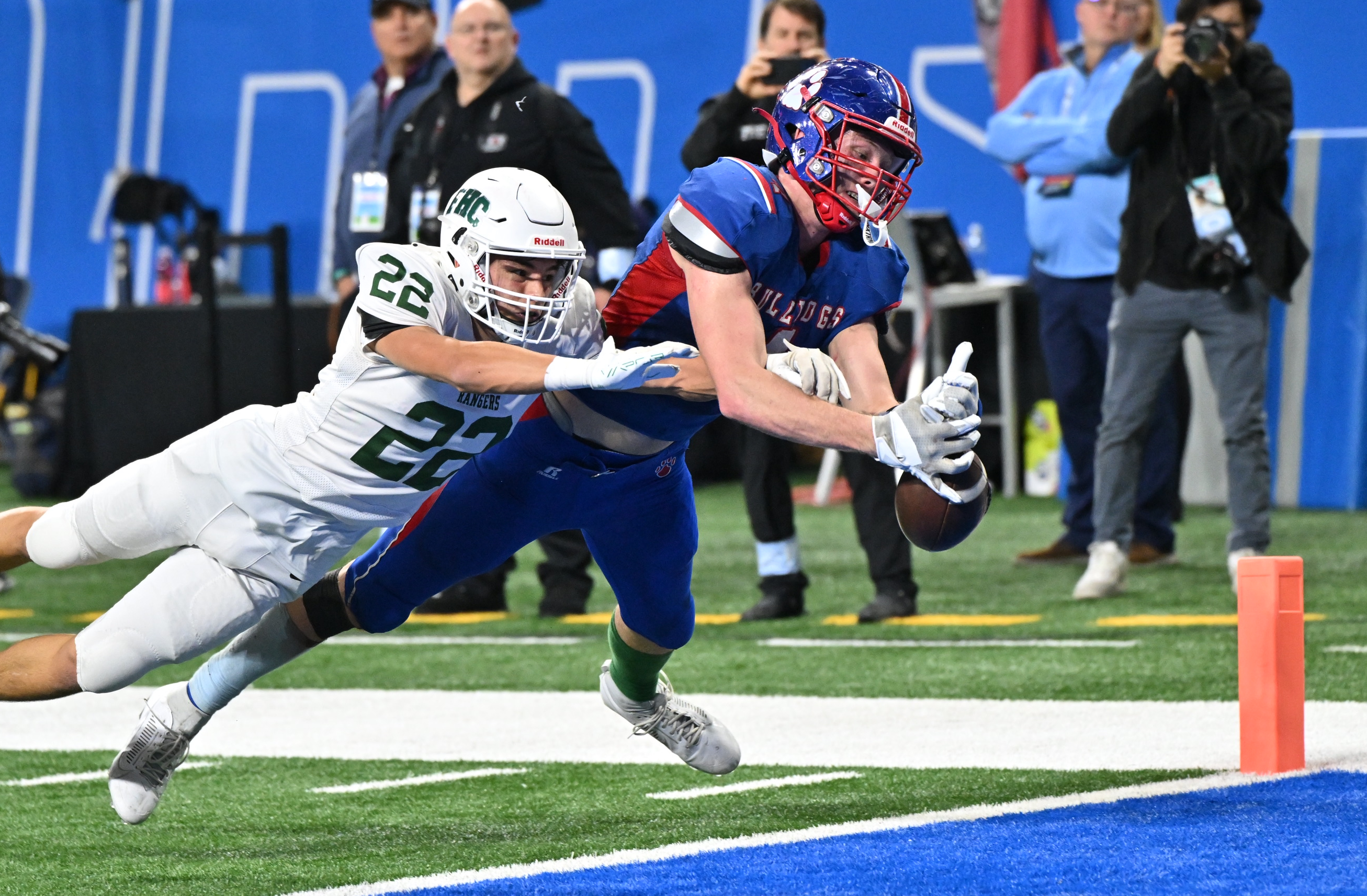
PHOTOS (Top) Forest Hills Central coach Tim Rogers holds up his program’s first championship trophy Sunday at Ford Field. (Middle) Ty Hudkins (5) hauls in a catch down the sideline for the Rangers. (Below) Jacob Harleton (22) breaks up a Mason pass at the goal line. (Photos by Hockey Weekly Action Photos.)