

New Math: Division & Multiplication Problems
July 25, 2017
By Jack Roberts
MHSAA Executive Director
This is the second part in a series on MHSAA tournament classification, past and present, that will be published over the next two weeks. This series originally ran in this spring's edition of MHSAA benchmarks.
High school tournament classifications went viral before there was social media and most of us knew what “viral” meant.
Much as a virus infects computers today or has created epidemics of disease around the world for centuries, high school tournament classification – once introduced – tends to spread uncontrollably. Once started, it tends to keep expanding and rarely contracts.
While we are still some distance from providing every team a trophy as a result of expanding high school tournament classification across the country, there is criticism nevertheless that we are headed in that direction – a philosophy which is supposed to exist only in local youth sports for our youngest children.
Michigan could be blamed for all this. Michigan is generally accepted as the first state to provide different classifications for season-ending tournaments for different sized schools. It started a century ago. Today, every state has various classifications for its tournaments in most if not all sports. And it is a bit ironic that Michigan – creator of the classification chaos – more than most other states has kept the number of tournament classes or divisions under control.
Yes, there is evidence that tournament classifications have expanded over the years in Michigan, especially with the relatively recent introduction of tournaments in football and the late 1990s’ move from classes to divisions in most MHSAA tournaments. But the MHSAA Representative Council has held true to its word when it expanded the playoffs for football from four classes to eight divisions: this is needed because of unique factors of football, factors that exist in no other sport; and all other sports should be capped at a maximum of four classes or divisions.
Kentucky is the preeminent defender of single-class basketball. All of its 276 high schools compete for the single state championship for each gender. In Indiana, there are still open wounds from its move in 1998 from one to four classes for its 400 schools in basketball.
Multi-class tournaments have tended to increase the number of non-public school champions, which some states are trying to lower through enrollment “multipliers,” and also tend to increase the number of repeat champions, which some states are trying to affect with “success factors” which lift smaller schools into classifications for larger schools if they take home too many trophies.
While there is considerable evidence that state tournaments do as much bad as good for educational athletics, state associations persist in providing postseason tournaments because, on balance, the experiences are supposed to be good for student-athletes. And once we reach that conclusion it is just a small leap to believe that if the tournaments are good for a few, they must be better for more – which leads to creating more and more tournament classifications. One becomes two classes, then three, then four and so forth.
While the argument is that more classifications or divisions provides more students with opportunities to compete and win, it is undeniable that the experience changes as the number of tournament classifications expands. It is not possible for state associations to provide the same level of support when tournament classifications expand to multiple venues playing simultaneously. For example, there is less audio and video broadcast potential at each venue, and less media coverage to each venue. Focus is diluted and fans diminished at each championship.
No one can argue reasonably that today's two-day MHSAA Football Finals of eight championship games has the same pizazz as the one-day, four-games event conducted prior to 1990.
In some states the number of divisions has grown so much that it is difficult to see much difference between the many season-ending state championship games and a regular-season event in the same sport.
It is a balancing act. And Michigan has been studying that balance longer than any other state, and charting a steadier course than most.
Addition by Division
The shift to Divisions for MHSAA Tournament play in numerous sports has added up to a greater number of champions for teams and individuals across the state. Following are the sports currently employing a divisional format, and the procedures for determining enrollment and classification.
In 23 statewide or Lower Peninsula tournaments, schools which sponsor the sport are currently divided into nearly equal divisions. They are:
- Baseball - 4 Divisions
- Boys Bowling - 4 Divisions
- Girls Bowling - 4 Divisions
- Girls Competitive Cheer - 4 Divisions
- LP Boys Cross Country - 4 Divisions
- LP Girls Cross Country - 4 Divisions
- LP Boys Golf - 4 Divisions
- LP Girls Golf - 4 Divisions
- Ice Hockey - 3 Divisions
- Boys Lacrosse - 2 Divisions
- Girls Lacrosse - 2 Divisions
- Boys Skiing - 2 Divisions
- Girls Skiing - 2 Divisions
- LP Boys Soccer - 4 Divisions LP
- Girls Soccer - 4 Divisions
- Girls Softball - 4 Divisions
- LP Boys Swimming & Diving - 3 Divisions
- LP Girls Swimming & Diving - 3 Divisions
- LP Boys Tennis - 4 Divisions
- LP Girls Tennis - 4 Divisions
- LP Boys Track & Field - 4 Divisions
- LP Girls Track & Field - 4 Divisions
- Wrestling - 4 Divisions
Lists of schools for each division of these 23 tournaments are posted on MHSAA.com approximately April 1. Listings of schools in Upper Peninsula tournaments for their sports are also posted on MHSAA.com. The lists are based on school memberships and sports sponsorships in effect or anticipated for the following school year, as known to the MHSAA office as of a date in early March.
In football, the 256 schools which qualify for MHSAA 11-player playoffs are placed in eight equal divisions annually on Selection Sunday. Beginning in 2017, the 8-player divisions will be determined in a like manner on Selection Sunday as well, with 32 qualifying schools placed in two divisions.
Schools have the option to play in any higher division in one or more sports for a minimum of two years.
The deadlines for "opt-ups" are as follows:
- Applications for fall sports must be submitted by April 15
- Applications for winter sports must be submitted by Aug. 15
- Applications for spring sports must be submitted by Oct. 15
Subsequent to the date of these postings for these tournaments, no school will have its division raised or lowered by schools opening or closing, schools adding or dropping sports, schools exercising the option to play in a higher division, or approval or dissolution of cooperative programs.
When the same sport is conducted for boys and girls in the same season (e.g., track & field and cross country), the gender that has the most sponsoring schools controls the division breaks for both genders.
Parchment Team On Verge of Never Playing Putting Off End As Long As Possible
By
Pam Shebest
Special for MHSAA.com
October 17, 2023
PARCHMENT — With just five returning players and no coach, things looked bleak for the Parchment soccer team at the beginning of summer.
 Boy, have things changed.
Former football offensive line coach Jesse Roder agreed to take the head soccer coach’s job and, with some intensive recruiting, the Panthers not only fielded a team this season but are headed into tonight’s Division 3 District Semifinal with an 11-6-1 record.
Those 11 wins are two more than the last three years combined and make this the first time in 14 years Parchment has had double-digit wins.
In fact, the Panthers’ record over the previous three seasons was 9-41-3 overall.
Athletic director Brennan Davis credits Roder for the turnaround.
“Our first-year coach has done an excellent job creating a positive environment for the team,” Davis said. “He is focused on building character and camaraderie within the program. Academics, participation, relationships, reliability are all important to Coach Roder.”
The players echo those accolades.
Junior goalkeeper Brady Caswell said it was an angry team the past two seasons with a lot of fighting among teammates.
“This year, everyone’s excited to play, ready to play, a little hungry to play, and I love that,” Caswell said. “Everybody works hard, and that’s the big change.
 “You can see it out there. We’re faster, we’re stronger, we have more ambition this year because no one pushed each other before.”
He credits the team’s defense for his own success this year.
“That’s one thing that has changed a lot over these last couple years,” the keeper said. “I used to see 20 or 30 shots a game and we’ve cut that down to about half, which gives me a way better chance at saving shots and less chance of getting injured.”
Major choice
Roder had a big decision to make before taking the head coaching job: His son, Brady Newington, is a senior lineman on the Panthers football team.
But Roder, who played soccer in high school while growing up in Garden in the Upper Peninsula, liked the challenge of turning the soccer program around.
Roder, who also coaches powerlifting and track, recruited from those ranks.
“Most of our athletes are first-year soccer players,” he said. “I approached a bunch of my powerlifters and told them I thought it would be right up their alley, so let’s give it a shot, and they did.”
Because of their dismal record the last few years, the Panthers have been underdogs in most of their games this season, including their District Quarterfinal last week, a 2-1 shootout win over South Haven.
“Last year they beat us 8-0,” Roder said. “We knew they were going to be a little confident, but our team’s philosophy starts with, ‘We’re going to outwork everybody in everything we do.’
![Micah Shank [5] steps into a kick.](/sites/default/files/article-images/2023/231017_Parchment_2H3.png) “We do an hour conditioning every day when we have practice. We played 100 minutes of soccer last night, and not a lick of them was tired.”
“We do an hour conditioning every day when we have practice. We played 100 minutes of soccer last night, and not a lick of them was tired.”
Roder also mandates lifting two days a week and has his own solution to any in-team fighting, holding players accountable.
“We have a three-strikes-and-you’re-out rule,” he said. “If you argue with a teammate once and I warn you about it, you’re sent home and you miss the next game.
“Do it again, you miss another game. You do it a third time, you’re off the team.”
The coach has given out just one warning all season.
Key players step up
Freshman Cameron Wagner, who leads the team with 26 goals, made an immediate impact.
“That kid’s vision of the field and his soccer IQ at the age of 15 is leaps and bounds beyond many coaches,” Roden said. “He’s got a real bright future in front of him.”
Wagner and teammate Caden Ragan were selected to the Southwestern Athletic Conference all-conference team Saturday.
Familiar with past Parchment teams, Wagner figured this season would be more of the same.
“I wasn’t going to take it seriously, but thought it would be good for conditioning,” the freshman said.
“Once (the season) started, it became more like a family.”
Wagner credits the coach with his success.
“The coach made me condition a lot, which helped me,” he said. “He changed dribble moves which I couldn’t even think of. At home, now I do the drills he taught me.”
Ragan was the one who fired the winning shot last week.
“I was the fourth (kicker) and I took the (shot) before the other person,” Ragan said. “Brady saved their fourth and saved us the game.”
Roder said the goalkeeper has been strong all season and is the most analytical and intelligent person he has met as far as goalkeeping goes.
![The Panthers’ Cayden Brown [4] defends.](/sites/default/files/article-images/2023/231017_Parchment_2H4.png) “During the game, he watches people and the way they play the ball off their foot,” the coach said. “He sees which way they go with the ball more often than not.
“During the game, he watches people and the way they play the ball off their foot,” the coach said. “He sees which way they go with the ball more often than not.
“So when we got into the shootout situation (in Districts), he actually was telling the ref before he walked up there which way the kid was going to go, and he guessed right every single time. He didn’t get to all the balls, but he still managed to pull off a couple stops which gave us the win.”
Another captain who has been on the team all four years is central defensive midfielder Ty Mulka.
“First two years weren’t the best,” he said. “My friends kept me on the team. This year was our best year.”
If Parchment did not field a team this year, “I was afraid we’d have to merge with our rival school, Comstock,” he said.
The coach said Mulka has been a workhorse.
“He’s been here every single day for everything,” Roder said. “He’s never missed, and he has a relentless work ethic.
“For being a small guy (5-foot-10, 150 pounds) he loves to put a body on people, so he plays a really physical style of soccer. Does a great job seeing the field, and he’s got a laser of a shot.”
Senior center midfielder Wyatt Nieboer said, “I thought 100 percent there would not be a team this year. I found out during the summer.
“I was just happy to play. I knew there was a new coach, and I heard he was really good, which he is, but I didn’t think there was going to be a massive change like there is.”
Roder said Nieboer is a “high energy, a bigger-bodied kid (5-8, 190). His work ethic will not let people beat him. He’s a honey badger.”
Not ready to end
Having tasted success this season, Ragan said the team is not ready to end it.
“The people want to play more,” the junior said. “We’ve had more practices that are actually helping us as a team.
“Things like the weight room are helping build the team and make us stronger, which helps us win games.”
Roder said Ragan, who is one of the captains, has good leadership qualities.
 “He has a natural good touch on the ball,” he said. “He’s very aggressive, very physically dominating. Does a great job going up to get balls, contesting people.”
The Panthers will have a tough test tonight when they host Grand Rapids South Christian (12-4-2), ranked seventh in the state in Division 3 and coming off a bye.
“They’re really good,” Roder said. “They move the ball really, really well. It’s going to be a tough test.
“The kids are excited about soccer around here, and that’s something we want to bring back. We’ve got eight seniors on the squad, probably the last time they’re going to play, so we’re trying to eke out as much time as we can.”
Caswell said all the credit goes to the coach.
“Thank Coach Roder for helping change everything here,” the goalkeeper said. “He’s been one of the biggest parts in changing the culture, changing the team, changing how we play soccer.”
Other seniors on the team are Devin Wilson, Myles Brooks, Kriss Patel, Tyler Lingbeek, Darius Baker and Akhil Veecumsee. Juniors are Keagan Cole, Trey Sukola, Conner Moynihan, Elijah Damron-Webster and Luka Lagina, while sophomores are Tyrone Edwards, Micah Shank, Cayden Brown and Hayden Hose.
 Pam Shebest served as a sportswriter at the Kalamazoo Gazette from 1985-2009 after 11 years part-time with the Gazette while teaching French and English at White Pigeon High School. She can be reached at [email protected] with story ideas for Calhoun, Kalamazoo and Van Buren counties.
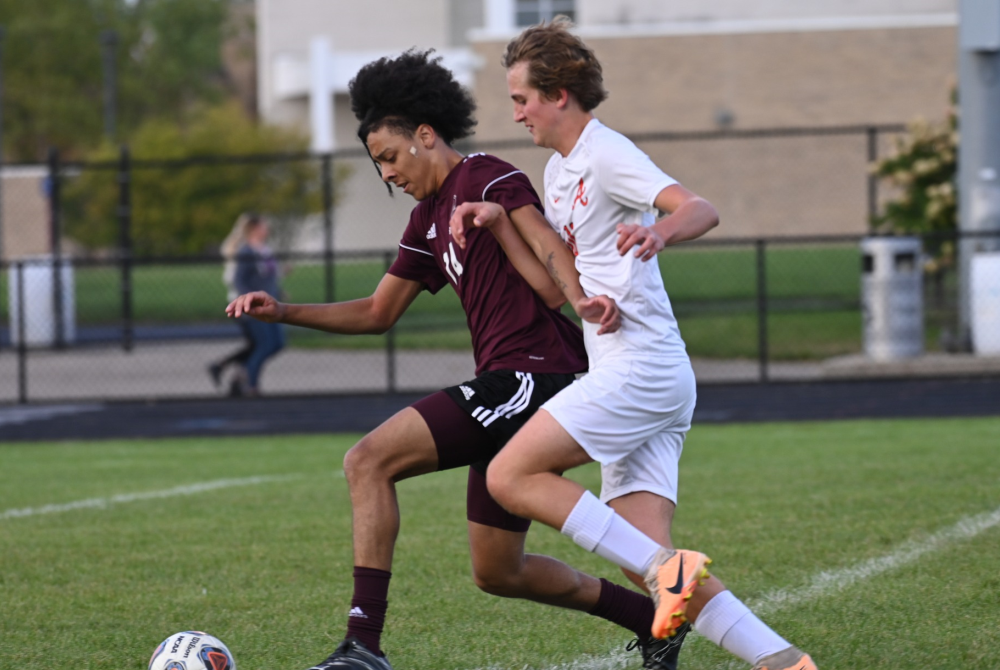
PHOTOS (Top) Parchment’s Darius Baker, left, controls possession during a game against Allegan. (2) From left: Parchment coach Jesse Roder, Brady Caswell and Caden Ragan. (3) Micah Shank [5] steps into a kick. (4) The Panthers’ Cayden Brown [11] defends. (5) From left: Wyatt Nieboer, Ty Mulka and Cameron Wagner. (Action photos by Shawnia Preston/Oh Shoot Photography, head shots by Pam Shebest.)