


New Math: Division & Multiplication Problems
July 25, 2017
By Jack Roberts
MHSAA Executive Director
This is the second part in a series on MHSAA tournament classification, past and present, that will be published over the next two weeks. This series originally ran in this spring's edition of MHSAA benchmarks.
High school tournament classifications went viral before there was social media and most of us knew what “viral” meant.
Much as a virus infects computers today or has created epidemics of disease around the world for centuries, high school tournament classification – once introduced – tends to spread uncontrollably. Once started, it tends to keep expanding and rarely contracts.
While we are still some distance from providing every team a trophy as a result of expanding high school tournament classification across the country, there is criticism nevertheless that we are headed in that direction – a philosophy which is supposed to exist only in local youth sports for our youngest children.
Michigan could be blamed for all this. Michigan is generally accepted as the first state to provide different classifications for season-ending tournaments for different sized schools. It started a century ago. Today, every state has various classifications for its tournaments in most if not all sports. And it is a bit ironic that Michigan – creator of the classification chaos – more than most other states has kept the number of tournament classes or divisions under control.
Yes, there is evidence that tournament classifications have expanded over the years in Michigan, especially with the relatively recent introduction of tournaments in football and the late 1990s’ move from classes to divisions in most MHSAA tournaments. But the MHSAA Representative Council has held true to its word when it expanded the playoffs for football from four classes to eight divisions: this is needed because of unique factors of football, factors that exist in no other sport; and all other sports should be capped at a maximum of four classes or divisions.
Kentucky is the preeminent defender of single-class basketball. All of its 276 high schools compete for the single state championship for each gender. In Indiana, there are still open wounds from its move in 1998 from one to four classes for its 400 schools in basketball.
Multi-class tournaments have tended to increase the number of non-public school champions, which some states are trying to lower through enrollment “multipliers,” and also tend to increase the number of repeat champions, which some states are trying to affect with “success factors” which lift smaller schools into classifications for larger schools if they take home too many trophies.
While there is considerable evidence that state tournaments do as much bad as good for educational athletics, state associations persist in providing postseason tournaments because, on balance, the experiences are supposed to be good for student-athletes. And once we reach that conclusion it is just a small leap to believe that if the tournaments are good for a few, they must be better for more – which leads to creating more and more tournament classifications. One becomes two classes, then three, then four and so forth.
While the argument is that more classifications or divisions provides more students with opportunities to compete and win, it is undeniable that the experience changes as the number of tournament classifications expands. It is not possible for state associations to provide the same level of support when tournament classifications expand to multiple venues playing simultaneously. For example, there is less audio and video broadcast potential at each venue, and less media coverage to each venue. Focus is diluted and fans diminished at each championship.
No one can argue reasonably that today's two-day MHSAA Football Finals of eight championship games has the same pizazz as the one-day, four-games event conducted prior to 1990.
In some states the number of divisions has grown so much that it is difficult to see much difference between the many season-ending state championship games and a regular-season event in the same sport.
It is a balancing act. And Michigan has been studying that balance longer than any other state, and charting a steadier course than most.
Addition by Division
The shift to Divisions for MHSAA Tournament play in numerous sports has added up to a greater number of champions for teams and individuals across the state. Following are the sports currently employing a divisional format, and the procedures for determining enrollment and classification.
In 23 statewide or Lower Peninsula tournaments, schools which sponsor the sport are currently divided into nearly equal divisions. They are:
- Baseball - 4 Divisions
- Boys Bowling - 4 Divisions
- Girls Bowling - 4 Divisions
- Girls Competitive Cheer - 4 Divisions
- LP Boys Cross Country - 4 Divisions
- LP Girls Cross Country - 4 Divisions
- LP Boys Golf - 4 Divisions
- LP Girls Golf - 4 Divisions
- Ice Hockey - 3 Divisions
- Boys Lacrosse - 2 Divisions
- Girls Lacrosse - 2 Divisions
- Boys Skiing - 2 Divisions
- Girls Skiing - 2 Divisions
- LP Boys Soccer - 4 Divisions LP
- Girls Soccer - 4 Divisions
- Girls Softball - 4 Divisions
- LP Boys Swimming & Diving - 3 Divisions
- LP Girls Swimming & Diving - 3 Divisions
- LP Boys Tennis - 4 Divisions
- LP Girls Tennis - 4 Divisions
- LP Boys Track & Field - 4 Divisions
- LP Girls Track & Field - 4 Divisions
- Wrestling - 4 Divisions
Lists of schools for each division of these 23 tournaments are posted on MHSAA.com approximately April 1. Listings of schools in Upper Peninsula tournaments for their sports are also posted on MHSAA.com. The lists are based on school memberships and sports sponsorships in effect or anticipated for the following school year, as known to the MHSAA office as of a date in early March.
In football, the 256 schools which qualify for MHSAA 11-player playoffs are placed in eight equal divisions annually on Selection Sunday. Beginning in 2017, the 8-player divisions will be determined in a like manner on Selection Sunday as well, with 32 qualifying schools placed in two divisions.
Schools have the option to play in any higher division in one or more sports for a minimum of two years.
The deadlines for "opt-ups" are as follows:
- Applications for fall sports must be submitted by April 15
- Applications for winter sports must be submitted by Aug. 15
- Applications for spring sports must be submitted by Oct. 15
Subsequent to the date of these postings for these tournaments, no school will have its division raised or lowered by schools opening or closing, schools adding or dropping sports, schools exercising the option to play in a higher division, or approval or dissolution of cooperative programs.
When the same sport is conducted for boys and girls in the same season (e.g., track & field and cross country), the gender that has the most sponsoring schools controls the division breaks for both genders.

Jones' Motto Inspires 'Get To' Foundation's Work to Provide Opportunities
By
Tom Kendra
Special for MHSAA.com
October 4, 2023
Ben Jones always had the same, simple message, even if it was 100 degrees and sunny or 35 degrees and raining sideways, and whether he was playing for a powerhouse like Muskegon Catholic Central or coaching a program trying to establish itself at Bloomfield Hills Cranbrook Kingswood.
 “We get to play football today,” Jones would say, as many of those around him were complaining and grumbling.
It was never “have to” for Jones, but always “get to.”
Jones, who was about to start his second year as head coach at Cranbrook, had his life tragically cut short by a drunk driver who crashed into his vehicle as he was traveling home from work in Detroit on Aug. 19, 2020. He was just 30 years old.
While Jones is gone, leaving a hole as large and painful as the 6-foot-2, 260-pound frame he carried as a tight end in his senior year at Hillsdale College, that “Get To” mentality is alive and well, and thriving and growing – thanks in large part to the efforts of his football teammates from Muskegon Catholic and later at Hillsdale.
The Get To Foundation, a 501(c)3 non-profit organization, was formed in Jones’ honor and has grown exponentially in less than three years, providing grants to sports organizations and scholarships to student-athletes.
“There is a core group of about 10 of them that have worked on (the foundation), and it’s been amazing,” said Theresa Jones, Ben’s mother, who with her husband Bruce has worked with the foundation. “It started small, and then it caught fire.”
The president of the foundation is Tim Hornak, Jones’ best friend and teammate in the trenches at both Muskegon Catholic and Hillsdale. Hornak returned to deliver a pre-game speech before the Crusaders’ home game on Sept. 15 against Kalamazoo United, where he talked about the man who is the inspiration behind the rapidly-growing Get To movement.
“You don’t have to, you get to – that simple difference can change your lives,” said Hornak, who teamed with Jones when both were seniors to help the Crusaders to a 14-0 record and the Division 8 championship in 2008. “You get to play football tonight and continue the tradition that started here in the 1950s.
“You get a chance to line up and play a great game with your best friends.”
Inspired by Hornak’s words and Jones’ legacy, the Crusaders downed Kalamazoo United 27-7 that night, the team’s second-straight win after an 0-2 start, which put them back in the Division 8 playoff picture.
 A tailgate party was held before the game as a fundraiser for the Get To Foundation, and it happened to coincide with the 15th anniversary of the Crusaders’ 2008 championship team – arguably one of the best teams in the school’s storied history. MCC has won 12 state championships, trailing only Farmington Hills Harrison in state playoff history.
The phrase “get to,” according to Hornak, goes back to the whiteboard in the MCC locker room his sophomore year and perfectly captures Jones’ approach to life and to football, whether his team was unbeaten like at MCC or struggling like the Chargers did just after he and Hornak graduated.
Jones, who wore No. 62 at MCC, was a two-way starting lineman who also played on the Crusaders’ 2006 championship team as a sophomore. His best friends on the team were the Hornak twins, Tim and Jon, whose father Mike was an assistant coach.
After his funeral service on Aug. 24, 2020, Jones’ hearse made a stop at MCC’s Kehren Stadium on the way to the cemetery, taking a lap on the track around Mike Holmes Field.
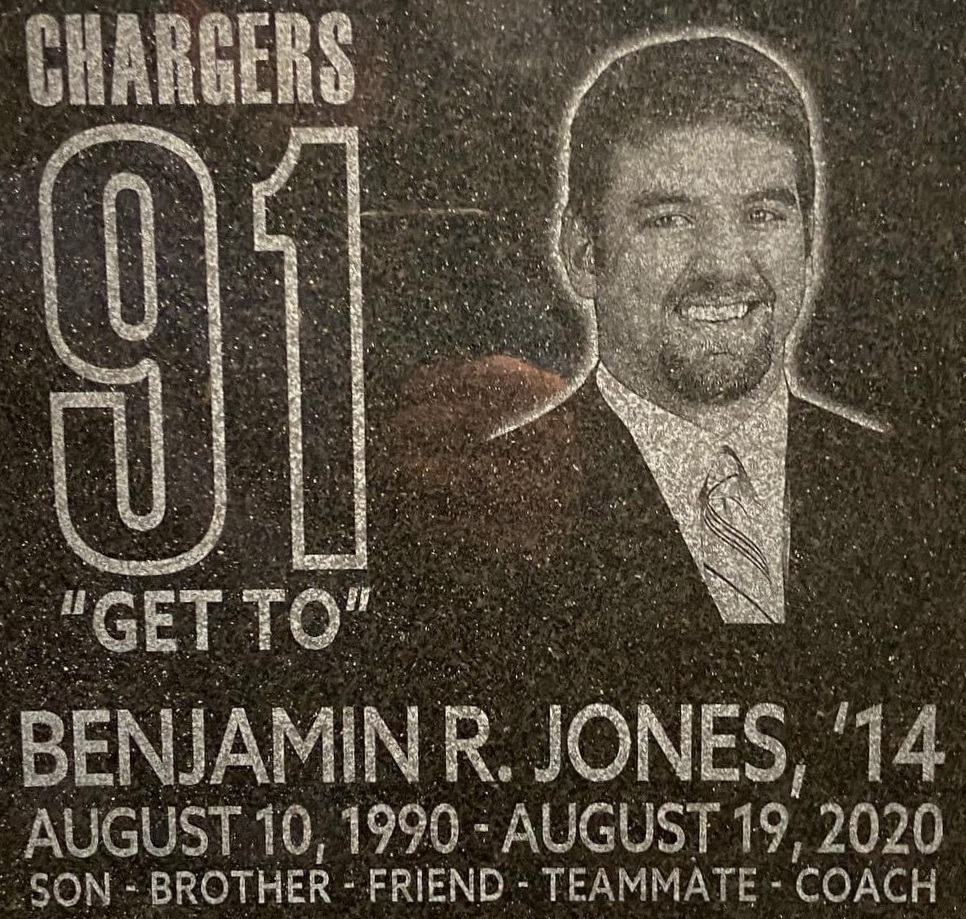
He went on to play on three teams which won or shared Great Lakes Interscholastic Athletic Conference titles at Hillsdale, where he wore No. 91 and played tight end and H-back.
“He had an inner self-confidence that you could tell right away when talking to him,” said Hillsdale coach Keith Otterbein. “He was very positive. He encouraged his teammates.”
Jones graduated from Hillsdale in 2013 with a degree in financial management and a minor in mathematics, moved to Royal Oak and took a job as a portfolio manager and financial planner at Schwartz & Co. Investment Advisors.
In his free time, he worked as an assistant varsity football coach at Cranbrook from 2015 to 2018, before being elevated to head coach in 2019 at the age of 28.
One of his first actions as head coach was getting Cranbrook football T-shirts printed with the message “Get To” on the back. Jones guided the Cranes to a 6-4 record and a Division 4 playoff berth in what would prove to be his only season as head coach.
 He died nine days before Cranbrook’s scheduled season opener in 2020, which ended up being delayed six weeks due to the COVID-19 pandemic.
In the immediate aftermath of Jones’ shocking death, the Hornak brothers and other former teammates vowed to do something to honor Ben and to help out his family. Out of that mission, the Get To Foundation was born.
Get To has awarded scholarships for the past three years. In 2023 alone, the foundation awarded $16,000 in scholarships to 22 student-athletes from around the state.
In addition, Get To has awarded $55,000 in grants to 17 organizations – including $3,000 to the Eaton Rapids High School football program for new shoulder pads and helmets and $2,500 to the Detroit Tigers Foundation’s Gloves for Kids program.
The next event on the foundation’s busy calendar is a speech by best-selling motivational author Jon Gordon at Lawrence Tech University on Oct. 17.
The foundation’s board has trademarked the phrase “Get To” and hopes to continue to grow the organization’s size and scope – in a way mirroring how big and impactful Ben’s life could have been if it wasn’t cut short.
For more information or to make a donation, go to the organization’s website at www.gettofoundation.org.
The relentless efforts of Ben’s ex-teammates to keep his memory alive means the world to his parents, as well as his two younger siblings – Alissa, a standout swimmer at Hillsdale who is now the school’s assistant women’s swimming coach; and Nate, who also played football for the Chargers and is now a foreign currency trader for Barclay’s, based in New York City.
Theresa Jones said coming together with all of Ben’s closest friends for Get To Foundation events has been a continuous blessing for the family.
“Every time we have an event for the foundation, it’s all of Ben’s friends and family members dressed up and having a good time,” his mother said. “It always feels like Ben’s wedding reception that he never got to have.”
 Tom Kendra worked 23 years at The Muskegon Chronicle, including five as assistant sports editor and the final six as sports editor through 2011. E-mail him at [email protected] with story ideas for Muskegon, Oceana, Mason, Lake, Oceola, Mecosta and Newaygo counties.
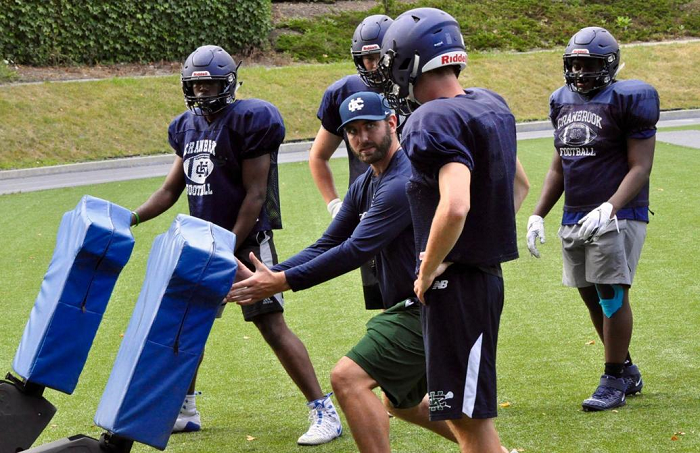
PHOTOS (Top) Ben Jones is shown before the 2008 Division 8 championship game at Ford Field during his senior year at Muskegon Catholic Central. The Crusaders defeated Crystal Falls Forest Park, 40-0. (Middle) Jones works with his linemen during his first year as head coach at Bloomfield Hills Cranbrook Kingswood in 2019. (Below) A plaque honoring Jones has been placed in the tunnel leading from the home locker room to the football field at Hillsdale College. (Top photo by Tim Reilly. Additional photos courtesy of the Get To Foundation.)