

New Math: Division & Multiplication Problems
July 25, 2017
By Jack Roberts
MHSAA Executive Director
This is the second part in a series on MHSAA tournament classification, past and present, that will be published over the next two weeks. This series originally ran in this spring's edition of MHSAA benchmarks.
High school tournament classifications went viral before there was social media and most of us knew what “viral” meant.
Much as a virus infects computers today or has created epidemics of disease around the world for centuries, high school tournament classification – once introduced – tends to spread uncontrollably. Once started, it tends to keep expanding and rarely contracts.
While we are still some distance from providing every team a trophy as a result of expanding high school tournament classification across the country, there is criticism nevertheless that we are headed in that direction – a philosophy which is supposed to exist only in local youth sports for our youngest children.
Michigan could be blamed for all this. Michigan is generally accepted as the first state to provide different classifications for season-ending tournaments for different sized schools. It started a century ago. Today, every state has various classifications for its tournaments in most if not all sports. And it is a bit ironic that Michigan – creator of the classification chaos – more than most other states has kept the number of tournament classes or divisions under control.
Yes, there is evidence that tournament classifications have expanded over the years in Michigan, especially with the relatively recent introduction of tournaments in football and the late 1990s’ move from classes to divisions in most MHSAA tournaments. But the MHSAA Representative Council has held true to its word when it expanded the playoffs for football from four classes to eight divisions: this is needed because of unique factors of football, factors that exist in no other sport; and all other sports should be capped at a maximum of four classes or divisions.
Kentucky is the preeminent defender of single-class basketball. All of its 276 high schools compete for the single state championship for each gender. In Indiana, there are still open wounds from its move in 1998 from one to four classes for its 400 schools in basketball.
Multi-class tournaments have tended to increase the number of non-public school champions, which some states are trying to lower through enrollment “multipliers,” and also tend to increase the number of repeat champions, which some states are trying to affect with “success factors” which lift smaller schools into classifications for larger schools if they take home too many trophies.
While there is considerable evidence that state tournaments do as much bad as good for educational athletics, state associations persist in providing postseason tournaments because, on balance, the experiences are supposed to be good for student-athletes. And once we reach that conclusion it is just a small leap to believe that if the tournaments are good for a few, they must be better for more – which leads to creating more and more tournament classifications. One becomes two classes, then three, then four and so forth.
While the argument is that more classifications or divisions provides more students with opportunities to compete and win, it is undeniable that the experience changes as the number of tournament classifications expands. It is not possible for state associations to provide the same level of support when tournament classifications expand to multiple venues playing simultaneously. For example, there is less audio and video broadcast potential at each venue, and less media coverage to each venue. Focus is diluted and fans diminished at each championship.
No one can argue reasonably that today's two-day MHSAA Football Finals of eight championship games has the same pizazz as the one-day, four-games event conducted prior to 1990.
In some states the number of divisions has grown so much that it is difficult to see much difference between the many season-ending state championship games and a regular-season event in the same sport.
It is a balancing act. And Michigan has been studying that balance longer than any other state, and charting a steadier course than most.
Addition by Division
The shift to Divisions for MHSAA Tournament play in numerous sports has added up to a greater number of champions for teams and individuals across the state. Following are the sports currently employing a divisional format, and the procedures for determining enrollment and classification.
In 23 statewide or Lower Peninsula tournaments, schools which sponsor the sport are currently divided into nearly equal divisions. They are:
- Baseball - 4 Divisions
- Boys Bowling - 4 Divisions
- Girls Bowling - 4 Divisions
- Girls Competitive Cheer - 4 Divisions
- LP Boys Cross Country - 4 Divisions
- LP Girls Cross Country - 4 Divisions
- LP Boys Golf - 4 Divisions
- LP Girls Golf - 4 Divisions
- Ice Hockey - 3 Divisions
- Boys Lacrosse - 2 Divisions
- Girls Lacrosse - 2 Divisions
- Boys Skiing - 2 Divisions
- Girls Skiing - 2 Divisions
- LP Boys Soccer - 4 Divisions LP
- Girls Soccer - 4 Divisions
- Girls Softball - 4 Divisions
- LP Boys Swimming & Diving - 3 Divisions
- LP Girls Swimming & Diving - 3 Divisions
- LP Boys Tennis - 4 Divisions
- LP Girls Tennis - 4 Divisions
- LP Boys Track & Field - 4 Divisions
- LP Girls Track & Field - 4 Divisions
- Wrestling - 4 Divisions
Lists of schools for each division of these 23 tournaments are posted on MHSAA.com approximately April 1. Listings of schools in Upper Peninsula tournaments for their sports are also posted on MHSAA.com. The lists are based on school memberships and sports sponsorships in effect or anticipated for the following school year, as known to the MHSAA office as of a date in early March.
In football, the 256 schools which qualify for MHSAA 11-player playoffs are placed in eight equal divisions annually on Selection Sunday. Beginning in 2017, the 8-player divisions will be determined in a like manner on Selection Sunday as well, with 32 qualifying schools placed in two divisions.
Schools have the option to play in any higher division in one or more sports for a minimum of two years.
The deadlines for "opt-ups" are as follows:
- Applications for fall sports must be submitted by April 15
- Applications for winter sports must be submitted by Aug. 15
- Applications for spring sports must be submitted by Oct. 15
Subsequent to the date of these postings for these tournaments, no school will have its division raised or lowered by schools opening or closing, schools adding or dropping sports, schools exercising the option to play in a higher division, or approval or dissolution of cooperative programs.
When the same sport is conducted for boys and girls in the same season (e.g., track & field and cross country), the gender that has the most sponsoring schools controls the division breaks for both genders.
Addison Emerges from Difficult Offseason Focused on Embracing Challenges Ahead
By
Doug Donnelly
Special for MHSAA.com
September 26, 2023
ADDISON – Addison’s football team was dealt multiple blows this past offseason, enough to bring many teams to their knees.
 After going 5-5 last fall with a young team, the Panthers were expecting big things in 2023. But tragedy struck twice. Junior Chad Miller, a fullback and safety, died in July. Starting linebacker Jay Griewahn, also a junior, was diagnosed with leukemia and began chemotherapy that same month.
Add in the transfer of a starting offensive lineman, and losing three expected contributors from a team of fewer than 30 players looked difficult to overcome.
Yet, through five games, Addison is undefeated and ranks at the top of the MHSAA playoff points list in Division 8. The Panthers have turned to what their coaches have been teaching them for years – control only what you can control.
“I felt strongly that we would embrace the challenge and not make excuses, because we just don’t allow it,” said Addison head coach Joshua Lindeman.
“We can’t control everything, right? It’s what we instill in kids every single day. The football team is an extension of the classroom. Anything you do through education and educational athletics is preparing you to become a man. That is really what we build our entire program around. We talk about it daily.”
Lindeman is in his 10th season as the Addison head coach and recently passed the 50-win mark. He said it took a couple of years to build the current culture at the school in southwest Lenawee County, but seasons like this one – where the team comes together to overcome adversity – shows it is working.
“There are going to be events in your life that are going to happen that you can’t control,” he said. “Everybody knows this, whether you are a faith-driven person or not. There are events in our lives that are out of our control. We can’t waste energy or time and effort on those things.
“The only thing we can focus on is our response to those events.”
Addison also has remained true to its culture when it comes to toughness on the football field, too. Lindeman employs a full house T formation, an offense he learned while playing at nearby Hudson. In most games, as many as four backs carry the ball at least eight times apiece. Spencer Brown had 19 carries in Friday’s win over Jonesville, by far the most of any Addison back in a single game this season.
“That doesn’t change,” Lindeman said of the offense. “We don’t get envious about who carries the ball. We teach that to our backs. If you ask anybody about our program, about who gets taken care of in our program … they’ll tell you the linemen.
“Football is so many times glorified by the guy carrying the ball or the guy throwing the ball,” Lindeman added. “I don’t care who has the ball. I care about the seven guys up front. That’s where football is won or lost, no matter what anybody says.”
 Addison has been an offensive juggernaut, scoring 258 points over five games. That includes wins of 50-14, 60-27, 58-14, 50-28 and 38-14, making the Panthers one of the highest-scoring teams in the state. They have 10 pass completions all season.
Brown is a perfect example of a player who has embraced the Addison culture. Coming in as a freshman, Brown shied away from contact. Once he hit the weight room and grew into his body, he became a bruising runner who fights for tough yards inside but has the speed to break long runs.
“When I came in as a freshman, I was tall and skinny,” Brown said. “I didn’t want anything to do with contact or someone touching me. As a sophomore, I started lifting, and last year things clicked.”
He said the team has remained close through the difficult offseason.
“It was hard losing a couple of guys, but you just have to look at the next guy up and lock in and do your job,” Brown said. “It’s talked about. It would be great to have those guys with us, but you just have to tell the guy there now to fill your spot and play your role.”
Brown is one of four captains with fellow seniors Jaxen Sword and Gabe Pepper, plus junior Joe Clark.
“Our captains say the right thing,” Lindeman said. “All four of them have done a really good job.”
This week Addison hosts Homer on Thursday in hopes of improving to 6-0.
“The mindset is to keep working hard in practice,” Brown said. “We are trying to go undefeated here.”
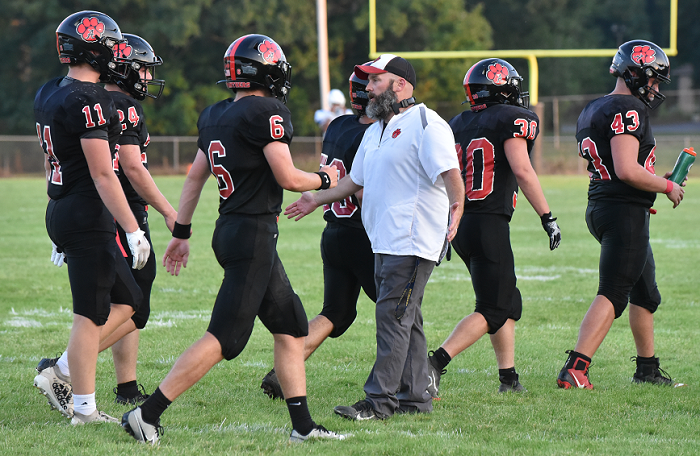
The Panthers know some difficult games lie ahead. No matter what happens, Lindeman will continue to do things like shake hands with every player after every practice and game and tell his players he loves them.
“All of that stuff creates the word culture that everybody speaks about,” Lindeman said. “It’s an identity. It’s not unnormal to see our football players in the hallway and they tell me they love me, and I say I love you back.”
 Doug Donnelly has served as a sports and news reporter and city editor over 25 years, writing for the Daily Chief-Union in Upper Sandusky, Ohio from 1992-1995, the Monroe Evening News from 1995-2012 and the Adrian Daily Telegram since 2013. He's also written a book on high school basketball in Monroe County and compiles record books for various schools in southeast Michigan. E-mail him at [email protected] with story ideas for Jackson, Washtenaw, Hillsdale, Lenawee and Monroe counties.
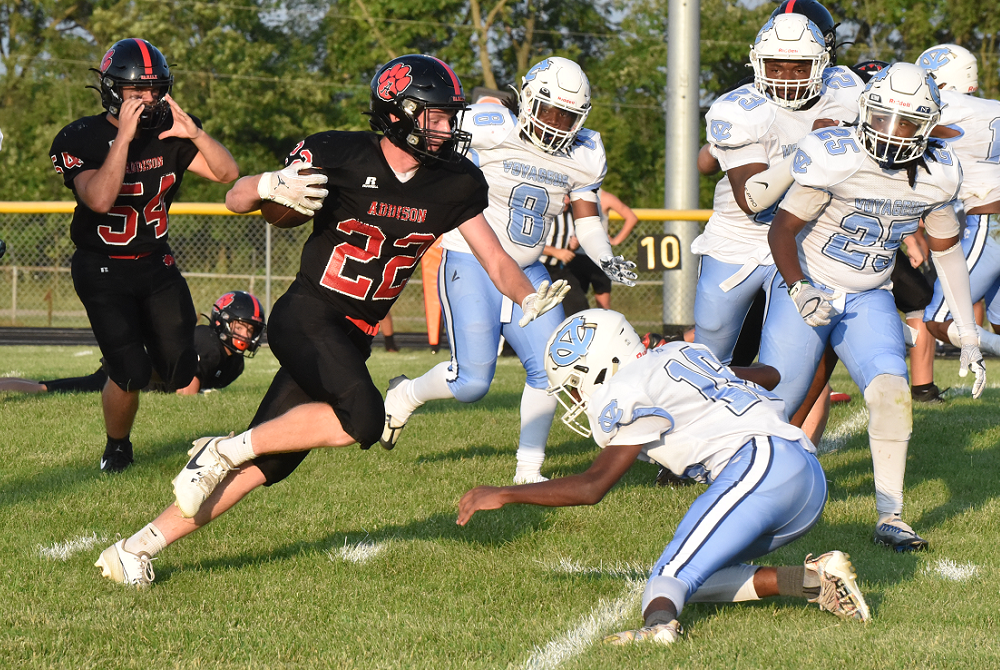
PHOTOS (Top) Addison’s Spencer Brown (22) attempts to elude a Detroit Voyageur defender during a 50-14 Week 1 win. (Middle) Panthers coach Joshua Lindeman greets his players before a game. (Photos by Deloris Clark-Osborne.)