

New Math: Division & Multiplication Problems
July 25, 2017
By Jack Roberts
MHSAA Executive Director
This is the second part in a series on MHSAA tournament classification, past and present, that will be published over the next two weeks. This series originally ran in this spring's edition of MHSAA benchmarks.
High school tournament classifications went viral before there was social media and most of us knew what “viral” meant.
Much as a virus infects computers today or has created epidemics of disease around the world for centuries, high school tournament classification – once introduced – tends to spread uncontrollably. Once started, it tends to keep expanding and rarely contracts.
While we are still some distance from providing every team a trophy as a result of expanding high school tournament classification across the country, there is criticism nevertheless that we are headed in that direction – a philosophy which is supposed to exist only in local youth sports for our youngest children.
Michigan could be blamed for all this. Michigan is generally accepted as the first state to provide different classifications for season-ending tournaments for different sized schools. It started a century ago. Today, every state has various classifications for its tournaments in most if not all sports. And it is a bit ironic that Michigan – creator of the classification chaos – more than most other states has kept the number of tournament classes or divisions under control.
Yes, there is evidence that tournament classifications have expanded over the years in Michigan, especially with the relatively recent introduction of tournaments in football and the late 1990s’ move from classes to divisions in most MHSAA tournaments. But the MHSAA Representative Council has held true to its word when it expanded the playoffs for football from four classes to eight divisions: this is needed because of unique factors of football, factors that exist in no other sport; and all other sports should be capped at a maximum of four classes or divisions.
Kentucky is the preeminent defender of single-class basketball. All of its 276 high schools compete for the single state championship for each gender. In Indiana, there are still open wounds from its move in 1998 from one to four classes for its 400 schools in basketball.
Multi-class tournaments have tended to increase the number of non-public school champions, which some states are trying to lower through enrollment “multipliers,” and also tend to increase the number of repeat champions, which some states are trying to affect with “success factors” which lift smaller schools into classifications for larger schools if they take home too many trophies.
While there is considerable evidence that state tournaments do as much bad as good for educational athletics, state associations persist in providing postseason tournaments because, on balance, the experiences are supposed to be good for student-athletes. And once we reach that conclusion it is just a small leap to believe that if the tournaments are good for a few, they must be better for more – which leads to creating more and more tournament classifications. One becomes two classes, then three, then four and so forth.
While the argument is that more classifications or divisions provides more students with opportunities to compete and win, it is undeniable that the experience changes as the number of tournament classifications expands. It is not possible for state associations to provide the same level of support when tournament classifications expand to multiple venues playing simultaneously. For example, there is less audio and video broadcast potential at each venue, and less media coverage to each venue. Focus is diluted and fans diminished at each championship.
No one can argue reasonably that today's two-day MHSAA Football Finals of eight championship games has the same pizazz as the one-day, four-games event conducted prior to 1990.
In some states the number of divisions has grown so much that it is difficult to see much difference between the many season-ending state championship games and a regular-season event in the same sport.
It is a balancing act. And Michigan has been studying that balance longer than any other state, and charting a steadier course than most.
Addition by Division
The shift to Divisions for MHSAA Tournament play in numerous sports has added up to a greater number of champions for teams and individuals across the state. Following are the sports currently employing a divisional format, and the procedures for determining enrollment and classification.
In 23 statewide or Lower Peninsula tournaments, schools which sponsor the sport are currently divided into nearly equal divisions. They are:
- Baseball - 4 Divisions
- Boys Bowling - 4 Divisions
- Girls Bowling - 4 Divisions
- Girls Competitive Cheer - 4 Divisions
- LP Boys Cross Country - 4 Divisions
- LP Girls Cross Country - 4 Divisions
- LP Boys Golf - 4 Divisions
- LP Girls Golf - 4 Divisions
- Ice Hockey - 3 Divisions
- Boys Lacrosse - 2 Divisions
- Girls Lacrosse - 2 Divisions
- Boys Skiing - 2 Divisions
- Girls Skiing - 2 Divisions
- LP Boys Soccer - 4 Divisions LP
- Girls Soccer - 4 Divisions
- Girls Softball - 4 Divisions
- LP Boys Swimming & Diving - 3 Divisions
- LP Girls Swimming & Diving - 3 Divisions
- LP Boys Tennis - 4 Divisions
- LP Girls Tennis - 4 Divisions
- LP Boys Track & Field - 4 Divisions
- LP Girls Track & Field - 4 Divisions
- Wrestling - 4 Divisions
Lists of schools for each division of these 23 tournaments are posted on MHSAA.com approximately April 1. Listings of schools in Upper Peninsula tournaments for their sports are also posted on MHSAA.com. The lists are based on school memberships and sports sponsorships in effect or anticipated for the following school year, as known to the MHSAA office as of a date in early March.
In football, the 256 schools which qualify for MHSAA 11-player playoffs are placed in eight equal divisions annually on Selection Sunday. Beginning in 2017, the 8-player divisions will be determined in a like manner on Selection Sunday as well, with 32 qualifying schools placed in two divisions.
Schools have the option to play in any higher division in one or more sports for a minimum of two years.
The deadlines for "opt-ups" are as follows:
- Applications for fall sports must be submitted by April 15
- Applications for winter sports must be submitted by Aug. 15
- Applications for spring sports must be submitted by Oct. 15
Subsequent to the date of these postings for these tournaments, no school will have its division raised or lowered by schools opening or closing, schools adding or dropping sports, schools exercising the option to play in a higher division, or approval or dissolution of cooperative programs.
When the same sport is conducted for boys and girls in the same season (e.g., track & field and cross country), the gender that has the most sponsoring schools controls the division breaks for both genders.
Hemlock, Rockford Follow 3-Point Success to 1st Titles, Record Book Fame
By
Geoff Kimmerly
MHSAA.com senior editor
September 1, 2023
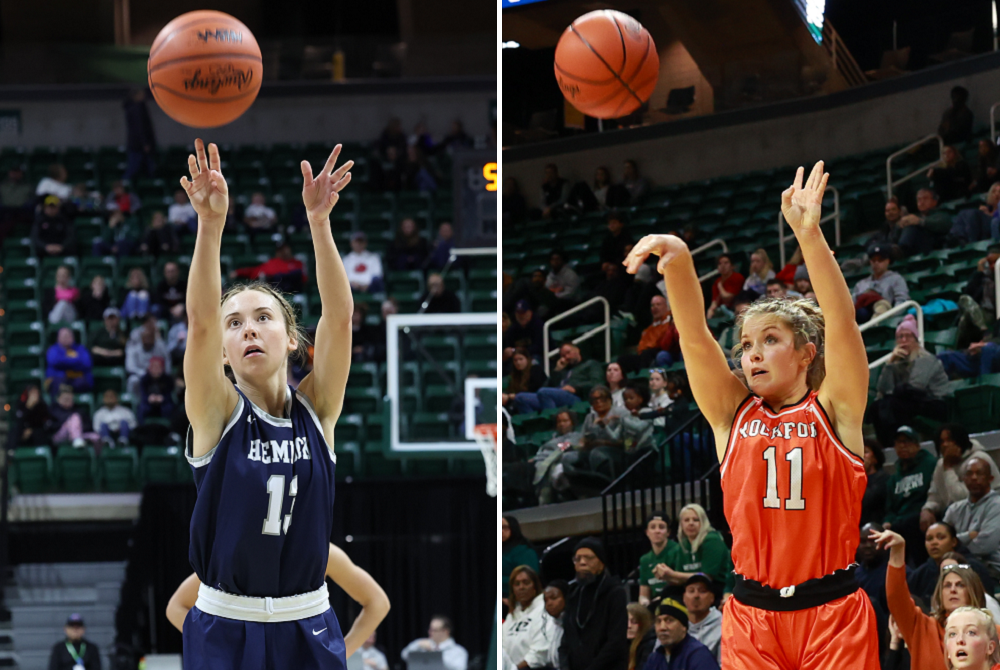
Hemlock and Rockford's drives to their first Girls Basketball Finals championships in March were paced in part by some of the strongest 3-point shooting in MHSAA history.
The Division 1 title-winning Rams connected on 243 3-pointers – third-most all-time – over 29 games in tying the single-season wins record while finishing 28-1. Grace Lyons, a senior this fall, made the single-season individual list with 70 3-pointers.
The Huskies won in Division 3 having connected on 229 3-pointers over 29 games, seventh-most in MHSAA history, on 678 attempts, which ranks 12th on that list. Chloe Watson made the single-season list with 75 3-pointers, and Regan Finkbeiner did as well connecting on 67.
Watson also made the career 3-pointers list with 224 and Finkbeiner with 194, and 2017 Hemlock graduate Samantha Krauss was added for 65 3-pointers as a junior in 2015-16 and 188 for her career. Additionally, past Hemlock standout Karli Herrington was added for her 317 rebounds in 2012-13, and Peyton Apsey was added for 144 steals in 2010-11.
Watson is continuing her career at Mid-Michigan College, and Finkbeiner is playing softball at Madonna. Herrington went on to play at Central Michigan and Northwood, Krauss played at Ferris State and Apsey played at Oakland.
Read on for more recent record book additions for girls basketball:
Girls Basketball
Hudsonville’s Maddie Petroelje joined the list of top 3-point shooters in MHSAA history as a junior in 2021-22, when she connected on 70 (in just 147 attempts) to make the single-season list. She graduated this spring 16th on the career list as well with 226 3-pointers in 512 attempts over 92 games and four seasons. She is continuing at Loyola (Ill.).
Byron Center’s Avery Zeinstra also finished her career among those top 3-point shooters. She also made the single-season list with 70 in 147 attempts as a freshman in 2018-19, and she capped her career in 2021-22 with 206 3-pointers (tied for 20th-most) in 502 attempts over four seasons and 80 career games. She is continuing at Grand Valley State.
Hannah Thompson was best known for her soccer scoring at Schoolcraft. But she’s made a second MHSAA record book for her 15 steals in a Jan. 28, 2022, basketball win over Galesburg-Augusta. She’s continuing her soccer career at Eastern Michigan.
Baraga’s run to the Division 4 Semifinals in 2022 received big boosts from Corina Jahfetson’s 3-point shooting and Reide Osterman’s defense. Jahfetson was added to the record book with 66 3-pointers over 25 games, including nine in a game against Carney Nadeau – when Baraga as a team made the record book with 14 3-pointers total. Osterman made the record book with 153 steals. Jahfetson graduated this spring, and Osterman is playing at Northern Michigan.
Grand Rapids West Michigan Aviation Academy’s Audrey Mileski had one of the busiest games at the free throw line in MHSAA history Dec. 14, 2021. She made 23 free throws – third-most in a single game – against Wyoming Kelloggsville. Mileski graduated this spring.
Sophia Bussell had set Monroe’s single-game 3-pointers record of eight as a freshman two seasons ago, and she bettered it last Dec. 13 by tying for the 10th-most in MHSAA history. She made 10-pointers including the game-winner of a 58-56 victory over Ypsilanti Lincoln. A little less than 10 months earlier, Adrian Lenawee Christian then-senior Kylie Summer also made 10, on 17 attempts, during a 57-34 win over Lansing Christian on Feb. 24, 2022.
Lydia Meredith enjoyed a memorable senior season for Portland St. Patrick in 2021-22, finishing her four-year varsity career with 453 steals over just 80 games. She also was added for drilling 17 free throws in 22 attempts against Fowler. She plays now at Saginaw Valley State.
Gabby Piepho got off to a fast start at Howell as a freshman last season, and at a record-setting pace at the free-throw line. She made 93 of 107 attempts over 25 games, for an .869 percentage that made the single-season list. That included a string of 47 straight free throws that ranks as the second-longest in MHSAA history. As a team, Howell tied for sixth all-time with 301 free throws over 25 games, on 439 attempts.
Kent City’s Lexie Bowers reached the single-season 3-pointers list for the second time last season, connecting on 72 of 233 tries over 26 games (after making 77 as a junior), and finished her four-season varsity career 16th on that 3-pointers list with 225 in 693 attempts over 99 games. She’s continuing her career at Northwood. Kent City as a team also reached the single-season 3-pointers made and attempted lists again, ranking fourth with 753 attempts and tying for eighth all-time by connecting on 202.
Posen then-junior Faith Cousins earned a par of record book entries during 2021-22 for assists. Her 16 in a District Final win on March 4, 2022, remain tied for fifth-most in one game, and she finished with 165 over 22 games for the season. She’s set to begin her softball career at Alma College.
Niles Brandywine went over 20 wins again this past season, finishing 21-3, and again the 3-pointer was a key tool in that pursuit. Brandywine made the record book with back-to-back games of 13 3-pointers to close the regular season, and finished with 175 3-pointers in 592 attempts over 23 games (with one won by forfeit).
Greenville’s Megan Leslie averaged more than two 3-pointers a game during her four-season varsity career, making the record list with 153 total over 76 games through graduation this spring. She’s continuing her career at Alma College.
Successful 3-point shooting played a major role in Saline finishing 21-4 with league and District titles last winter. The Hornets attempted 704 3-pointers – ninth-most all-time for one season – and connected on 191, which is 12th on that list. They made a season-high 14 against Ypsilanti Lincoln on Nov. 29 to make the single-game list.
Marcellus senior Brooklyn VanTilburg enjoyed a big finish to her high school career last winter, making the record book with 16 blocked shots in a game against Centreville and 135 blocks total for the season. She’ll continue at Kalamazoo Valley Community College.
Kennedy Gustafson made headlines last winter as a sophomore and earned a pair of record listings for her rebounding. She grabbed 26 in a March 3 District Final win over Muskegon Western Michigan Christian, and she finished with 376 rebounds over 25 games for the season.
PHOTO Hemlock's Regan Finkbeiner, left, follows through on a free throw attempt during last season's Division 3 Final, and Rockford's Grace Lyons launches the game-winning 3-pointer in Division 1.