

New Math: Division & Multiplication Problems
July 25, 2017
By Jack Roberts
MHSAA Executive Director
This is the second part in a series on MHSAA tournament classification, past and present, that will be published over the next two weeks. This series originally ran in this spring's edition of MHSAA benchmarks.
High school tournament classifications went viral before there was social media and most of us knew what “viral” meant.
Much as a virus infects computers today or has created epidemics of disease around the world for centuries, high school tournament classification – once introduced – tends to spread uncontrollably. Once started, it tends to keep expanding and rarely contracts.
While we are still some distance from providing every team a trophy as a result of expanding high school tournament classification across the country, there is criticism nevertheless that we are headed in that direction – a philosophy which is supposed to exist only in local youth sports for our youngest children.
Michigan could be blamed for all this. Michigan is generally accepted as the first state to provide different classifications for season-ending tournaments for different sized schools. It started a century ago. Today, every state has various classifications for its tournaments in most if not all sports. And it is a bit ironic that Michigan – creator of the classification chaos – more than most other states has kept the number of tournament classes or divisions under control.
Yes, there is evidence that tournament classifications have expanded over the years in Michigan, especially with the relatively recent introduction of tournaments in football and the late 1990s’ move from classes to divisions in most MHSAA tournaments. But the MHSAA Representative Council has held true to its word when it expanded the playoffs for football from four classes to eight divisions: this is needed because of unique factors of football, factors that exist in no other sport; and all other sports should be capped at a maximum of four classes or divisions.
Kentucky is the preeminent defender of single-class basketball. All of its 276 high schools compete for the single state championship for each gender. In Indiana, there are still open wounds from its move in 1998 from one to four classes for its 400 schools in basketball.
Multi-class tournaments have tended to increase the number of non-public school champions, which some states are trying to lower through enrollment “multipliers,” and also tend to increase the number of repeat champions, which some states are trying to affect with “success factors” which lift smaller schools into classifications for larger schools if they take home too many trophies.
While there is considerable evidence that state tournaments do as much bad as good for educational athletics, state associations persist in providing postseason tournaments because, on balance, the experiences are supposed to be good for student-athletes. And once we reach that conclusion it is just a small leap to believe that if the tournaments are good for a few, they must be better for more – which leads to creating more and more tournament classifications. One becomes two classes, then three, then four and so forth.
While the argument is that more classifications or divisions provides more students with opportunities to compete and win, it is undeniable that the experience changes as the number of tournament classifications expands. It is not possible for state associations to provide the same level of support when tournament classifications expand to multiple venues playing simultaneously. For example, there is less audio and video broadcast potential at each venue, and less media coverage to each venue. Focus is diluted and fans diminished at each championship.
No one can argue reasonably that today's two-day MHSAA Football Finals of eight championship games has the same pizazz as the one-day, four-games event conducted prior to 1990.
In some states the number of divisions has grown so much that it is difficult to see much difference between the many season-ending state championship games and a regular-season event in the same sport.
It is a balancing act. And Michigan has been studying that balance longer than any other state, and charting a steadier course than most.
Addition by Division
The shift to Divisions for MHSAA Tournament play in numerous sports has added up to a greater number of champions for teams and individuals across the state. Following are the sports currently employing a divisional format, and the procedures for determining enrollment and classification.
In 23 statewide or Lower Peninsula tournaments, schools which sponsor the sport are currently divided into nearly equal divisions. They are:
- Baseball - 4 Divisions
- Boys Bowling - 4 Divisions
- Girls Bowling - 4 Divisions
- Girls Competitive Cheer - 4 Divisions
- LP Boys Cross Country - 4 Divisions
- LP Girls Cross Country - 4 Divisions
- LP Boys Golf - 4 Divisions
- LP Girls Golf - 4 Divisions
- Ice Hockey - 3 Divisions
- Boys Lacrosse - 2 Divisions
- Girls Lacrosse - 2 Divisions
- Boys Skiing - 2 Divisions
- Girls Skiing - 2 Divisions
- LP Boys Soccer - 4 Divisions LP
- Girls Soccer - 4 Divisions
- Girls Softball - 4 Divisions
- LP Boys Swimming & Diving - 3 Divisions
- LP Girls Swimming & Diving - 3 Divisions
- LP Boys Tennis - 4 Divisions
- LP Girls Tennis - 4 Divisions
- LP Boys Track & Field - 4 Divisions
- LP Girls Track & Field - 4 Divisions
- Wrestling - 4 Divisions
Lists of schools for each division of these 23 tournaments are posted on MHSAA.com approximately April 1. Listings of schools in Upper Peninsula tournaments for their sports are also posted on MHSAA.com. The lists are based on school memberships and sports sponsorships in effect or anticipated for the following school year, as known to the MHSAA office as of a date in early March.
In football, the 256 schools which qualify for MHSAA 11-player playoffs are placed in eight equal divisions annually on Selection Sunday. Beginning in 2017, the 8-player divisions will be determined in a like manner on Selection Sunday as well, with 32 qualifying schools placed in two divisions.
Schools have the option to play in any higher division in one or more sports for a minimum of two years.
The deadlines for "opt-ups" are as follows:
- Applications for fall sports must be submitted by April 15
- Applications for winter sports must be submitted by Aug. 15
- Applications for spring sports must be submitted by Oct. 15
Subsequent to the date of these postings for these tournaments, no school will have its division raised or lowered by schools opening or closing, schools adding or dropping sports, schools exercising the option to play in a higher division, or approval or dissolution of cooperative programs.
When the same sport is conducted for boys and girls in the same season (e.g., track & field and cross country), the gender that has the most sponsoring schools controls the division breaks for both genders.
Championship Memories, High School Tennis' Impact Stick with Hackett Pair
By
Pam Shebest
Special for MHSAA.com
July 12, 2023
KALAMAZOO — As a senior at Hackett Catholic Central, Luke Samra knew that season was his last chance to win a state title.
Enter freshman Alex Dombos.
 “When I saw Alex for the first time at Hackett, I said, ‘If you play tennis, we’ll win state,’” Samra said.
The senior nailed it.
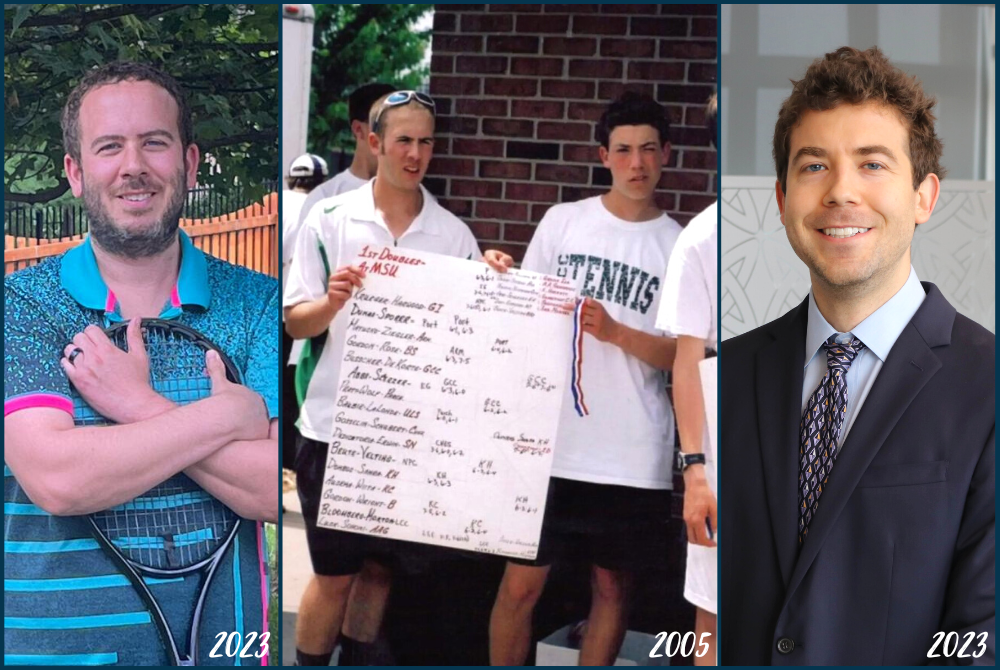
Coach Matt Boven paired the two, and they not only won the No. 1 doubles title, but helped lead the Irish to the 2005 MHSAA Lower Peninsula Division 4 team co-championship with Grosse Ile.
The pair defeated T.J. Busscher and Paul Dekorte, from Grandville Calvin Christian, 7-6(2), 6-2 to clinch their flight.
Eighteen years later, Dombos remembers it well.
“I’m pretty sure we were down a set point in the first set, and we saved at least one set point and won the set. The second was a little bit easier,” Dombos recalled.
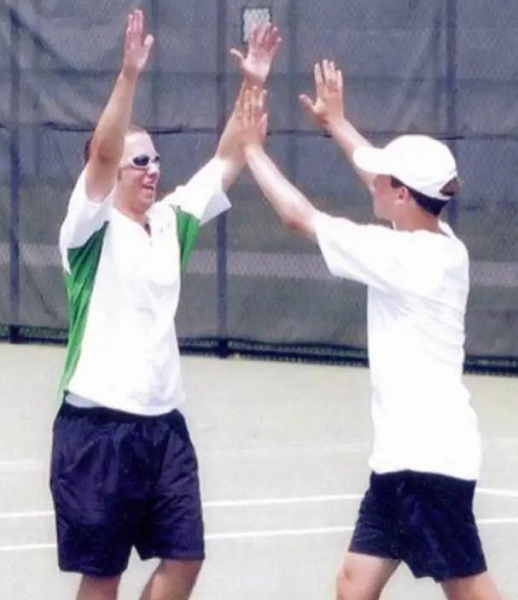
“I remember match point. I hit a backhand down the line for a winner, and then Luke and I looked at each then and I’m pretty sure we jumped up and did a Bryan Brothers chest bump.”
After graduation, Samra headed to Kalamazoo Valley Community College and then Marian University in Indianapolis, playing tennis and earning a bachelor’s degree in business management.
Dombos remained at Hackett, adding a Finals title at No. 2 singles as a sophomore and earning D4 first-team all-state honors.
“The experience I gained from playing doubles as a freshman was really beneficial,” Dombos said. “Playing doubles helped my net game in singles, where there’s a translation of skills.”
Although Samra and Dombos took different paths, they have kept in touch through texting and social media.
Samra and his wife, Adrianna Story Samra, live in Indianapolis where he is a teaching pro at Carmel (Ind.) Racquet Club after a similar position at Western Michigan University’s West Hills Athletic Club.
Dombos works in a data science role at Stryker Corporation in Kalamazoo, “applying a lot of the data analysis skills that I learned from high school, college and graduate school at Stryker.”
After Hackett, Dombos continued his tennis career at Kalamazoo College, earning a degree in physics with a minor in mathematics. He was a four-year letter winner and helped lead the Hornets to four Michigan Intercollegiate Athletic Association tennis titles.
Dombos spent study-abroad time in Aberdeen, Scotland, where he and his girlfriend Kelsey Hassevoort found a way to keep their tennis skills from atrophying.
Hassevoort, who is now his wife, played for the Hornets women’s tennis team and “very quickly we found the lone tennis court in the center of campus,” he said.
“When it got too dark too early in the day, we found the Aberdeen Tennis Center but to get there was a 45-minute trip through a lot of bus rides.”
After K-College, Dombos continued studying at Michigan State.
“They’ve got a lab on campus called the National Superconducting Cyclotron Laboratory, so I got my Ph.D. there in a six-year long program,” he said.
Next came three years at Notre Dame for a post-doctoral research associate position in physics and astronomy.
“My particular area of physics, there’s a lot of fundamental research part of it, but also practical applications,” he said. “A lot of the physics work I did, it’s common for people to go to a national lab.
“They’re doing research that’s usually funded by the government. Postdoctoral research associate positions are similar to the residency portion of medical school.”
With such in-depth studies, tennis has currently faded to the background, although Dombos has tried his hand at pickleball.
Looking back
Boven, currently the boys and girls tennis coach at Mattawan High School, remembers Hackett’s team title well.
“It was really Kyle Bedford at No. 2 singles and the No. 1 doubles team that gave us the (2005) title,” he said. “Alex and Luke seemed to complement each other. I knew Alex was a very gifted ground-stroker, and Luke’s volleys were improving. Alex was dominant at the baseline and could set up Luke at the net.”
Since Dombos rarely played doubles while competing in USTA events, he did not have many expectations as part of a doubles duo.
 “Having played singles for pretty much all of my tennis at that point, I didn’t see it as a setback, but had an open mind and open attitude: Let’s see where this goes,” he said.
“We ended up winning the state title, so that was exciting.”
Besides his high school tennis success — Dombos did not lose a set at the MHSAA Tournament his first two years — he said he continued learning from his experiences.
During USTA tournaments, Andrew Devlieger from Grand Rapids NorthPointe Christian was his nemesis.
“I had lost to him consistently,” Dombos said. “I ended up playing him in a high school match (in 2006), and I won. I was like, I can beat him now.
“In the (2006) finals at the state tournament, I played him and won again with a better score (6-1, 6-2). It was that belief of having won in the regular season that gave me the belief going into the state tournament.”
Dombos’ streak of not losing a set at the MHSAA Tournament ended during the 2007 No. 1 singles semifinals, where he fell to eventual champ Michael Calderone from Jackson Lumen Christi. Calderone was named Michigan’s Mr. Tennis and played collegiately at Western Michigan University.
Dombos said much of what he learned in high school has helped him in his career, including how to balance things in everyday life.
“As a student-athlete, you’re playing tennis and studying,” he said. “That’s really important for anything in life, especially in graduate school, having your attention pulled in a lot of different directions.”
Another advantage was learning teamwork.
“Working as part of a team and working with new people,” he said. “You’ll be doing that in any type of professional setting; learning that you don’t succeed alone.
“In general, there is also the importance of staying active for your physical and mental health.”
Advice he would give to young athletes today includes: “Hard work will be important for anything in life, and a lot of the lessons you learn on the tennis court will be very helpful later in life. They can be just as important as some of the lessons you learn in the classroom.”
Samra said tennis has changed since his high school days.
“The game is a lot faster now,” he said. “I tried to model my game on Pete Sampras and Andy Roddick, but you can’t play like that anymore.
“Serve and volley is out of the question, too. The ball comes back too fast.”
Samra said he can’t believe that with all the good players on his Hackett team, he is the only one who ended up with tennis as a career.
“My parents invested a lot of money in me growing up,” he said. “I’m glad they know it wasn’t a waste.”
Boven is not surprised by Samra’s career pursuit.
“I remember how intense Luke was and how much he cared about the team,” he said. “I’m so excited he stuck with it because he cared for it so much.”
Made in Michigan is powered by Michigan Army National Guard.
2023 Made In Michigan
July 6: Brother Rice Finals Hero Aiming to Ace Family Life, Financial World - Read
July 5: Lapeer West 4-Time Finals Winner Set to Build Champions at Oklahoma - Read
PHOTOS (Top) Luke Samra, left, and Alex Dombos hold up their championship bracket after winning the No. 1 doubles flight at the 2005 LP Division 4 Finals. (Middle) Samra and Dombos celebrate their victory. (Photos from 2005 courtesy of Luke Samra; current photos courtesy of Samra and Dombos.)