

New Math: Division & Multiplication Problems
July 25, 2017
By Jack Roberts
MHSAA Executive Director
This is the second part in a series on MHSAA tournament classification, past and present, that will be published over the next two weeks. This series originally ran in this spring's edition of MHSAA benchmarks.
High school tournament classifications went viral before there was social media and most of us knew what “viral” meant.
Much as a virus infects computers today or has created epidemics of disease around the world for centuries, high school tournament classification – once introduced – tends to spread uncontrollably. Once started, it tends to keep expanding and rarely contracts.
While we are still some distance from providing every team a trophy as a result of expanding high school tournament classification across the country, there is criticism nevertheless that we are headed in that direction – a philosophy which is supposed to exist only in local youth sports for our youngest children.
Michigan could be blamed for all this. Michigan is generally accepted as the first state to provide different classifications for season-ending tournaments for different sized schools. It started a century ago. Today, every state has various classifications for its tournaments in most if not all sports. And it is a bit ironic that Michigan – creator of the classification chaos – more than most other states has kept the number of tournament classes or divisions under control.
Yes, there is evidence that tournament classifications have expanded over the years in Michigan, especially with the relatively recent introduction of tournaments in football and the late 1990s’ move from classes to divisions in most MHSAA tournaments. But the MHSAA Representative Council has held true to its word when it expanded the playoffs for football from four classes to eight divisions: this is needed because of unique factors of football, factors that exist in no other sport; and all other sports should be capped at a maximum of four classes or divisions.
Kentucky is the preeminent defender of single-class basketball. All of its 276 high schools compete for the single state championship for each gender. In Indiana, there are still open wounds from its move in 1998 from one to four classes for its 400 schools in basketball.
Multi-class tournaments have tended to increase the number of non-public school champions, which some states are trying to lower through enrollment “multipliers,” and also tend to increase the number of repeat champions, which some states are trying to affect with “success factors” which lift smaller schools into classifications for larger schools if they take home too many trophies.
While there is considerable evidence that state tournaments do as much bad as good for educational athletics, state associations persist in providing postseason tournaments because, on balance, the experiences are supposed to be good for student-athletes. And once we reach that conclusion it is just a small leap to believe that if the tournaments are good for a few, they must be better for more – which leads to creating more and more tournament classifications. One becomes two classes, then three, then four and so forth.
While the argument is that more classifications or divisions provides more students with opportunities to compete and win, it is undeniable that the experience changes as the number of tournament classifications expands. It is not possible for state associations to provide the same level of support when tournament classifications expand to multiple venues playing simultaneously. For example, there is less audio and video broadcast potential at each venue, and less media coverage to each venue. Focus is diluted and fans diminished at each championship.
No one can argue reasonably that today's two-day MHSAA Football Finals of eight championship games has the same pizazz as the one-day, four-games event conducted prior to 1990.
In some states the number of divisions has grown so much that it is difficult to see much difference between the many season-ending state championship games and a regular-season event in the same sport.
It is a balancing act. And Michigan has been studying that balance longer than any other state, and charting a steadier course than most.
Addition by Division
The shift to Divisions for MHSAA Tournament play in numerous sports has added up to a greater number of champions for teams and individuals across the state. Following are the sports currently employing a divisional format, and the procedures for determining enrollment and classification.
In 23 statewide or Lower Peninsula tournaments, schools which sponsor the sport are currently divided into nearly equal divisions. They are:
- Baseball - 4 Divisions
- Boys Bowling - 4 Divisions
- Girls Bowling - 4 Divisions
- Girls Competitive Cheer - 4 Divisions
- LP Boys Cross Country - 4 Divisions
- LP Girls Cross Country - 4 Divisions
- LP Boys Golf - 4 Divisions
- LP Girls Golf - 4 Divisions
- Ice Hockey - 3 Divisions
- Boys Lacrosse - 2 Divisions
- Girls Lacrosse - 2 Divisions
- Boys Skiing - 2 Divisions
- Girls Skiing - 2 Divisions
- LP Boys Soccer - 4 Divisions LP
- Girls Soccer - 4 Divisions
- Girls Softball - 4 Divisions
- LP Boys Swimming & Diving - 3 Divisions
- LP Girls Swimming & Diving - 3 Divisions
- LP Boys Tennis - 4 Divisions
- LP Girls Tennis - 4 Divisions
- LP Boys Track & Field - 4 Divisions
- LP Girls Track & Field - 4 Divisions
- Wrestling - 4 Divisions
Lists of schools for each division of these 23 tournaments are posted on MHSAA.com approximately April 1. Listings of schools in Upper Peninsula tournaments for their sports are also posted on MHSAA.com. The lists are based on school memberships and sports sponsorships in effect or anticipated for the following school year, as known to the MHSAA office as of a date in early March.
In football, the 256 schools which qualify for MHSAA 11-player playoffs are placed in eight equal divisions annually on Selection Sunday. Beginning in 2017, the 8-player divisions will be determined in a like manner on Selection Sunday as well, with 32 qualifying schools placed in two divisions.
Schools have the option to play in any higher division in one or more sports for a minimum of two years.
The deadlines for "opt-ups" are as follows:
- Applications for fall sports must be submitted by April 15
- Applications for winter sports must be submitted by Aug. 15
- Applications for spring sports must be submitted by Oct. 15
Subsequent to the date of these postings for these tournaments, no school will have its division raised or lowered by schools opening or closing, schools adding or dropping sports, schools exercising the option to play in a higher division, or approval or dissolution of cooperative programs.
When the same sport is conducted for boys and girls in the same season (e.g., track & field and cross country), the gender that has the most sponsoring schools controls the division breaks for both genders.
Hot Hitting Again Bolsters Plentiful Pitching as Novi Clinches 1st Title
By
Keith Dunlap
Special for MHSAA.com
June 17, 2023
EAST LANSING – When Novi head baseball coach Rick Green presided over his team for the official start of practice in March, there were two immediate observations.
One, in his words, “there is a lot of work to do” – but that’s normal talk that just about every coach probably spoke at that moment.
Second and most importantly, there was something else about his team that stood out as he began his 23rd season at the helm.
“I knew we had the pitching staff as long as we are healthy,” Green said. “We were deep in the pitching staff.”
The entire state saw that firsthand during this MHSAA Tournament.
For the first time, Novi is a state champion in baseball following an 8-3 win over Brownstown Woodhaven in the Division 1 championship game at Michigan State University’s McLane Stadium.
Over seven tournament games, Novi allowed just 14 runs, and Green added that another facet of his team emerged over the last three weeks.
 “Our pitching staff carried us most of the way, and then hitting came through in the playoffs,” he said.
It certainly wasn’t an easy road for Novi (32-8), which knocked off the likes of Catholic League finalist Detroit Catholic Central, No. 3-ranked Northville, No. 7 Battle Creek Lakeview, No. 16 Hartland and a 30-win Woodhaven team en route to the title.
Before this dream run, Novi hadn’t made it to the Semifinal round since doing so in 1973, when the Wildcats finished runner-up in Class C.
Senior Alex Czapski was able to speak about the historical significance for the program better than any of his teammates after the game, given he had older brothers who graduated in 2014 and 2017 and the farthest any of them got was the Regional round.
Czapski, whose tying single with two outs in the seventh inning of a Semifinal against Mattawan kept Novi alive before his team went on to win that game in 10 innings, literally has grown up around the program.
“We have just been playing for this team for a long time,” Czapski said. “We had pitching depth, and we had hitting that tended to get hot. The thing we know about this team that makes us stand out is we have a brotherhood. Our team chemistry is something I don’t think I’ve seen out of a Novi team.”
Novi was in control throughout the Final, collecting 15 hits and putting constant traffic on the bases.
The Wildcats opened the scoring in the top of the third inning, taking a 2-0 lead on a 2-run single by junior Thad Lawler with the bases loaded and two outs.
Novi tacked on three more runs in the fourth inning, with juniors Brendon Bennett and Andrew Kummer and senior catcher Brett Reed each providing RBI singles to give their team a 5-0 lead.
 Woodhaven (32-12) got on the board in the bottom of the fourth, cutting Novi’s lead to 5-1 when senior Nick Phillips singled with pinch-runner Dawson Terry on second base. Terry scored when a throw to home got past the catcher.
After a scoreless fifth inning, Novi all but put the game away by scoring three runs. One scored on a wild pitch, and then Reed hit a 2-run single to left-center to give the Wildcats an 8-1 lead.
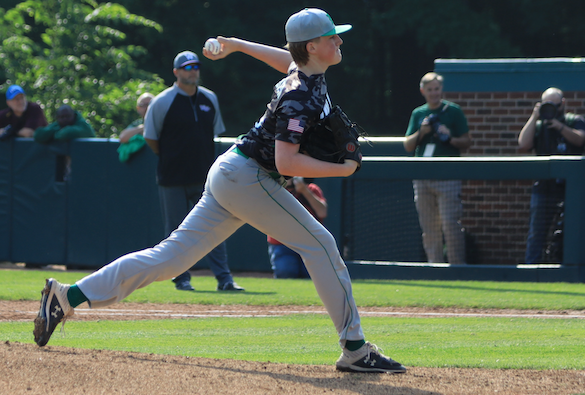
Woodhaven did make things a bit interesting in the bottom of the seventh, scoring two runs and putting runners on first and third with one out. But Reed threw out a runner trying to steal second, and Novi sophomore Uli Fernsler then finished a complete-game performance with a strikeout to start the celebration on the field.
Fernsler allowed three runs and eight hits, walked none and struck out eight. Woodhaven, meanwhile, had to use four pitchers and struggled to contain Novi’s offense.
The Warriors were making their second trip to the championship game after falling 8-1 to Grosse Pointe South in 2018.
“(Fernsler) pitched a really good game, and we were the opposite,” Woodhaven head coach Corey Farner said. “We didn’t hit our spots at all and had a hard time getting outs. You can’t put 19 runners on base and expect to win. That was the difference in the game. They pitched a really good game, and we didn’t.”
Bennett had three hits and an RBI, junior Caleb Walker had three hits and Reed had two hits and three RBI to lead Novi in its historic victory.
“This is so special,” Green said. “I’m so happy for our kids, and I’m so happy for all of our past players.”
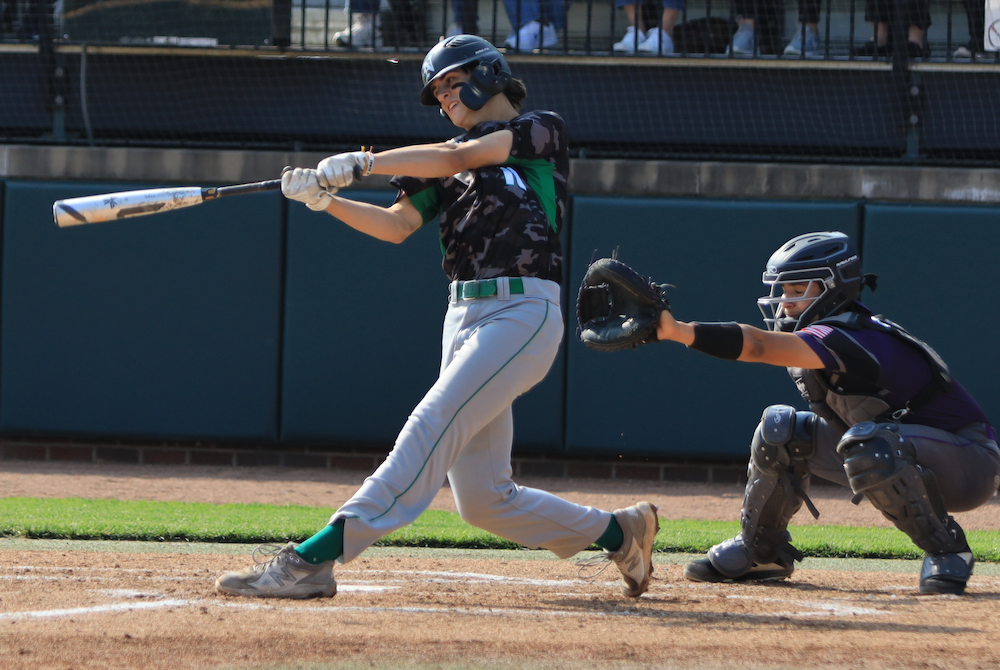
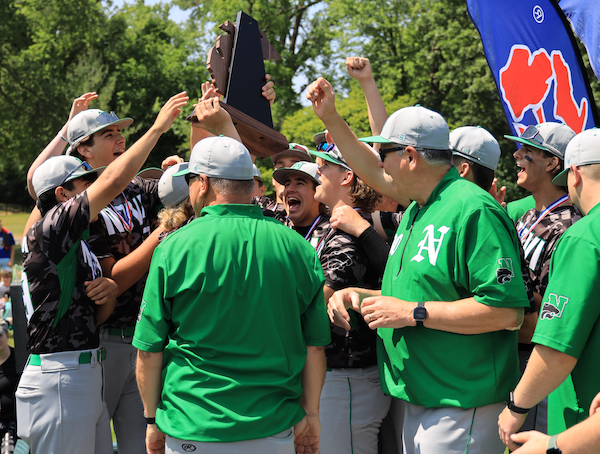
PHOTOS (Top) A Novi hitter drives a pitch during Saturday's first championship game at McLane Stadium. (Middle) The Wildcats raise their trophy during the awards presentation. (Below) Novi's Uli Fernsler makes his move toward the plate. (Photos by Olivia Napier/Hockey Weekly Action Photos.)