

New Math: Division & Multiplication Problems
July 25, 2017
By Jack Roberts
MHSAA Executive Director
This is the second part in a series on MHSAA tournament classification, past and present, that will be published over the next two weeks. This series originally ran in this spring's edition of MHSAA benchmarks.
High school tournament classifications went viral before there was social media and most of us knew what “viral” meant.
Much as a virus infects computers today or has created epidemics of disease around the world for centuries, high school tournament classification – once introduced – tends to spread uncontrollably. Once started, it tends to keep expanding and rarely contracts.
While we are still some distance from providing every team a trophy as a result of expanding high school tournament classification across the country, there is criticism nevertheless that we are headed in that direction – a philosophy which is supposed to exist only in local youth sports for our youngest children.
Michigan could be blamed for all this. Michigan is generally accepted as the first state to provide different classifications for season-ending tournaments for different sized schools. It started a century ago. Today, every state has various classifications for its tournaments in most if not all sports. And it is a bit ironic that Michigan – creator of the classification chaos – more than most other states has kept the number of tournament classes or divisions under control.
Yes, there is evidence that tournament classifications have expanded over the years in Michigan, especially with the relatively recent introduction of tournaments in football and the late 1990s’ move from classes to divisions in most MHSAA tournaments. But the MHSAA Representative Council has held true to its word when it expanded the playoffs for football from four classes to eight divisions: this is needed because of unique factors of football, factors that exist in no other sport; and all other sports should be capped at a maximum of four classes or divisions.
Kentucky is the preeminent defender of single-class basketball. All of its 276 high schools compete for the single state championship for each gender. In Indiana, there are still open wounds from its move in 1998 from one to four classes for its 400 schools in basketball.
Multi-class tournaments have tended to increase the number of non-public school champions, which some states are trying to lower through enrollment “multipliers,” and also tend to increase the number of repeat champions, which some states are trying to affect with “success factors” which lift smaller schools into classifications for larger schools if they take home too many trophies.
While there is considerable evidence that state tournaments do as much bad as good for educational athletics, state associations persist in providing postseason tournaments because, on balance, the experiences are supposed to be good for student-athletes. And once we reach that conclusion it is just a small leap to believe that if the tournaments are good for a few, they must be better for more – which leads to creating more and more tournament classifications. One becomes two classes, then three, then four and so forth.
While the argument is that more classifications or divisions provides more students with opportunities to compete and win, it is undeniable that the experience changes as the number of tournament classifications expands. It is not possible for state associations to provide the same level of support when tournament classifications expand to multiple venues playing simultaneously. For example, there is less audio and video broadcast potential at each venue, and less media coverage to each venue. Focus is diluted and fans diminished at each championship.
No one can argue reasonably that today's two-day MHSAA Football Finals of eight championship games has the same pizazz as the one-day, four-games event conducted prior to 1990.
In some states the number of divisions has grown so much that it is difficult to see much difference between the many season-ending state championship games and a regular-season event in the same sport.
It is a balancing act. And Michigan has been studying that balance longer than any other state, and charting a steadier course than most.
Addition by Division
The shift to Divisions for MHSAA Tournament play in numerous sports has added up to a greater number of champions for teams and individuals across the state. Following are the sports currently employing a divisional format, and the procedures for determining enrollment and classification.
In 23 statewide or Lower Peninsula tournaments, schools which sponsor the sport are currently divided into nearly equal divisions. They are:
- Baseball - 4 Divisions
- Boys Bowling - 4 Divisions
- Girls Bowling - 4 Divisions
- Girls Competitive Cheer - 4 Divisions
- LP Boys Cross Country - 4 Divisions
- LP Girls Cross Country - 4 Divisions
- LP Boys Golf - 4 Divisions
- LP Girls Golf - 4 Divisions
- Ice Hockey - 3 Divisions
- Boys Lacrosse - 2 Divisions
- Girls Lacrosse - 2 Divisions
- Boys Skiing - 2 Divisions
- Girls Skiing - 2 Divisions
- LP Boys Soccer - 4 Divisions LP
- Girls Soccer - 4 Divisions
- Girls Softball - 4 Divisions
- LP Boys Swimming & Diving - 3 Divisions
- LP Girls Swimming & Diving - 3 Divisions
- LP Boys Tennis - 4 Divisions
- LP Girls Tennis - 4 Divisions
- LP Boys Track & Field - 4 Divisions
- LP Girls Track & Field - 4 Divisions
- Wrestling - 4 Divisions
Lists of schools for each division of these 23 tournaments are posted on MHSAA.com approximately April 1. Listings of schools in Upper Peninsula tournaments for their sports are also posted on MHSAA.com. The lists are based on school memberships and sports sponsorships in effect or anticipated for the following school year, as known to the MHSAA office as of a date in early March.
In football, the 256 schools which qualify for MHSAA 11-player playoffs are placed in eight equal divisions annually on Selection Sunday. Beginning in 2017, the 8-player divisions will be determined in a like manner on Selection Sunday as well, with 32 qualifying schools placed in two divisions.
Schools have the option to play in any higher division in one or more sports for a minimum of two years.
The deadlines for "opt-ups" are as follows:
- Applications for fall sports must be submitted by April 15
- Applications for winter sports must be submitted by Aug. 15
- Applications for spring sports must be submitted by Oct. 15
Subsequent to the date of these postings for these tournaments, no school will have its division raised or lowered by schools opening or closing, schools adding or dropping sports, schools exercising the option to play in a higher division, or approval or dissolution of cooperative programs.
When the same sport is conducted for boys and girls in the same season (e.g., track & field and cross country), the gender that has the most sponsoring schools controls the division breaks for both genders.
Jones Era Ends with 3 More Race Wins - But Better Yet, Benzie's 1st Team Title
By
Scott DeCamp
Special for MHSAA.com
June 4, 2023
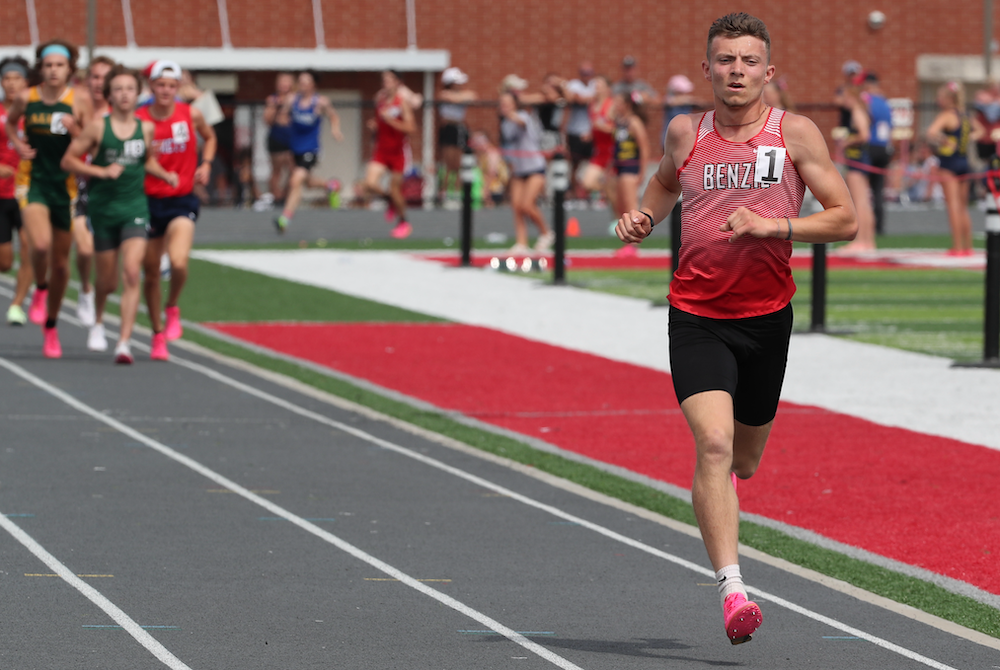
KENT CITY – For four years of MHSAA cross country and track, Benzie Central’s boys runners and competitors alike have been trying to keep up with the Joneses.
Specifically, Benzie Central senior All-American Hunter Jones.
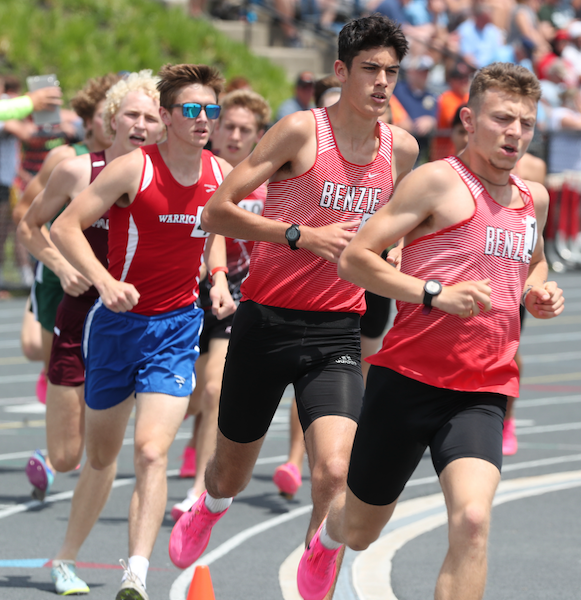
Well, Pol Molins lives with the Joneses (Hunter’s family) as a foreign-exchange student from Spain. Over the last few months, Molins has done a better job keeping up with Hunter Jones.
Now Jones, Molins and their Benzie Central teammates are all on the same level – as MHSAA Lower Peninsula Division 3 champions. The Huskies captured their first MHSAA Boys Track & Field Finals title, powered by Jones’ three individual championships along with strong efforts by Molins & Co. at Kent City High School.
Benzie Central totaled 51 points to hold off runner-up Pewamo-Westphalia, which tallied 44 points. Hart finished third (38), Sanford Meridian fourth (36) and Ottawa Lake Whiteford fifth (28).
“I’m very proud of myself, but ultimately my biggest goal today was to win a team state championship. We came out here, that’s what we did,” said Jones, a 6-foot, 160-pound Wake Forest signee, who cruised to victories Saturday in the 800-meter run (1:57.60), 1,600 run (4:17.48) and 3,200 (9:10.19).
Jones expressed much gratitude for not only Molins – who earned valuable points by taking second in the 1,600, fifth in the 3,200 and seventh in the 800 -- but for the other two runners on Benzie Central’s runner-up 3,200 relay team: Lucan Louwsma and Dorian Olson.
Benzie Central veteran coach Asa Kelly said Olson had never competed at Finals track meet before, and that this was the first time this foursome had run the 3,200.
“I really praise the 4x8 – those other two guys, they put us in the race and we got those eight points we needed,” Jones said. “If we didn’t run the 4x8, we would have lost. I thank those guys and I feel very blessed to finally get a team state championship. That’s been my biggest goal since I’ve gotten to Benzie.”
 That’s a big statement coming from a generational runner who closes his MHSAA career with 10 individual Finals championships: four in Division 3 cross country and six in track & field.
Jones is a multiple-time national champion in various events as well as an indoor state champ numerous times. He holds MHSAA LP Division 3 Finals records in the 800 and 1,600, and he missed the Finals record in the 3,200 on Saturday by 1½ seconds.
After he learned Benzie Central had wrapped up the team title, he said he didn’t even care if he had won any events Saturday.
“It’s an overwhelming feeling, you know,” Jones said. “A couple of minutes ago, I was getting tears in my eyes and I was like, ‘It’s all over now.’ But I’m really happy that it ended with this and I couldn’t have asked for anything better. I’m very, very happy.”
There was plenty of joy to go around Saturday. North Muskegon junior Jerry Wiegers, who was making his Finals debut, raced to victories in the 200 and 400 with personal-record times in both. In the 200, he won with a time of 22.11 seconds. In the 400, he finished first with a time of 49.49.
Wiegers also anchored North Muskegon’s 800 relay team that placed seventh (1:32.44) for all-state honors.
“Yeah, I’m still processing it,” Wiegers said. “It’s just, like, a good feeling to have when all the work you put in through the whole year finally comes to a close out of everyone. I’ve been waiting to do this for a long time.”
It was a bit of a “bittersweet” day for Hart senior standout thrower Kellen Kimes. The Liberty University signee defended his Division 3 title in discus with a toss of 174 feet, 3 inches, but he came up just short in winning the shot put with a second-place toss of 57-¼.
It was the second-straight year Kimes finished runner-up in shot put, but the New Balance Indoor national champion in the weight throw was trying to keep proper perspective.
“I’m pretty sad that it’s over. I’ve got two more meets this year with the high school events, but from then on I’m going to be moving to college (competition),” Kimes said. “It’s easy to be, like, ‘OK, next chapter in my life,’ but I do need to spend some time reflecting on it and just realizing just how blessed I am with all the people that God’s put in my life.”
Kimes is a fierce competitor, but he’s always willing to help others, including his direct competition.
That was the case with Pewamo-Westphalia junior Gavin Nurenberg, who launched a personal record in shot put by two feet with an effort of 57-¼ that edged Kimes.
“I mean, it means a lot. It’s just, we were competitors – honestly, he taught me the most out of anybody in shot put,” Nurenberg said. “Like, this guy is telling me, get like certain cues and stuff and I do credit him for some of that for sure.”
Other champions Saturday included: Warren Michigan Collegiate’s Jailin Spikes in the 100 (10.71 PR), Napoleon’s Holden Van Poppel in the 110 hurdles (14.48 PR), Delton Kellogg’s Torren Mapes in the 300 hurdles (40.01 PR), Meridian’s Sawyer Moloy in high jump (6-4), Ovid-Elsie’s Tryce Tokar in pole vault (15-0), Grayling’s Mitchel Harrington in long jump (22-1.75), Meridian’s 400 relay (Kenneth Emmerson, Madix Saunders, Nickolas Metzer and Brayden Riley; 43.47), Burton Atherton’s 800 relay (Romiel Clausell, Joseph Embury, Jaymes Vines, Patrick Rice; 1:30.51), Whiteford’s 1,600 relay (Shea Ruddy, Ryin Ruddy, Dylan Anderson, Jacob Iott; 3:27.28), and Hart’s 3,200 relay (Clayton Ackley, Seth Ackley, Guillermo Ortega, Wyatt Dean; 8:04.54). Grosse Pointe Woods University Liggett junior Jake Juip won the adaptive 100 race (1:04.21), and Perry junior Alec Chapman competed in the adaptive shot put (3-8¼).
Benzie Central was the Division 3 runner-up in 2021 and 2001. This time, the Huskies got over the hump.
Dominant as Jones was, Molins provided quite the boost in the way of quality depth.
“It’s crazy with Pol (when he applied to be an exchange student) – they said he liked to run and he checked off track & field as an interest, but can’t find anything else about the kid,” Kelly said with a smile. “… In cross, he was maybe like 23rd (in the state) or something like that, but then over the course of the winter running every day with Hunter, he just exploded.”
Kelly said that Molins will head back to Spain in a few weeks and he’ll race in the Spanish U18 Nationals. Kelly noted that after this season with Benzie Central, Molins is ranked second in Spain for his division in the 1,500 and 800.
Molins, a sophomore who recently turned 16 years old, said he could not have asked for a better experience or better host family than the Joneses.
“They’ve pushed me in every way,” he said. “I’ve learned lots of stuff, a lot of discipline. I’ve worked a lot, put in a lot of miles. All of this, I’m going to take it to Spain. I’m going to get better and if I can, I’m going to come back in a couple of years for college. It would be great.
“I’m really grateful,” added the lanky, 6-foot-3 Molins. “l couldn’t have asked for a better experience. I’m looking forward to coming back one day and checking on everyone, how they are doing.”
(PHOTOS) Benzie Central’s Hunter Jones, far right, leads one of his races by a significant margin Saturday at Kent City. (Middle) Teammate Pol Molins, second from right and leading the rest of the field, follow Jones. (Photos by Carter Sherline/RunMichigan.com.)