

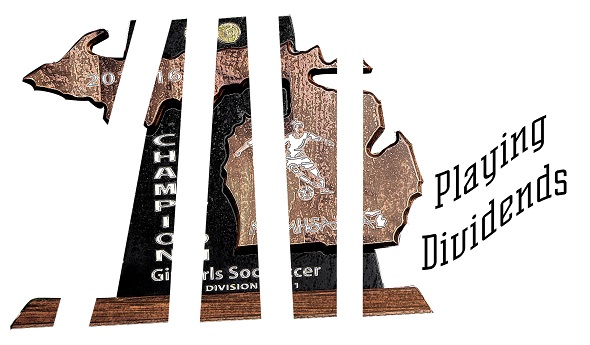
New Math: Division & Multiplication Problems
July 25, 2017
By Jack Roberts
MHSAA Executive Director
This is the second part in a series on MHSAA tournament classification, past and present, that will be published over the next two weeks. This series originally ran in this spring's edition of MHSAA benchmarks.
High school tournament classifications went viral before there was social media and most of us knew what “viral” meant.
Much as a virus infects computers today or has created epidemics of disease around the world for centuries, high school tournament classification – once introduced – tends to spread uncontrollably. Once started, it tends to keep expanding and rarely contracts.
While we are still some distance from providing every team a trophy as a result of expanding high school tournament classification across the country, there is criticism nevertheless that we are headed in that direction – a philosophy which is supposed to exist only in local youth sports for our youngest children.
Michigan could be blamed for all this. Michigan is generally accepted as the first state to provide different classifications for season-ending tournaments for different sized schools. It started a century ago. Today, every state has various classifications for its tournaments in most if not all sports. And it is a bit ironic that Michigan – creator of the classification chaos – more than most other states has kept the number of tournament classes or divisions under control.
Yes, there is evidence that tournament classifications have expanded over the years in Michigan, especially with the relatively recent introduction of tournaments in football and the late 1990s’ move from classes to divisions in most MHSAA tournaments. But the MHSAA Representative Council has held true to its word when it expanded the playoffs for football from four classes to eight divisions: this is needed because of unique factors of football, factors that exist in no other sport; and all other sports should be capped at a maximum of four classes or divisions.
Kentucky is the preeminent defender of single-class basketball. All of its 276 high schools compete for the single state championship for each gender. In Indiana, there are still open wounds from its move in 1998 from one to four classes for its 400 schools in basketball.
Multi-class tournaments have tended to increase the number of non-public school champions, which some states are trying to lower through enrollment “multipliers,” and also tend to increase the number of repeat champions, which some states are trying to affect with “success factors” which lift smaller schools into classifications for larger schools if they take home too many trophies.
While there is considerable evidence that state tournaments do as much bad as good for educational athletics, state associations persist in providing postseason tournaments because, on balance, the experiences are supposed to be good for student-athletes. And once we reach that conclusion it is just a small leap to believe that if the tournaments are good for a few, they must be better for more – which leads to creating more and more tournament classifications. One becomes two classes, then three, then four and so forth.
While the argument is that more classifications or divisions provides more students with opportunities to compete and win, it is undeniable that the experience changes as the number of tournament classifications expands. It is not possible for state associations to provide the same level of support when tournament classifications expand to multiple venues playing simultaneously. For example, there is less audio and video broadcast potential at each venue, and less media coverage to each venue. Focus is diluted and fans diminished at each championship.
No one can argue reasonably that today's two-day MHSAA Football Finals of eight championship games has the same pizazz as the one-day, four-games event conducted prior to 1990.
In some states the number of divisions has grown so much that it is difficult to see much difference between the many season-ending state championship games and a regular-season event in the same sport.
It is a balancing act. And Michigan has been studying that balance longer than any other state, and charting a steadier course than most.
Addition by Division
The shift to Divisions for MHSAA Tournament play in numerous sports has added up to a greater number of champions for teams and individuals across the state. Following are the sports currently employing a divisional format, and the procedures for determining enrollment and classification.
In 23 statewide or Lower Peninsula tournaments, schools which sponsor the sport are currently divided into nearly equal divisions. They are:
- Baseball - 4 Divisions
- Boys Bowling - 4 Divisions
- Girls Bowling - 4 Divisions
- Girls Competitive Cheer - 4 Divisions
- LP Boys Cross Country - 4 Divisions
- LP Girls Cross Country - 4 Divisions
- LP Boys Golf - 4 Divisions
- LP Girls Golf - 4 Divisions
- Ice Hockey - 3 Divisions
- Boys Lacrosse - 2 Divisions
- Girls Lacrosse - 2 Divisions
- Boys Skiing - 2 Divisions
- Girls Skiing - 2 Divisions
- LP Boys Soccer - 4 Divisions LP
- Girls Soccer - 4 Divisions
- Girls Softball - 4 Divisions
- LP Boys Swimming & Diving - 3 Divisions
- LP Girls Swimming & Diving - 3 Divisions
- LP Boys Tennis - 4 Divisions
- LP Girls Tennis - 4 Divisions
- LP Boys Track & Field - 4 Divisions
- LP Girls Track & Field - 4 Divisions
- Wrestling - 4 Divisions
Lists of schools for each division of these 23 tournaments are posted on MHSAA.com approximately April 1. Listings of schools in Upper Peninsula tournaments for their sports are also posted on MHSAA.com. The lists are based on school memberships and sports sponsorships in effect or anticipated for the following school year, as known to the MHSAA office as of a date in early March.
In football, the 256 schools which qualify for MHSAA 11-player playoffs are placed in eight equal divisions annually on Selection Sunday. Beginning in 2017, the 8-player divisions will be determined in a like manner on Selection Sunday as well, with 32 qualifying schools placed in two divisions.
Schools have the option to play in any higher division in one or more sports for a minimum of two years.
The deadlines for "opt-ups" are as follows:
- Applications for fall sports must be submitted by April 15
- Applications for winter sports must be submitted by Aug. 15
- Applications for spring sports must be submitted by Oct. 15
Subsequent to the date of these postings for these tournaments, no school will have its division raised or lowered by schools opening or closing, schools adding or dropping sports, schools exercising the option to play in a higher division, or approval or dissolution of cooperative programs.
When the same sport is conducted for boys and girls in the same season (e.g., track & field and cross country), the gender that has the most sponsoring schools controls the division breaks for both genders.

Preview: Lower Peninsula Boys Finals Filled with Standout Seniors
By
Geoff Kimmerly
MHSAA.com senior editor
June 1, 2023
Seniors competing at this weekend’s Lower Peninsula Boys Track & Field Finals have won a combined 20 individual championships over the last three seasons, a feat even more impressive considering their freshman season in 2020 was canceled due to COVID-19.
But as is often the case in this sport, picking out individual favorites is a simpler task than reasoning out possible team champions – and that’s certainly true in at least three divisions this weekend.
All four LP Finals will again be contested at Grand Rapids-area schools, with pole vault and long jump beginning at 9 a.m., race semifinals and the 3,200 relay at 10 a.m. and the rest of the running finals starting at noon. Tickets cost $11 and are available digitally only via GoFan.
MHSAA.tv will live-stream all four meets beginning at 10 a.m., viewable with subscription.
Below is a glance at team contenders and individuals to watch in all four divisions:
LP Division 1 at Rockford
Team forecast: This meet has been won with 34 and 41 points over the last two seasons, and a few standouts could be the difference-makers Saturday. Ann Arbor Huron, led by Braxton Brann, has enough with him to make a run at a first Finals championship. Rockford, a co-champion in 2021, had three top-five seeded relays and speed in the sprints to be in the mix. Reigning champion Detroit U-D Jesuit and sprinter Jaiden Reed could make a strong push again.
Benne Anderson, Grand Rapids Ottawa Hills senior: He’s been the next of a stellar group of distance runners to come through Michigan, winning the LPD1 cross country title in the fall after taking the 3,200 title last spring. His Regional times were first in LPD1 in the 800 (1:52.98) and 3,200 (9:10.53) and second-fastest in the 1,600 (4:14.23).
Andrew Berryhill, Battle Creek Lakeview senior: Last season’s shot put champion and 11th-place finisher in discus posted the top LPD1 Regional throws in both at 58-6½ and 166-0, respectively.
Braxton Brann, Ann Arbor Huron senior: After finishing fourth in the 100 and second in the 200 at last season’s Finals, Brann enters this one coming off the fastest LPD1 Regional times in the 200 (21.65) and 110 hurdles (13.92) and fifth-fastest in the 100 (10.7).
Shamar Heard, Clinton Township Chippewa Valley junior: The reigning champion in the 100 and 200 is switching gears for this weekend entering with the fastest LPD1 Regional time in the 400 (48.46) and as part of two relays.
Nathan Levine, Canton junior: The reigning high jump champion at 6-8 jumped a winning 6-6 at his Regional and likely will contend with Muskegon Reeths-Puffer’s Liam McHugh, who posted a 6-8½ to also win a Regional title.
Kayenn Mabin, Kalamazoo Central senior: He had the second-fastest LPD1 Regional time in both the 110 (14.33) and 300 hurdles (39.21) and also is expected to run on two contending relays. He won the 110 and was fourth in the 300 last season.
Trent McFarland, Utica senior: The reigning 800 champion won last week with the third-fastest LPD1 Regional time overall of 1:53.91, about two seconds off his winning Finals time from 2022.
LP Division 2 at Ada Forest Hills Eastern
Team forecast: The last six LPD2 Finals have seen six schools win championships and three more finish runners-up. Berrien Springs has a chance to break that trend after claiming last year’s title, entering this weekend with the fastest 400 and 800 relays in all Division 2 Regionals, plus contenders in at least three individual events. Whitehall, third last year, is seeking its first Finals title since 1996 and combines a significant group of scorers in races, relays and field events. Forest Hills Eastern was last year’s runner-up and has representatives in nearly every race including all four relays, plus two field events. Vicksburg, Freeland and Corunna also have opportunities.
Dalton DeBeau, Frankenmuth senior: Last season’s discus champion and shot put seventh-place finisher won both at his Regional with throws that were third for shot put (53-9½) and sixth for discus (156-9) among all LPD2 Regional performances.
Stuart Gould, Howard City Tri County senior: His lone event at the 2022 Finals was a win in the 400, and he’ll be a little busier this time also contending in the 200 and running a relay. He finished second in the 400 (49.15) at his Regional to Whitehall junior Trannon Aylor – who finished second to Gould at last year’s Final.
Carter McCalister, Monroe Jefferson senior: He just missed scoring in the 3,200 last season, finishing ninth, but he should put up some points this time entering off the fastest LPD2 Regional times in both the 3,200 (9:20.47) and the 1,600 (4:17.33).
Aiden Sullivan, Ada Forest Hills Eastern senior: The reigning champion in the 800 is coming off a Regional win in 1:58.40, exactly two seconds off his Finals time of a team ago. He’ll also run the 1,600 and on two relays.
Michael Wright, Vicksburg senior: Only a single relay contributor at last year’s Finals, he’s set to offer much more with the fastest LPD2 Regional times in the 100 (10.82) and 200 (22.0) while running on two relays including a contender in the 800.
Division 3 at Kent City
Team forecast: The top seven teams last season finished within 10 points of each other, and a strong group of favorites could make this close at the top again. Sanford Meridian tied for sixth last season and enters with tons of scoring potential in sprints and jumps, including with the fastest 400 and 800 relays from all LPD3 Regionals. Benzie Central, third last spring, could be carried by distance stars Hunter Jones and Pol Molins. Last year’s ninth-place Chesaning has qualifiers all over the meet and contenders in hurdles and relays, and Hart – fifth last season – also is strong in distance, and throws.
Hunter Jones, Benzie Central senior: The graduating Benzie star and four-time cross country champion has won the 1,600 the last two seasons and the 800 last spring as well, and he ran the top LPD3 Regional times in the 800 (1:57.76), 1,600 (4:19.78) and 3,200 (9:24.89) – the latter two by notable margins – and was part of the fifth-fastest 3,200 relay.
Torren Mapes, Delton Kellogg junior: He competed in the 110 hurdles last season but didn’t make the final – but he’ll be in the hunt for multiple championships after running the second-fastest LPD3 Regional time in the 110 (15.34) and third-fastest in the 300 hurdles (41.13).
Kellen Kimes, Hart senior: Last season’s discus champ and shot put runner-up topped the LPD3 Regional performances in both with tosses of 181-9 and 57-11, respectively.
Brayden Riley, Sanford Meridian senior: He qualified in the 200 last season and didn’t make the final but was part of the winning 800 relay. He could pace a team title run entering with the fastest LPD3 Regional time in the 200 (22.25), fourth-fastest in the 100 (11.20) and as part of the two top sprint relays mentioned above.
Tryce Tokar, Ovid-Elsie sophomore: Last season’s pole vault champion as only a freshman posted the top LPD3 Regional vault (14-8¼) by more than eight inches.
Jerry Wiegers, North Muskegon junior: After finishing ninth in the 400 last season, Wiegers is lined up to score with the top 400 LPD3 Regional time (50.58) and second-fastest in the 200 (22.52).
Division 4 at Hudsonville
Team forecast: Kalamazoo Hackett Catholic Prep is the reigning champion and has won three of the last four championships (not counting 2020, where the season was canceled due to COVID-19). The Irish have qualifiers in good position to score in five individual races, three relays and at least three field events. Flint Beecher has coverage in fewer events but big points potential in sprints, hurdles and relays led by speedy Jaylin Townsend. Reading has qualifiers in all but three events and a pair of relays that could lead a team title run.
Alex Affer, Peck senior: Last season’s long jump champ by more than three inches had the second-farthest LPD4 Regional jump this time (21-7¼), just a half-inch shorter than that of Detroit Frederick Douglass’s Anthany Buford, who finished second to Affer at last year’s Finals.
Tyler Bays, Reading senior: He’s back after winning the 800 and finishing third in the 1,600 last spring and returns with the third-best 800 (1:57.86), sixth-best 1,600 (4:32.95) and fourth-best 3,200 (10:00.98) times from all LPD4 Regionals.
Isiah Biers, Coleman senior: He won the pole vault last season by seven inches and enters with the fifth-best vault (12-9) from LPD4 Regionals.
Brady Feldpausch, Fowler sophomore: After running on a relay at last year’s Finals, Feldpausch will be busier entering with the top LPD4 Regional times in both the 110 (15.33) and 300 hurdles (40.84) and as part of two relays.
Liam Mann, Kalamazoo Hackett Catholic Prep senior: The reigning champion in the 200 and runner-up in the 100 also was part of a winning relay last season, and he enters with the second-fastest LPD4 Regional times in both the 100 (11.13) and 200 (22.76) and slated to run on both sprint relays.
Lezawe Osterink, Wyoming Potter’s House Christian senior: He’ll look to add to his 1,600, 3,200 and 3,200 relay championships from a season ago, plus two cross country titles, entering this weekend with the top LPD4 Regional time in the 1,600 (4:22.73) and also running the 3,200 and on two relays.
Braden Prielipp, Marion junior: He won the high jump by seven inches last season, and his 6-3 at his Regional was the third-highest in all of LPD4 two weeks ago. He’ll also long jump and run the 400 and on a relay.
Jaylin Townsend, Flint Beecher senior: He’ll look to add to his two sprint and one relay championship from 2021 and third individual title won last season in the 100. He had the fastest LPD4 Regional times in the 100 (10.99) and 200 (22.23) and will run on two relays expected to contend as well.
PHOTO Potter’s House Christian’s Lezawe Osterink takes the baton during a relay at last season’s LPD4 Finals. (Click for more from RunMichigan.com.)