

New Math: Division & Multiplication Problems
July 25, 2017
By Jack Roberts
MHSAA Executive Director
This is the second part in a series on MHSAA tournament classification, past and present, that will be published over the next two weeks. This series originally ran in this spring's edition of MHSAA benchmarks.
High school tournament classifications went viral before there was social media and most of us knew what “viral” meant.
Much as a virus infects computers today or has created epidemics of disease around the world for centuries, high school tournament classification – once introduced – tends to spread uncontrollably. Once started, it tends to keep expanding and rarely contracts.
While we are still some distance from providing every team a trophy as a result of expanding high school tournament classification across the country, there is criticism nevertheless that we are headed in that direction – a philosophy which is supposed to exist only in local youth sports for our youngest children.
Michigan could be blamed for all this. Michigan is generally accepted as the first state to provide different classifications for season-ending tournaments for different sized schools. It started a century ago. Today, every state has various classifications for its tournaments in most if not all sports. And it is a bit ironic that Michigan – creator of the classification chaos – more than most other states has kept the number of tournament classes or divisions under control.
Yes, there is evidence that tournament classifications have expanded over the years in Michigan, especially with the relatively recent introduction of tournaments in football and the late 1990s’ move from classes to divisions in most MHSAA tournaments. But the MHSAA Representative Council has held true to its word when it expanded the playoffs for football from four classes to eight divisions: this is needed because of unique factors of football, factors that exist in no other sport; and all other sports should be capped at a maximum of four classes or divisions.
Kentucky is the preeminent defender of single-class basketball. All of its 276 high schools compete for the single state championship for each gender. In Indiana, there are still open wounds from its move in 1998 from one to four classes for its 400 schools in basketball.
Multi-class tournaments have tended to increase the number of non-public school champions, which some states are trying to lower through enrollment “multipliers,” and also tend to increase the number of repeat champions, which some states are trying to affect with “success factors” which lift smaller schools into classifications for larger schools if they take home too many trophies.
While there is considerable evidence that state tournaments do as much bad as good for educational athletics, state associations persist in providing postseason tournaments because, on balance, the experiences are supposed to be good for student-athletes. And once we reach that conclusion it is just a small leap to believe that if the tournaments are good for a few, they must be better for more – which leads to creating more and more tournament classifications. One becomes two classes, then three, then four and so forth.
While the argument is that more classifications or divisions provides more students with opportunities to compete and win, it is undeniable that the experience changes as the number of tournament classifications expands. It is not possible for state associations to provide the same level of support when tournament classifications expand to multiple venues playing simultaneously. For example, there is less audio and video broadcast potential at each venue, and less media coverage to each venue. Focus is diluted and fans diminished at each championship.
No one can argue reasonably that today's two-day MHSAA Football Finals of eight championship games has the same pizazz as the one-day, four-games event conducted prior to 1990.
In some states the number of divisions has grown so much that it is difficult to see much difference between the many season-ending state championship games and a regular-season event in the same sport.
It is a balancing act. And Michigan has been studying that balance longer than any other state, and charting a steadier course than most.
Addition by Division
The shift to Divisions for MHSAA Tournament play in numerous sports has added up to a greater number of champions for teams and individuals across the state. Following are the sports currently employing a divisional format, and the procedures for determining enrollment and classification.
In 23 statewide or Lower Peninsula tournaments, schools which sponsor the sport are currently divided into nearly equal divisions. They are:
- Baseball - 4 Divisions
- Boys Bowling - 4 Divisions
- Girls Bowling - 4 Divisions
- Girls Competitive Cheer - 4 Divisions
- LP Boys Cross Country - 4 Divisions
- LP Girls Cross Country - 4 Divisions
- LP Boys Golf - 4 Divisions
- LP Girls Golf - 4 Divisions
- Ice Hockey - 3 Divisions
- Boys Lacrosse - 2 Divisions
- Girls Lacrosse - 2 Divisions
- Boys Skiing - 2 Divisions
- Girls Skiing - 2 Divisions
- LP Boys Soccer - 4 Divisions LP
- Girls Soccer - 4 Divisions
- Girls Softball - 4 Divisions
- LP Boys Swimming & Diving - 3 Divisions
- LP Girls Swimming & Diving - 3 Divisions
- LP Boys Tennis - 4 Divisions
- LP Girls Tennis - 4 Divisions
- LP Boys Track & Field - 4 Divisions
- LP Girls Track & Field - 4 Divisions
- Wrestling - 4 Divisions
Lists of schools for each division of these 23 tournaments are posted on MHSAA.com approximately April 1. Listings of schools in Upper Peninsula tournaments for their sports are also posted on MHSAA.com. The lists are based on school memberships and sports sponsorships in effect or anticipated for the following school year, as known to the MHSAA office as of a date in early March.
In football, the 256 schools which qualify for MHSAA 11-player playoffs are placed in eight equal divisions annually on Selection Sunday. Beginning in 2017, the 8-player divisions will be determined in a like manner on Selection Sunday as well, with 32 qualifying schools placed in two divisions.
Schools have the option to play in any higher division in one or more sports for a minimum of two years.
The deadlines for "opt-ups" are as follows:
- Applications for fall sports must be submitted by April 15
- Applications for winter sports must be submitted by Aug. 15
- Applications for spring sports must be submitted by Oct. 15
Subsequent to the date of these postings for these tournaments, no school will have its division raised or lowered by schools opening or closing, schools adding or dropping sports, schools exercising the option to play in a higher division, or approval or dissolution of cooperative programs.
When the same sport is conducted for boys and girls in the same season (e.g., track & field and cross country), the gender that has the most sponsoring schools controls the division breaks for both genders.
Doubles Deliver Ishpeming's 1st Boys Tennis Finals Title Since 1994
By
Alexandria Bournonville
Special for MHSAA.com
May 31, 2023
ISHPEMING — Through a rousing fight on neutral tennis courts at Westwood High School, Ishpeming won the MHSAA Upper Peninsula Division 2 Finals on Tuesday.
It capped off quite a rollercoaster of a season for these Hematites, who hadn’t won a U.P. title in the sport since 1994 when they competed in the Class C-D division. They hadn’t even been a U.P. runner-up since finishing second in Division 2 in 2004, just a couple of years after the U.P. split into numeric divisions for tennis.
On Tuesday, Ishpeming captured three flight championships, all in doubles, to score 12 points to 11 for runner-up Iron Mountain, which won only one flight but scored points in all but one of the rest.
Munising and West Iron County tied for third with nine points, while Menominee was a relatively close fifth with seven.
Each of the five schools present won at least one flight, with Munising – with two – the only other team to win multiple championships besides the Hematites.
But it proved to be Ishpeming’s day, though that came about almost completely through doubles.
“I feel amazing,” Ishpeming head coach Kaitlin Rich said. “I was watching the last match, and the kids came over with their arms pumped in the air and … I’m just really proud of them.
“This is something that really hasn’t happened in Ishpeming for the tennis program, and it just shows how dedicated these kids are to excellence.
“I have so many kids that are dual sporting. They play baseball and AAU (basketball), and to edge out Iron Mountain by one point? I’m just really proud of them.”
Rich had a relatively inexperienced team and thought it might’ve been too soon for her lineup to contend for the title.
“I have three seniors … one senior had never played before, and I’m really happy because our other two seniors are U.P. champions,” the coach said. “I’m really glad their last meet of the year they took the gold, and I’m really proud of them.
 “We’ll have a very stocked team next year as well. … Hopefully, we can work a little bit in the summer and come back for another one next year.”
The Hematites scored 11 of their 12 points in doubles, winning championships at Nos. 2, 3 and 4 and finishing as runners-up at No. 1.
At No. 2, Logan Hurkmans and Ben Rubick scored a 6-1, 6-3 win in the championship match over Tanner Theurerkauf and Landon Daigneau of Menominee.
No. 3 proved to be one of the most competitive finals matches of the day, even though it went only two sets. Ishpeming’s Caden Luoma and Ryan Maki hung on for a 7-6 (7-5), 7-6 (7-4) win over Munising’s duo of Mike Robinson II and Logan Walsh.
And No. 4 appeared to be more typical only by that standard set at No. 3 as the Hematites’ Griffin Argall and Ethan Corp won 6-1, 6-4 in the final over West Iron’s Dominick Brunswick and Jackson Secord.
The only doubles flight not won by Ishpeming still proved important to its team title as the Hematites’ Hayden Hares and Hunter Smith picked up two points for reaching the finals as they lost in another close match to Munising’s Carson Kienitz and Kane Nebel, 6-7 (2-7), 6-2, 6-3.
“Hayden Hares had a little accident (last) weekend,” Rich said. “He had a gash (over the whole) bottom of his foot … but he played it out.”
And also just as important to the Hematites’ success was No. 4 singles player Tramon Gauthier winning his first-round match 6-0, 6-0.
That win gave Ishpeming its one final point to push it over the top.
“We knew the numbers coming in (to the finals) were going to be really tight between us, Iron Mountain, Munising, West Iron,” Rich said. “I told my singles players we need one point somewhere, we need one point and Tramon Gauthier stepped it up and he won his first-round match.
“That sealed it for us, and I couldn’t be prouder of him specifically, too.”
Gauthier advanced to face eventual No. 4 singles champion Zander Birmingham of West Iron in the semifinals, where Birmingham prevailed 6-3, 6-2 before going on to defeat Iron Mountain’s Colin Schneider in the final, 6-4, 6-4, to give the Wykons their lone flight championship of the day.
Iron Mountain picked up its flight title at No. 2 singles, where Kaden Sheldon pulled off a 1-6, 6-4, 6-2 comeback against Menominee’s Danny Birch in the final.
“It just wasn’t enough team-wise for us to come away (with the team title), but I’m really happy for Kaden, he was our one first-place finish for the whole day,” Mountaineers coach Marcus Celello said. “Overall, we finished second and I’m really proud of the guys for that.
 “We only won one dual match during the (regular) season, but we had a lot of tough opponents and we split with Ishpeming. We knew that we were going to be right there with them at the end of the day, and it came right down literally to the final match.
“We’ve come a long way. Our singles have been pretty strong all season, but our doubles teams really were a work in progress, and today they showed up and obviously we finished ... a little short, but all the guys improved so much from the beginning of the season.
“We lost to a really good Ishpeming team, and I’m really happy for them.”
Iron Mountain added a pair of runner-up finishes, and just as importantly, got through the first round at four other flights to ring up its 11 points.
Munising’s two titlists came at No. 1 doubles, with Kienitz and Nebel winning, and at No. 3 singles, where Ashton Wymer could make a case for the best championship match of the day when he defeated West Iron’s Drew Alexa 6-2, 6-7 (2-7), 6-3.
“I’m happy with how our guys competed, and I think the program’s in good standing going forward,” said Mustangs head coach Noah Ackerman, himself a Munising tennis star not quite a full decade ago. “That was my goal, taking over, was hopefully we can get (our) foot in the door, get back into competing for U.P.s.”
West Iron’s champion was Birmingham as the Wykons had a pair of runner-up finishes and Munising had one as well.
For Menominee, No. 1 singles player Brock Murphy picked up the Maroons’ flight championship with a 6-0, 6-0 win over Iron Mountain’s Reece Kangas. In fact, Murphy never lost a game all day, as after receiving a bye in the first round, he also posted a 6-0, 6-0 victory over Munising’s Danny Goss in the semifinals.
Menominee also had a pair of runner-up finishes.
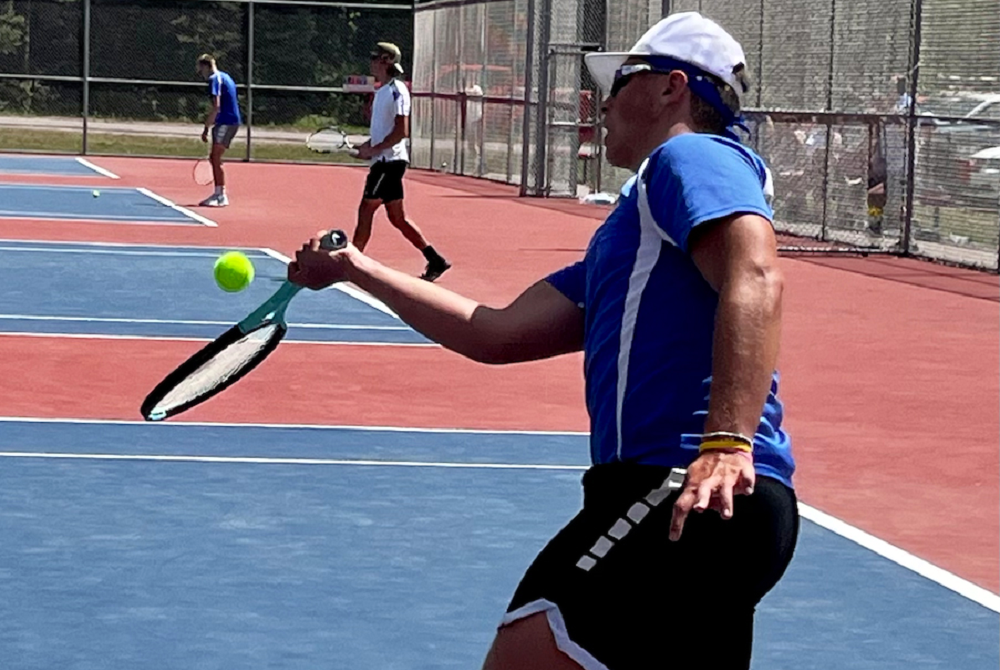
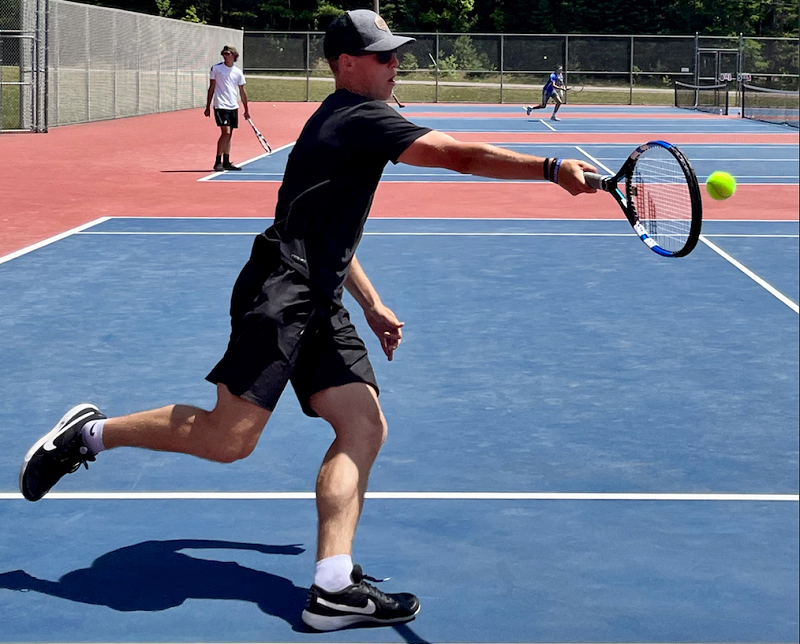
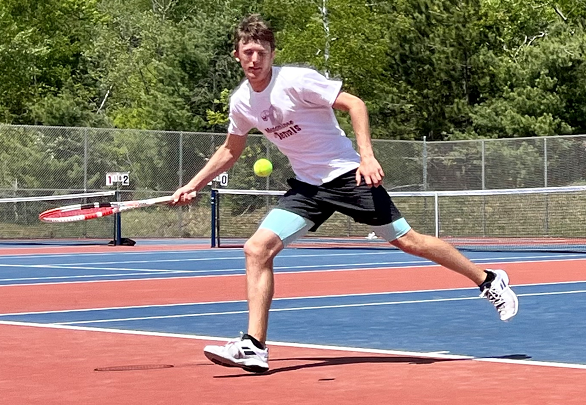
PHOTOS (Top) Ishpeming's Hayden Hares returns a volley at No. 1 doubles during Tuesday’s UP Division 2 Finals at Westwood. (Middle) Munising’s Carson Kienitz returns a shot during a No. 1 doubles match. (Below) Menominee’s Danny Birch chases down a shot at No. 2 singles. (Photos by Alexandria Bournonville.)